A stronger economy, a weaker shopping basket
South Korea's economy grew 1.0% in the third quarter of 2026, more than three times the Bank of Korea's August forecast of 0.3%, as semiconductor exports, machinery investment and government spending powered an expansion that households did not share evenly.
Contents
- A stronger economy, a weaker shopping basket
- Chips lift exports and factory investment
- Why booming exports added little through net trade
- Government activity supplied most of the quarterly gain
- Households cut spending despite the production surge
- National purchasing power rises much faster than output
- Higher tax receipts support bigger spending plans
- Inflation limits the room to support consumers
- November forecasts will clarify the annual outlook
- Key Points
The central bank's advance estimates, released on October 27, showed private consumption falling 0.2% from the previous quarter. Purchases of cars and home appliances declined, alongside spending on financial services and dining. Government activity, meanwhile, contributed 0.8 percentage points of the economy's 1.0% growth.
Real gross domestic product, or GDP, measures the goods and services an economy produces after accounting for price changes. Its quarterly growth accelerated from 0.6% in April through June. Compared with a year earlier, however, growth slowed to 3.4% from 3.7%.
The figures reveal an economy advancing through factories, exports and public expenditure while consumer businesses face weaker demand. Semiconductor companies are selling more abroad and buying equipment to expand production, but the flow of that income into household spending is taking longer.
Lee Dong-won, director general of the Bank of Korea's economic statistics department, described the industry's contribution at a briefing:
It is estimated that about half of economic growth is being driven by semiconductors,
That estimate puts chips at the centre of both the stronger growth outlook and its concentration. The central bank expects dividends and employee bonuses to help consumption recover, while economists point to borrowing costs and employment conditions as constraints on how widely the gains will spread.
Chips lift exports and factory investment
Exports increased 2.3% from the previous quarter, led by semiconductors, machinery and electrical equipment. Global investment in artificial intelligence infrastructure is supporting demand for chips used to process and store the large amounts of information these systems require.
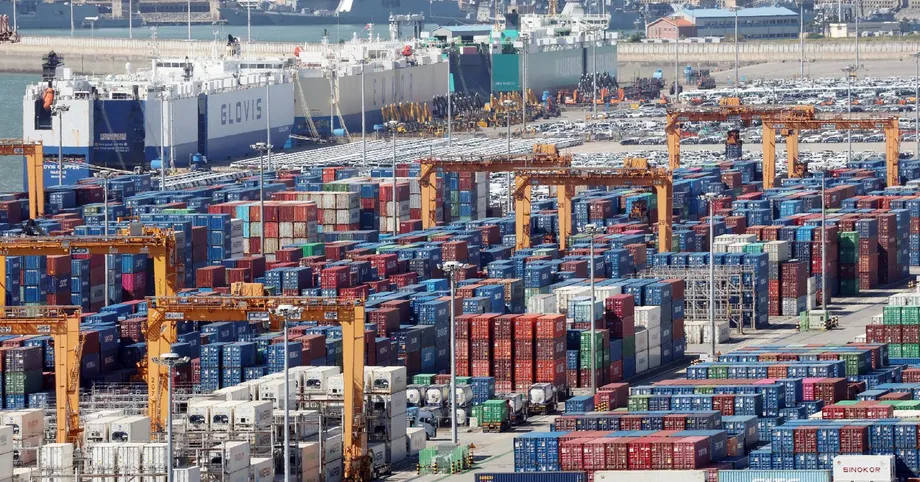
September merchandise exports reached a record $120.9 billion, up 83.5% from a year earlier. Semiconductor shipments exceeded $60 billion, equivalent to more than 49.6% of the month's export total.
South Korea exported more than $800 billion in goods from January through September, already exceeding the previous year's annual record. Bank of Korea Governor Shin Hyun Song said exports were heading towards $1 trillion for the first time. The Trade Ministry said reaching that level would make South Korea the fourth economy to do so, after the United States, China and Germany.
Companies also spent more on the equipment needed to keep production growing. Facility investment rose 4.1%, compared with 0.2% in the second quarter, with machinery including semiconductor manufacturing equipment leading the increase. Investment in intellectual property products, including research and development and software, grew 2.3%.
Manufacturing output increased 2.0% during the quarter and 7.0% from a year earlier. Computers, electronic and optical equipment, along with machinery, led the quarterly gain. Lee expects chip production volumes to rise further in 2027, with prices continuing to increase at a slower pace.
Why booming exports added little through net trade
Exports alone contributed 1.1 percentage points to quarterly GDP growth. Net exports, which subtract imports from exports, contributed just 0.1 percentage points, down from 0.3 points in the second quarter.
Imports rose 2.4%, supported by purchases of crude oil and semiconductor manufacturing equipment. Some of the same investment that expands South Korea's chip industry therefore also increases purchases from overseas.
GDP accounting subtracts imports because spending totals can include goods made abroad. A factory's purchase of an imported machine appears in investment spending, while the import adjustment accounts for the machine's foreign production. The equipment can then help the Korean factory produce more in later quarters.
The September merchandise export figures measure the dollar value of shipments. The quarterly GDP export figures measure changes after accounting for prices. Higher chip prices help explain why export receipts and measured production can grow at very different rates.
Government activity supplied most of the quarterly gain
Government consumption increased 1.9%, following growth of just 0.1% in the second quarter. Spending rose on goods purchases and health insurance benefits.
Government consumption contributed 0.3 percentage points to GDP growth, while government investment contributed another 0.5 points. Together, government activity supplied 0.8 points, reversing a contribution of minus 0.5 points in the previous quarter.
The private sector's contribution fell to 0.2 percentage points from 1.1 points. Put another way, government activity accounted for four fifths of the quarter's net growth, even as private manufacturers and exporters expanded.
Domestic demand contributed 0.9 percentage points, up from 0.3 points. Domestic demand includes government consumption and investment as well as household spending and business investment. Its improvement came while private consumption reduced GDP growth by 0.1 percentage points.
Construction investment increased 0.7% as civil engineering work expanded, although it remained 0.7% below its level a year earlier. Construction output, a different measure tracking activity in the industry, rose 2.0% during the quarter.
Households cut spending despite the production surge
Private consumption fell for the first time since the fourth quarter of 2022. Its 0.2% decline reversed a 0.4% increase in the second quarter and was the largest contraction since the 1.0% fall recorded in the first quarter of 2022.
The Bank of Korea linked the weakness partly to a stock market correction that reduced financial services spending and strikes at major automakers that disrupted car sales. Spending also declined on home appliances and dining, extending the weakness beyond those two areas.
Central bank officials estimated consumption could have risen 0.4% without the financial services and automobile disruptions. That calculation helps explain their expectation of a gradual recovery as those effects ease and semiconductor income reaches shareholders and workers.
Services output grew only 0.2%, slowing from 1.0% in the second quarter, while finance and insurance contracted 4.3%. An October central bank survey also showed slightly weaker consumer sentiment, including softer expectations for household income and spending.
Jeong-Woo Park, an economist at Nomura Holdings, described the gap between the headline expansion and household conditions:
Companies and the government are benefiting from and spending the money generated by the semiconductor boom, but households are being left behind.
National purchasing power rises much faster than output
Real gross domestic income, or GDI, increased 3.4% from the previous quarter and 18.8% from a year earlier. The annual gain accelerated from 15.7% in the second quarter and was the highest since the fourth quarter of 1977, when it reached 19.0%.
GDI measures the purchasing power of income generated through production. It takes account of changes in the prices a country receives for exports relative to the prices it pays for imports, known as its terms of trade.
Higher semiconductor prices improved those terms for South Korea. When exporters receive more for their products relative to the cost of imported goods, the country can buy more with the income it earns. That helps explain why real income grew much faster than real production.
Household spending depends on how and when that income reaches people. Company earnings, government revenue, shareholder dividends and employee pay follow different schedules. Lee expects semiconductor company dividends in the fourth quarter and employee bonuses in the first quarter of 2027 to support household income.
Park Sang-hyun, an economist at iM Securities, offered a more cautious view of the likely spending response:
There could be short-term boosts, but it is difficult to expect strong momentum given labour market conditions and restrictive interest rates,
Higher tax receipts support bigger spending plans
The government expects national tax revenue to reach a record 478.6 trillion won in 2026, up 28% from 2025. Strong semiconductor earnings, exceptional dividend distributions and active stock trading are helping raise receipts.
Seoul has proposed increasing government spending by 12.8% in 2027, with substantial funding directed towards artificial intelligence and semiconductor infrastructure. The proposal would extend public support for industries already driving exports and equipment purchases.
The third quarter shows how public spending can support total demand while households pull back. The planned budget increase would continue that support, although its final size and composition depend on approval.
South Korea's recovery also follows a period when Taiwan gained ground through technology exports. After Taiwan's GDP per capita crossover in 2025, the latest Korean figures show a sharp strengthening in chip exports and investment. Korea's current quarterly data bring a different issue into focus: how quickly stronger production becomes stronger household spending.
Inflation limits the room to support consumers
The Bank of Korea held its benchmark interest rate at 3% at its latest meeting, following two increases earlier in the year. Governor Shin has said policy will remain restrictive until the bank is confident inflation will converge towards its 2% target.
September consumer inflation was 2.9% from a year earlier. Core inflation, which excludes food and energy to track underlying price movements, was 2.8%. Both measures remained above the central bank's target despite easing from August.
Higher interest rates can restrain inflation by making borrowing more expensive and reducing demand. They can also leave households with less money to spend after loan payments and make major purchases harder to finance.
Jeong-Woo Park cited tighter financial conditions, stock market losses and weak employment as drags on consumption. Before the GDP release, Citigroup and Nomura expected increases of a quarter percentage point in November and February, which would take the benchmark rate to 3.5%.
The central bank must weigh strong export earnings and investment against weak household demand. A recovery in wages and spending would broaden the expansion, while persistent inflation would keep pressure on policymakers to maintain high borrowing costs.
November forecasts will clarify the annual outlook
The Bank of Korea's August forecast put annual growth at 3.3%. The stronger third quarter has increased expectations for an upward revision, with updated projections scheduled for November 26. The advance GDP estimates are also subject to revision.
Lee said annual growth of 3.6% was likely if the fourth quarter maintained the third quarter's pace, and that quarterly growth of 1.4% could lift the annual result to 4%. Another preliminary calculation put annual growth at about 3.7% if fourth quarter output stayed at the third quarter's level. The November forecast will provide the bank's updated assessment.
The main developments and next milestones are:
- First quarter of 2026: GDP grew 1.8% from the previous quarter.
- Second quarter: Growth slowed to 0.6%, while private consumption increased 0.4%.
- Third quarter: GDP grew 1.0%, but private consumption fell 0.2%.
- October 27: The Bank of Korea released its advance third quarter estimates.
- November 26: Updated economic projections are due.
- Fourth quarter of 2026 and first quarter of 2027: Semiconductor dividends and employee bonuses are expected to support household income.
Exports and investment are expected to remain strong in the final quarter. The next stage of the recovery will depend partly on whether the income generated by chips translates into more spending at shops, restaurants and other consumer businesses.
Key Points
- South Korea's GDP grew 1.0% in the third quarter, compared with the central bank's August forecast of 0.3%.
- Semiconductors drove about half of growth, according to Bank of Korea official Lee Dong-won.
- Government activity contributed 0.8 percentage points to the quarterly expansion.
- Private consumption fell 0.2%, its first decline since the fourth quarter of 2022.
- Real gross domestic income rose 18.8% from a year earlier as higher chip prices improved purchasing power.
- The benchmark interest rate stood at 3%, with September inflation above the 2% target.
- The Bank of Korea's next economic projections are due on November 26.