First passengers take off from Sydney's new gateway
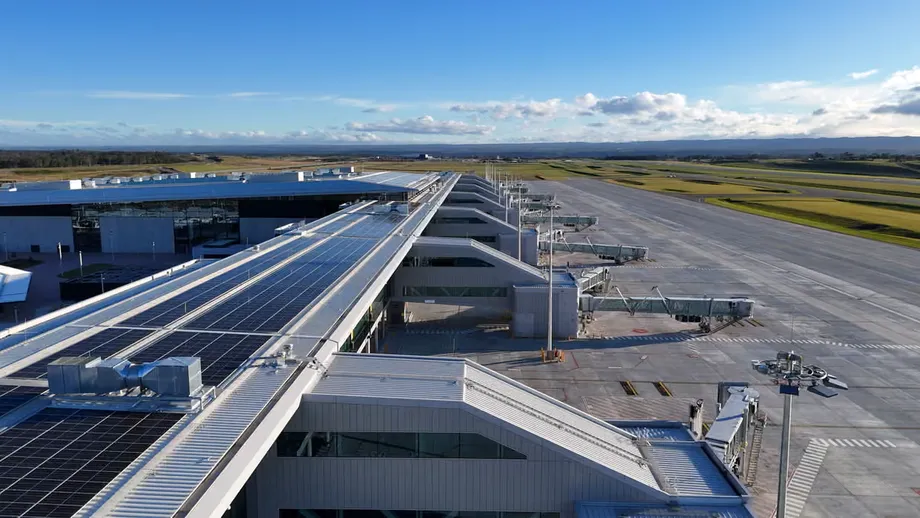
Western Sydney International Airport opened to passengers on Sunday, 25 October 2026, with a fully booked Jetstar flight to the Gold Coast, launching a new alternative to Sydney's established airport at Mascot. Flight JQ362 departed at about 11:20 a.m., following check-in from 8 a.m., beginning passenger operations at an airport built to handle 10 million travellers a year.
Contents
- First passengers take off from Sydney's new gateway
- Domestic flights begin small, with more services coming
- Auckland leads an international rollout into 2027
- The missing railway changes the journey
- Will passengers actually pay less?
- What operating through the night changes
- Public investment reaches beyond the terminal
- Growth depends on passengers, airlines and nearby businesses
- An opening eight decades in the making
- Key Points
The Airbus A320 departure marked the first passenger service from a major new Australian airport in more than 50 years. Jetstar flight JQ363 from the Gold Coast arrived at about 3:10 p.m., while the opening schedule also included flight JQ375 to Melbourne, scheduled for 6 p.m.
Western Sydney International, formally Western Sydney International (Nancy-Bird Walton) Airport, opened without the direct railway connection intended to make it easier to reach. Passengers initially depend on buses, coaches and roads, creating an immediate test of whether cheaper parking, new routes and unrestricted operating hours outweigh longer journeys for some travellers.
Francis, a passenger on the inaugural service, travelled by train to St Marys before changing to a bus. His journey took about one hour and 20 minutes. He said he was excited to take part in the opening and would consider using the airport again, particularly because it can operate around the clock.
Airport chief executive Simon Hickey described the opening as a turning point for Australian aviation:
This is a massive milestone; this is a generational change to aviation.
Prime Minister Anthony Albanese, Infrastructure and Transport Minister Catherine King and Opposition leader Angus Taylor attended the opening. For nearby communities, the occasion brought both opportunities for work and travel and renewed concern about aircraft noise at night.
Domestic flights begin small, with more services coming
Jetstar begins with routes linking Western Sydney to Melbourne, the Gold Coast and Brisbane. The federal government's opening date announcement, issued on 10 June, set out up to 14 weekly Melbourne flights, four weekly Gold Coast flights and three weekly Brisbane flights.
The airport's flight sales page lists the same Melbourne and Brisbane frequencies but advertises daily Gold Coast services. Travellers therefore face different published Gold Coast schedules and need to check the flights offered for their dates.
QantasLink plans to join on 28 March 2027, using Embraer E190 aircraft for four weekly flights to Brisbane and four to Melbourne. The airport lists those services as subject to government and regulatory approval, with schedules subject to change.
The opening network gives passengers another departure point rather than the breadth of options already available at Kingsford Smith. Three Brisbane flights a week, for example, offer less flexibility than a route with departures throughout each day. A low fare becomes useful only when a flight fits the passenger's plans.
Aglaya Papadokokolakis, the pilot raised in Blacktown who was chosen for the inaugural departure, described what the occasion meant to her:
It's such an honour and something I'm going to remember for the rest of my career.
Auckland leads an international rollout into 2027
Air New Zealand is scheduled to begin the airport's first international passenger service on Monday, 26 October, with three weekly morning flights to Auckland. The airport lists the service as subject to regulatory approval. Singapore Airlines follows on 23 November with a daily evening service to Changi.
Singapore and later Doha services will give passengers access to connecting flights across much larger networks. Hickey expects more than 250 destinations to become reachable through connections in just over a year. Most of those journeys will involve changing aircraft rather than flying directly from Western Sydney.
The published rollout stretches well beyond opening weekend:
- 26 July 2026: Freight operations began, with regular Qantas Freight services scheduled from the following evening.
- 25 October 2026: Jetstar launched passenger services with the inaugural Gold Coast departure.
- 26 October 2026: Air New Zealand's Auckland service is scheduled to begin.
- 23 November 2026: Singapore Airlines plans to start daily Singapore flights.
- January 2027: Vietjet plans two weekly Ho Chi Minh City services, increasing to three in March.
- March 2027: Fiji Airways plans three weekly Nadi services, while QantasLink begins its Melbourne and Brisbane routes on 28 March.
- November 2027: Thai Vietjet plans Bangkok services.
- 15 December 2027: Qatar Airways plans three weekly Doha services, with tickets scheduled to go on sale on 19 December 2026.
The staged timetable means passengers choosing the new airport during its first months will have a much smaller direct network than travellers booking later in 2027.
The missing railway changes the journey
St Marys station is the main rail interchange for passengers using public transport to reach the new terminal. A free airport shuttle is scheduled every 30 minutes between the station and the airport, while local bus routes connect surrounding centres. Express coaches, taxis, rideshare vehicles and private cars provide other options.
The Sydney Metro connection remains under construction. Opening estimates extend from late 2027 into 2028, with no firm opening date given. Once operating, the 23 kilometre line is expected to connect St Marys with the airport in about 15 minutes.
Distance alone can give travellers a misleading idea of convenience. A published journey comparison put the trip from Werrington station to Western Sydney International at about one hour and 15 minutes, almost identical to the one hour and 14 minutes needed to reach Sydney Airport, despite the new airport being much closer to Werrington.
Express shuttle fares have been listed at $25 one way or $45 return from Parramatta, $55 one way or $80 return from central Sydney, and $65 one way or $90 return from Kingsford Smith. Those costs matter particularly for visitors staying near the city centre or passengers transferring between airports.
Drivers can use the new M12 motorway without paying a toll on that road, although other parts of their journey may involve tolls. The airport has about 6,000 parking spaces. FlixBus has also announced two daily services linking Canberra with the airport.
Western Sydney resident Nathan Clissold described the planning required to make existing transport connections work:
I've really got to plan ahead to try and work out my travel options.
Will passengers actually pay less?
Early fare comparisons show savings depend on the destination, travel date and cost of reaching the terminal. For a hypothetical return trip from 1 to 12 December, Melbourne fares started at $187 from Western Sydney and $258 from Kingsford Smith, a difference of $71. Gold Coast fares were $131 and $192 respectively, saving $61 from the new airport.
Brisbane reversed that pattern in the same comparison: $236 return from Western Sydney against $207 from Kingsford Smith. Another comparison by travel eSIM company Holafly found a Jetstar Brisbane fare for 3 November of $116 from Western Sydney and $138 from Kingsford Smith. Different dates produced different winners.
Holafly travel expert Harry Deacon put the calculation simply:
The cheapest flight isn't always the cheapest trip.
International fares showed similar variation. Auckland return fares began at $602 from either airport, although Western Sydney's limited operating days required changes to the proposed itinerary. For December travel to Vietnam via Singapore, a Western Sydney return itinerary cost $2,249.82, compared with $1,889.84 from Kingsford Smith. The Western Sydney itinerary also involved changing to Scoot for part of the journey.
Parking can shift the result for people who drive. For the same December comparison, Western Sydney's P2 parking cost $147 under an introductory offer, against $213.40 at Kingsford Smith's domestic parking and $248.80 at its international terminal. That represents savings of $66.40 and $101.80 respectively, before fuel and tolls.
A passenger's useful comparison is the combined bill for flights, baggage, parking and ground transport, alongside the time spent travelling. The introductory parking discount also makes the date of booking relevant.
What operating through the night changes
Kingsford Smith operates under an 11 p.m. to 6 a.m. curfew and a limit of 80 aircraft movements an hour. An aircraft movement means one takeoff or one landing. Western Sydney International has approval to operate 24 hours a day, giving airlines more freedom to schedule passenger and freight services.
The government's June announcement identified 1 November 2026 as the intended date for formal publication of the night operations arrangements under the Sydney Airport Curfew Act 1995. That step is also intended to end currently permitted overnight freight operations at Kingsford Smith, apart from emergencies or special dispensations.
Freight carriers will determine how much traffic shifts to the new airport. The airport has not specified how many flights or how much cargo will be diverted. Its longer term plans provide for up to 1.8 million tonnes of air cargo annually.
Salim Hijazeen, an aviation lecturer at Swinburne University, said the lack of a curfew creates opportunities that are unavailable at Mascot. He gave the example of sports spectators potentially returning from a Melbourne event without paying for another night's accommodation, depending on airline schedules.
Night operations also change daily life for neighbouring communities. Luddenham resident Carolyn Wong said aircraft noise had prompted her and her daughter to consider moving. She also raised concerns about sound insulation, local bus access and unresolved planning for Luddenham village.
Wong, whose family has lived in Luddenham for 70 years, described her reaction to the opening:
It makes me sad that the airport is about to fully open; it really is the end of an era and our lives as we know it.
Public investment reaches beyond the terminal
The federal government has put its airport construction spending at $5.3 billion; another construction estimate places the airport's cost at $5.6 billion. The wider public investment includes roads and rail, with the government's June announcement describing a package of nearly $18 billion across Western Sydney.
A Commonwealth Bank estimate puts transport and enabling infrastructure supporting the airport at about $22 billion. That broader estimate covers a different collection of projects from the government's investment announcement. The airport railway alone has an estimated cost of about $11 billion, jointly funded by the Commonwealth and New South Wales governments.
The government says the entire airport project created more than 12,800 jobs, around half filled by local workers. Hickey separately put the workforce that helped build the airport at about 10,000. More than $500 million went to over 360 businesses based in Western Sydney during major construction works, according to the government.
International route development also receives public support. New South Wales and the airport are subsidising Air New Zealand, Singapore Airlines, Vietjet and Qatar Airways through the $16 million Take-Off Fund. Individual payments and the duration of support have not been disclosed.
The practical test for surrounding communities is whether investment produces lasting jobs and accessible transport alongside the terminal. Hickey projects up to 8,500 jobs supporting operations across the precinct when annual passenger traffic reaches 10 million.
Growth depends on passengers, airlines and nearby businesses
The terminal has capacity for 10 million passengers annually, but Hickey expects traffic to approach that level only in the early to mid-2030s. The opening schedule starts well below the building's capacity, leaving airlines time to develop routes and attract regular customers.
Further terminals and another runway could eventually increase capacity to 82 million passengers annually by the 2060s. That would be 8.2 times the initial capacity. Achieving it would require decades of additional construction, airline commitments and passenger growth.
Andrew Barker, infrastructure program director at the Grattan Institute, said the economic benefits extend beyond competition over ticket prices. Better connections can help businesses reach customers, move goods and attract investment.
Barker described the evidence linking aviation connections with economic activity:
Internationally there is increasing evidence that air connectivity growth stimulates productivity, research and development, foreign direct investment and trade specialisation.
Commonwealth Bank commercial property director Kevin Stanley identified about 5.5 million square metres of proposed industrial floor space across 205 projects around the airport, worth an estimated $24 billion. The development could take 10 to 12 years, with roughly two thirds of the space in Badgerys Creek and Kemps Creek.
Those plans create a connection between the passenger terminal and the wider employment district. More businesses can increase demand for freight and travel, while reliable air services can make nearby sites more attractive. For passengers, growth will become visible through more departure times, destinations and transport options.
An opening eight decades in the making
Debate about a second Sydney airport began in 1946, with 19 locations considered before the Hawke government selected Badgerys Creek in 1986 and began acquiring land. Earlier proposals included Towra Point and Galston, while a 1976 International Air Transport Association report argued that a second airport was unnecessary.
The Abbott government confirmed Badgerys Creek in 2014. Construction began in 2018, eventually requiring workers to move more than 25 million cubic metres of soil and rock. The completed airport includes a runway measuring 3.7 kilometres. Major construction was delivered in 2025, followed by testing before the 2026 launch.
Local responses have changed over those decades. Wayne Willmington, president of the Luddenham Progress Association, opposed the airport in the 1980s but later accepted that it would proceed. He booked a seat on the inaugural Gold Coast service and now regards it as an airport for Western Sydney's people.
The terminal also presents local Indigenous culture to arriving passengers. Dharug and Darkinjung artist Adam Laws created the forecourt sculptures Barayabinyang, or Songbirds, drawing on local plants and animals.
Laws explained the importance of that presence:
To have Dharug culture represented there for all those visitors, it's just so good to get us on the map and get our stories and traditions out there. Let people know we are still here, still resilient.
Opening day ends the long wait for passenger flights. The next stage brings more immediate measures of success: whether travellers return, airlines add services, workers can reach jobs and nearby residents receive practical responses to the changes around them.
Key Points
- Jetstar flight JQ362 to the Gold Coast launched passenger operations on 25 October 2026, departing at about 11:20 a.m.
- Air New Zealand's Auckland service is scheduled from 26 October, followed by Singapore Airlines on 23 November.
- The airport opens without a direct rail connection. A free shuttle links the terminal with St Marys every 30 minutes.
- Early comparisons show some cheaper flights and parking, but savings depend on dates, destinations and ground transport costs.
- The government identified 1 November as the intended date for night operations arrangements that shift permitted overnight freight away from Kingsford Smith.
- Initial capacity is 10 million passengers annually, with traffic expected to approach that level in the early to mid-2030s.
- Future expansion promises more flights and jobs, while nearby residents continue to raise concerns about noise and local infrastructure.