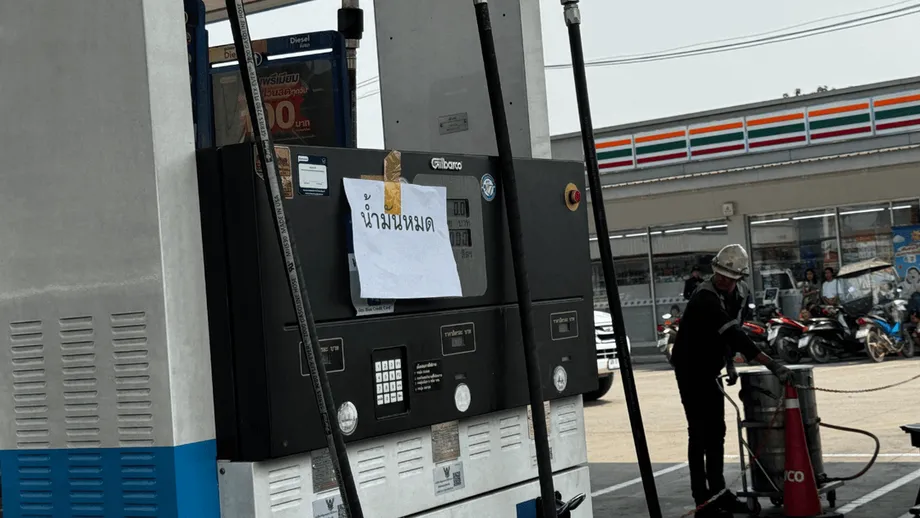
A small cash cushion meets rising energy costs
Thai households earning no more than 24,000 baht a month account for 57.2% of the country's households, and those with debt have less than 500 baht left each month after expenses and debt payments, according to Krungsri Research. Rising fuel, food and transport costs threaten to consume that narrow financial cushion while putting some of their jobs at risk.
Contents
- A small cash cushion meets rising energy costs
- Three groups with very different protection
- How fuel prices reach the dinner table
- Jobs could come under pressure too
- What the national survey shows
- Financial weakness predates the energy surge
- Public concern and the energy timeline
- Relief now, stronger incomes over time
- Key Points
The pressure was visible in spending figures for January to September 2026. The Commerce Ministry's Trade Policy and Strategy Office, or TPSO, put average monthly household expenditure at 21,217 baht, up 326 baht from the same period in 2025. Transport and communications accounted for 228 baht of the increase, roughly 70% of the total rise.
Energy markets added further strain in October. An Energy Ministry market update for October 20 put the Asian benchmark for spot liquefied natural gas at $29.89 per million British thermal units and Dubai crude at $107.90 a barrel. Thailand imports energy, and natural gas is its main fuel for generating electricity, making international prices a concern for both household bills and business costs.
Krungsri's assessment shows why the damage could spread unevenly. Wealthier households may initially pay more because they spend more on vehicle fuel. Families with lower incomes become more exposed as higher energy costs reach groceries, prepared meals and other necessities. Their room to reduce spending is smaller, and many work in industries where businesses may respond by cutting hours, wages or jobs.
Three groups with very different protection
Krungsri used National Statistical Office household surveys covering 2015 to 2025 to assess spending, employment security, financial reserves and debt. Its classification uses household income in 2025:
- Financially stretched households earn up to 24,000 baht a month, averaging 14,464 baht. They represent 57.2% of households.
- The middle group earns between 24,001 and 51,657 baht a month, averaging 34,173 baht. It represents 32.1%.
- Financially strong households earn at least 51,658 baht a month, averaging 84,745 baht. They represent 10.7%.
Debt makes a substantial difference within these groups. Stretched households without debt have about 1,300 baht left each month. Those with debt have less than 500 baht. Financially strong households have a monthly surplus of about 30,000 to 35,000 baht, giving them much more capacity to absorb higher bills.
The middle group has some reserves against temporary disruption, although debt payments can restrict access to cash. For stretched households, outstanding debt is 2.7 times their financial assets. A family in that position can quickly face a choice between drawing down savings, selling assets and borrowing again when essential costs rise.
How fuel prices reach the dinner table
Food, utilities and fuel together absorb 53.4% of expenditure among stretched households, compared with 47.2% for the middle group. These are expenses families have limited freedom to postpone: people still need meals, electricity and transport to work.
Krungsri considers a scenario in which prices across those three categories rise by 10%. If families buy the same quantities and other prices stay unchanged, that would increase the stretched group's total spending by about 5.34%, compared with 4.72% for the middle group. This is a calculation from the spending shares, with the 10% increase serving as a scenario rather than a forecast.
Oil affects household budgets through several routes. Drivers pay more at the pump, while transport operators face higher costs moving passengers and goods. Food producers and sellers can then raise prices to cover delivery, cooking and packaging expenses. Fertiliser, naphtha and petrochemical inputs create further routes through which energy costs reach farming and manufacturing.
TPSO's figures show prepared food spending rising to 3,528 baht a month in January to September 2026, from 3,435 baht a year earlier. Food and non-alcoholic beverages remained the largest category at 8,342 baht, up 118 baht. Transport and communications reached 4,895 baht, or 23.07% of total expenditure.
Housing expenditure, by contrast, fell 17 baht to 5,117 baht a month, partly because electricity charges were lower. Household energy bills can move at different speeds as contracts, tariffs and government measures affect how quickly international prices reach consumers.
Jobs could come under pressure too
Krungsri found that 51.1% of stretched households have members working in construction, wholesale and retail trade, agriculture, accommodation or food services. These industries are sensitive to rising input costs and weaker customer spending.
A restaurant facing more expensive cooking fuel, ingredients and deliveries may raise menu prices. If customers then buy fewer meals, the business may reduce staff hours. A household can therefore face higher living costs and lower earnings at the same time.
Only 24.3% of financially strong households have members working in those exposed industries. About 40.7% have members in sectors Krungsri considers more stable, including public administration, education, healthcare, professional services, finance and insurance.
Income growth has offered limited protection. Krungsri's assessment found that nominal income, the amount received before adjusting for inflation, declined on average for the strongest group over the past decade and grew only modestly for the middle group. Average inflation of about 1% a year further weakened purchasing power.
The stretched group recorded faster nominal income growth, partly supported by government assistance. Such assistance increased from 3.6% of its income in 2015 to 5.6% in 2025. Excluding that support, income grew by an average of only 1.7% a year.
What the national survey shows
The National Statistical Office's household survey summary puts average household income at 28,151 baht a month in the first half of 2025, against expenditure of 21,984 baht. Spending absorbed 78.1% of income.
The difference between those two averages was 6,167 baht a month. Krungsri's figures for the stretched group show how much less room many families have after expenses and debt payments. National averages combine households with very different incomes, assets and obligations.
The NSO recorded debt in 40.7% of households. Debt averaged 144,871 baht across all households, including those without borrowing, with 109,628 baht classified as borrowing for household purposes such as consumption, housing and education. Among indebted households, 92.7% borrowed only through formal channels, 5.1% only through informal channels and 2.2% through both.
Regular income per person rose from 10,765 baht a month in 2023 to 11,246 baht in the first half of 2025. The survey's income inequality measure, the Gini coefficient, fell from 0.285 to 0.260. A lower value means income is distributed more evenly. The lowest income group's share increased from 8.7% to 9.9%, while the highest group's share fell from 40.0% to 38.6%.
The NSO figures describe household finances in the first half of 2025, while TPSO's spending figures cover January to September 2026 and use a different statistical series. Each provides its own comparison with an earlier period: TPSO recorded rising spending from a year earlier, while the NSO recorded improvements in regular income per person and income distribution.
Financial weakness predates the energy surge
Krungsri Research's October 1, 2025 household assets analysis, written by Thansin Klinthanom, documented limited financial recovery after COVID-19. Using survey data from 2021 to 2023, it found that liquid assets increased by only 8,218 baht per household per year. Liquid assets include deposits and other holdings that can be converted into cash relatively easily.
For households earning below 20,000 baht a month, the annual increase was less than 2,000 baht. Households earning below 10,000 baht also experienced an average annual decline of 82,294 baht in the value of property and vehicles. The decline exceeded 17,425 baht for households earning between 10,000 and 20,000 baht.
Income and expenses were rising almost together. The analysis put their average annual increases at 1,806 baht and 1,803 baht respectively during 2021 to 2023, leaving little extra capacity to save.
Workers with the lowest earnings faced a particularly difficult recovery. In 2024, average worker income after adjusting for inflation was 3.2% above its level before COVID-19. For workers earning below 7,800 baht a month, it was 18.5% lower.
Bank of Thailand figures cited in the analysis placed household debt at 16.35 trillion baht, or 87.4% of gross domestic product, in the first quarter of 2025. Household lending contracted 0.12% from a year earlier as lenders remained cautious. Families with little cash and declining assets can therefore struggle to borrow just when they need help covering a disruption.
Public concern and the energy timeline
Suan Dusit Poll's survey, Thais and Energy Measures, gathered responses from 1,347 people nationwide. It found that 45.88% were very concerned about energy price increases and 44.10% were somewhat concerned, a combined 89.98%.
About 69.93% planned to switch off unnecessary lights and appliances to save energy. Some 30.51% said their emergency savings would last only one to three months, while 71.05% wanted the government to freeze fuel and cooking gas prices for as long as possible.
Pornphan Buathong, president of Suan Dusit Poll, called for management of price mechanisms, energy reserves and public communication. Anchalee Rattana, a political science lecturer at Suan Dusit University's School of Law and Politics, said higher oil and gas prices could increase goods and services costs through production and distribution.
The dated developments show how existing financial weakness has met a fresh external shock:
- 2021 to 2023: Krungsri's later analysis found household income and expenses rising by almost equal amounts.
- First half of 2025: The NSO recorded average household income of 28,151 baht a month and debt in 40.7% of households.
- September 2026: Brent crude averaged about 60% above its February 2026 level.
- January to September 2026: TPSO recorded monthly household spending rising by 326 baht from a year earlier.
- October 20, 2026: The Energy Ministry's update put spot Asian LNG at $29.89 per million British thermal units and Dubai crude at $107.90 a barrel.
Relief now, stronger incomes over time
Thai authorities have prioritised gas bought through longer contracts, which are less volatile than spot purchases, while maintaining measures to stabilise domestic oil prices. An unnamed senior energy official said the Energy Regulatory Commission expected further market stability measures in November 2026; their details and exact announcement date were not specified.
Thailand faces the same budget constraint confronting other economies across ASEAN and China, Japan and South Korea. Successive shocks, including COVID-19 and inflation following the war in Ukraine, have left governments with higher debt and less room to finance protection. Broad price freezes can help many consumers quickly, while targeted assistance directs limited public money toward households with the smallest reserves.
Krungsri argues that relief from bills and debt needs to be accompanied by more secure earnings. Its proposals include stronger social protection, financial education, skills development throughout people's working lives and investment in technology industries that can create better paid jobs. The October 2025 analysis also supports stronger small and medium businesses, flexible debt restructuring and accessible alternatives to informal borrowing.
Thansin Klinthanom, author of that analysis, described why measures focused on debt alone have limits:
Without addressing these root causes, solutions to the household-debt problem are unlikely to yield sustainable results.
Flooding adds another immediate concern. TPSO warned that damaged farmland and disrupted transport could raise agricultural prices, especially for fresh vegetables. Affected households may also need to pay for repairs, replacement appliances and building materials.
Private consumption may still grow because financially strong households and middle income households without debt can maintain spending. Stretched households represent 57.2% of households but account for 34.3% of consumption. National spending growth can therefore coexist with worsening financial pressure for a majority of families.
Key Points
- Krungsri classifies 57.2% of Thai households as financially stretched, earning no more than 24,000 baht a month.
- Stretched households with debt have less than 500 baht left monthly after expenses and debt payments.
- Food, utilities and fuel absorb 53.4% of spending in that group, making essential price increases difficult to absorb.
- Transport and communications accounted for roughly 70% of the rise in monthly household spending during January to September 2026.
- More than half of stretched households have members working in industries exposed to rising costs and weaker demand.
- Krungsri recommends immediate relief alongside stronger social protection, more stable employment and higher earnings.