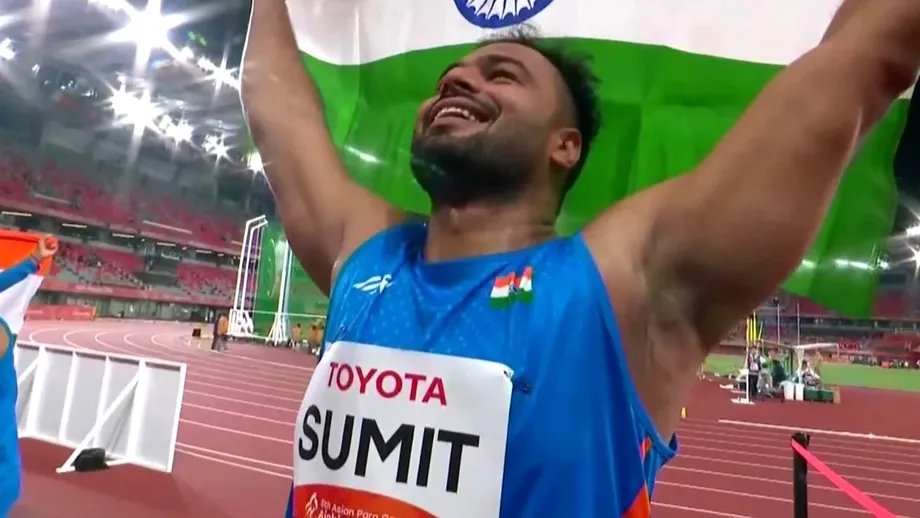
Three Indian medals, decided by distance and points
Sumit Antil retained his Asian Para Games javelin title in Nagoya on Friday, October 23, 2026, throwing 72.46 metres on his second attempt to lead an Indian sweep of the men's F42-44/F61-64 combined event. Mahendra Gurjar won silver and Sandip Sanjay Sargar took bronze, with the final order decided by points that account for differences between their classifications.
Contents
- Three Indian medals, decided by distance and points
- Why the longest distances do not determine every medal
- What F42, F44 and F64 mean
- A title defence below his record, with 75 metres still the target
- Gurjar and Sargar bring records of their own
- How Antil reached a second continental crown
- India's success extends beyond the combined final
- Key Points
Antil, 28, competed in F64 and scored 1,112 RAZA points. Gurjar, an F42 athlete, earned 1,066 points for a throw of 59.03 metres. Sargar, competing in F44, threw 64.48 metres and received 1,006 points. Gurjar and Sargar each set a Games record in their respective classifications.
The result contains an apparent puzzle: Sargar threw 5.45 metres farther than Gurjar but finished behind him. In this combined competition, athletes from different classifications shared one medal contest, so their distances were converted into comparable scores. Gurjar's performance earned 60 more points than Sargar's.
For Antil, the victory added another continental title to a career that already includes two Paralympic gold medals and three consecutive World Para Athletics Championships titles. His winning distance was 2.36 metres below the world record of 74.82 metres he set in Bengaluru in May 2026.
Why the longest distances do not determine every medal
RAZA points provide the common scale used to rank athletes when several eligible classifications compete together. A classification groups athletes according to how an eligible impairment affects their sporting activity. Combining classifications allows organisers to bring together a larger field while retaining a way to compare performances.
Gurjar's 59.03 metres and Sargar's 64.48 metres therefore had to be assessed within their respective classes before the medal order could be settled. A metre has the same length for every athlete, but its value in the combined standings depends on the scoring system applied to that classification.
Antil finished 46 points ahead of Gurjar, while Gurjar held a 60 point advantage over Sargar. Those margins explain the podium more accurately than the distance gaps alone. Antil had both the longest throw among the three medal winners and the highest score.
The published results give the three final scores but do not include a detailed calculation for each throw. Readers can follow the outcome directly: 1,112 points won gold, 1,066 won silver and 1,006 won bronze.
What F42, F44 and F64 mean
Antil, Gurjar and Sargar all compete in standing throwing events, but their classifications reflect different effects of impairments involving their lower limbs. The letter F identifies a field event, such as javelin or discus. Track events use T classifications.
F42 and F44 include athletes with eligible lower limb impairments who compete without a prosthesis for running or throwing. Those impairments can involve limb deficiency, differences in leg length or reduced muscle power. Gurjar competed in F42 and Sargar in F44.
F62 and F64 include athletes who compete standing while using a prosthetic leg or legs. Antil competes in F64 following the amputation of his left leg below the knee. The classifications brought together in this competition included F42, F44, F62 and F64.
The classification numbers identify sporting groups rather than a simple scale on which a larger number means a greater or smaller impairment. For spectators, the practical point is that athletes can share the throwing area and contest the same medals while having their performances compared through points.
A title defence below his record, with 75 metres still the target
Antil arrived in Japan after setting his latest world record at the eighth Indian Open International Para Athletics Championships in Bengaluru in May. His 74.82 metres left him just 18 centimetres short of 75 metres, the distance he is pursuing.
His Nagoya winning throw of 72.46 metres was 3.2% shorter than that record. It still secured the highest score in the combined event and another Asian Para Games gold. His best effort came early, on his second attempt.
Antil had also won at the Dubai Grand Prix earlier in 2026 and at the New Delhi Grand Prix in March, where he threw 69.25 metres. His Nagoya mark was 3.21 metres farther than that March performance, although his Bengaluru record remains the strongest of those three marks.
His previous Asian Para Games victory came at the Hangzhou edition, branded as the 2022 Games but held in 2023. The winning distance is widely listed as 73.29 metres, although a competing published figure gives 72.29 metres. Using 73.29 metres, his Nagoya winning throw was 83 centimetres shorter.
No date has been announced for Antil's next attempt at 75 metres. His immediate achievement in Nagoya was a successful title defence, alongside two Indian teammates who also produced Games records in their own classifications.
Gurjar and Sargar bring records of their own
Mahendra Gurjar's silver followed an established record of success in F42 javelin. In May 2025, he threw 61.17 metres at the World Para Athletics Grand Prix in Nottwil, Switzerland, setting a world record in his classification.
His Nagoya throw of 59.03 metres was 2.14 metres below that mark, but it set a Games record and earned the second highest score in the combined competition. Gurjar's result illustrates why the classification matters: his performance was measured against the demands of F42 before being placed alongside those of athletes in other classes.
Sandip Sanjay Sargar's bronze added another major medal to the career of an athlete from Maharashtra's Sangli district. He took up javelin in 2016 after completing a degree in chemistry and later moved to Pune for better training facilities. He worked as a delivery executive while pursuing the sport.
Sargar had experienced a serious leg injury in childhood and later required surgery for an ankle injury in 2023. He returned to win gold at the 2025 World Para Athletics Championships. In Nagoya, his 64.48 metres brought a Games record in F44 and completed India's sweep.
India's three medals therefore came from athletes with achievements across three different classifications. Antil supplied the highest score, Gurjar converted a record performance at the Games into silver, and Sargar added bronze after returning from an injury that had required surgery.
How Antil reached a second continental crown
Antil was born on June 7, 1998, in Sonipat, Haryana, and originally wanted to become a wrestler. He admired Yogeshwar Dutt, India's bronze medallist at the London 2012 Olympics. A motorcycle accident on January 5, 2015, led to the amputation of Antil's left leg below the knee.
Para athlete Rajkumar introduced him to para sport in 2017. Coach Naval Singh then guided him towards javelin. Within several years, Antil was setting records at the sport's biggest competitions.
His route to Nagoya includes a sequence of major victories:
- 2017: Antil entered para sport and began the move towards javelin under Naval Singh.
- Tokyo 2020 Paralympics, held in 2021: He won F64 gold, breaking the world record three times during the final and finishing with a best throw of 68.55 metres.
- Hangzhou Asian Para Games, held in 2023: He won his first Asian Para Games title.
- Paris 2024 Paralympics: He successfully defended his Paralympic title.
- 2025: He won a third consecutive World Para Athletics Championships gold.
- May 2026: He raised the F64 world record to 74.82 metres in Bengaluru.
- October 23, 2026: He retained his Asian Para Games crown in Nagoya.
Antil's May 2026 record was 6.27 metres farther than his winning mark of 68.55 metres in Tokyo, an increase of about 9.1%. That comparison shows the distance he has added since his first Paralympic title, even as his Nagoya victory came below his latest record.
India's success extends beyond the combined final
Navdeep also won a javelin medal for India in Nagoya, taking bronze in the men's F41 event with 42.55 metres. His event had its own medal contest, separate from the combined final won by Antil.
India's gold medals elsewhere at the Games included successes in archery, badminton, athletics and shooting. Harvinder Singh and Vijay Sundi were among the archery gold medallists. Nitesh Kumar and Naveen Sivakumar won badminton gold, as did the women's doubles pair of Thulasimathi Murugesan and Manasi Joshi.
Sandeep won the men's 400 metres T64, while Mona Agarwal took gold in the women's R8 50 metres rifle three positions SH1 event. Antil competed with support from the Target Olympic Podium Scheme, known as TOPS, India's programme for athletes preparing for the highest levels of international competition.
The javelin sweep came five days after the Games opened in Nagoya on October 18. Japan's first staging of the Asian Para Games brought together a record 45 countries and regions, with competition scheduled across 18 sports and 502 events through October 24.
Host Japan's medal tally at the end of October 23 stood at 63 gold, 60 silver and 62 bronze, a total of 185. Japanese sprinter Kengo Oshima was among the hosts' gold medallists in the men's T64 100 metres and 200 metres. The Indian javelin sweep formed part of a busy closing stretch of competition, with one day remaining on the Games schedule.
Key Points
- Sumit Antil retained his Asian Para Games title with 72.46 metres and 1,112 RAZA points in Nagoya on October 23.
- Mahendra Gurjar won silver with 59.03 metres and 1,066 points; Sandip Sanjay Sargar took bronze with 64.48 metres and 1,006 points.
- Gurjar finished ahead of Sargar because medals in the combined event were decided by points accounting for different classifications.
- Gurjar and Sargar each set a Games record in their respective classifications.
- Antil's world record stands at 74.82 metres, just 18 centimetres short of his 75 metre target.
- Navdeep added bronze in the separate men's F41 javelin event with 42.55 metres.