Investors punish Swiggy despite a smaller annual loss
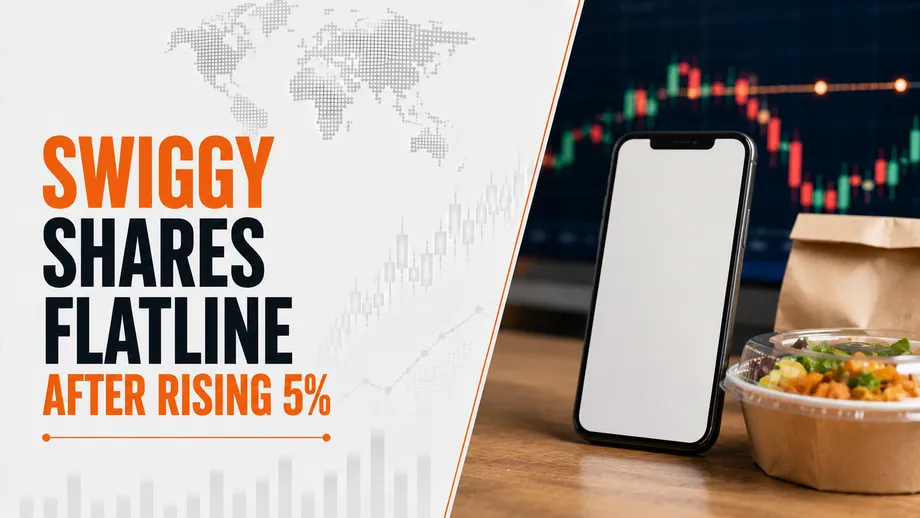
Swiggy shares fell as much as 14.4% to Rs 180.95 on Friday, October 23, 2026, as investors focused on a widening Rs 895 crore quarterly loss at Instamart, its rapid delivery business. The selloff followed September quarter results that showed stronger food delivery profits and rising revenue, alongside continued spending on discounts, customer acquisition and warehouses.
Contents
- Investors punish Swiggy despite a smaller annual loss
- How the selloff unfolded
- Why a narrower net loss disappointed investors
- Instamart grows while its margins remain under pressure
- Dark stores make speed possible and expansion costly
- Food delivery supplies the stronger earnings engine
- Swiggy bets on repeat customers and distinctive products
- Management sets out the next profitability milestones
- Brokerages lower targets but retain faith in food delivery
- Key Points
The stock had closed at Rs 211.30 on Thursday. Friday's decline took it to a record low and extended a fall of more than 50% since the start of the year. Several brokerages reduced their price targets, including firms that continued to recommend buying the shares.
Swiggy's consolidated net loss narrowed to Rs 922 crore for the quarter ended September 30, compared with Rs 1,092 crore a year earlier. Revenue from operations rose 36.1% to Rs 7,571 crore. Yet the loss exceeded the Rs 792 crore expected by analysts in an LSEG compilation, even though revenue beat their Rs 7,281 crore forecast.
The results left investors weighing two businesses moving at different speeds. Food delivery generated a record Rs 341 crore in adjusted operating profit. Instamart's adjusted operating loss widened from Rs 849 crore a year earlier to Rs 895 crore, an increase of about 5.4%.
Swiggy expects Instamart's losses to decline after the September quarter and has outlined margin improvements for December. Investors are now looking for those improvements while rival Blinkit expands its network and competition keeps pressure on prices.
How the selloff unfolded
Friday's trading followed results released after the market closed on Thursday, October 22. Shares were initially quoted at Rs 202 and then Rs 198.30 before falling below Rs 185. A subsequent trading update put the decline at 14.4%, with the stock at Rs 180.95.
The sequence explains why different intraday prices appeared during the session. The Rs 180.95 figure was a trading snapshot rather than a final closing price.
- September 30: Swiggy completed the second quarter of its 2026-27 financial year.
- October 22: The company released quarterly results after market hours. Its shares had closed at Rs 211.30.
- October 23: Shares fell sharply as investors assessed Instamart's losses and brokerages lowered their valuation targets.
- December quarter: Management expects about one percentage point of sequential improvement in Instamart's adjusted operating margin.
- Next two to three quarters: Swiggy expects to complete a transition towards an operating model in which Instamart owns inventory.
At Rs 180.95, the shares were about 53.6% below Swiggy's Rs 390 initial public offering price. The decline also left the stock below even the lowest revised brokerage target listed in the results coverage, although those targets depend on forecasts for future performance.
Why a narrower net loss disappointed investors
Swiggy reduced its consolidated net loss by Rs 170 crore compared with the same quarter a year earlier, an improvement of 15.6%. Against the preceding quarter, however, the loss increased from Rs 791 crore to Rs 922 crore.
The Rs 922 crore loss was also Rs 130 crore larger than analysts expected. Revenue exceeded the analyst forecast by Rs 290 crore. In simple terms, Swiggy brought in more revenue than expected, but its spending still left a larger loss than investors had anticipated.
Total expenses reached Rs 8,703 crore, compared with Rs 6,711 crore a year earlier and Rs 7,813 crore in the preceding quarter. That represents annual expense growth of about 29.7%, below the reported 36.1% revenue growth rate.
The company therefore made progress in reducing its annual net loss while remaining under pressure from the cost of expansion. Food delivery's improving profits helped the group, but Instamart continued to require substantial investment.
Instamart grows while its margins remain under pressure
Instamart's net order value was reported at Rs 6,594 crore for the September quarter, although a conflicting published figure put it at Rs 6,954 crore. Annual growth was given as both 31.4% and 34.8%; sequential growth was reported at 13.4%.
Net order value measures the value of orders after discounts. Gross order value, or GOV, is the broader measure used as the denominator for several of Swiggy's margins. Instamart's GOV reached Rs 9,230 crore, up 16.7% from the preceding quarter.
Instamart handled around 130 million orders, an increase of 29.3% from a year earlier. Its monthly transacting customer base grew 23% to 14.8 million, showing that more people were using the service as order volumes expanded.
The business nevertheless recorded a contribution margin of negative 1% of GOV. Contribution margin measures what remains after costs directly associated with serving orders, before broader business expenses. At negative 1%, those direct costs exceeded the associated income by roughly Rs 1 for every Rs 100 of GOV.
That margin improved by 157 basis points compared with a year earlier but deteriorated by 82 basis points from the preceding quarter. A basis point is one hundredth of a percentage point, so 82 basis points means 0.82 percentage points.
Instamart's adjusted EBITDA margin improved slightly to negative 9.7%, from negative 9.8% in the preceding quarter. EBITDA measures earnings before interest, tax, depreciation and amortisation, with company adjustments applied. It is a different measure from contribution margin and from the group's final net loss.
Dark stores make speed possible and expansion costly
Instamart added 69 net dark stores during the quarter, taking its network to 1,240 across 133 cities. The stores occupied a combined 5.2 million square feet. Dark stores are small warehouses used to pick and dispatch online orders rather than serve shoppers walking through aisles.
Locating these warehouses close to customers makes fast deliveries possible. Opening and operating them requires spending on premises, stock handling and staff. A store serving more orders can spread some of those costs across a larger volume of business.
Blinkit added 308 net stores during the quarter, more than four times Instamart's 69. Brokerage comparisons also circulated additions of 508 stores for Blinkit and 97 for Instamart. Either set placed Blinkit's expansion ahead of Swiggy's.
Motilal Oswal's comparison put Blinkit's daily orders per dark store at 1,611 during the September quarter, against 1,168 for Instamart. That is a gap of 443 orders per store, or about 38% relative to Instamart's figure.
The same brokerage put growth in net order value during the first half of the financial year at 83% for Blinkit and 37% for Instamart. Blinkit also planned to accelerate expansion while expecting no near term reduction in margins, increasing the pressure on Swiggy to improve growth and profitability together.
Food delivery supplies the stronger earnings engine
Swiggy's food delivery business generated Rs 10,054 crore in GOV, up 17.7% from a year earlier and 5.9% from the preceding quarter. Monthly transacting users increased 15.2% annually to 19.8 million.
Adjusted EBITDA rose to Rs 341 crore from Rs 240 crore a year earlier, an increase of Rs 101 crore, or about 42%. Its margin reached 3.4% of GOV, compared with 2.8% a year earlier.
Swiggy attributed the improvement to advertising income, higher order density and delivery efficiencies. More orders within a delivery area can help the company use its delivery network more efficiently, while advertising gives restaurants another way to pay for visibility on the platform.
Sriharsha Majety, Swiggy's managing director and group chief executive officer, described the performance and the company's affordable meals app, Toing:
Our food delivery business delivered its highest-ever profits and margins while we continue to unlock new category growth through Toing, our standalone offering for affordable meals.
Toing operated in more than 50 cities, and Swiggy said two out of three new users on the app were new to the food delivery category. The company retained its annual growth guidance of 18% to 20% for its core food delivery business and its longer term target of a 5% adjusted EBITDA margin.
Competition remained visible here too. Motilal Oswal put food delivery GOV growth during the first half at 21.7% for Eternal and 17.5% for Swiggy. Swiggy's out of home consumption business offered another profitable operation, recording Rs 1,508 crore in GOV and its seventh consecutive quarter of profitability.
Swiggy bets on repeat customers and distinctive products
Swiggy is trying to make Instamart more attractive through products customers cannot easily substitute elsewhere. Its initiatives include the Noice private label, curated fruit and vegetables under Nectr, and Switch partnerships involving around 400 brands.
The company said retention after the first month averaged more than 60% among transacting users during the quarter. Noice products appeared in more than one in eight orders, and customers buying those products showed retention 15 percentage points higher.
Swiggy explained its approach in its shareholder letter:
As speed becomes table stakes in quick commerce and aggressive pricing proves unsustainable, we believe differentiated assortment will help us build a unique consumer proposition.
The strategy puts more weight on what customers can buy and whether they return, alongside delivery speed. Repeat purchases matter because attracting a new customer through discounts costs money; keeping that customer ordering gives the business more opportunities to recover that spending.
Management sets out the next profitability milestones
Swiggy expects Instamart's adjusted EBITDA losses to have reached their highest level in the September quarter. Its shareholder letter stated:
We believe the adjusted Ebitda losses to have peaked out in Q2FY27.
Management guided for around 100 basis points, or one percentage point, of sequential improvement in the December quarter's adjusted EBITDA margin. It expected contribution margin to remain between zero and negative 1% of GOV during that quarter, with improvement thereafter.
Swiggy is also preparing to move Instamart towards an inventory model in which it owns the goods being sold. Majety said the company had obtained the approvals needed to qualify as owned and controlled by Indian interests, with the transition underway.
The company expects the inventory change to improve contribution margin by around 80 basis points once fully implemented. It anticipates completing the transition over the next two to three quarters. These are management forecasts; no date for Instamart to achieve adjusted EBITDA profitability was given.
Brokerages lower targets but retain faith in food delivery
Jefferies retained its buy recommendation but reduced its target price to Rs 330 from Rs 435, a cut of about 24%. It identified Instamart's losses as a central concern while arguing that Swiggy's market price undervalued its food delivery operation and cash holdings.
Emkay also retained a buy rating and cut its target by 11% to Rs 310. It identified sustained sequential growth of at least 10% in Instamart's net order value, better customer retention, greater income from orders and higher store utilisation as factors that could support a higher valuation.
Motilal Oswal reduced its target to Rs 280 from Rs 360 and lowered its assumed annual compound growth in Instamart's net order value for financial years 2026 to 2030 to 32%, from 38%. Its valuation assigned Instamart a negative value, reflecting expectations of continued losses and the funding needed to support growth.
Citi retained buy with a reduced Rs 330 target. HSBC kept hold and lowered its target to Rs 240 from Rs 315. CLSA retained outperform with a reduced target of Rs 262, while Nomura cut its target to Rs 300.
Nomura expected food delivery to generate EBITDA of Rs 1,300 crore to Rs 1,900 crore in financial years 2027 and 2028, but lacked conviction to assign a positive value to quick commerce. Across 30 analysts covering Swiggy, 23 recommended buy, four hold and three sell.
The common issue behind the target cuts is how long food delivery's improving earnings will have to support investment elsewhere. December's margins, repeat ordering and store utilisation will provide the next measures of whether Instamart is moving towards the improvement management expects.
Key Points
- Swiggy shares fell as much as 14.4% to Rs 180.95 on October 23, reaching a record low.
- The September quarter net loss narrowed annually to Rs 922 crore but exceeded analysts' Rs 792 crore forecast.
- Instamart's adjusted operating loss widened to Rs 895 crore from Rs 849 crore a year earlier.
- Food delivery generated record adjusted EBITDA of Rs 341 crore, with a margin of 3.4% of GOV.
- Instamart ended the quarter with 1,240 dark stores across 133 cities.
- Management expects December margin improvement and further benefits from a transition to owning inventory.
- Several brokerages cut price targets while retaining positive recommendations on Swiggy.