A game mission reaches emergency services
Some 550,000 Delta Force players registered as emergency aid volunteers within three days of a campaign launch on September 21, while participants reported the locations of automated external defibrillators across 383 Chinese cities. On October 16, the initiative reached a more practical milestone: more than 50 volunteers passed CPR and AED assessments at Shenzhen Emergency Medical Center.
Contents
- A game mission reaches emergency services
- A family loss behind a volunteer's commitment
- Three tasks connect players with real responsibilities
- Why reporting an AED means more than adding a dot
- Inside Shenzhen's first practical class
- How the volunteer network connects to 120
- Shenzhen has equipment, but needs more trained people
- Game funding is directed toward more classes
- From recognition to readiness
- Key Points
The campaign, scheduled from September 21 to November 4, 2026, connects the tactical game's familiar tasks of locating medical equipment and helping teammates with real activities: joining a volunteer network, receiving nearby emergency alerts and mapping equipment that could help save a life.
Shenzhen's health commission, in its account of the training, said an accompanying public lesson attracted more than 6 million online viewers. Four gaming livestreamers joined professional instructors for the broadcast and practical training.
The project brings together Delta Force, Tencent SSV's Penguin First Aid Assistant, Tencent Charity and Tencent Growth Guardian. Its central challenge is turning a large audience into people who can find equipment, call for help and act under professional guidance before an ambulance arrives.
For volunteer Si Yipin, that connection is personal. Long before he earned a game badge for helping 5,000 teammates, a death in his family had pushed him toward emergency rescue work.
A family loss behind a volunteer's commitment
In 2008, Si was a first year middle school student in Harbin, living with his aunt and preparing for examinations when she suddenly became ill in a supermarket. He recalls that nobody present knew cardiopulmonary resuscitation, or CPR, and AEDs were rarely available in public places. His aunt died despite efforts to save her.
Si kept wondering whether someone with emergency skills might have made a difference. After finishing his university entrance examinations, he applied to join a volunteer rescue team at 18. During university, he used weekends to obtain a Red Cross first aid certificate and encountered an AED for the first time.
An AED is a portable device that checks the heart's electrical rhythm and, when appropriate, delivers a shock. CPR uses chest compressions to keep blood moving when a person's heart has stopped pumping effectively. Training teaches people how to recognize an emergency and use these measures together.
After starting work, Si wanted his own AED so he could teach others how to use one. Devices then commonly cost more than 10,000 yuan, beyond his budget. He first bought a training simulator costing more than 1,000 yuan, still a substantial expense for someone beginning a career.
As prices fell, he eventually bought an actual AED. In warmer weather, he carries it in a backpack. During the harsh northeastern winter, he keeps it with a first aid kit in his car for travel and rescue team duties. When work prevents him from joining operations, he supports teammates remotely by gathering information and preparing charts.
Three tasks connect players with real responsibilities
Si joined Delta Force when public testing began in 2024. He often plays its medical support operator, known in Chinese as Fengyi, whose abilities focus on treatment and rescue. When he learned about the emergency aid campaign through a September update, he found a way to connect that interest with his volunteer work.
Players enter the campaign through the game and can complete three activities using Penguin First Aid Assistant:
- Register as an emergency aid volunteer.
- Activate online duty status to receive nearby requests for help.
- Report the location and condition of an AED.
Completing any two tasks earns a campaign avatar, dog tag and profile card inside the game. Volunteers receiving an alert can choose to attend, provided they protect their own safety and follow instructions from 120, China's medical emergency telephone service.
The campaign's schedule links online participation with public events and practical instruction:
- September 21, 2026: The campaign and nationwide AED reporting activity begin.
- September 25 and 26: An emergency education booth is scheduled at the game's anniversary event in Chongqing.
- October 16: Shenzhen hosts the first practical training session on World Restart a Heart Day.
- November 4: The announced campaign and AED reporting period end.
For Si, the activity has also created a community. Players have asked him about AED use in video comments, shared their first aid certificates and exchanged experiences. He met another player who had also bought an AED with personal funds.
Why reporting an AED means more than adding a dot
Participants are asked to photograph an AED's location and submit its position and condition through the campaign interface. After verification, the information can enter the emergency map, helping volunteers and callers locate equipment nearby.
The instructions ask players to leave devices in place, avoid blocking access and protect other people's privacy when taking photographs. Reporting the condition of equipment also gives the platform information beyond a street address. A rescue network needs to know where a device is and whether it is available for use.
Organizers said the campaign's AED submissions reached 383 cities across 34 provincial level regions. They did not give a total number of devices verified and added through the campaign, so the geographic reach is the clearest measure of its mapping activity.
Delta Force already treats an AED as a valuable medical item that players search for. The campaign uses that recognition to make a real device more familiar. During the Shenzhen broadcast, participants followed clues to find an AED and practised recording its location in the Penguin First Aid mini program.
Si sees recognition as an achievable first step: a player who learns what an AED looks like may later seek proper instruction. His experience carrying equipment also points to the limits of an individual effort. A shared map can make devices owned by many different organizations easier for a wider community to find.
Inside Shenzhen's first practical class
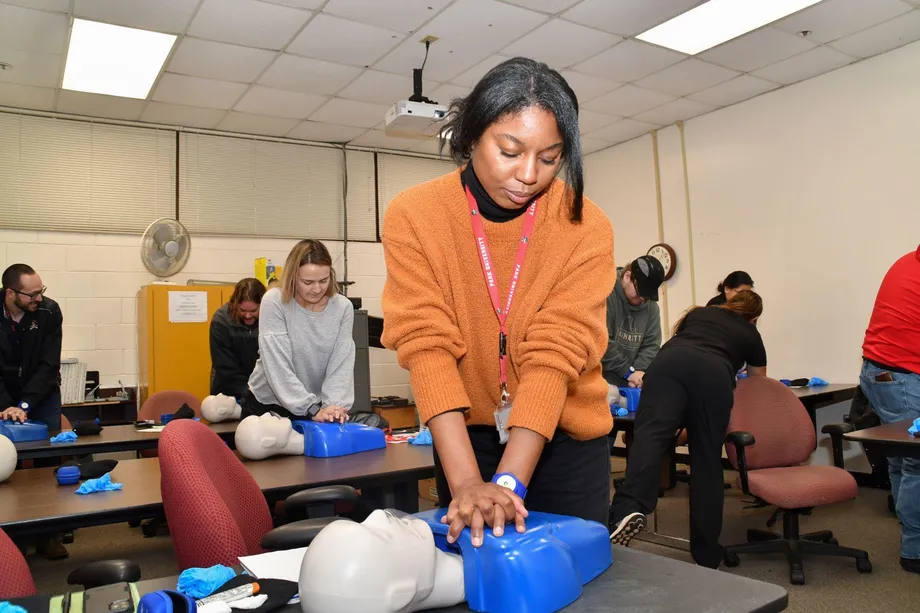
More than 50 volunteers, including players and members of the public, attended the October 16 training alongside four gaming livestreamers. Professional instructors led the CPR and AED course, and participants passed assessments to receive certification.
Peng Longhua, a training instructor at Shenzhen Emergency Medical Center, said a single class could help participants develop an emergency response mindset, while broader competence required more learning. He encouraged players to move from awareness inside the game to practical training outside it.
The public broadcast showed the work of Shenzhen's 120 dispatch center and emergency medical service: receiving a call, sending location information, dispatching an ambulance and guiding people at the scene. Viewers also saw equipment including mechanical CPR devices used in ambulances.
Instructors translated emergency tasks into language players recognized. Giving dispatchers a precise location became the equivalent of reporting a tactical position. Finding an AED resembled searching for valuable medical supplies. CPR practice drew on the familiar idea of helping a teammate.
Organizers recorded more than 6.2 million viewing visits and over 500,000 likes for the lesson. Those figures describe the broadcast's reach, while the practical assessments show how a much smaller group progressed to supervised skills training.
How the volunteer network connects to 120
Penguin First Aid Assistant combines emergency calling, location services, AED maps, video guidance and volunteer dispatch. The platform operates in 12 cities, including Shenzhen, and connects with local 120 systems so professional dispatchers can coordinate callers, nearby volunteers and equipment.
Tencent's platform figures put its network at more than 30,000 connected AEDs and more than 1 million volunteers. By June 2026, it recorded 80,973 instances of assistance across its services. Within cardiac arrest responses, it recorded 6,881 cases and described 1,341 people as effectively assisted.
These figures cover different parts of the service. The 80,973 total concerns assistance across emergency situations; the 6,881 responses concern cardiac arrest specifically. The smaller figure of 1,341 uses the platform's description of effective assistance.
Shenzhen Emergency Medical Center offers a more specific clinical measure. It said telephone and video guidance from 120 dispatchers helped more than 450 cardiac arrest patients regain spontaneous circulation between January and September 2026. That means their hearts resumed pumping blood.
Su Pingping, a representative of Tencent SSV's Time Laboratory, said professional dispatchers can provide live instructions when volunteers call 120. She also said the platform purchases insurance for volunteers registered under their real names, addressing one concern among people hesitant to help.
The project therefore gives participants several possible roles. Someone may report equipment, another may receive an alert, and a trained volunteer may assist under dispatch guidance. Each role supports the period before professional responders reach the patient.
Shenzhen has equipment, but needs more trained people
Shenzhen has more than 44,000 AEDs in public places, according to the municipal health commission, which described its coverage as the highest in China. The city is developing a five minute community emergency response network built around its emergency medical center, 120 service, volunteers and digital coordination.
Its aim is to get help to a patient within five minutes. Meeting that target requires more than installing equipment: someone must recognize the emergency, communicate the location, retrieve an AED and begin appropriate assistance.
Zhu Hong, director of Shenzhen Emergency Medical Center, put the city's first aid knowledge coverage at 5.51% by the end of 2025. The figure illustrates why a city with tens of thousands of devices is still seeking ways to reach people who have never taken a course.
The game offers access to a large potential audience. The health commission described Delta Force as having 58 million daily active users. The 550,000 registrations during the campaign's first three days amount to about 0.95% of that audience, using those two figures.
Organizers later said more than 600,000 players and other users had shared Penguin First Aid volunteer certificates, and that the platform's volunteer total had risen by more than 60%. Registration, certificate sharing and completion of a practical course are separate activities within the effort to build a larger response community.
Chen Jieping, director of Tencent SSV's Time Laboratory, described the human element during the broadcast:
It is never the equipment placed somewhere that actually carries out a rescue, but the living people walking along the streets.
Game funding is directed toward more classes
Players can also unlock charitable funds provided with support from the Tencent Foundation. They claim the allocation inside the game, then move to the Tencent Charity mini program to direct it toward One Foundation's Safe Home Program.
The funding is intended to support emergency education and training in more cities. Players contribute through participation and directing the allocation, while the foundation supplies the campaign funds. The amount committed and dates for subsequent city courses have not been announced.
Established in 2015, the Safe Home Program says it has operated in 1,368 villages and communities across 23 provincial level regions. Its work includes forming community volunteer rescue teams and teaching emergency response, first aid and disaster preparedness.
Xu Haishen, a rural teacher from Chao'an district in Guangdong, attended the Shenzhen course with an audience beyond himself in mind. He hopes to take the knowledge back to school, helping children understand emergencies and learn how to seek help correctly.
Tencent Growth Guardian's involvement provides another connection with schools. Bringing teachers into practical classes gives the campaign a route from a gaming audience into communities where access to emergency education may be limited.
From recognition to readiness
Si's story shows the different commitments that can follow an initial interest: obtaining a certificate, buying training equipment, joining rescue operations and supporting others when work keeps him away. His game experience became another route to finding people with similar ambitions.
The campaign gives newer participants a shorter first step. They can learn an AED symbol, locate a device near home or register to receive alerts. Practical classes then provide a place to practise skills with professional supervision.
Zhu Hong, Shenzhen Emergency Medical Center's director, described the goal of bringing younger people into that process:
We hope the reach of first aid knowledge will continue to grow, and that young people will know how to save lives and have the courage to do so.
The next announced deadline is November 4, when the campaign's participation period closes. Organizers plan to bring training to more cities through Tencent Charity and One Foundation. The lasting work will lie in keeping equipment information current, giving volunteers opportunities to practise and connecting willing helpers with professional dispatchers when emergencies occur.
Key Points
- Delta Force's emergency aid campaign runs from September 21 to November 4, 2026.
- Organizers recorded 550,000 volunteer registrations in its first three days and AED location reports across 383 cities.
- More than 50 volunteers passed CPR and AED assessments in Shenzhen on October 16.
- The accompanying public lesson attracted more than 6 million online viewers.
- Penguin First Aid Assistant connects volunteers, AED information and local emergency services in 12 cities.
- Foundation funding directed through the game will support further community emergency training.