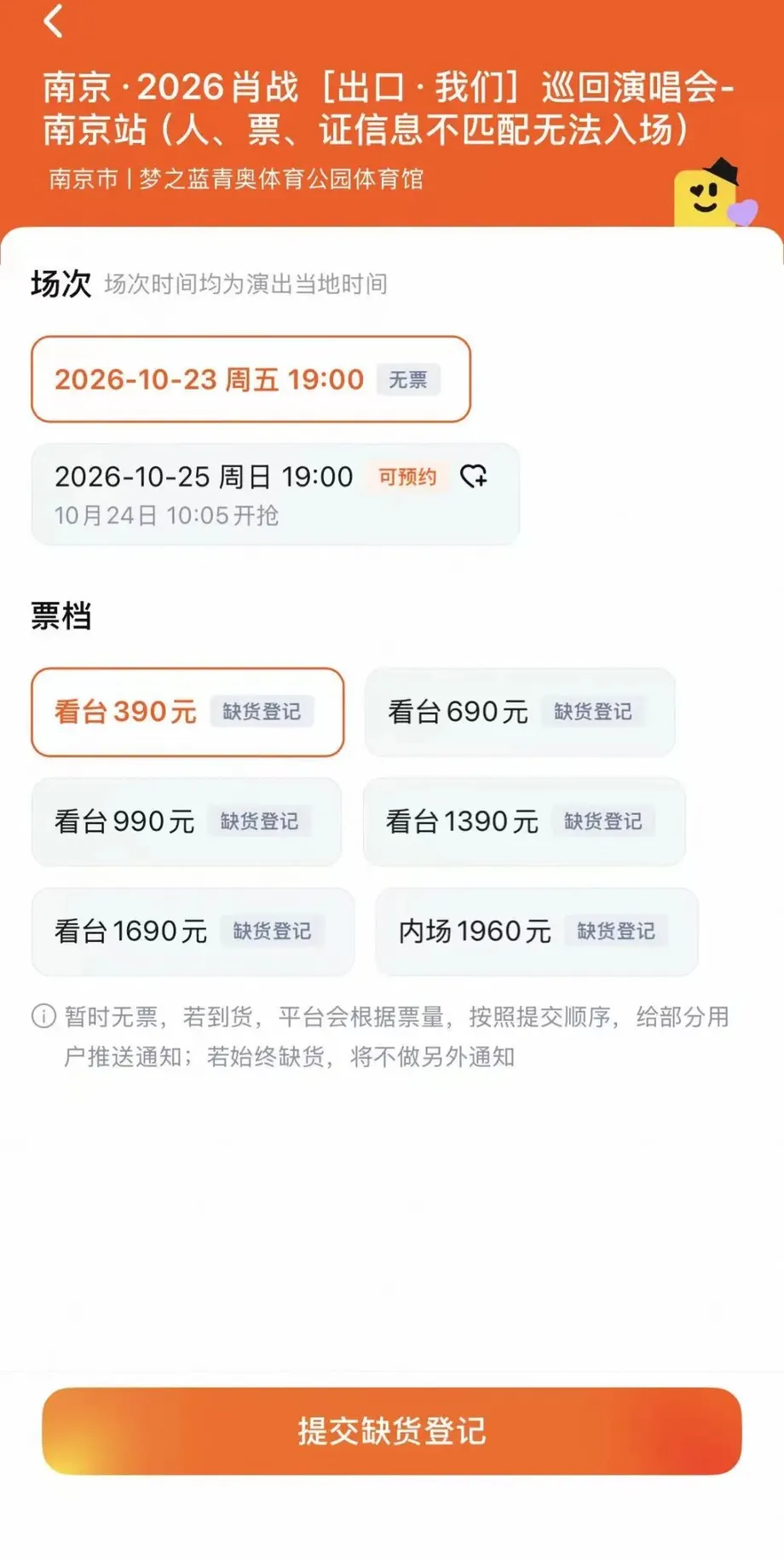
October 22 Release Sells Out Before Nanjing Opening Night
The latest release of tickets for Xiao Zhan's Nanjing concerts sold out on the morning of October 22, 2026, under rules that leave buyers unable to return, exchange or transfer their tickets. The release opened at 10:05 a.m. for the October 23 performance, one day before the actor and singer takes the stage at Dream of the Blue Youth Olympic Sports Park Gymnasium.
Contents
- October 22 Release Sells Out Before Nanjing Opening Night
- What Is Being Released This Time?
- The Dates Buyers Need to Follow
- What the No Refund Policy Means
- Why an Electronic Ticket Alone Will Not Get Someone Inside
- How Large Is the Gap Between Interest and Supply?
- Fans Describe Access Problems as Damai Defends Its Systems
- Damai Says the 250,000 Yuan Claim Was Fabricated
- Proxy Buying Adds Fees and Personal Data Risks
- Key Points
Fans seeking the October 25 performance have a separate date to watch: its second ticket release is scheduled for October 24 at 10:05 a.m. Damai announced the arrangements on October 20, separating the two sales rather than reopening both performances together.
The restrictions make this release different from the first sale on October 15, when tickets across six price categories, from 390 to 1,960 yuan, quickly sold out. Buyers in the new release accept a policy allowing no refunds or exchanges, alongside identity checks that prevent them from passing a ticket to somebody else.
Demand has remained intense. More than 5 million people marked interest in the first Nanjing performance, while Damai separately said more than 5 million people participated in the October 15 ticket rush. The platform had announced 22,020 tickets across the two Nanjing shows.
For people still trying to attend, the immediate decision involves more than getting through the payment screen. Some newly released seats may have restricted views, adjacent seats are not guaranteed, and admission requires the attendee's identity document, electronic ticket and face to match.
What Is Being Released This Time?
The second sale adds another buying opportunity for the existing Nanjing performances, rather than an additional concert. Its ticket pool includes returns from the first sale and seats in viewing areas along the sides of the stage.
Damai's sale notice warns that the venue's structure and the staging of some songs may affect sightlines from certain seats. Someone seated beside the stage could have a different view from an audience member facing it directly. The notice also says the release does not guarantee seats together, an important condition for friends or families hoping to attend as a group.
The number of tickets offered in each second release has not been disclosed. The previously announced total of 22,020 covers the two Nanjing performances; buyers have not been given a breakdown showing how many returned tickets or additional side seats are included in the new sales.
The practical tradeoff is straightforward: the release gives fans another chance to attend, while requiring them to accept the seating conditions and commit to their purchase immediately.
The Dates Buyers Need to Follow
Xiao announced his first solo tour on October 13. The schedule names two Nanjing concerts, on October 23 and 25, followed by Shanghai performances on November 6 and 8 at Mercedes-Benz Arena.
The Nanjing arrangements place the end of each earlier refund window before the next ticket release. That allows returned tickets to be gathered for sale before the corresponding performance.
- October 15, 10:05 a.m.: The first Nanjing ticket sale opened and quickly sold out.
- October 20: Damai announced the second release schedule.
- October 21, 7 p.m.: The earlier refund window closed for the October 23 performance.
- October 22, 10:05 a.m.: The second release for October 23 opened and sold out.
- October 23, 7 p.m.: The first Nanjing concert begins, and the earlier refund window closes for the October 25 performance.
- October 24, 10:05 a.m.: The second release for October 25 is scheduled to open.
- October 25, 7 p.m.: The second Nanjing concert is scheduled to begin.
What the No Refund Policy Means
Damai's second release notice says these purchases carry no refund entitlement and that no form of return or exchange will be accepted. A successful order is treated as acceptance of the purchasing rules, with buyers responsible for their decision. Completing a purchase also means accepting the seat conditions, including potentially restricted views and no guarantee of adjacent seats.
The earlier sale had a refund process with deadlines. Tickets bought in the second release come after that process has closed for the relevant performance. A buyer therefore needs to be ready to attend on the named date before completing payment.
A change of plans creates a particularly difficult situation because ticket transfers are also prohibited. Someone who becomes unable to travel cannot use the platform's stated arrangements to refund the purchase or give the ticket to a friend. The financial commitment can extend beyond the ticket if transport and accommodation have already been booked.
The combination also increases the cost of speculative buying. A person who purchases a ticket hoping to resell it loses the option of returning it through this sale's refund process. The same restrictions apply to ordinary fans, including those whose circumstances change unexpectedly.
Why an Electronic Ticket Alone Will Not Get Someone Inside
Damai says admission requires three matching elements: the attendee's original identity card, the electronic ticket information and facial recognition. This is the meaning of the strict real name policy used for the concerts. The ticket is attached to a named person, rather than functioning as an item that can freely change hands.
The platform says attendee details cannot be changed after purchase. A ticket tied to another person's identity therefore presents a direct obstacle at the entrance, even if the buyer has paid a private seller and received an electronic ticket.
Damai, the exclusive ticketing platform, explained the entry requirement in its October 15 statement:
Admission will only be granted if all information matches. Aside from Damai's official ticket-verification procedures, no other methods of entry will be permitted.
Xiao's studio has likewise warned that tickets offered by scalpers may already be bound to somebody else's identity. Its warning connects two risks for buyers: being refused entry and struggling to recover the extra money paid privately.
How Large Is the Gap Between Interest and Supply?
Damai's announced inventory of 22,020 tickets across two Nanjing shows helps explain why so many fans left the first sale empty handed. The platform said more than 5 million people joined the October 15 rush, while its visible interest count was reported to have passed 5.14 million.
The figures describe different activities. Marking a concert as wanted records interest on the platform; joining a sale means attempting to buy. Damai's participation figure nevertheless shows the scale of the pressure on a ticket pool measured in tens of thousands.
Xiao's tour had already attracted 2.04 million Nanjing reservations by the morning of October 14, before ticket sales opened. The subsequent rush turned that early attention into widespread competition at checkout.
The inventory also offers a more useful measure of purchase opportunities than the building's headline capacity. A concert's stage, equipment and seating layout determine which places can be sold. The second release's addition of viewing areas beside the stage shows how those arrangements can affect the final seat pool.
Xiao's studio also gave up a customary internal allocation of 15%, placing those tickets into public sale. The studio has explicitly rejected claims that employee tickets, internal tickets or seats reserved for commercial partners are available through private channels.
Fans Describe Access Problems as Damai Defends Its Systems
Some fans described the Damai app becoming inaccessible around the October 15 opening. Others said they reached the payment stage only to find that tickets were no longer available. Complaints about the app spread on social media as the sale sold out.
Damai said its platform remained stable and functioning despite a sharp increase in simultaneous traffic from more than 5 million participants. Its customer service response pointed to the large number of buyers and limited ticket supply, advising users to refresh and try again.
Damai also announced technical measures against automated purchasing. It said its systems would identify and block malicious activity involving fake devices, unsafe plugins, external cheating software and network proxies, and that related orders could be cancelled under platform rules.
For buyers, the difficult experience combined scarce seats with uncertainty at each step of checkout. A reservation made before the sale did not hold a ticket: Damai said its rule allowing a reservation for only one performance at the same venue was a platform rule, while actual purchases still depended on availability when sales opened.
Damai Says the 250,000 Yuan Claim Was Fabricated
Online advertisements added another source of pressure, with screenshots claiming prices of 190,000 to 230,000 yuan for seats in the first three rows and as much as 250,000 yuan for a front row ticket. The highest official ticket price was 1,960 yuan, making the 250,000 yuan claim about 128 times that amount.
Damai initially responded on October 15 that the extreme prices were malicious publicity by scalpers without legitimate ticket supplies. On October 18, the company gave a more specific account, saying findings by the relevant authorities identified an individual surnamed Wang who had fabricated the front row price claim to attract attention despite having no tickets.
The company said it was cooperating with the investigation and that authorities were handling the matter according to law. It also repeated that the venue would enforce identity checks and reject tickets issued with incorrect attendee information.
On October 21, the Ministry of Public Security's Cybersecurity Bureau said Wang, a 33-year-old man, had fabricated and posted the high-priced ticket claims on WeChat Moments on October 13 to attract customers for a proxy ticket-buying business. Police found that the claims spread rapidly, repeatedly appeared on trending lists and disrupted public order. Local police imposed seven days of administrative detention and a 1,000 yuan fine for violating Article 29, item (1), of the Law of the People's Republic of China on Penalties for Administration of Public Security.
Private sellers had promoted supposed front row invitations arriving one to three days before a performance. Xiao's studio's warning directly addresses such promises: Damai's app is the only authorised sales channel, and no internal, employee or partner allocation is being offered privately.
Proxy Buying Adds Fees and Personal Data Risks
Services offering to buy tickets on somebody else's behalf have also appeared on resale platforms. Advertised charges range from small service listings of 100 to 300 yuan to quoted fees of 1,000 to 4,000 yuan for attempts to secure Nanjing tickets. Some sellers have claimed they can guarantee a purchase or directly enter attendee information.
A fee of 4,000 yuan would itself exceed twice the highest official ticket price of 1,960 yuan, before paying for the ticket. Buyers may also be asked to hand over identity details, account access or payment permissions to strangers.
Xiao's studio has warned against private sales presented as official staff transactions, internal access or personal transfers. Its message is that fans should buy only through the Damai app and avoid promises of privileged access.
Nanjing travel costs add another commitment. Hotels near the venue have been described as fully booked during the concerts, with some rooms priced above 1,000 yuan and some room categories approaching ten times their earlier rates. Each concert is listed to last at least 120 minutes and include at least 20 songs, but securing admission still depends on a valid ticket with matching identity information.
The next scheduled purchase opportunity is October 24 at 10:05 a.m. for the October 25 performance. Buyers face the same central conditions: no refund or exchange, no transfer, possible restrictions on the view and no guarantee of adjacent seats.
Key Points
- The October 22 ticket release for Xiao Zhan's October 23 Nanjing concert sold out.
- Tickets for the October 25 performance are scheduled for a second release on October 24 at 10:05 a.m.
- Second release purchases cannot be refunded, exchanged or transferred.
- The ticket pool includes earlier returns and seats beside the stage; some views may be restricted.
- Admission requires matching original identity documentation, electronic ticket details and facial recognition.
- The Ministry of Public Security's Cybersecurity Bureau said Wang fabricated the high-priced ticket claims to attract proxy ticket-buying customers; local police imposed seven days of administrative detention and a 1,000 yuan fine.
- Xiao's studio says the Damai app is the only authorised sales channel.