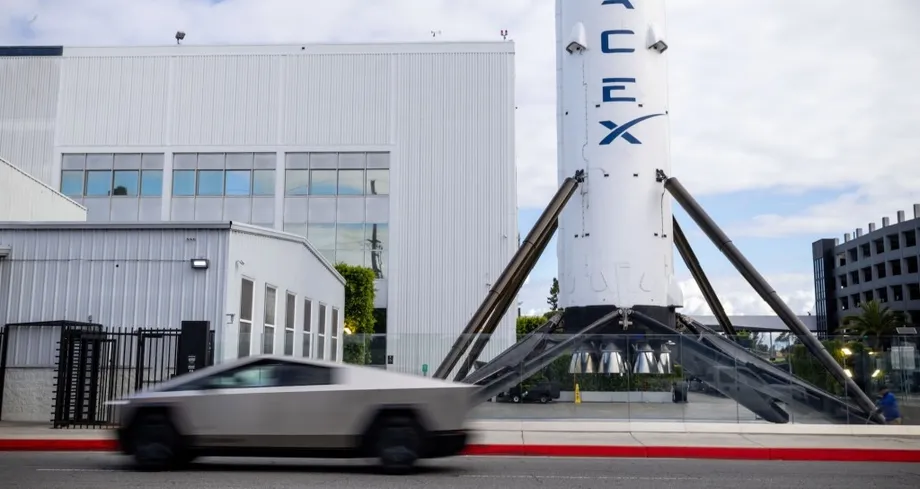
Two independent committees, no agreed deal
Elon Musk has backed combining SpaceX and Tesla into a business worth roughly $3.5 trillion, bringing rockets, satellite internet, electric vehicles, robots and artificial intelligence under one corporate roof. Independent board committees are examining the proposal, but they have not agreed on transaction terms.
Contents
- Two independent committees, no agreed deal
- Why Musk wants rockets, cars and AI together
- Terafab shows how closely the businesses already work
- AI growth comes with a large spending bill
- Tesla's shareholder vote is a demanding test
- Independent directors face overlapping relationships
- Texas law shapes shareholder protections
- China creates the sharpest strategic conflict
- The next steps run beyond Musk's endorsement
- Key Points
Musk confirmed the discussions during SpaceX's earnings call on October 20, 2026. The committees were established at shareholders' request. Musk, chief executive and the largest individual shareholder of both companies, said his interests on both sides prevent him from joining their negotiations.
At recent valuations of about $2 trillion for SpaceX and $1.5 trillion for Tesla, a combination would sit among the world's most valuable companies. Those figures describe the businesses' stock market values; the committees still have to negotiate what shareholders would receive.
Musk told investors that support from the committees and shareholders would determine whether the proposal advances:
The special committees have not reached agreement on terms of any transaction and there's no guarantee that they will.
The biggest tests extend beyond agreeing on a price. Tesla needs approval representing a majority of all outstanding shares. Regulators would examine a group joining a major American national security contractor with a carmaker that generated $21 billion in China last year.
For investors, the central choice is concrete: whether shared technology and easier investment decisions would outweigh the costs of combining several expensive businesses and concentrating more authority around Musk.
Why Musk wants rockets, cars and AI together
Musk's argument is that Tesla and SpaceX increasingly work on different parts of the same technological system. Chips provide computing power, data centers run AI software, satellites carry communications, and vehicles and robots put that software to work.
During the October 20 call, Musk described the opportunity in terms of increasingly capable AI:
I do think there's a lot of merit to combining the companies as we are pretty much in the superintelligence singularity, and there's a lot to be gained from cooperating.
Superintelligence means AI that surpasses human abilities across a broad range of tasks. The singularity describes a proposed point when advances become rapid and difficult to predict. Musk uses that vision to explain why he wants closer cooperation on software, chips, robotics, communications and space infrastructure.
Starlink could provide connectivity for Tesla vehicles and Optimus humanoid robots. Tesla's batteries and energy storage systems could support SpaceX's growing electricity needs, including data centers. Tesla's experience automating factories could also help SpaceX manufacture Starship vehicles.
SpaceX's proposed orbital AI data center project, Starmind, adds another possible connection. Computing infrastructure in orbit would bring launch capability, communications, chips and energy systems into the same undertaking.
Morningstar analysts Seth Goldstein and Nicolas Owens have described a practical management benefit: engineers and investment could move between projects more easily inside one company. Shareholders would then depend on a single board to decide which projects deserve resources.
Terafab shows how closely the businesses already work
Tesla and SpaceX announced Terafab in March, a planned semiconductor factory in Texas with an estimated cost of $119 billion. The project is intended to supply chips for autonomous vehicles, robots and AI infrastructure.
Musk has outlined a target of producing one million semiconductor wafers a month. A wafer is a thin disc on which many chips are manufactured before being separated. The proposed scale makes Terafab a major manufacturing commitment alongside the companies' existing operations.
The development schedule stretches beyond the merger talks:
- March 2026: Tesla and SpaceX announced the Terafab project.
- June 2026: SpaceX began public trading, increasing attention on a possible combination.
- July 22, 2026: Musk discussed growing overlap between the companies during an earnings call.
- October 20, 2026: Musk confirmed that independent committees were examining a merger.
- May or June 2027: Musk targets the first functioning test chips from Terafab.
- 2028: Production targets extend from the third quarter to late in the year.
The companies' cooperation already reaches finished products. A Roadster prototype demonstrated the week before the merger announcement used SpaceX cold gas thrusters. SpaceX has also bought Tesla batteries and Cybertruck vehicles.
For shareholders, the merger therefore concerns the ownership and financing of an existing relationship as much as the creation of a new one. A combined business could coordinate those projects internally, while putting their costs and technical risks into one investment.
AI growth comes with a large spending bill
SpaceX's latest results show why AI is central to the proposal. Revenue reached about $14.6 billion in the quarter ending September 30, up 161% from a year earlier. Its AI business generated about $7.6 billion, more than half the total.
The AI operation includes computing services, the Grok assistant, advertising and subscriptions from X, and the coding platform Cursor. SpaceX acquired xAI and X before its public listing. Cursor contributed $608 million in quarterly revenue after its $60 billion acquisition in August.
SpaceX invested $16.4 billion in AI infrastructure during the quarter, compared with $4.8 billion a year earlier. That is about 3.4 times as much spending. Building the computing capacity to serve customers is consuming money faster than the AI division generates revenue.
Other businesses also expanded. Connectivity revenue reached about $5.3 billion, rising 69%, as Starlink added more than 1.6 million subscribers during the quarter. Space operations, including Falcon and Starship services, generated about $1.8 billion, up 6%.
SpaceX reported quarterly net profit of $4.4 billion, compared with a $1 billion loss a year earlier. Across the first nine months, however, it lost $1.1 billion on revenue of $27 billion, up from $13.7 billion.
Visible Alpha estimates that a combined Tesla and SpaceX would employ more than 155,000 people and generate $153 billion in revenue this year. It could also record at least $54 billion in negative free cash flow because of spending on AI infrastructure, semiconductor factories and launch vehicles.
Free cash flow is the money left after operating expenses and investment in assets such as factories and equipment. A negative figure means those activities consume more cash than they produce. Profit and cash flow can move differently because accounting spreads some investment costs over several years.
Tesla's shareholder vote is a demanding test
Tesla's approval requirement gives investors a decisive role. Musk said a merger would need support representing a majority of all outstanding shares, rather than simply a majority of the votes submitted.
For a simple illustration, a company with 100 outstanding shares would need more than 50 supporting shares even if only 60 participated. A shareholder who does not vote supplies no support toward that threshold.
Musk holds about 20% at Tesla. At SpaceX, shares carrying extra votes give him control of more than four fifths of voting power, making the approval challenge very different at the two companies.
The committees also have to negotiate an exchange ratio, the number of shares investors in one company would receive in the other. That decision would distribute ownership of the combined business and determine how much of its future gains each group receives.
Barclays has suggested SpaceX could acquire Tesla entirely through shares. Under its modeled structure, Musk could own about 37% of the combined company while controlling roughly 56% of its votes. Those are analyst estimates of a possible arrangement.
Tesla's annual proxy filed on October 19 contained no merger proposal. The companies have announced neither a negotiated structure nor a date for a merger vote.
Independent directors face overlapping relationships
Musk has not named the members of either special committee. Tesla's October 19 proxy identifies seven independent directors, including chair Robyn Denholm, Ira Ehrenpreis and former chief technology officer JB Straubel. SpaceX's independent directors include Ehrenpreis, Randy Glein and Roelof Botha.
Ehrenpreis's presence on both boards illustrates how closely the companies' governance networks overlap. The committees' task is to negotiate for their respective shareholders while evaluating a proposal publicly supported by the chief executive of both businesses.
SpaceX director Antonio Gracias, who is not classified as independent, leads Valor Equity Partners. The firm owns 3.4% of SpaceX and financed purchases of AI hardware through arrangements in which equipment is bought and leased back to the company using it.
Tesla's transactions with other Musk businesses already involve substantial sums. An analysis of its regulatory filings put fiscal 2025 business with Musk controlled companies above $573 million, including $430.1 million in Megapack battery sales to xAI and $143.3 million in Cybertruck sales to SpaceX. Tesla's audit committee judged the transactions to be on commercial terms comparable to those between unrelated businesses.
The xAI investment decision provides another example of the relationship between shareholder input and board authority. In November 2025, about 1.06 billion Tesla shares supported a nonbinding investment proposal, 916.3 million opposed it and more than 473 million abstained. The proposal failed because abstentions counted against it. Tesla later disclosed a $2 billion investment in January 2026.
Texas law shapes shareholder protections
Tesla's acquisition of SolarCity a decade ago led to years of litigation over allegations that Musk had used Tesla's resources to rescue another business connected to him. A SpaceX merger would again put the treatment of shareholders on both sides under scrutiny.
Both companies have moved their legal domiciles from Delaware to Texas. Texas corporate law gives boards stronger protections and places substantial requirements on some shareholder lawsuits.
SpaceX's charter requires investors bringing derivative lawsuits to hold at least 3% of its shares and directs shareholder claims to mandatory arbitration. A derivative lawsuit is a case brought by shareholders on a company's behalf, usually alleging that directors or executives harmed the business. Arbitration sends disputes to a private decision maker rather than the usual court process.
At a $2 trillion valuation, a 3% holding would be worth about $60 billion. That calculation shows how large an investment would be needed to reach the stated ownership threshold.
SpaceX also gives Class B shares 10 votes each. Estimates place Musk's voting control at roughly 82% to 84%. The extra votes allow him to exercise much greater authority than his economic ownership alone would provide.
Combining the businesses would therefore change more than their product range. Tesla investors would be negotiating entry into a corporate structure whose voting rules could give Musk firmer control over their investment.
China creates the sharpest strategic conflict
China generated $21 billion in Tesla revenue last year, about 22% of its total. Tesla's Shanghai factory is also central to vehicle production and sales.
SpaceX, meanwhile, is a major contractor for the U.S. Defense Department, intelligence agencies and NASA. It conducted 18 U.S. national security flights in the latest quarter and is developing Starshield satellites for military surveillance and secure communications.
JPMorgan analysts have identified the national security conflict as a particularly serious obstacle. A merged group would have to manage sensitive American government work alongside a large manufacturing and commercial presence in China.
Possible responses include separating Tesla's Chinese business or transferring control to a local consortium. Under such a structure, the wider group might retain licensing income from Tesla's brand and autonomous driving technology. Either approach would change how it earns money in a market responsible for more than one fifth of Tesla's revenue.
Regulatory scrutiny would also extend to competition authorities in the United States, United Kingdom and European Union. American lawmakers could examine national security, Chinese investment and supply chain concerns. The companies would need to address those issues alongside the commercial terms demanded by shareholders.
The next steps run beyond Musk's endorsement
Barclays has suggested a merger announcement could come before Tesla's annual shareholder meeting in December. People close to Tesla's leadership believe a transaction could be completed before President Donald Trump's term ends. Both expectations leave considerable negotiation and regulatory work ahead.
SpaceX is also projecting rapid business growth while those talks proceed. Chief financial officer Bret Johnsen forecast revenue of $33 billion to $37 billion for the first quarter of 2027, compared with a $22 billion analyst estimate compiled by LSEG.
Musk has forecast annual recurring revenue of $500 billion to $1 trillion by the end of 2027. Annual recurring revenue estimates the yearly pace of repeat business; actual revenue will depend on services delivered and customer demand.
Investors would gain exposure to a broader collection of businesses through one holding. Tesla shareholders could participate in Starlink and launch services, while SpaceX shareholders would acquire exposure to vehicles, energy storage and robotics. They would also share the cost of setbacks across those operations.
Morningstar analyst David Sekera has warned about dependence on Musk personally. That concern becomes more concentrated when more businesses rely on one leader. The committees now have to turn his technological vision into terms that shareholders can assess: ownership, voting power, financing and a workable treatment of China.
Key Points
- Independent Tesla and SpaceX committees are examining a merger, with no transaction terms agreed.
- The companies have a combined market value of roughly $3.5 trillion.
- Musk supports the proposal but is excluded from committee negotiations because of his conflict of interest.
- Tesla approval requires support representing a majority of all outstanding shares.
- Shared projects include the planned $119 billion Terafab semiconductor factory.
- Heavy investment could leave the combined business with at least $54 billion in negative free cash flow this year.
- Tesla's Chinese operations and SpaceX's American national security work present a major regulatory challenge.