Seven AI racks, one container and a shorter route to revenue
Nvidia has introduced DSX POD, a modular AI factory design that puts seven Vera Rubin NVL72 computing racks inside a container for assembly and testing before shipment. The company says deployment at a prepared site could take as little as 14 days, compared with about six months for conventional installation and integration.
Contents
- Seven AI racks, one container and a shorter route to revenue
- What is packed inside a DSX POD?
- How factory assembly changes the schedule
- Taiwan partners move further into complete systems
- Power and cooling still shape every deployment
- Managing electricity as well as installing it
- Why weeks of delay carry a large price
- Shipping a working system becomes an engineering task
- Where containers fit alongside conventional data centers
- Key Points
The design, announced at GTC Berlin in an October 21 announcement dated 2026, brings six Taiwanese businesses into a global delivery network: Foxconn through Ingrasys, Delta, GIGABYTE, Pegatron, Quanta Cloud Technology (QCT) and Wistron. Worldwide deliveries are planned for early 2027.
The 14 days cover deployment after the destination has the necessary electricity, cooling, networking and supporting infrastructure ready. Land preparation, foundations, power connections and other facility construction remain part of the wider project schedule.
Nvidia's commercial argument is straightforward: expensive processors start doing useful work sooner when fewer cables, pipes and systems need to be assembled at the destination. An AI factory is a data center designed to train AI models or run them for customers. Its output includes tokens, the small pieces of text or other information that models process and generate.
Jensen Huang, Nvidia's founder and chief executive, described the point at which that infrastructure begins creating value:
An AI factory creates value when it starts producing tokens
For operators, the target is therefore more specific than finishing construction. Nvidia calls it time to first production token: the moment the new facility starts running models for actual customer workloads. Earlier operation gives a company an earlier opportunity to sell computing services, provided customers are ready to use the capacity.
What is packed inside a DSX POD?
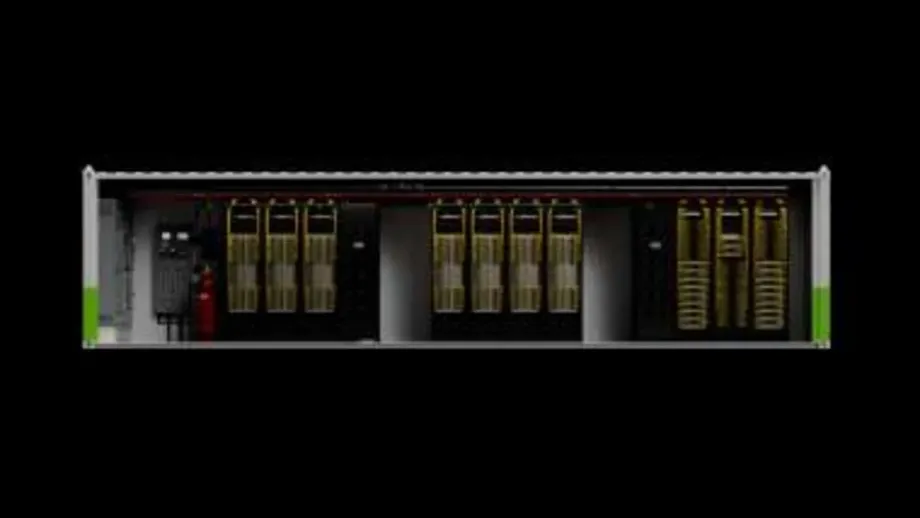
A compute container holds 504 Rubin graphics processing units, or GPUs, across its seven NVL72 racks. GPUs handle many calculations at once, making them useful for the enormous mathematical workloads involved in AI. Connecting hundreds together lets them share work that would overwhelm a single processor.
The container weighs roughly 28,000 kilograms, or 28 metric tons, and is comparable in size to a standard shipping container. Its integrated systems contain about 10 million components and 3,500 cables. The connections include roughly 20 kilometers of NVLink copper, which links processors, and 17 kilometers of networking for communication across the wider computing system.
Nvidia's design reaches beyond the computing racks. It includes storage, service and management functions, power distribution, cooling, controls and the connections between containers. Storage must move training data, model information and saved progress quickly enough to keep the processors supplied with work.
The result is a reference design rather than a single finished product manufactured entirely by Nvidia. A reference design gives partners a common engineering foundation, including layouts, interfaces and testing requirements, from which they build and support customer installations.
How factory assembly changes the schedule
Traditional installation requires teams at the destination to position racks, pull cables, connect cooling pipes and test interconnected equipment. Those tasks depend on different specialists arriving in the right order, with the right components, while the building and utilities become ready.
DSX POD moves much of that repeatable work into a manufacturing facility. Partners complete connections between racks, electrical wiring, cooling plumbing and functional checks before shipment. Meanwhile, teams at the destination can prepare foundations, electricity, external cooling and network access.
Factory work and site preparation can therefore proceed at the same time. After delivery, crews position the containers, connect them to neighboring units and external services, check their condition after transport and complete commissioning. Commissioning means verifying that the connected installation operates as intended under working conditions.
Ian Buck, Nvidia's vice president of hyperscale computing, described arrival as a sequence of placement, connections and final testing. Burn-in testing, part of that final process, runs equipment to identify faults before normal service begins. Nvidia expects moving integration into the factory to reduce exposure to component delays and expensive mistakes during installation.
The rollout has three main stages:
- October 21, 2026: Nvidia announces DSX POD at GTC Berlin.
- Before deployment: partners assemble and validate containers while destination teams prepare the supporting infrastructure.
- Early 2027: worldwide deliveries are planned, with deployment at prepared sites targeted at as little as 14 days.
Taiwan partners move further into complete systems
Foxconn's Ingrasys participated in early design and manufacturing work for DSX POD. Its inclusion places the group alongside Taiwanese companies with businesses spanning computing systems, electrical infrastructure and manufacturing integration. QCT is part of Quanta, while Delta, GIGABYTE, Pegatron and Wistron complete the Taiwanese group named by Nvidia.
The full ecosystem contains 17 partners. Alongside those six are Anduril, Armada, Bull, Crusoe, DayOne, Dell Technologies, Eaton, HPE, Lenovo, Schneider Electric and Vertiv. The roster combines computing manufacturers with companies involved in power, cooling, modular infrastructure and deployment.
Nvidia provides the validated design foundation. Equipment manufacturers integrate computing systems; infrastructure specialists adapt electrical and cooling arrangements; modular providers build enclosures and integrate subsystems; and site partners handle location preparation, installation and commissioning support.
Foxconn's involvement also follows its Taiwan supercomputing center plan, announced in 2025 with Nvidia. That project carried a planned investment of $1.4 billion, a power rating of 27 megawatts and a target of beginning operations in the first half of 2026. Developed through Visonbay.ai around Blackwell GB300 systems, it illustrated Foxconn's expansion into both manufacturing AI infrastructure and selling access to computing capacity.
DSX POD extends the manufacturing side of that relationship into larger integrated units. More assembly, testing and transport engineering takes place before delivery, making the factory responsible for a greater share of the working installation.
Power and cooling still shape every deployment
Nvidia's DSX POD technical explanation, published on October 21 by senior director of product management Premal Savla, specifies a standard input design using 800 volts of direct current. It covers electrical protection, distribution, grounding, rack connections, controls and telemetry, the measurements used to monitor equipment.
Partners must engineer the upstream power supply and conversion equipment to suit each location. Electrical rules, available equipment and grid arrangements vary by region. The common interface at the container boundary allows a repeatable core design while leaving the external supply tailored to local conditions.
Liquid cooling carries heat away from the dense computing racks. Factory teams can assemble, flush and pressure test the internal pipes, check for leaks and validate sensors before shipment. Destination teams then connect the container to prepared water and heat removal infrastructure and verify the complete cooling circuit.
Nvidia has also described cooling across the broader DSX architecture that accepts water entering at 45 degrees Celsius and uses a closed loop with dry coolers. A closed loop circulates coolant repeatedly; a dry cooler transfers heat to outside air rather than relying on evaporation.
The company estimates that suitable installations using this approach could save up to 54 million liters of water a day at a scale of 2 gigawatts. The figure is a projection for a very large deployment. Actual water use depends on the cooling arrangement, local climate and the facility being compared.
Managing electricity as well as installing it
Nvidia's broader DSX platform includes MaxLPS, which dynamically directs power toward the computing work that needs it. The company says the technology can deliver the same output using up to 30% less power. Software also helps operators schedule workloads within the electricity available to a facility.
DSX Flex addresses another constraint: demand elsewhere on the grid. It uses application programming interfaces, or APIs, to let data center systems coordinate automatically with electricity operators. Some computing work can be delayed or reduced during peak demand, freeing capacity for other users.
Buck described a shift from arrangements that can depend on telephone calls toward automated coordination. For an operator, that means designing around both the maximum electricity supply and the timing of workloads. A training job that can pause has different scheduling needs from a customer service that must respond immediately.
Huang presented AI infrastructure in Berlin as five connected layers: power, advanced computing, AI factories, models and applications. DSX POD concentrates on bringing the physical layers into service faster, while the power management tools address how efficiently that installed capacity can operate.
Why weeks of delay carry a large price
Huang used a large financial example at GTC Berlin: an AI factory drawing 1 gigawatt could cost about $50 billion and generate roughly $40 billion in annual revenue. At that assumed revenue rate, a delay of three months would correspond to about $10 billion in missed revenue.
Huang, discussing that estimate, said:
$10 billion worth of revenue will make anybody anxious
The calculation explains Nvidia's focus on getting installed hardware into service. Its revenue assumptions describe a hypothetical facility operating at the stated scale. Each operator's returns will depend on demand, utilization, prices and operating costs.
Huang also said that the period from equipment arrival through installation to token production had already fallen from four or five months to around one month. The DSX POD announcement sets a more specific target of as little as 14 days at a prepared destination, against its stated six month comparison for conventional deployment.
Nvidia also presented Vera Rubin as a platform for AI agents, software that can undertake tasks using models and tools. Huang said AI performance had improved a millionfold over the previous decade, and presented related Vera Rubin processing performance as 30 times that of Blackwell over two years. Those are Nvidia's performance claims; the deployment proposal tackles the separate practical task of getting that computing capacity connected and operating.
Shipping a working system becomes an engineering task
A container carrying installed racks needs more than space on a truck. Nvidia's technical design addresses structural loading, equipment restraints, weight distribution, the center of gravity, lifting points and access for handling. The systems must remain within their mechanical, electrical and cooling requirements through transport and installation.
Partners document the configuration and test status before shipment, secure the equipment and repeat defined checks after arrival. Factory validation can include firmware versions, power checks, network connectivity, sensors, cooling integrity and tests of the integrated system. Firmware is the basic software that controls hardware.
Standard labels, cable paths and service clearances also matter after the opening day. Technicians need to identify connections, reach equipment and replace parts without dismantling unrelated systems. Repeatable layouts give operators a consistent unit for planning expansion and maintenance.
Where containers fit alongside conventional data centers
Modular data centers already have a history in Europe and Taiwan. Germany's JUPITER supercomputer, inaugurated in 2025, used about 50 prefabricated container modules. Delta has developed a containerized AI data center measuring 20 feet, and GIGABYTE displayed its GADU modular data center solution at Computex 2026.
Nvidia positions DSX POD for projects that need to add hundreds of megawatts of capacity quickly. Conventional buildings remain an option for campuses at gigawatt scale, where large permanent facilities can benefit from economies of scale. Containers can also bring AI applications into operation while permanent facilities are being prepared.
Electricity Express general manager Liu Yao-yuan has cautioned that rapid container installation still requires a complete power supply and backup infrastructure before a facility can operate. His point places the remaining construction work at the center of project planning: operators must coordinate the factory delivery date with readiness at the destination.
Nvidia has not disclosed DSX POD pricing, detailed supply assignments for individual partners or customer purchase volumes. The 14 day target awaits validation through actual deployments, and no exact date within early 2027 has been given for the first deliveries. Customers planning projects must therefore align the announced delivery window with their own utility, construction and commissioning schedules.
Key Points
- Nvidia announced DSX POD at GTC Berlin on October 21, 2026, with worldwide deliveries planned for early 2027.
- A compute container combines seven Vera Rubin NVL72 racks and 504 Rubin GPUs, with integration and testing completed before shipment.
- Nvidia targets deployment in as little as 14 days after power, cooling, networking and supporting site infrastructure are ready.
- Taiwanese partners include Foxconn through Ingrasys, Delta, GIGABYTE, Pegatron, QCT and Wistron.
- The design uses an 800 volt direct current input and factory integration of computing, storage, networking, power and liquid cooling.
- Pricing and customer order volumes remain undisclosed, while conventional data center construction continues alongside the modular approach.