A second Tainan opening is planned for 2028
Taiwan Semiconductor Manufacturing Co. plans to add another factory using its 3 nanometer process in Tainan, with commercial production scheduled for the first half of 2028. The decision adds capacity beyond an existing Tainan project expected to begin mass production in the first half of 2027, extending the city's role in supplying chips for smartphones, demanding computing tasks and artificial intelligence.
Contents
- A second Tainan opening is planned for 2028
- Why TSMC is adding more 3nm capacity
- New factories and converted equipment
- Tainan's government prepares land and utilities
- Anding's 14.6 hectare site takes shape
- The milestones from land planning to production
- A larger industrial base brings local demands
- Japan and Arizona join the expansion
- Newer chip technology advances alongside 3nm
- Key Points
Chairman and Chief Executive C. C. Wei announced the expansion at an investor conference on October 15. He said customers would need substantial amounts of 3nm production for years, prompting TSMC to depart from its usual practice of stopping further expansion once a manufacturing process reaches its target capacity.
Tainan's government said it would help secure water, electricity and public facilities while speeding up administrative procedures for construction. Those commitments connect the company's production timetable with practical decisions about land, utilities and the services needed around a large industrial site.
TSMC has already completed 20 wafer fabrication, packaging and testing facilities at the Southern Taiwan Science Park, according to the city government. Its cumulative investment there exceeds NT$1.86 trillion, and it has created more than 11,300 jobs. The existing operations include facilities for 3nm and 5nm manufacturing and chip packaging.
The newly announced factory is part of a wider expansion spanning Taiwan, the United States and Japan. Within Tainan, it also comes as industrial development extends toward Anding District, where the city has prepared land for another advanced semiconductor project. Together, the investments put factory capacity, land development and public infrastructure on closely connected schedules.
Why TSMC is adding more 3nm capacity
Wei said strong customer demand justified another Tainan factory beyond the previously planned 3nm additions in Taiwan, the United States and Japan. The expansion has been described as three planned factories plus one additional facility, reflecting the extra commitment to Tainan.
A fabrication plant, commonly called a fab, makes chips on thin discs of semiconductor material known as wafers. The term 3nm names a generation of manufacturing technology. It helps customers distinguish between production processes, rather than giving a simple measurement of every feature inside a chip.
TSMC is expanding this generation even while developing newer processes. Customers plan products years ahead, and moving a chip design into manufacturing requires extensive preparation. A newer technology therefore creates another production option while established advanced processes continue serving products designed for them.
Wei said TSMC's capacity planning draws on its understanding of customer product road maps and manufacturing plans over several years. He expressed strong confidence in demand associated with AI, alongside smartphones and high performance computing. The decision to add a factory scheduled for 2028 reflects that longer planning horizon.
New factories and converted equipment
TSMC is using more than new construction to increase supply. Wei said the company is converting some equipment used for 5nm manufacturing in Taiwan to support 3nm capacity. It is also adjusting production resources across its 7nm, 5nm and 3nm processes.
Equipment conversion gives the company another way to respond as demand shifts between generations of chips. Building a factory adds physical manufacturing space; adapting existing equipment changes how part of the installed production base is used. Both approaches feature in the company's expansion plans.
Wei described nearly 20 factory projects underway worldwide. Over the coming years, the Taiwan program includes 13 facilities for advanced manufacturing and advanced packaging, while another five to six wafer factories are being developed overseas. Packaging connects and protects manufactured chips, making it another part of turning semiconductor production into finished components.
Tainan's government prepares land and utilities
Tainan Economic Development Bureau Director Chang Ting-yuan said Mayor Huang Wei-che had led coordination between city departments to prepare resources for semiconductor investment. The work addresses the central government's concerns about shortages of industrial resources, including land, water, electricity and workers.
Chang pointed to development block A in the special district surrounding the Southern Taiwan Science Park. The city's urban development work covered seven blocks, designated A, B, C, D, E, N and O. Industrial land was planned, reviewed by the Ministry of the Interior and then assigned to the city's land administration department for development.
That preparation gave the city confidence it could hand over industrial land within three months after TSMC's construction team visited the mayor in late 2025, Chang said. In June 2026, the city and TSMC signed an agreement establishing rights to use municipal land for construction.
The city described that agreement as allowing a 2nm factory to begin construction in Anding District. It also said this was TSMC's first factory project on land belonging to a local government. A land use right of this kind allows construction and use of a site under an agreement while the municipality retains ownership.
Anding's 14.6 hectare site takes shape
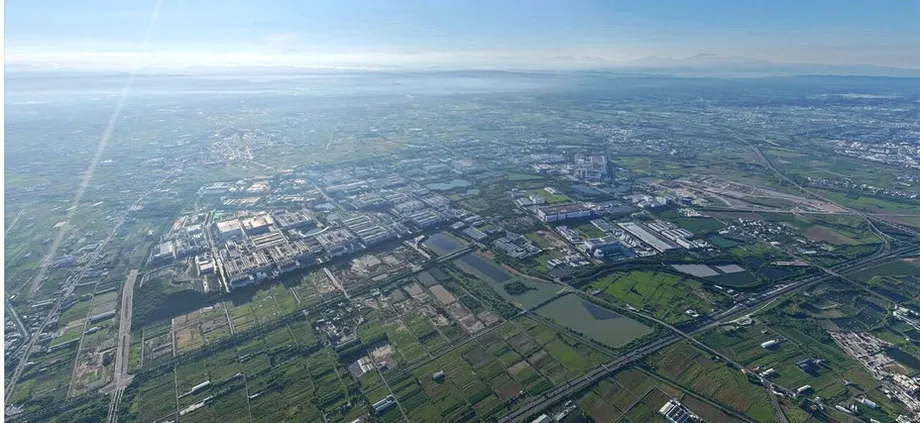
A related planning project in development block A covers approximately 14.6 hectares in Anding, equivalent to about 146,000 square meters. The site lies near County Road 178 to the north and Zhijianong Boulevard to the west, with Tree Valley Park to the south and the existing Tainan science park to the east.
The location places the proposed manufacturing facilities beside an established industrial area. The planning changes rearrange roads, industrial service land, green space and parks that also function as detention basins, which temporarily hold stormwater to reduce pressure on drainage systems.
Tainan's main urban plan for the adjustment took effect on September 9, 2026, followed by the detailed plan at midnight on September 10. The changes followed public display in May, a public information meeting on May 19, urban planning review and central approval.
The city identifies the municipal land project as a 2nm factory, while the public environmental assessment information describes advanced manufacturing without specifying a process generation or mass production date. The newly announced 3nm factory has a first half 2028 production target; its precise site, budget, wafer capacity and expected employment were not given.
The milestones from land planning to production
Tainan's expansion involves several schedules, from preparing land to installing equipment and starting commercial output. The key dates show how municipal decisions and TSMC's manufacturing plans fit together:
- Late 2025: TSMC's construction team visits Tainan's mayor. The city says its land preparation allows a handover within three months.
- May 2026: The Anding planning changes enter public display, with an information meeting held on May 19.
- June 2026: Tainan and TSMC sign the agreement for use of municipal land in Anding.
- September 9 and 10, 2026: The main and detailed urban plans take effect in succession.
- October 15, 2026: Wei announces the additional Tainan 3nm factory at an investor conference.
- First half of 2027: An already planned Tainan 3nm factory is expected to begin mass production.
- First half of 2028: The additional Tainan 3nm factory is scheduled to begin commercial production.
Planning approval sets the permitted arrangement of industrial land and public facilities. Environmental, building and other development procedures remain part of bringing a factory into operation. Tainan's promise to accelerate administration focuses on moving those steps forward alongside utility preparation.
A larger industrial base brings local demands
The Tainan section of the Southern Taiwan Science Park recorded revenue of NT$2.34 trillion from January through August 2026, according to the city government. That was 33.53% higher than in the same period a year earlier.
Using those figures, revenue in January through August 2025 was approximately NT$1.75 trillion. The increase was therefore about NT$588 billion in eight months. The figures cover the Tainan park's businesses, giving a measure of activity across the industrial area rather than TSMC alone.
Tainan said it would continue identifying industrial land and factory buildings available for investment, while strengthening workforce training, public facilities and the living environment. Those commitments extend beyond preparing an individual construction site.
Anding's position beside the science park and Tree Valley Park puts roads, commuting and local services alongside industrial land use in the planning process. The existing total of more than 11,300 TSMC jobs gives a measure of the company's established presence, while future hiring will depend on the staffing needs and construction schedules of the new facilities.
Japan and Arizona join the expansion
TSMC's second factory operated by Japan Advanced Semiconductor Manufacturing in Kumamoto is planned to use 3nm technology and begin production in 2028. The project follows the company's Kumamoto technology upgrade, announced earlier in 2026, which changed the facility's intended processes from a range of 6nm to 12nm to the more advanced generation.
Arizona's second factory is also scheduled to begin mass production in the third quarter of 2027. One description of Wei's remarks identifies its process as 2nm, while another identifies it as 3nm and says equipment delivery and installation are ahead of schedule. The timing is consistent across the accounts, but the stated manufacturing generation differs.
Wei said major American customers had asked TSMC to expand production in the United States and that the US government had provided assistance. The overseas program and the additional Tainan investment show the company adding capacity in several locations at once.
Texas remains at an earlier stage. Wei said TSMC was evaluating possible cooperation with Elon Musk's Terafab project, with discussions still preliminary. He said any factory involved would need to be operated by TSMC so the company could control production.
Newer chip technology advances alongside 3nm
TSMC expects its 2nm production capacity to more than double in 2027 compared with the previous year. Wei linked the increase to demand from smartphones, high performance computing and AI applications, the same broad markets supporting expansion elsewhere in the company's manufacturing network.
The company is also developing A14, with trial production scheduled for 2027 and mass production for 2028. Trial production is the stage when a manufacturing process is tested and prepared before larger commercial output.
Compared with 2nm, TSMC expects A14 to deliver a 10% to 15% speed improvement at the same power consumption, or a 25% to 30% reduction in power consumption at the same speed. It also expects nearly 20% greater logic density, meaning more computing circuitry can fit into a given area.
The speed and power figures describe alternative comparisons. A customer might use a newer process to seek faster operation at a similar power level, or lower electricity consumption at similar performance. The final result also depends on the product's design.
The production schedules place A14's commercial introduction in the same year as the additional Tainan 3nm factory's opening. TSMC is preparing newer manufacturing technology while expanding an earlier generation that customers still expect to need. For Tainan, delivering that extra capacity means coordinating the company's factory plans with the city's land, utility and workforce preparations.
Key Points
- TSMC plans an additional Tainan 3nm factory, with commercial production scheduled for the first half of 2028.
- Another Tainan 3nm factory is expected to begin mass production in the first half of 2027.
- Tainan has promised support for water, electricity, public facilities and construction administration.
- TSMC's existing investment at the Southern Taiwan Science Park exceeds NT$1.86 trillion and has created more than 11,300 jobs.
- A 14.6 hectare advanced manufacturing site in Anding received effective urban planning changes in September 2026.
- The Tainan science park recorded NT$2.34 trillion in revenue during January through August 2026, up 33.53% from a year earlier.
- TSMC is expanding overseas, converting equipment in Taiwan and preparing A14 for mass production in 2028.