A final routine ends America's seven-title streak
China won the women's team final at the 2026 Artistic Gymnastics World Championships by just 0.233 points on October 21 in Rotterdam, ending seven consecutive American world titles and securing a team place at the Los Angeles 2028 Olympics. Japan took bronze and an Olympic berth of its own, returning to the world team podium for the first time in 60 years.
Contents
- A final routine ends America's seven-title streak
- The Americans built their lead early
- China turned the contest on balance beam
- Why the scoring challenges mattered
- Qiu held the lead through the final floor routine
- Japan ended a wait stretching back to 1966
- France led the teams outside the medals
- A new American lineup faced a narrow defeat
- Olympic places secured, more finals to come
- Key Points
The championship's official team results record China at 165.764, the United States at 165.531 and Japan at 164.063. China's winning total was also confirmed by Olympics.com, although a published results listing carried 165.674.
Qiu Qiyuan settled the contest with the final floor routine. With the Americans finished, she needed more than 12.600 to put China ahead. Her 12.833 delivered the country's first women's world team championship since 2006 and its first team gold at a world championship or Olympics since Beijing 2008.
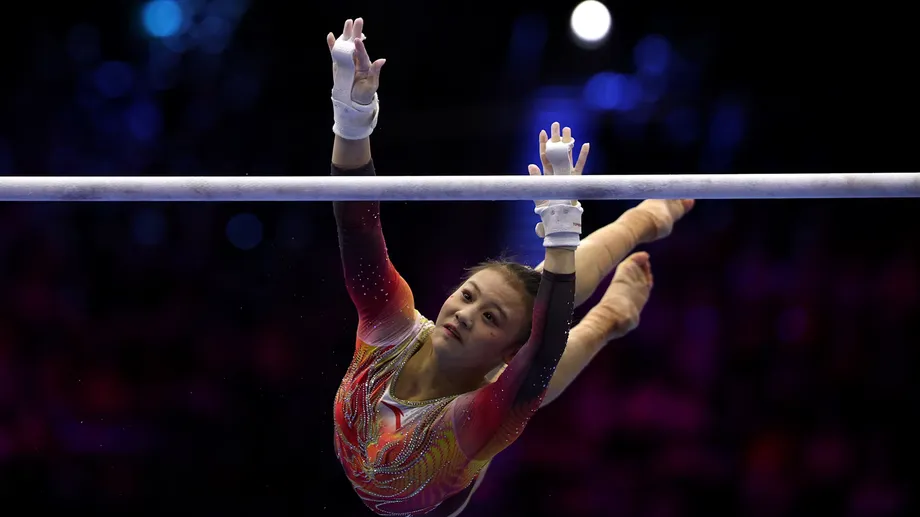
China's victory was built on balance beam, where Zhang Qingying scored 15.066, the highest mark on any apparatus in the final. China gained 4.167 points over the Americans on beam, enough to survive a strong US recovery on floor.
Rotterdam provided a striking historical connection. The Americans' previous defeat at a world team championship came there in 2010, when Russia won gold. Sixteen years later, the same city witnessed the end of the winning run that began in 2011.
The Americans built their lead early
The United States and China entered the final as the top two qualifiers and competed together, beginning on vault before moving to uneven bars, balance beam and floor. Their shared order made the contest easy to follow: each rotation offered a direct comparison on the same apparatus.
Skye Blakely led the American vault effort with 14.300. Claire Pease added 14.200 and Charleigh Bullock scored 14.133, producing a total of 42.633. China scored 40.966, giving the United States an immediate advantage of 1.667 points.
China's vault total had fallen from 42.032 in qualifying, a loss of 1.066 points. Du Siyu supplied its highest individual vault score in the final, 14.100, while Zhang contributed 13.233 and Ke Qinqin 13.633.
The Americans extended their advantage on uneven bars. Bullock scored 14.000, Pease 14.366 and Blakely 14.400, bringing the team's apparatus total to 42.766. All six American routines across the opening two events had scored at least 14.000.
China remained close on bars with 42.466, helped by Du's 14.300, Qiu's 14.233 and Zhang's 13.933. At halfway, the United States led 85.399 to 83.432, a gap of 1.967. The American bars total was 0.801 higher than in qualifying.
China turned the contest on balance beam
Ke opened China's beam rotation with 14.400, improving by half a point on her qualifying score. Zhang, the reigning world beam champion, followed with 15.066, a performance that gave China its biggest individual contribution of the evening.
Qiu completed the rotation with 13.900 despite landing short on her double pike dismount, a skill involving two backward somersaults with her legs straight and her body folded at the hips. China's three scores added up to 43.366.
Dulcy Caylor's opening American routine ended with a fall backward on her dismount. Her 12.333 had to count. In this team final, three gymnasts performed on each apparatus and every score entered the total, leaving no spare result to replace a costly mistake.
Pease followed with a score initially shown as 13.500, while Blakely received 13.266. Even after a successful American scoring challenge added a tenth to Pease's mark, the US beam total was 39.199, more than four points behind China's.
China emerged from beam leading 126.798 to 124.598. In a single rotation, it had changed a deficit of 1.967 points into an advantage of 2.200. Its beam gain of 4.167 eventually outweighed the Americans' combined advantage of 3.934 across vault, bars and floor.
Why the scoring challenges mattered
Pease's beam score rose to 13.600 after an inquiry was accepted. The American challenge to Blakely's score was rejected, leaving her result at 13.266. Those decisions mattered in a final separated by less than a quarter of a point.
Gymnastics scores combine the difficulty of a routine with how well the gymnast performs it. The difficulty score rewards credited skills and connections between them. The execution score begins at 10, with points removed for errors such as bent legs, balance checks and poor landings. Other penalties can reduce the final mark.
Blakely's difficulty score on beam was 5.3, compared with 6.2 in qualifying. That difference meant her routine started from a lower scoring base even though she avoided a fall. A routine can lose difficulty value when judges do not credit a skill or connection as intended.
The accepted inquiry gave Pease another 0.100 and narrowed the American deficit before floor. China's advantage still left the United States needing a substantial gain on the last apparatus, where the Americans had outscored China by 2.166 in qualifying.
Qiu held the lead through the final floor routine
Caylor began the American floor effort with 13.600, recovering from her beam fall. Zhang answered with 13.033 for China. The Americans had made up 0.567, but China still had room to defend its lead.
Pease then produced 13.933, the highest floor score of the team final and a gain of 0.600 from qualifying. Ke earned 13.100, leaving China ahead by exactly 0.800 with one gymnast from each country still to perform.
Reese Esponda had led floor qualifying with 13.633, which was 0.833 higher than Qiu's qualifying score of 12.800. Repeating those marks would have been enough to overturn the remaining gap.
Esponda scored 13.400 in the final, finishing the American total at 165.531. Qiu then scored 12.833, slightly above her qualifying mark, to secure China's victory. The final floor totals were 40.933 for the United States and 38.966 for China.
The Americans recovered 1.967 points on floor, leaving the decisive 0.233 between the teams. China's floor routines also improved from qualifying: Zhang rose from 12.566 to 13.033, Ke from 12.400 to 13.100 and Qiu from 12.800 to 12.833. Together, those gains added 1.200 points at the moment China needed them most.
Japan ended a wait stretching back to 1966
Japan's 164.063 brought its first women's world team medal since bronze in 1966. Its previous world team podium finishes had come in 1962 and 1966, making Rotterdam the end of a 60-year wait.
Haruka Nakamura's 14.133 helped Japan reach 41.066 on beam. Aiko Sugihara, the defending world floor champion, contributed 13.900 on floor and 14.200 on vault. Japan's vault total of 42.132 was particularly valuable, placing it only 0.501 behind the Americans on that apparatus.
Japan entered its final rotation on uneven bars with 123.631, less than a point behind the United States. A fall by Misa Nishiyama, who scored 12.533, limited its closing total, but Japan retained bronze comfortably.
The Japanese finished 1.468 behind the Americans and 2.933 ahead of France. Their medal carried an immediate practical reward: a place for a team of five women at Los Angeles 2028, secured two years before the Games.
France led the teams outside the medals
France finished fourth with 161.130 after starting strongly on beam. Elena Colas scored 14.200, Maiana Prat 13.900 and Morgane Osyssek-Reimer 13.266, giving France 41.366 on the apparatus. That was the second highest beam total of the final, behind China.
Brazil placed fifth with 159.730. Rebeca Andrade contributed 14.400 on vault, while Flavia Saraiva scored 14.066 on beam. Russia, listed as RUS in the official results and WG2 in other competition listings, finished sixth with 159.394.
Russia competed without several experienced gymnasts, including Olympic champion and former world all-around champion Angelina Melnikova, after they were denied visas by the Netherlands. The team scored 41.332 on bars but fell back with 38.498 on beam.
Italy finished seventh at 158.129 despite scoring 42.166 on uneven bars, led by Giulia Perotti's 14.400 and Elisa Iorio's 14.300. Three beam falls left Italy with 37.732 on that apparatus. Canada placed eighth at 158.096, just 0.033 behind Italy.
A new American lineup faced a narrow defeat
The American silver medal team consisted of Blakely, Bullock, Caylor, Esponda and Pease. None had competed at an Olympics, and Blakely was the only member with previous experience of a world team event. She had been part of the squad that won the 2023 title.
Hezly Rivera, a Paris 2024 team gold medalist and the US national all-around champion in 2025 and 2026, withdrew before qualifying because of left ankle pain. Caylor stepped into the competing lineup and contributed on both beam and floor.
Pease competed on all four apparatus and accumulated 56.099, the highest combined total among gymnasts who performed four routines in the team final. Zhang's four routines added up to 55.265. The women's individual all-around title was scheduled to be decided separately on Friday, October 23.
The American roster could change before Los Angeles. Suni Lee and Jordan Chiles had announced plans to return to competition, while Jade Carey had already returned to elite gymnastics and was an alternate for this world team. Simone Biles had not announced whether she would pursue a fourth Olympics.
Olympic places secured, more finals to come
China, the United States and Japan each earned a team quota for five women at LA28. As explained in the Olympics.com event recap, the remaining nine women's team places will be decided at the 2027 World Championships in Chengdu, China.
China's win also became its first women's world team medal since bronze in 2018. The 0.233 margin was the second smallest since gymnastics replaced the perfect 10 scoring system in 2006. Russia's 2010 victory over the United States, also in Rotterdam, came by 0.201.
The championships ran from October 17 to 25, with individual medals still to be decided after the team contest. The key dates were:
- October 21: China won the women's team final, with the United States second and Japan third.
- October 22: The men's all-around final was scheduled.
- October 23: The women's all-around final was scheduled, with Blakely and Pease among the qualifiers.
- October 24 and 25: Apparatus finals were scheduled, including women's beam and floor on Sunday.
- 2027: Chengdu will host the world championships that decide the remaining nine women's Olympic team places.
Zhang headed toward the beam final after leading qualifying with 15.100 and delivering another score above 15 in the team competition. For China, that strength had already produced the championship's biggest team prize.
Key Points
- China won with 165.764, beating the United States by 0.233 points.
- The victory ended seven consecutive American world team titles dating to 2011.
- China gained 4.167 points over the United States on beam, led by Zhang Qingying's 15.066.
- Qiu Qiyuan's closing floor score of 12.833 secured China's first women's world team gold since 2006.
- Japan scored 164.063 for its first women's world team medal since 1966.
- All three medalists secured places for teams of five women at the Los Angeles 2028 Olympics.
- The remaining nine women's Olympic team berths will be decided at the 2027 World Championships in Chengdu.