A major football investment awaits approval
Bhutan could receive up to USD 25 million for football development during the 2027 to 2030 cycle, following FIFA President Gianni Infantino's visit on October 19 and 20, 2026. The proposed funding would support infrastructure, youth development and women's football, alongside plans for an academy accommodating 500 children.
Contents
- A major football investment awaits approval
- What happens before the money becomes available?
- How large is the proposed increase?
- What earlier investment has built
- Why Bhutan wants a new development model
- A school and football academy for 500 children
- Young players need coaches and matches
- Women's football has a foundation to expand
- National leaders join the discussion
- Key Points
The announcement carries an important condition: the allocation still requires approval. FIFA's proposed Surplus Solidarity Programme covers all 211 member associations, with rules on eligibility, applications, payments and auditing due for consideration by the FIFA Council in December 2026. The wider programme then goes to the FIFA Congress in March 2027.
Infantino presented the investment as a way to give more children access to football. Bhutan Football Federation President Ugen Tsechup wants that support to help the country move beyond its existing facilities and programmes, improving both grassroots participation and national team performance.
The proposed academy would accommodate 250 boys and 250 girls, combine schooling with football training and include four pitches. Another idea, a regional competition tentatively called the FIFA Himalaya Cup, would create more opportunities to play competitive matches.
Bhutan already has a substantial record of FIFA investment. In its August 2024 development update, FIFA said its Forward programme had contributed USD 11.4 million to the country. Eight artificial pitches had been installed since January 2018, including facilities in Thimphu, Dagana, Punakha and Samtse.
The next decisions therefore concern more than a larger budget. They will shape how Bhutan connects pitches, schools, coaches and competitions so that children can progress from their first training session to representing their country.
What happens before the money becomes available?
The USD 25 million figure was presented during the visit as a major increase in support. The funding proposal, however, places Bhutan within a wider programme that must pass through FIFA's governing bodies before the federation can receive an approved allocation.
The FIFA Council is the organisation's strategic decision making body. The FIFA Congress brings together its member associations. For Bhutan, the practical sequence is that programme rules and approval come before applications and payments under those rules.
The main dates and milestones are:
- July 2023: Bhutan introduced FIFA Football for Schools, which teaches football and life skills.
- August 7, 2024: FIFA reported USD 11.4 million in Forward support to Bhutan and eight artificial pitches installed since January 2018.
- October 19 and 20, 2026: Infantino visited Bhutan, discussed development proposals and attended activities involving young players.
- December 2026: The FIFA Council is due to consider conditions for the proposed funding programme.
- March 2027: The wider programme is due to go before the FIFA Congress for approval.
Bhutan's final allocation and the conditions for accessing it will depend on those decisions and the application process. The academy's location, cost, construction timetable and operating arrangements have also yet to be publicly confirmed.
How large is the proposed increase?
FIFA Forward funding per association rose from USD 3.8 million in the 2016 to 2018 cycle to USD 8 million for 2023 to 2026. The proposed USD 25 million allocation for 2027 to 2030 would be USD 17 million more than the current cycle, or just over three times as much.
Infantino used an earlier USD 1 million allocation every four years as his reference point when describing the change since he became FIFA president in 2016. Speaking about the children he had seen during the Bhutan visit, he said:
When I started as FIFA president, it was one million every four years. Now it's USD 25 M every four years. This is a big change, and this will impact all these children that we have seen out there in a real way because it gives them opportunities.
Bhutan's dependence on international development funding makes the approval process especially consequential. In FIFA's 2024 update, Ugen Tsechup said the federation lacked the sponsorship, media support and large stadium ticket revenues available in many other countries. He described FIFA Forward and the Asian Football Confederation as essential sources of financial support.
What earlier investment has built
FIFA's 2024 account documents how funding changed the places where Bhutanese players train. Its eight artificial pitches included facilities serving girls' and boys' academies in Thimphu, upgraded venues in Dagana and Punakha, and pitches in more distant locations such as Samtse.
Artificial turf provides a manufactured playing surface rather than natural grass. For players, access to a proper pitch means training can take place on a prepared football surface instead of rough ground. The spread of facilities beyond the capital also gives regional programmes places to operate.
Existing FIFA support has helped fund floodlights, the federation's headquarters and training centre, the National Women's League and regional youth training programmes. Bhutan's Football for Schools programme, introduced in July 2023, adds a route into the sport through education.
Infantino also noted in 2024 that Bhutan's men's national team had taken part in the FIFA Series that year. The combination of facilities and international fixtures shows the two sides of the federation's development effort: preparing players at home and giving them matches against opponents abroad.
Why Bhutan wants a new development model
Ugen Tsechup said FIFA's support had brought Bhutanese football a long way, but the federation now needed fresh initiatives to keep improving. During the visit, the BFF president described the position it had reached:
"We have proposed initiatives that will help us create a new graph and improve the quality and development of our national team and grassroots programmes," he said.
The federation's wider ambitions include a school and academy project at Rama, commercial redevelopment of existing football facilities at Changjiji and GMC, and a new stadium in Paro. These proposals extend beyond adding playing fields: they concern education, training, venues and the federation's use of its existing property.
For children and families, the practical value would come from access to regular coaching and a route into stronger competition. For the federation, the challenge is to connect its grassroots programmes with teams capable of performing better internationally.
Infantino said progress would require cooperation between FIFA, the BFF and the government. Infrastructure, talent development, coaching and opportunities to compete were central to those discussions.
A school and football academy for 500 children
The proposed academy is one of the most specific ideas discussed during the visit. Its planned intake is divided equally between 250 boys and 250 girls, with schooling facilities and four football pitches on the same development.
Combining education and training would allow children to continue their studies while following a structured football programme. The equal allocation of places would also put girls at the centre of the plan from the beginning, rather than leaving their participation to a later expansion.
FIFA is expected to send specialists to assess whether the proposal can be delivered. That assessment is the next step for the academy, while the broader funding programme follows its separate approval timetable.
The BFF already has experience running academy facilities. The proposed expansion would require it to organise education, coaching and player development for a much larger group, making the arrangements for running the academy as important as the pitches themselves.
Young players need coaches and matches
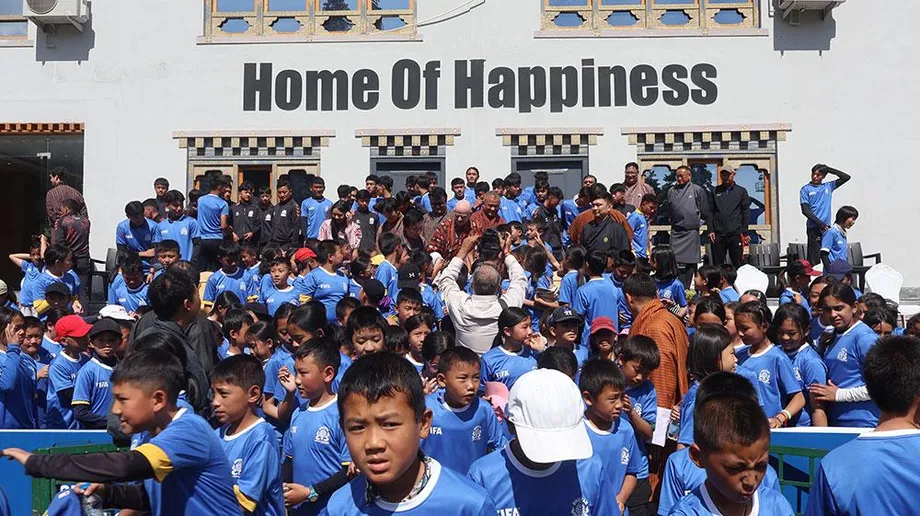
Infantino attended the opening of a programme for children under 12 and met Bhutan's under 15 boys' national team, which was preparing for the inaugural FIFA U-15 World Cup and Festival in Azerbaijan. His visit included Changlimithang Stadium and the federation's headquarters and training centre, known as the Home of Happiness.
FIFA plans to work with the BFF on identifying promising players, developing their abilities and strengthening local coaches. Talent identification means finding children with potential and helping them enter suitable training programmes. Coaches then need the skills and time to support their progress.
Bhutan's youth system already includes school programmes, regional training centres and club academies. In July 2026, Paro FC became the first club in South Asia to receive a Two-Star rating under the Asian Football Confederation's Elite Youth Scheme.
Infantino, explaining why training must lead to opportunities to play against other teams, put the priority simply:
"Competitions are the key," he said.
Regular matches let young footballers use what they learn under pressure, while international fixtures expose national teams to different opponents. The proposed FIFA Himalaya Cup fits that aim, although participating countries, a format and a schedule have not been announced.
Women's football has a foundation to expand
Bhutan's women's national team entered FIFA Women's World Cup qualifying for the first time during the campaign for the 2027 tournament. The team finished third in its group after victories over Lebanon and Singapore, giving the federation concrete results on which to build.
Pema Choden Tshering, captain of Bhutan's women's national team, has described how facilities changed her own experience of the game:
"I grew up playing on dusty pitches. Now I have the opportunity to play on artificial turf and natural grass pitches through my international experiences," Tshering noted.
Tshering pointed to a girls' academy in Gelephu where more than 60 girls train throughout the year. She also credited FIFA Forward with funding international trips that allow the women's team to compete, and said Bhutanese national team players were securing contracts abroad.
The proposed 250 places for girls at the new academy would add substantial capacity to that existing work. Its connection to schooling would be particularly relevant for families weighing a child's education alongside the time required for football training.
Tshering said her ambition was for current players' progress to encourage wider participation:
I hope this inspires the young girls of the future and encourages parents to let more girls play the sport.
National leaders join the discussion
Infantino met King Jigme Khesar Namgyel Wangchuck, Prime Minister Tshering Tobgay and Prince Jigyel Ugyen Wangchuck, president of the Bhutan Olympic Committee, during the visit. Discussions with the prime minister covered football's role in engaging young people and bringing communities together.
Prince Jigyel Ugyen Wangchuck hosted Infantino and his delegation for lunch at Pangrizampa in Thimphu. The programme included a traditional chibdrel ceremony, a khadar presentation, cultural performances and demonstrations of indigenous sports, including archery and khuru, a game involving darts thrown at a distant target.
The meetings brought football administrators and national leaders into the same development conversation. The immediate milestones are now December's consideration of programme conditions and the Congress decision in March, followed by the work needed to turn approved funding into specific projects.
Key Points
- Bhutan could receive up to USD 25 million for the 2027 to 2030 football development cycle, subject to FIFA approval and application rules.
- The FIFA Council is due to consider programme conditions in December 2026, with Congress approval scheduled for March 2027.
- A proposed academy would combine schooling, four pitches and places for 250 boys and 250 girls, pending a feasibility assessment.
- FIFA reported USD 11.4 million in Forward support to Bhutan by August 2024, including eight artificial pitches installed since January 2018.
- Priorities include coaching, youth development, women's football and more competitive matches. The FIFA Himalaya Cup remains under discussion.