Borrowers with weaker credit pay nearly twice as much
South Korean borrowers in credit grades 7 to 10 faced an average annual rate of 10.8% on new unsecured bank loans in the second quarter, up from 9.3% a year earlier, according to Bank of Korea data submitted to People Power Party lawmaker Song Eon-seog. Across 20 domestic banks, their rate increase was 2.3 times the increase for borrowers with the strongest credit.
Contents
- Borrowers with weaker credit pay nearly twice as much
- How the quarterly interest gap widened
- July figures show a longer rise in the gap
- What the averages measure
- Why weaker credit brings a larger increase
- How the central bank's increases fit in
- What higher rates mean for a household
- Shinhan cuts rates within a capped product
- Woori and Hana offer other routes to relief
- Key Points
A separate Bank of Korea submission to Democratic Party lawmaker Kim Tae-nyeon puts the average for borrowers with weaker credit at 10.96% in July 2026, against 5.54% for those in grades 1 to 3. That is almost twice the rate for the same broad type of borrowing: a personal loan without property pledged as security.
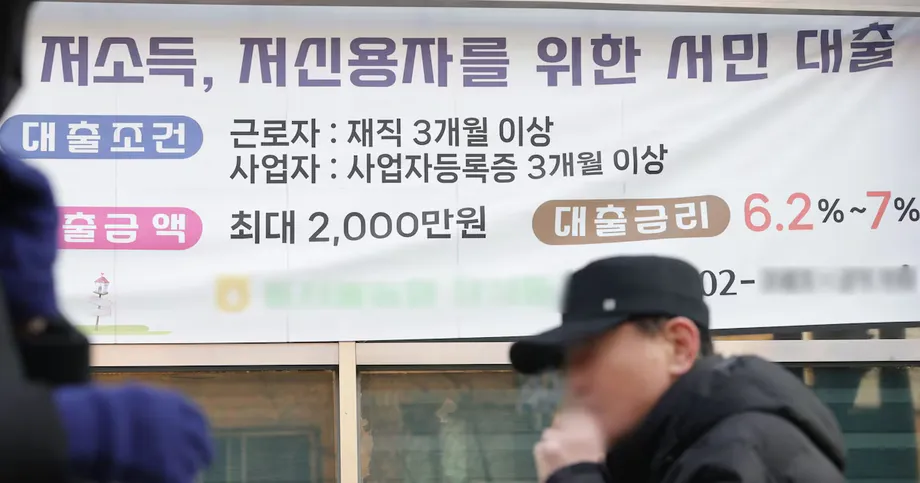
The figures show pressure on households even as banks introduce interest caps, cheaper refinancing and products aimed at people with lower credit scores. Whether a household benefits depends on the loan category, its eligibility and the bank's approval decision.
The quarterly figures submitted to Song do not identify their calendar year, while the monthly figures submitted to Kim specify July 2026. The bank product announcements also lack a calendar year. Those periods therefore need to be kept separate when following the changes.
How the quarterly interest gap widened
Borrowers in grades 7 to 10 saw their average rate move above 10% in the first quarter, reaching 10.53%, before rising another 0.27 percentage points to 10.8% in April through June. The figures cover ordinary unsecured loans and exclude policy lending.
Borrowers with better credit also faced increases, but the changes were smaller:
- Grades 1 to 3: rates rose from 4.81% to 5.46%, an increase of 0.65 percentage points.
- Grades 4 to 6: rates rose from 6.80% to 7.52%, an increase of 0.72 percentage points.
- Grades 7 to 10: rates rose from 9.3% to 10.8%, an increase of 1.5 percentage points.
The gap between the weakest and strongest credit groups widened from 4.49 to 5.34 percentage points. A percentage point measures the difference between two rates: moving from 9.3% to 10.8% adds 1.5 percentage points to the annual borrowing cost.
July figures show a longer rise in the gap
The July 2026 figures submitted to Kim show an annual increase of 1.74 percentage points for borrowers with weaker credit, from 9.22% to 10.96%. For borrowers with stronger credit, the increase was 0.73 percentage points, from 4.81% to 5.54%.
The difference between those groups consequently widened by 1.01 percentage points, from 4.41 to 5.42 percentage points. Comparing July with July helps show how the gap changed across several years:
- July 2023: the gap was 3.90 percentage points.
- July 2024: the gap reached 4.26 percentage points.
- July 2025: the gap stood at 4.41 percentage points.
- April 2026: the gap reached 6.22 percentage points.
- July 2026: the gap was 5.42 percentage points, up from 5.17 in June.
July's gap was smaller than April's, but wider than in each of the three previous Julys. During March and April 2026, the average rate for borrowers with weaker credit exceeded twice the rate for those with stronger credit.
What the averages measure
The Korea Federation of Banks explains in its household loan disclosures that ordinary unsecured loans are household loans issued without collateral. Overdraft facilities and housing related group loans, such as certain moving expense and interim payment loans, are excluded from that category.
The federation's measure excluding inclusive finance removes Financial Services Commission recognised medium rate loans and public support products such as New Hope Spore loans. A household qualifying for one of those products may therefore face a different rate from the ordinary loan average.
The federation weights its disclosed rates by loan amount, giving a larger loan more influence over the average. By contrast, the July figures submitted to Kim use simple averages across credit grades. Changes in which loans are issued, and in their composition, can move those averages.
The federation generally publishes averages for lending in the preceding month, or balances at the previous month's end, depending on the measure. Its comparisons use scores from credit bureaus, while individual banks also use their own assessments. A customer's actual quote can therefore differ from the published average.
Since July 2023, the disclosure system has expanded from four loan categories to six, adding jeonse deposit loans and total household lending. Jeonse is a Korean rental arrangement involving a large deposit. Comparing the same loan category matters when tracking rates through these changes.
Why weaker credit brings a larger increase
Seo Ji-yong, a professor at Sangmyung University, attributed the larger increase to restrictions on household lending and tighter bank management of repayment risk during rising interest rates. He described how those pressures affect borrowers more likely to miss payments.
With loan supply restricted due to household loan regulations and banks tightening credit management amid rising interest rates, lenders have applied higher rates to low-credit borrowers, who pose a greater risk of delinquency.
The federation's explanation of loan pricing shows the parts behind the final rate. Banks start with a reference rate, add a margin covering costs, expected losses and profit, and apply any adjustments or discounts. A risk premium is the amount charged to cover the possibility that a borrower will not repay.
Seok Byeong-hun, an economics professor at Ewha Womans University, similarly explained that banks tend to raise these margins when rising rates increase the risk of repayment trouble among borrowers with weaker credit. He also pointed to the greater pressure on borrowers whose incomes are relatively low.
A borrower can consequently face pressure from both the general cost of money and the bank's assessment of repayment risk. Where lending supply is limited, getting approval becomes another concern alongside the interest rate.
How the central bank's increases fit in
The Bank of Korea's base rate history records a sustained series of increases beginning in August 2021. The base rate influences financing conditions across the economy, while each customer's loan rate also reflects bank funding costs and individual pricing.
The official chronology records the following milestones:
- August 26, 2021: the base rate rose to 0.75%.
- November 25, 2021: it reached 1.00%.
- January 14, 2022: it increased to 1.25%.
- July 13 and August 25, 2022: it rose to 2.25% and then 2.50%.
- November 24, 2022: it reached 3.25%.
- January 13, 2023: it rose to 3.50%.
Later entries record reductions to 3.25% in October 2024, 3.00% in November 2024, 2.75% in February 2025 and 2.50% in May 2025. The history then lists increases to 2.75% on July 16, 2026, and 3.00% on August 27, 2026. Individual loan prices also depend on when a contract resets and what margin the bank applies.
What higher rates mean for a household
The Bank of Korea estimated that a rise of one percentage point in lending rates would increase the average annual interest burden for a borrower with weaker credit by 306,000 won. Spread evenly across a year, that amounts to 25,500 won a month.
A simple illustration shows the effect of the quarterly rates. On an unchanged principal balance of 10 million won, annual interest at 9.3% would be 930,000 won. At 10.8%, it would be 1.08 million won, an increase of 150,000 won. Actual payments depend on the repayment schedule and any changes in the outstanding balance.
Mortgage borrowers showed a much narrower difference by credit grade in July 2026. Rates on mortgages repaid in instalments over a long term averaged 5.06% for borrowers with weaker credit and 4.60% for those with stronger credit, a gap of 0.46 percentage points.
That mortgage gap was down from 0.72 percentage points in June but above 0.33 a year earlier. Property pledged as security gives the lender an asset to recover if repayment fails, helping explain why collateral is an important part of loan pricing.
Shinhan cuts rates within a capped product
Shinhan Bank's announced measures target customers in the lower half of external credit scores assessed by NICE or KCB. From October 16, the bank reduced calculated rates on eligible medium rate loans by 0.3 percentage points while retaining a maximum annual rate of 6.9%. New applications submitted from the implementation date qualify for assessment under the change.
The order of the calculation matters. A customer whose calculated rate is 6.8% would pay 6.5%. Someone whose calculated rate is 7.3% would still pay 6.9%, because the reduced rate remains above the existing cap. The same approach applies to eligible loans arranged digitally.
Shinhan also launched its Super SOL medium rate loan in August, offering up to 20 million won through a digital application. Its alternative credit assessment model is intended to assess applicants who have difficulty documenting income or have limited financial transaction histories, subject to screening.
Woori and Hana offer other routes to relief
Woori Bank introduced a 7% annual cap on personal unsecured loans in January, regardless of credit grade. During the first five months, 46,000 people received a combined 1.37 billion won in interest reductions. That works out to about 29,800 won per recipient over that period, although individual savings varied.
Its Woori WON Dream refinancing product allows eligible customers to replace loans from Woori Card, Woori Financial Savings Bank and Woori Financial Capital. It offers up to 20 million won, with principal and interest repaid in instalments over as long as 10 years. Advertised rates start in the middle of the 4% range and are capped at 7%.
Eligible applicants include employees earning up to 35 million won annually, as well as freelancers, other people outside salaried employment and homemakers who may have difficulty proving income. A longer repayment period can lower each instalment while extending the time during which interest is paid.
Hana Bank's Hana OneQ Ansim medium rate programme has an announced scale of 2 trillion won. It offers customers in the lower half of personal credit scores up to 10 million won at a fixed annual rate of 5.5%. The rate stays unchanged throughout the loan period.
Those products give eligible households alternatives to ordinary unsecured lending. Song called for effective measures to reduce interest costs and improve access to finance. For borrowers, the practical issues are the approved rate, the amount available and the repayment schedule, alongside whether they pass the lender's assessment.
Key Points
- Quarterly Bank of Korea figures put ordinary unsecured loan rates for borrowers in grades 7 to 10 at 10.8%, up from 9.3% a year earlier.
- Their increase was 2.3 times the increase for borrowers in grades 1 to 3.
- July 2026 figures show rates of 10.96% for weaker credit and 5.54% for stronger credit.
- The federation's disclosures use averages weighted by loan amount; the July comparison uses simple averages across credit grades.
- Shinhan, Woori and Hana have announced rate caps, reductions or refinancing products, with access subject to eligibility and approval.