A defense concept faces a production deadline
Taiwan and the United States have yet to build the mass of unmanned systems intended to slow a Chinese invasion, Randall Schriver, chair of the U.S.-China Economic and Security Review Commission, warned in Taipei on October 20, 2026. His warning comes as Taiwan prepares six years of spending on unmanned vehicles and considers further purchases, while some major weapons deliveries are expected only from 2030.
Contents
- A defense concept faces a production deadline
- Why numbers and coordination matter
- Taiwan's NT$240 billion plan runs through annual budgets
- Chinese patrols extend pressure east of Taiwan
- Mobile artillery is the other side of the drone problem
- Training and deliveries follow different calendars
- U.S. commitments compete with shortages and sales delays
- Key Points
Schriver said American shortages of munitions and other essential capabilities would persist even a couple of years beyond August 1, 2027, the date by which Chinese President Xi Jinping has reportedly directed the People's Liberation Army to be ready to take Taiwan by force. That is a military readiness target, rather than an announced invasion date.
The immediate challenge is turning money, industrial capacity and military plans into equipment that units can actually use together. Taiwan is seeking large numbers of drones while also making its artillery more mobile, protecting communications and preparing crews to operate under constant surveillance.
Schriver, a former U.S. assistant secretary of defense, referred to a concept described in 2024 by Admiral Samuel Paparo, commander of U.S. Indo-Pacific Command. Paparo said he wanted to turn the Taiwan Strait into an unmanned hellscape, using unmanned systems to disrupt an invasion and buy time for an American response. Schriver cautioned that the concept remained unfinished.
But remember, hellscape is very aspirational. We haven't built it out.
For Taiwan, the practical question is how much usable defensive strength can be put in place during the next several years. Funding decisions, manufacturing schedules and training all affect that answer.
Why numbers and coordination matter
Schriver argued that modern warfare increasingly rewards the side able to produce and deploy technology fastest. Having the most advanced artificial intelligence or equipment to defeat drones is only part of the task. Armed forces also need enough systems, trained operators and workable plans for employing them.
An operational concept is the military's plan for how different forces work together. In Taiwan's case, that could mean unmanned aircraft locating approaching forces, other systems passing targeting information, and artillery or maritime drones attacking while mobile air defenses protect the defenders.
A February 2026 proposal by Stacie Pettyjohn and Molly Campbell at the Center for a New American Security described a layered defense combining unmanned systems, artillery, mines and mobile air defense. Each layer would give an attacking force another problem to solve, while supporting the survival of the others.
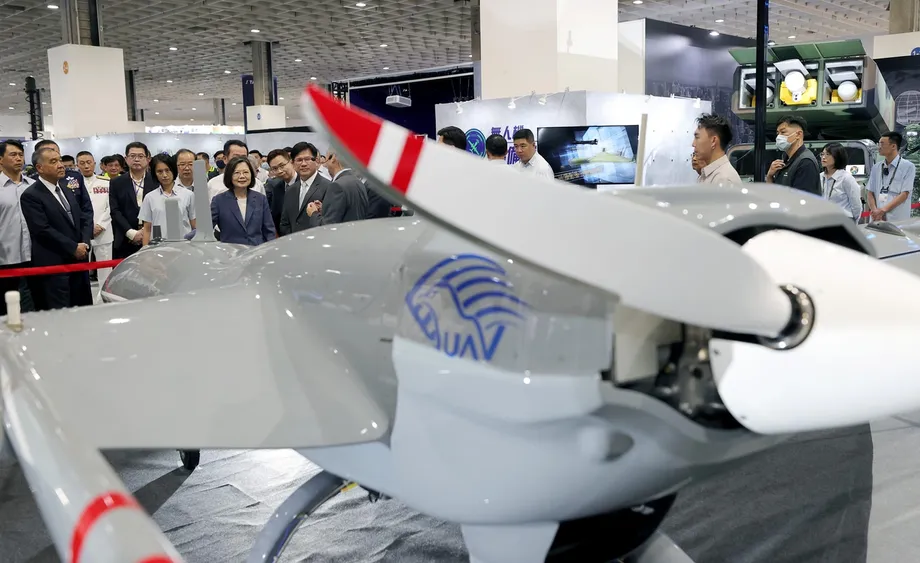
Plans described in October include more than 200,000 aerial and maritime drones, alongside a target of more than 1,000 uncrewed surface vessels. Those ambitions make production capacity central to the defense effort. Large fleets also require maintenance, replacement parts and dependable communications throughout their service.
Schriver pointed to Ukraine's resistance against Russia as an example of a defender sustaining its position by preventing an attacker from achieving its aims. He described that approach in simple terms.
We're seeing Ukraine win by not losing.
His argument for Taiwan was that a defense able to keep functioning can deny an attacker a quick victory. Unmanned systems are one part of that effort, alongside the weapons and support networks needed to keep fighting.
Taiwan's NT$240 billion plan runs through annual budgets
Taiwan's Legislative Yuan passed the Strengthening National Defense Autonomy and Unmanned Vehicle Industry Development Act on August 27, 2026. The legislation provides for NT$240 billion, approximately US$7.36 billion, over six years, with NT$40 billion a year as the baseline.
The legislative provisions specify that the money is to be allocated through the annual budget process. Although the NT$240 billion initiative has also been described as a special budget, the mechanism set out in the law is a continuing series of annual appropriations. Both the total and yearly allocations may be increased if required.
The Ministry of Economic Affairs is the lead agency, with the Ministry of National Defense responsible for matters involving military procurement. Relevant agencies are to work together on defense purchases, research subsidies, imports of key technologies, cybersecurity reviews and the designation of testing sites.
That division gives the program both an industrial and a military purpose: building Taiwan's capacity to make unmanned vehicles while supplying equipment suited to defense missions. Cybersecurity reviews are especially relevant because the usefulness of a drone depends partly on protecting its software and control links.
The Cabinet has separately proposed NT$145.7 billion in additional defense spending through a supplementary budget. Of that, NT$55.9 billion is earmarked for uncrewed systems, including drones. That is about 38 percent of the proposed supplementary spending, showing how prominent unmanned equipment has become in Taiwan's purchasing priorities.
Chinese patrols extend pressure east of Taiwan
China's coast guard has conducted regular patrols east of Taiwan since June, adding pressure on a side of the island that is also important to Taiwan's access to the wider Pacific. Taiwanese officials believe the activity may rehearse a maritime blockade using military, paramilitary and civilian assets.
A blockade would seek to restrict movement to and from the island, putting shipping and supplies under pressure. Preparing to resist one requires Taiwan to consider threats around its coastline, alongside a possible landing across the Taiwan Strait.
Schriver said apparently civilian law enforcement activity could advance Beijing's sovereignty claim. He described the persistent patrols as part of a broader campaign using legal arguments, political pressure and information.
This is an extension of legal warfare and political and information warfare. This is highly destabilising if they continue to operationalise this law enforcement role.
Joseph Wu, secretary general of Taiwan's National Security Council, told the same forum that China had no legal claim to waters east of Taiwan. China's foreign ministry maintained that the waters were Chinese and defended the activities as lawful. Beijing claims Taiwan as its territory, while Taiwan rejects that claim.
Later on October 20, Taiwan's defense ministry reported a Chinese joint combat readiness patrol involving 27 military aircraft, including H-6 bombers capable of carrying nuclear weapons. The combination of coast guard patrols and military activity presents Taiwan with several forms of pressure at once.
Mobile artillery is the other side of the drone problem
Taiwan is also adapting to the danger posed by an opponent's drones. Its October policy direction calls for all next generation howitzers, as well as 120 mm and 81 mm mortars, to be mounted on vehicles.
Artillery crews face a race after firing. Drones can locate their positions, while radar can track shells back toward the guns that fired them. Vehicle mounted weapons can leave a firing position faster than equipment that must be packed up and attached to a towing vehicle.
Taiwan's existing inventory includes M109A2 and M109A5 self propelled howitzers, M110A2 heavy guns and towed artillery. Much of its mortar force also depends on manual handling or separate transport, making the proposed change wider than the replacement of a single weapon.
An initial M109A7 package includes 60 howitzers, 60 M992A3 ammunition resupply vehicles, 13 M88A2 recovery vehicles, 42 fire control systems and 4,080 Precision Guidance Kits. Deliveries are expected to begin from 2030. The resupply and recovery vehicles show why buying guns alone is insufficient: crews need ammunition brought forward and damaged vehicles removed or repaired.
Taiwan is also planning 178 wheeled vehicles carrying 105 mm guns under the Cheetah program, with production scheduled from 2027 to 2033. Its planned HIMARS expansion includes 82 launchers beyond 29 previously ordered. HIMARS is a mobile system that fires guided rockets and missiles.
Procurement choices, budgets and schedules for the complete artillery replacement effort remain unresolved. Existing units therefore carry much of the responsibility for readiness during the transition.
Training and deliveries follow different calendars
Taiwan's artillery exercise at Kengzikou in Hsinchu on August 25, 2026, rehearsed rapid deployment, firing and withdrawal using weapons already in service. Participating formations included the 21st Artillery Command, the 269th Combined Arms Brigade, the 206th and 109th Infantry Brigades, and Lanyang Area Command.
The exercise combined maintenance checks with tactical firing by M109A2 and M110A2 systems and towed guns. For crews, the immediate change is procedural: prepare quickly, complete the mission and relocate before an opponent can strike.
The key dates show how current training overlaps with longer purchasing and manufacturing schedules:
- August 25, 2026: Taiwan rehearsed artillery readiness and rapid relocation at Kengzikou.
- August 27, 2026: The legislature passed the act providing NT$240 billion over six years for unmanned vehicles and defense industry development.
- October 20, 2026: Schriver warned in Taipei that the planned unmanned defense remained unfinished.
- 2027 to 2033: Production is planned for 178 Cheetah wheeled gun vehicles.
- August 1, 2027: The reported Chinese military readiness target cited by Schriver.
- From 2030: Initial M109A7 howitzer deliveries are expected.
The first expected M109A7 deliveries fall roughly three years after the 2027 readiness target. Taiwan's near term defense consequently depends on existing equipment, improved tactics and whichever new systems can be fielded sooner.
U.S. commitments compete with shortages and sales delays
The fiscal 2026 U.S. National Defense Authorization Act directs the Department of Defense to seek a joint program with Taiwan to develop and field uncrewed systems and systems designed to defeat them. The program is to include joint development and production for both militaries.
That creates a route for cooperation extending beyond Taiwan buying finished American equipment. The practical work still includes organizing production and integrating the resulting systems into military units.
Schriver warned that American forces were already stretched. He cited the conflict involving the United States and Iran and an aircraft carrier gap after the USS Abraham Lincoln was relieved following an extended Middle East deployment. Coordinated pressure from North Korea and Russia alongside China, he said, would place further demands on U.S. resources.
Weapons sales face another timetable. President Donald Trump had yet to approve a proposed US$14 billion arms package for Taiwan, after approving US$11 billion in arms in December. In May, following a meeting with Xi in Beijing, Trump described such sales as a negotiating chip.
Schriver expected movement on the proposed package in 2027, after possible Trump-Xi meetings at APEC in China and the G20 in Florida. He suggested it might be divided or handled through different sales channels. Direct commercial sales involve purchases from companies, while foreign military sales are managed through the U.S. government.
Taiwan's central task is bringing these different calendars together. Annual budgets must support production, training must prepare crews for equipment they receive, and mobile weapons need supplies and communications that can survive attack. Schriver's warning focused on the distance between approving a defense concept and having enough functioning units ready to carry it out.
Key Points
- Schriver said Taiwan and the United States have yet to build the mass unmanned defense intended to disrupt a Chinese invasion.
- Taiwan's legislature passed a framework for NT$240 billion over six years, allocated through annual budgets.
- A proposed supplementary defense budget includes NT$55.9 billion for uncrewed systems.
- Chinese coast guard patrols east of Taiwan have added to concerns about preparations for a possible blockade.
- Taiwan plans to put future artillery on vehicles, while initial M109A7 deliveries are expected from 2030.
- A proposed US$14 billion American arms package remains awaiting presidential approval.