A defence pledge moves toward a parliamentary vote
Turkey submitted a defence agreement with Saudi Arabia and Pakistan to parliament on Tuesday, October 20, 2026, bringing a commitment to mutual military assistance closer to approval. The 16 article Mecca Joint Defence Agreement would treat an external armed attack on any member as an attack on all three, while leaving the scale and type of assistance to an assessment of needs and available resources.
Contents
- A defence pledge moves toward a parliamentary vote
- What happens next in Turkey?
- What would trigger mutual assistance?
- Would Turkish troops be sent abroad?
- Why Saudi Arabia wants a wider security network
- A shared pledge, with different national interests
- Joint production could give the pact lasting weight
- How the alliance would operate
- Open to new members, with regional tensions unresolved
- A long commitment facing an immediate test
- Key Points
Signed in Mecca on August 7, the agreement would remain in force indefinitely. Members could withdraw only after 10 years from its entry into force, with at least three months of written notice. It also provides for a secretariat in Saudi Arabia, a Pakistani national as its first secretary general, and regular meetings of foreign ministers, defence ministers and military chiefs.
The parliamentary move comes as Saudi Arabia faces renewed attacks by Yemen's Houthi movement against energy and civilian infrastructure, with shipping in the Red Sea also under threat. At an emergency meeting in Riyadh earlier in October, the three countries agreed to ensure the rapid deployment of military forces and capabilities in Saudi Arabia.
Turkey's immediate contribution is expected to centre on military equipment, intelligence sharing and weapons systems, according to a Turkish official speaking anonymously. The official said no other Turkish deployment under the alliance had taken place. Ankara has also agreed to join a Saudi initiative to protect navigation in the Red Sea.
The agreement combines that immediate security response with a longer commitment to training, weapons production, intelligence exchanges and logistical support. Its practical reach will depend on national approval procedures, decisions by the three governments and the resources they make available.
What happens next in Turkey?
Parliament Speaker Numan Kurtulmus is expected to refer the agreement to the Foreign Affairs Commission after returning from a visit to Kyrgyzstan. The commission would examine it before sending it to the General Assembly for debate and a vote. A simple majority is sufficient for parliamentary approval.
Three parliamentary sources described the submission. One said the commission could consider the agreement as early as Friday, October 23, although its schedule had not been confirmed. Parliamentary approval in Turkey is one step in a wider process: Article 16 requires every member to complete its own ratification procedures, with the agreement taking effect when the final ratification document is deposited with the secretariat.
The main developments span more than a year:
- September 2025: Saudi Arabia and Pakistan signed a separate mutual defence agreement.
- August 7, 2026: Saudi Crown Prince Mohammed bin Salman, Turkish President Recep Tayyip Erdogan and Pakistani Prime Minister Shehbaz Sharif signed the Mecca agreement.
- Earlier in October 2026: An emergency meeting in Riyadh agreed on rapid deployment of forces and capabilities in Saudi Arabia.
- October 20, 2026: Turkey submitted the agreement to parliament for ratification.
- October 23, 2026: The earliest possible commission discussion identified by a parliamentary source, subject to scheduling.
What would trigger mutual assistance?
Article 1 covers threats to a member's independence, sovereignty, territorial integrity and internationally recognised borders. It requires the parties to cooperate in protecting those interests and to use all necessary means to remove threats or dangers to sovereignty, territory or borders.
Article 2 addresses an external armed attack. It commits the members to immediate assistance when a partner faces an armed attack or military aggression by another country or group of countries. The governments would assess the assistance required and determine its scope and nature within their available resources, including military capabilities.
The practical choices could therefore include supplying equipment, sharing intelligence, providing logistical support or making military capabilities available. The treaty sets an obligation to help while placing decisions about the form of that help with the participating governments.
Article 2 also invokes Article 51 of the United Nations Charter, which recognises individual and collective self defence following an armed attack. Collective self defence means a country can help another country defend itself. No particular adversary or region is named in the agreement.
Would Turkish troops be sent abroad?
Turkey's government has described its intended assistance to Saudi Arabia as defensive logistical and technical support. Foreign Minister Hakan Fidan said the agreement was not offensive and that Turkey would not send troops to another country to carry out attacks on its territory.
Turkey's Defence Ministry said any contribution of forces or capabilities would follow national legal procedures. In a statement issued the previous week, the ministry set out the governing requirement:
Within the scope of the Mecca Defense Alliance, the process regarding the military forces and capabilities that can be provided by Türkiye to Saudi Arabia will be carried out in accordance with the provisions of our Constitution and relevant legislation.
Sending Turkish troops to Saudi Arabia would require parliamentary authorisation after ratification of the agreement. Lawmakers would therefore face separate decisions about approving the treaty and authorising a troop deployment.
Pakistan has already sent some troops and air defence capabilities to Saudi Arabia, according to the Atlantic Council. That existing assistance helps explain why the three partners may contribute in different ways: one can provide personnel or air defence, while another supplies weapons, technical support or intelligence.
Why Saudi Arabia wants a wider security network
Saudi Arabia is seeking support amid attacks on airports, oil facilities, tankers and other critical infrastructure. The Houthis, who control much of northwestern Yemen and receive support from Iran, have announced a maritime embargo against the kingdom. Turkey has condemned the attacks and called for an end to strikes on Saudi energy facilities, civilian infrastructure and sacred sites.
The Red Sea gives the agreement a direct shipping dimension. Attacks on vessels or threats to navigation can disrupt the movement of cargo and energy supplies. Turkey's decision to join the Saudi initiative on navigational safety connects its military technology and logistical assistance to that immediate concern.
The pact was signed at Al Safa Palace in Mecca during a summit convened at King Salman's invitation. Mohammed bin Salman received Erdogan and Sharif, and the three leaders presented the agreement as a way to strengthen collective deterrence. Deterrence means discouraging an attack by making its likely cost greater.
Saudi Arabia already had mutual defence arrangements with Pakistan dating from September 2025 and with Gulf Cooperation Council partners dating from 2000. The new agreement adds Turkey to this network rather than replacing those relationships.
A shared pledge, with different national interests
The Atlantic Council's August 7 assessment of the pact describes different incentives for each member. Allison Minor, director of its Project for Middle East Integration and a former US deputy special envoy for Yemen, argues that Saudi Arabia is building several partnerships to respond to shifting threats rather than depending on one security provider.
Minor assesses that the diplomatic benefits could outweigh the immediate military gains. Saudi Arabia's closer relationship with Pakistan, she writes, has already helped Riyadh shape negotiations and manage escalation with Tehran. She also sees continued room for cooperation with the United States as Washington seeks more security contributions from regional partners.
Pakistan's interests include energy supplies, major regional allies and several million Pakistani expatriates living in the Middle East. Michael Kugelman, an Atlantic Council resident senior fellow for South Asia, argues that the pact could increase Islamabad's influence while supporting its efforts to deepen defence ties with Egypt and Jordan.
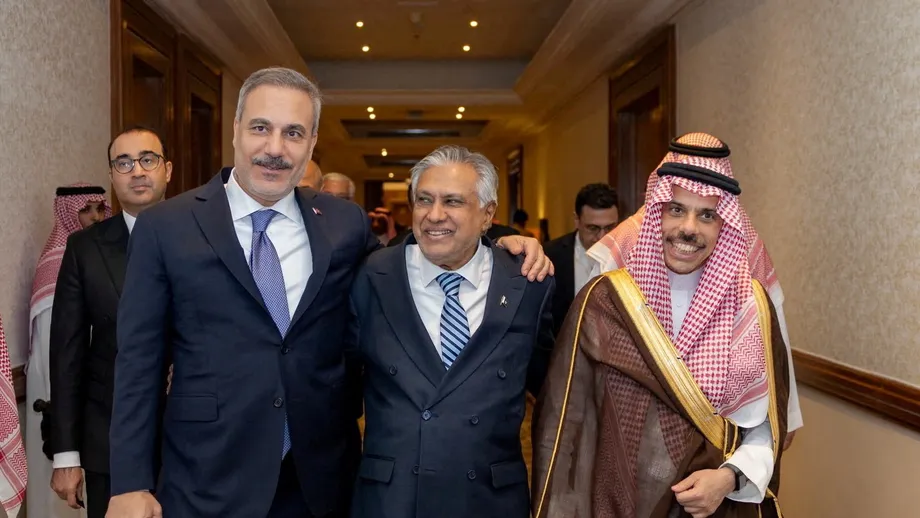
Pakistan also brings the experience of its separate Saudi agreement and its role in diplomacy between Washington and Tehran. Army Chief Asim Munir and Foreign Minister Ishaq Dar accompanied the Pakistani delegation to Saudi Arabia ahead of the August signing.
Turkey gains a broader market and partnership network for its defence industry. Rich Outzen, a nonresident senior fellow at the Atlantic Council's Turkey Program, assesses that the agreement could strengthen Turkish deterrence against Israel and support commercial links across regional energy and trade routes. Those are strategic assessments; the treaty itself names no country as a target.
Joint production could give the pact lasting weight
Article 7 sets out a programme extending beyond emergency assistance. It covers technology sharing, joint research, joint production, specialist training and exchanges of experience among defence institutions and companies. Each activity would depend on mutual agreement.
Turkish officials say domestic industry meets about 80% of the country's defence needs, leaving roughly one fifth supplied from abroad. Five Turkish defence companies also feature among the world's 100 largest arms and military services businesses. Those figures help explain Ankara's interest in turning a political partnership into production and procurement projects.
Burcu Ozcelik of the Royal United Services Institute identified the industrial opportunities for Turkey as:
joint production, technology partnerships, procurement and greater military interoperability
Interoperability means different armed forces can work together effectively, using compatible procedures, communications and equipment. Article 6 supports that aim through personnel exchanges, joint training, exercises and agreed deployments in both peace and war.
How the alliance would operate
Article 8 creates a Strategic Political and Defence Committee comprising the three countries' foreign ministers, defence ministers and chiefs of general staff. It would meet twice a year, with hosting rotating among the members. Leaders could meet once a year when considered necessary.
A secretariat based in Saudi Arabia would support the committee. Its secretary general would serve a term of three years, with the position rotating among the founding members and the first officeholder coming from Pakistan. The governments would agree separately on the secretariat's structure and working rules.
Article 9 provides for intelligence exchanges through secure channels agreed by the partners. Article 13 restricts classified material to people with the required clearance and a need to know, and bars its transfer to outside states, companies or individuals. Those confidentiality duties would continue after withdrawal or termination.
Article 10 covers weapons, ammunition, fuel, spare parts and other logistical assistance in peace, war and emergencies, subject to availability and compatibility. Article 5 adds operational cooperation against terrorism. Together, these provisions could make the pact a framework for routine military work as well as a response to attack.
Further agreements or protocols could set out how particular projects work. Disputes over interpretation or implementation would be handled through consultations, while amendments would require unanimous agreement among the founding members.
Open to new members, with regional tensions unresolved
Pakistan's Foreign Minister Ishaq Dar said the agreement was defensive and open to countries willing to uphold its principles and resolve differences peacefully. He also explained how it would sit alongside existing commitments:
The Makkah Accord does not abrogate or replace any existing bilateral or multilateral agreements between these countries, or with other countries or organizations.
Article 12 preserves rights and obligations under earlier international agreements. For Turkey, a NATO member, that provision is particularly relevant. Article 8 allows the founding members, acting by consensus, to approve procedures for admitting other countries.
The shared defence pledge has prompted comparisons with NATO's Article 5. Allison Minor and Islamabad defence analyst Abdullah Khan both caution against equating the arrangements. The Mecca text sets out its own decision process, based on an assessment of assistance needed, available resources and national legal requirements.
Pakistan possesses nuclear weapons, but the agreement sets out no nuclear guarantee. Pakistani officials have also said their September 2025 agreement with Saudi Arabia did not include a nuclear umbrella, meaning a promise to protect another country through nuclear deterrence. Saudi Foreign Ministry deputy for public diplomacy Raed Qarmali has described the Mecca agreement as unrelated to nuclear ambitions or an arms race.
A long commitment facing an immediate test
Iranian parliamentarian Ebrahim Rezaei, a member of the National Security Commission, criticised the pact after its signing. Turkish and Pakistani officials have said it is not aimed at Iran or any other country, while Saudi officials have described it as a lasting defence partnership rather than a military or sectarian bloc.
The immediate test is practical: whether the partners can coordinate useful defensive support for Saudi Arabia while managing the risk of wider conflict. The October deployment commitment, Turkey's promised equipment and intelligence assistance, and Pakistan's existing military contribution give the agreement concrete tasks before its institutions are fully developed.
The longer commitment is unusually durable. Article 16 gives the treaty no expiry date, protects ongoing agreed projects after withdrawal and keeps confidentiality obligations in place. Its 10 year minimum before withdrawal starts only when the agreement enters into force, rather than from the August signing.
The text was signed in Turkish, Arabic and English, with all three versions authentic and English prevailing if interpretations differ. For lawmakers, the central decision is whether to approve a broad mutual assistance obligation whose detailed military and industrial activities would be worked out over time.
Key Points
- Turkey submitted the Mecca Joint Defence Agreement to parliament on October 20, 2026.
- The pact treats an external armed attack on one member as an attack on all three and requires immediate assistance.
- The scope of support would depend on assessed needs, available resources and national legal procedures.
- Turkish troop deployment to Saudi Arabia would require separate parliamentary authorisation.
- The agreement covers intelligence, logistics, training, counterterrorism and joint defence production.
- A secretariat would be based in Saudi Arabia, with a Pakistani national serving as its first secretary general.
- The treaty would last indefinitely, with withdrawal permitted only after 10 years from entry into force and advance written notice.