A Robot Akita Takes on a Local Danger
Akita Prefectural University has presented an autonomous robot dog designed to detect bears, growl at them and help drive them away from places where people live. Officially named MATAGIroid Hacchan, the machine was one of three excellence award winners in a university competition that attracted 41 proposals for tackling encounters between people and bears.
Contents
- A Robot Akita Takes on a Local Danger
- How Hacchan Is Designed to Respond
- A Competition With More Than One Answer
- Why Akita Is Looking Beyond Existing Measures
- Can a Robot Convince a Bear to Retreat?
- AI Cameras Offer Faster Warnings in Fukushima
- Drones Follow Bears From Above
- The Next Steps Move Into the Field
- Key Points
Hacchan combines the appearance of an Akita dog with cameras, sensors and a robotic platform. Its developers are drawing on the work of the Matagi, traditional mountain hunters in northeastern Japan whose trained dogs help them handle encounters with bears. The aim is to give communities a machine that can approach danger while people keep their distance.
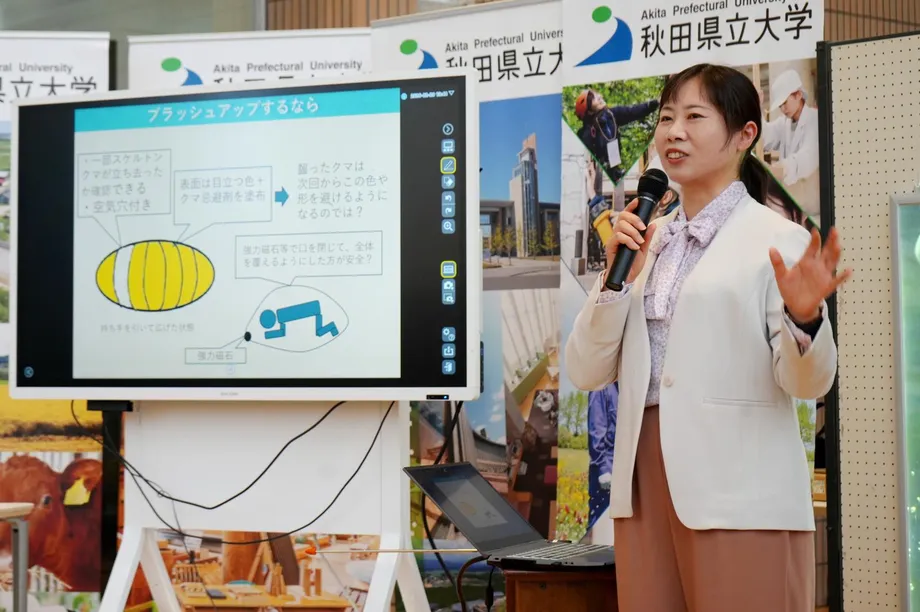
The university presented the technology at LiSH AKITA, a facility near Akita Station in Akita city. About 60 representatives from companies and local governments attended the exhibition, where researchers described their progress and discussed the practical problems that must be solved before the inventions enter regular use.
Masayuki Yoshida, a research administrator at the university's Science and Technology Integration Center and a member of the development team, described the intended outcome:
Our goal is to drive bears back into mountains, just as Akita dogs trained by hunters do.
A team of six plans field tests by the end of the year. The university has also committed to moving promising competition entries into practical joint research, making testing outside the exhibition hall the next step for the robot and the wider project.
How Hacchan Is Designed to Respond
Hacchan uses a modified Go2 robot made by Chinese robotics company Unitree. Its four legs carry a body styled after the Akita dog, a breed closely associated with the prefecture. AI cameras and infrared sensors are intended to help it identify bears during patrols.
When the robot detects a bear, a speaker produces barking or growling sounds. Artificial intelligence, or AI, is the software used to recognize patterns in camera images, helping the system distinguish a possible bear from other objects in view.
The proposed equipment also includes communications that could summon nearby robot companions and bear deterrent spray for an emergency response. Those functions give the concept several possible stages: finding an animal, sounding a warning, gathering other machines and using a stronger deterrent if needed.
The immediate development milestone is field testing. The cost, patrol range, operating time and conditions for using spray have not been announced. Those details will matter to local governments deciding whether a robot can work reliably around roads, homes and the edges of woodland.
A Competition With More Than One Answer
Akita Prefectural University's competition announcement places Hacchan within a broader effort called Bear-Tech Solution. Judges selected one top prize, three excellence awards and nine technology encouragement awards from the 41 entries. They considered originality, technical novelty, practical effectiveness and how much reassurance an idea could offer residents.
The announcement names Yoshida, Takeshi Kagaya and Makoto Tamura from the regional collaboration and research promotion team as the entrants behind Hacchan. The top prize went to assistant professor Chiharu Sone of the Department of Biological Production for an idea inspired by armadillos.
Sone's proposal uses biomimicry, which means borrowing ideas from the structures or behavior of living things to solve a human problem. The university praised the approach, although its announcement gives little detail about how the proposed bear countermeasure would operate.
The other excellence awards show how widely the researchers are looking. One proposal combines thermal cameras and AI image processing to detect bears with a time of flight sensor and a three dimensional hologram system intended to repel them. A time of flight sensor measures distance by timing how long a signal takes to travel to an object and return.
Another proposal would use optical fibers to monitor the surrounding environment, creating what its developers describe as a network of nerves across the ground. Together, the entries cover different jobs: noticing movement, recognizing animals and responding to their presence.
Why Akita Is Looking Beyond Existing Measures
Akita Prefectural University says communities have continued using electric fences, firecrackers and traps as bear appearances in inhabited areas have become a serious problem. Its project brings together work already under way on animal repellent stakes, bear countermeasure robots and detection systems, alongside newer research using AI, connected devices and materials.
Autumn adds pressure in Akita because black bears feed heavily before winter hibernation. A bear searching for food near a settlement can bring residents, agricultural workers and people traveling through the area into its path. The university's stated goal is to develop measures that provide lasting protection for local communities.
National figures show the human cost. Japan's Environment Ministry recorded 238 people killed or injured by bears in fiscal 2025, including 13 deaths. That means 225 people survived with injuries, with deaths accounting for about 5.5 percent of the total.
A June 3 tally also recorded four fatal attacks since April. The victims were women aged 55 and 69 in Iwate Prefecture, a man aged 78 in Yamagata Prefecture and a woman aged 73 in Akita Prefecture. All four deaths occurred in northeastern Japan.
For a municipality, a useful new device must fit into an existing response involving officials, police, hunters and emergency services. A robot that drives an animal away would perform a different task from a camera that sends an alert, even if both begin by detecting a bear.
Can a Robot Convince a Bear to Retreat?
Hacchan's appearance has attracted attention online, including comments that its angular dog shape looks too cute to frighten a bear. Some users suggested that a bear could knock it away. Others questioned whether an animal using smell and body heat to assess its surroundings would quickly recognize the machine as something other than a dog.
Those reactions point toward the central task for field testing: observing what bears actually do when the robot approaches, barks or growls. Developers will need to examine whether animals retreat, remain nearby or approach the equipment, and how the machine behaves when an encounter changes quickly.
The university says practical effectiveness was part of its judging process, and the exhibition included discussion of obstacles to real use. Testing will now move the project from a demonstration of its equipment toward measuring its effect on animals and its usefulness to the people responsible for responding.
Some online commenters proposed drones instead. Japan already has examples of drones and automated cameras being developed for bear monitoring. Their roles help explain why local authorities may have several tools to consider, depending on whether they need to find a bear, follow it or move it away.
AI Cameras Offer Faster Warnings in Fukushima
Showa Village in Fukushima Prefecture, with just over 1,000 residents, is considering an AI image analysis service from NTT Docomo Business. The village recorded 95 bears captured last year, compared with a usual annual figure of around 30. That is slightly more than three times the usual number. One person was injured.
The service, launched in April, works with trail cameras that automatically photograph passing animals. When the AI identifies a bear, it sends an email alert to local officials, police and the fire service. Its image analysis accuracy is reported at 99.9 percent.
Yoko Sugawara of NTT Docomo Business described the company's work on rapid identification:
We've refined the AI specifically to identify bears immediately.
Showa already had cameras, but officials said identifying the animals in the pictures took time. Automating that task could reduce patrols and give staff more time to respond to a sighting. The practical change is the speed at which a photograph becomes a warning someone can act on.
Kuniaki Igarashi, a village administration official, identified the boundary between human settlements and animal habitat as a crucial area to monitor. A camera placed there serves a different purpose from Hacchan: it watches a location and alerts people, while the robot is intended to move around and deter a bear.
Drones Follow Bears From Above
In Shintotsukawa, Hokkaido, KDDI SmartDrone is working with the town on aircraft controlled from an operations hub in Tokyo, about 900 kilometers away. The company signed a partnership with the municipality in December and established a drone port at the town hall.
After a reported sighting, the drone can take off within 10 minutes and track the bear until police or hunters arrive. A thermal camera uses differences in heat to help locate animals, supporting searches in areas with dense vegetation.
No bear sightings had been reported locally since the system was introduced at the time of the account. The town and company were preparing the service for future incidents. Remote operation also allows a municipality to use the system without having a trained drone pilot based locally.
Masafumi Hirono, chief executive of KDDI SmartDrone, linked the service to the pressure on public services in rural areas:
Even as populations decline in rural areas, we want to build systems that can sustain essential infrastructure.
The three approaches address different parts of a response. Cameras can issue warnings from fixed positions. Drones can search and follow from the air. Hacchan is intended to operate on the ground and encourage a bear to leave. For residents, the useful result would be an earlier warning or a response that requires fewer people to approach the animal.
The Next Steps Move Into the Field
Hacchan's developers have set a deadline of the end of the year for field tests, while the university plans practical joint research on promising competition ideas. The exhibition brought potential users and developers together before broader deployment decisions.
The projects described across Japan have reached different stages, with the following milestones:
- December: KDDI SmartDrone signed its partnership with Shintotsukawa to support remote drone operations.
- April: NTT Docomo Business launched its AI image analysis service for trail cameras.
- June 3: A tally recorded four deaths from bear attacks since April in northeastern Japan.
- By the end of the year: Hacchan's development team plans to conduct field tests.
Akita's robot has a specific assignment: use the mobility and warning behavior associated with a hunting dog to help send bears back toward the mountains. Field tests will give the team the chance to observe that response and decide how the machine can fit into local bear management.
Key Points
- Akita Prefectural University's robot dog, MATAGIroid Hacchan, received an excellence award in a competition with 41 entries.
- The modified Unitree Go2 uses cameras and sensors to detect bears and a speaker to bark or growl at them.
- A team of six plans field tests by the end of the year.
- The Environment Ministry recorded 238 people killed or injured by bears in fiscal 2025, including 13 deaths.
- Showa Village is considering automated camera alerts, while Shintotsukawa has introduced remotely operated drones for tracking bears.
- The university plans practical joint research to move promising ideas toward community use.