Rapid growth meets a major infrastructure proposal
Anthropic says its Japanese workforce has grown from three people to more than 50 in a year, while the number of companies adopting its technology has increased tenfold. Now, a proposed data center in southern Osaka Prefecture could give that expansion a much larger physical footprint: construction could cost about 1 trillion yen ($6.3 billion), with power intake capacity of up to 500 megawatts.
Contents
- Rapid growth meets a major infrastructure proposal
- What is being considered in Osaka?
- A year of expansion, with more milestones ahead
- Where Japanese customers are using Claude
- Five priorities for the second year
- Who controls the data?
- The Japan AI Index will track work, not just growth
- Fast growth sits alongside uneven adoption
- Cybersecurity, robotics and the need for testing
- Osaka fits a much larger computing expansion
- The Bottom Line
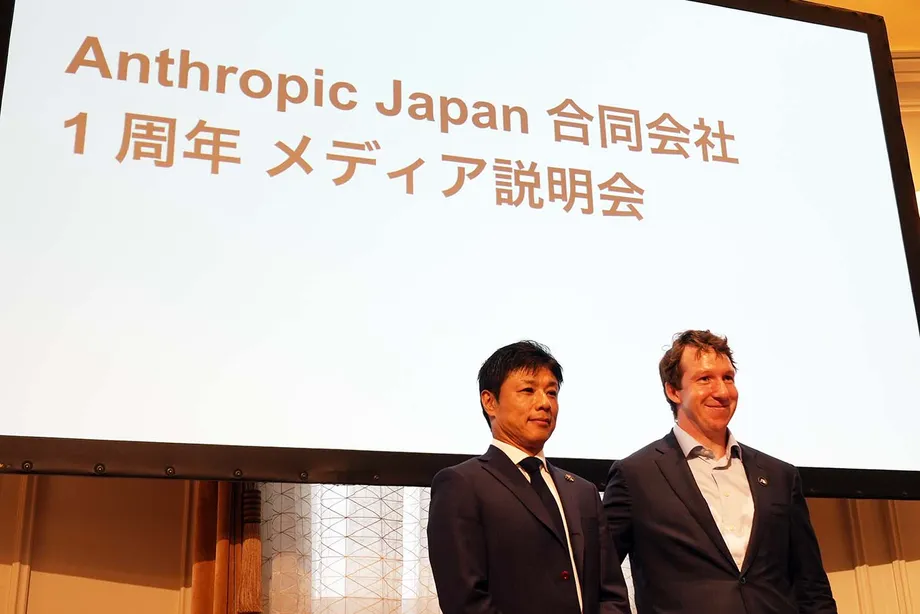
Hidetoshi Tojo, president of Anthropic Japan, presented the growth figures at an October 14, 2026, briefing on the company's first year in Japan. He described Japan as one of Anthropic's fastest growing markets and said Claude usage in the country was 1.9 times the average across other countries.
NTT is considering the Osaka project, with its subsidiary NTT Data Group expected to handle construction. Talks were reported to be in their final stages, with the companies seeking an agreement by the end of fiscal 2026 and partial operations possible as early as 2028.
Anthropic cofounder Jack Clark expressed interest in building data centers in Japan at the briefing, without announcing the Osaka project. The proposal brings together three developments: rising demand from Japanese businesses, government interest in domestic computing infrastructure, and concerns about how increasingly powerful AI systems should be tested and controlled.
A parallel effort offers a way to measure how that growth affects ordinary working life. The University of Tokyo, PKSHA Technology and Anthropic are developing the Japan AI Index, combining Claude usage statistics with Japanese employment, industry and education data. Its first report and dashboard were scheduled for autumn 2026.
What is being considered in Osaka?
NTT Data's proposed facility would be Anthropic's first dedicated core data center in Japan, located in a coastal area of southern Osaka Prefecture. The reported construction estimate is roughly 1 trillion yen, while the proposed power intake capacity is up to 500 megawatts.
A data center houses computers that run digital services. For AI, those computers perform the large amounts of calculation needed to develop models and answer users' requests. Power intake capacity describes how much electricity a facility could receive, rather than how many people it can serve.
The companies reportedly aim to sign an agreement by March 31, 2027, the end of Japan's fiscal 2026. Partial operations could begin in 2028. A final agreement, precise site and construction schedule have not been publicly announced, and NTT declined to comment on the reported negotiations.
Digital Minister Toshiharu Furukawa said the government had asked Anthropic to consider Japan as a data center location during an October 13 meeting in Tokyo with Clark. Furukawa also said the government was willing to support a project, although the form of that support was not specified.
A year of expansion, with more milestones ahead
Anthropic's Tokyo office announcement, published on October 29, 2025, described Tokyo as its first office in the Asia Pacific region. Chief executive and cofounder Dario Amodei visited Japan, met Prime Minister Takaichi and addressed members of the Liberal Democratic Party's Digitization Headquarters Committee.
The sequence shows how the company's presence has expanded from an office and cooperation agreements to a possible major infrastructure investment:
- October 29, 2025: Anthropic announced its Tokyo office opening and an AI evaluation agreement with the Japan AI Safety Institute.
- June 4, 2026: The University of Tokyo's Matsuo–Iwasawa Laboratory, PKSHA Technology and Anthropic announced plans for the Japan AI Index.
- October 13, 2026: Furukawa met Clark in Tokyo, and final stage negotiations over an Osaka data center were reported.
- October 14, 2026: Anthropic outlined its Japanese business growth and priorities for its second year.
- Autumn 2026: The first Japan AI Index report and dashboard were scheduled for publication.
- March 31, 2027: The reported target deadline for a data center agreement.
- 2028: The earliest reported start for partial data center operations.
Where Japanese customers are using Claude
Tojo's staffing figures mean the Japanese team has grown to more than 16 times its original size. The tenfold increase in adopting companies gives another measure of commercial expansion, although Anthropic did not disclose the total number of Japanese corporate customers.
NEC, Hitachi and Fujitsu are among the partners Anthropic has worked with during its first year. Tojo also cited Digital Hollywood, where Claude Team has been provided to all students and faculty. Claude models are due to become available through Gennai, the Digital Agency's Government AI platform.
Anthropic's October 2025 announcement named Rakuten, Nomura Research Institute, Panasonic and Classmethod as users. Rakuten was using Claude for autonomous coding projects, Nomura Research Institute had shortened document analysis from hours to minutes, and Panasonic had integrated Claude into business operations and consumer applications.
Classmethod reported productivity gains of ten times and said Claude Code generated 99% of the codebase for a recent project. These figures describe particular deployments. For readers, the practical point is the range of work involved: writing software, processing documents, supporting education and supplying models through a government platform.
Amodei, Anthropic's chief executive, described the company's view of technology during the Tokyo office opening:
"Technology and human progress are not in tension, but advance together," said Dario Amodei.
Anthropic also reported in October 2025 that its Asia Pacific revenue run rate had grown more than tenfold over the preceding year. A revenue run rate estimates annual revenue from the current pace of business. The company said its Tokyo Builder Summit brought together more than 150 startups and founders.
Five priorities for the second year
Tojo set out five areas for the next phase: expanding enterprise and public sector business, developing partner business, finding advanced uses, working with research, policy and cultural institutions, and increasing Tokyo hiring.
Finance, manufacturing and public services are priority sectors. Anthropic intends to work with systems integrators, resellers and cloud providers, including through collaboration involving engineers who help customers put AI into practical use. Systems integrators connect new technology with the software and processes an organisation already operates.
Legacy modernisation and cybersecurity are among the advanced uses Anthropic wants to develop. Legacy modernisation means updating older computer systems that organisations still depend on. AI coding tools can assist with understanding and changing software, while the customer still needs a process for reviewing and testing the result.
The research and cultural programme includes the Japan AI Index, cooperation with the Japan AI Safety Institute and the Mori Art Museum. Anthropic extended its museum partnership in 2025, alongside plans at that time to expand its regional presence to Seoul and Bengaluru.
Who controls the data?
Clark said Anthropic makes clear that customers own their data. Tojo said sovereignty requirements vary according to the company and the type of information involved, with systems integrators and cloud providers helping offer different options.
Data sovereignty concerns the rules and control surrounding information, including where it is stored and processed and which legal requirements apply. A Japanese facility could give customers a domestic location for some computing work, a concern for organisations handling confidential business records or personal information.
Tojo also suggested that customers could choose between Claude and models developed by partner companies according to the task. His approach places the choice of model and infrastructure within a customer's security requirements rather than presenting one arrangement for every organisation.
NTT Data already operates facilities in Tokyo and Osaka. Its stated international footprint includes more than 150 data centers across more than 20 countries and regions. The proposed Anthropic facility would therefore draw on an operator with an existing Japanese and international infrastructure business.
The Japan AI Index will track work, not just growth
The University of Tokyo's Matsuo–Iwasawa Laboratory announced the Japan AI Index partnership on June 4, 2026. Its Japan AI Index announcement explains how the project will combine anonymised, aggregated Claude usage statistics with Japanese economic, employment and education data.
The laboratory will lead the analytical design. Anthropic will contribute usage statistics of the kind used in its Economic Index, while PKSHA will provide knowledge from implementing AI in industry. The announcement said the specific cooperation arrangements would be finalised through further discussion.
Planned inputs include productivity data by industry, employment counts and occupational information from Japan O*NET, which describes jobs and the tasks they involve. The researchers intend to examine where AI is used, how the division of tasks between people and AI changes, and how usage relates to GDP, employment, wages and productivity.
The University of Tokyo plans to publish the findings through a dashboard and annual reports, with quarterly updates and an expansion of participating companies. The purpose is to give businesses, policymakers and educators information they can use when deciding where to invest, how to organise work and what skills to teach.
The laboratory frames this work around Japan's declining working population. Measuring which tasks AI helps people complete is more useful for those decisions than counting subscriptions alone. A company can adopt an AI service while still using it for only a narrow part of its work.
Fast growth sits alongside uneven adoption
The university announcement includes findings from Anthropic Economic Index data for February 2026. Estimated AI usage relative to the working population was concentrated in places including Tokyo, Osaka and Kanagawa.
Its international occupational comparison found that even in computer and mathematical occupations, where adoption was furthest advanced, Japan's measured usage was 40% of the US level. That is less than half the US benchmark in that category.
Anthropic's October 2025 office announcement, meanwhile, placed Japan in the top quarter of countries globally for AI adoption. Tojo's October 2026 briefing gave another measure, saying Claude usage in Japan was 1.9 times the average across other countries.
Each measure answers a different question. The global ranking compares countries, the occupational figure compares a particular kind of work with the United States, and the company briefing describes Claude usage against an international average. Together, they show a market with strong demand and room for wider use across occupations and regions.
Cybersecurity, robotics and the need for testing
Anthropic said it had begun providing its Mythos model to Japanese companies including Hitachi. Mythos is described as highly capable of finding security vulnerabilities, weaknesses in software that attackers might exploit. Hitachi is also participating in Anthropic's Critical Infrastructure Defense Program.
Clark, Anthropic's cofounder and head of public benefit, discussed research and governance addressing cyberattacks and biological weapon risks. He also described plans to strengthen security teams so the company could support policy work on cyber defence.
Japan's manufacturing strengths are another focus. Clark pointed to AI supply chains, scientific equipment and robotics, while Anthropic said it was working with Japanese companies on the Model Hardware Standard, or MHS, for physical AI. Physical AI connects AI systems with machines that sense or act in the real world.
Clark forecast recursive self improvement in 2027. The term describes a process in which AI helps improve its own capabilities or development methods, then uses those improvements in the next round. He presented this as a prediction and discussed possible scientific applications, including materials science.
His proposed safeguards included corporate transparency and policy frameworks with appropriate evaluation and testing methods to manage the pace of improvement. Anthropic's agreement with the Japan AI Safety Institute already covers cooperation on evaluation methods and monitoring emerging developments.
Osaka fits a much larger computing expansion
Anthropic has reportedly signed agreements for at least 14.8 gigawatts of computing capacity since October 2025, spanning physical data centers and capacity supplied through cloud services. The proposed Osaka facility's maximum 500 megawatts equals 0.5 gigawatts, about 3.4% of that reported total.
The agreements include arrangements with Amazon Web Services, Google Cloud, Microsoft, CoreWeave and other providers, as well as a partnership valued at $50 billion with AI cloud company Fluidstack. Much of the reported infrastructure development is in the United States, while Anthropic has also been in discussions about capacity in Australia.
Anthropic reportedly submitted a confidential initial public offering filing to the US Securities and Exchange Commission in June 2026. Details of the filing and a public listing timetable have not been disclosed. The immediate Japanese milestones are more concrete: the planned AI Index release, the reported March 2027 agreement target and possible partial data center operations in 2028.
Japan's role is expanding across customers, infrastructure, research and safety cooperation. The Osaka proposal would add substantial domestic computing capacity, while the Japan AI Index is designed to show how AI use translates into changes in work, education and economic activity.
The Bottom Line
- Anthropic says its Japanese workforce grew from three to more than 50, and corporate adoption rose tenfold in a year.
- NTT Data is considering an Osaka facility costing about 1 trillion yen, with power intake capacity of up to 500 megawatts.
- A reported agreement target is March 31, 2027, with partial operations possible in 2028.
- Japan's government asked Anthropic to consider a domestic data center and offered support.
- The Japan AI Index will combine Claude usage statistics with Japanese employment, industry and education data.
- Anthropic is expanding work on cybersecurity, physical AI and evaluation methods with Japanese partners.