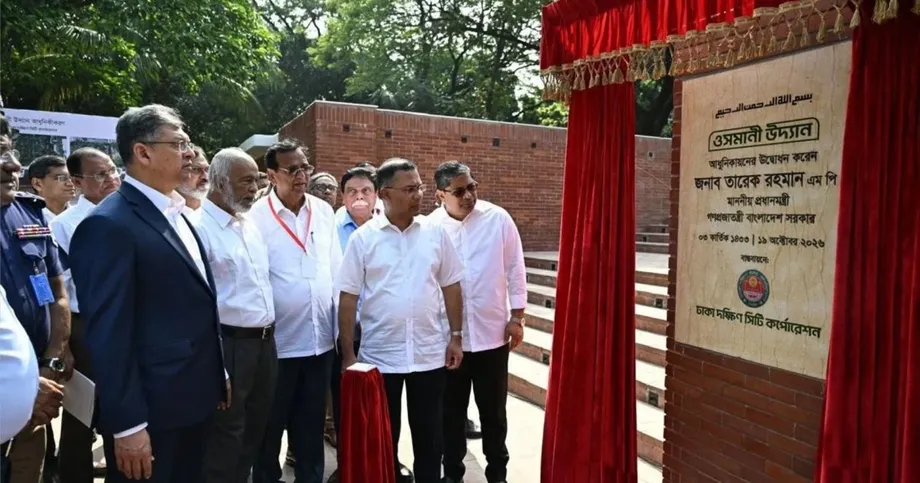
A place of remembrance and a political challenge
Prime Minister Tarique Rahman inaugurated a memorial bearing the names of 834 people killed in the July 2024 uprising at Dhaka's Osmani Udyan on Monday, October 19, 2026, joining bereaved parents to open the monument before challenging opposition leaders over their absence.
Contents
- A place of remembrance and a political challenge
- Bereaved parents joined the inauguration
- 834 names within a longer history
- What has changed inside Osmani Udyan?
- Tree protection drew a warning
- Why did opposition attendance become an issue?
- Rahman calls for debate in Parliament
- Support for families beyond the monument
- Dengue becomes a call for joint action
- Key Points
The July Memorial rises 90 feet above a site covering about one acre. Its opening accompanied the inauguration of the renovated park, a 23 acre public space beside the Secretariat, where old and new Dhaka meet. Rahman arrived at 10 a.m., and the inauguration took place at about that time.
The ceremony brought together two purposes: preserving the memory of those killed in the uprising and returning a renovated recreation space to residents. Visitors now have access to about 3.1 kilometres of walking paths, water features, exercise facilities and a library.
Rahman also used the occasion to call for cooperation in Parliament and against dengue. He accused the opposition of opposing the government for its own sake and warned that political conduct allowing authoritarianism to return would betray the sacrifices of the July uprising and the 1971 Liberation War.
Bereaved parents joined the inauguration
Four parents accompanied the prime minister as he opened the memorial: Md Mokbul Hossain, father of Abu Sayeed; Mir Mostafizur Rahman, father of Mir Mahfuzur Rahman Mugdho; Sanjida Khan Dipti, mother of Shahriar Khan Anas; and Mohammad Shafiul Alam, father of Wasim Akram.
Rahman planted a sapling in the memorial grounds after the inauguration. He then opened the renovated park, walked through it and visited its library.
Family members also spoke at the programme. They included Mugdho's father and Anas's mother, giving bereaved relatives a role beyond taking part in the opening ceremony.
Dhaka South City Corporation Administrator Abdus Salam chaired the event. Home Minister Salahuddin Ahmed, Local Government Minister Abdul Moyeen Khan, State Minister Mir Shahe Alam and the prime minister's political adviser, Mirza Abbas, were among those who addressed it.
834 names within a longer history
The names of 834 people killed in the July uprising have been inscribed on the monument using laser cutting. Twenty symbolic grave markers stand in front, creating a separate place for remembrance within the larger memorial grounds.
Two relief sculptures connect the July uprising to earlier movements in Bangladesh. A relief is a sculpture whose figures project from a background surface, allowing scenes and people to be shown along a wall.
The outer relief measures 163 feet long and 4.5 feet high. The inner relief is 171 feet long and 7.5 feet high. Together, their scenes present a sequence of struggles over language, political rights and independence:
- 1952: The Language Movement, which sought recognition for Bangla.
- 1969: The mass uprising against authoritarian rule.
- 1971: The Liberation War that brought Bangladesh independence.
- 1990: The mass movement against military rule.
- 2024: The July uprising commemorated by the new memorial.
The monument gives the names of those killed a permanent public setting while placing their memory alongside events already central to the country's history. Rahman's speech drew on the same connection, linking the aspirations of people involved in July to those of the liberation struggle.
What has changed inside Osmani Udyan?
The park renovation combined repairs to an existing waterbody with the construction of five new ones. New planting and green islands were also included, alongside work described as preserving existing trees.
Residents have about 3.1 kilometres of walking routes, an exercise facility, a pagoda, public toilets, parking and steps leading down to the water. The library Rahman visited adds a reading space to the park's recreation facilities.
Osmani Udyan has been arranged on two levels. A route intended for quicker movement sits two metres above the adjoining road, separating that part of the circulation system from street level.
A rainwater storage system can hold 50,000 litres. That is equivalent to 50 cubic metres of water, providing a measure of the system's capacity alongside the park's new and restored water features.
Tree protection drew a warning
Rahman raised an environmental concern during the opening, saying that many trees had been cut down during Osmani Udyan's development work. Reports of the renovated park also described existing trees as preserved, alongside new planting and green islands. The accounts do not establish how many trees were retained or removed.
The prime minister asked architects and planners to cause as little damage as possible to trees and nature when designing future projects. He said infrastructure was needed to serve people, while protecting the environment would benefit them in the end.
His remarks placed the quality of the park's renovation alongside its new facilities. Walking paths, buildings and planted areas serve different purposes, and his appeal was to retain more of the existing natural environment when adding structures.
Rahman also urged visitors to keep Osmani Udyan clean and avoid dropping rubbish. He described the park and memorial as public and state assets and asked visitors to cooperate with those responsible for their upkeep. The request extended responsibility for its condition beyond the agencies that carried out the renovation to the people who will use it.
Why did opposition attendance become an issue?
Rahman said important opposition figures, including the opposition leader, had been invited to the ceremony but had not attended. He argued that political distance from the government should not have prevented them from sitting with the families of those killed.
The prime minister questioned their commitment to the July uprising and said their absence had also slighted bereaved families. Explaining his objection, he said:
They did not have to sit on this stage. But if they truly believe in the spirit of July, they could have come and sat among the families of those who were martyred. We do not see them here today.
Rahman's comments were an accusation against his political opponents. No explanation from the opposition for its absence was given.
Other political figures did attend and speak, including Nagorik Oikya President Mahmudur Rahman Manna and Biplobi Workers Party General Secretary Saiful Haque. The programme also included cabinet members, lawmakers and families affected by the uprising.
The dispute turned a memorial opening into an argument over how political parties should honour July: through attendance at commemorations, practical support for families and the way they conduct politics after the uprising.
Rahman calls for debate in Parliament
Rahman cited the mandate of the 13th parliamentary election, saying voters had assigned the Bangladesh Nationalist Party responsibility for governing and other parties responsibility for serving in opposition. Both sides, he said, represented the public.
The prime minister rejected the idea that either side could claim exclusive ownership of people's interests. He called for an end to the politics of blame:
Both the government and the opposition represent people. We should move away from this culture of blame and accusations.
He also called for constructive opposition:
"If we continue with this old political culture of opposing for the sake of opposition, how can we move the country forward? The opposition must certainly oppose, but its opposition should be constructive," he said.
Constitutional amendments and reforms were legitimate subjects of disagreement, Rahman said. Parliament was the place for parties to present arguments, debate their positions and reach decisions. He urged cooperation on public safety, independence, healthcare, education and employment.
His sharpest warning concerned the possible return of authoritarianism. Rahman said:
If you open the way for authoritarianism while opposing the government, it will certainly not bring a good outcome for the country. It would be a betrayal of the July martyrs and, in the same way, of the freedom fighters of 1971.
Rahman also asked parties to avoid road blockades and protest programmes that disrupt business, work, education and healthcare. He presented stability as a practical concern for people trying to earn a living, attend school or receive treatment.
Support for families beyond the monument
Rahman said the government was gradually arranging medical treatment for people injured in the July uprising, assistance for bereaved families and employment support for family members.
He described those efforts as part of the BNP's commitment to July, drawing a parallel with its attachment to the 1971 Liberation War. His remarks connected remembrance at the monument with continuing responsibilities towards people living with the uprising's consequences.
The prime minister said the aspirations of those who died included democratic rights, freedom of expression and the ability to vote. He also identified education, healthcare, jobs for young people and a safe living environment as part of those aspirations.
For the families gathered at Osmani Udyan, the ceremony therefore combined public recognition with a statement of government responsibility. The memorial records names, while the measures Rahman described concern treatment, household support and livelihoods.
Dengue becomes a call for joint action
Rahman used dengue prevention as a concrete example of work that should bring government and opposition together. He said cleanliness campaigns had been running across Bangladesh for about a month and a half, involving the Bangladesh National Cadet Corps, Scouts, students, voluntary organisations and sanitation workers.
The prime minister appealed directly to opposition lawmakers:
I would like to tell the opposition lawmakers that Aedes mosquitoes do not recognise the ruling party or the opposition. Let us all work together to eliminate dengue in the interests of the country and its people.
Aedes mosquitoes spread dengue and breed in standing water. Cleaning neighbourhoods and managing places where water collects are practical parts of prevention, making routine maintenance relevant to homes, institutions and public spaces.
Rahman said early morning cleaning activities visible just after the government took office had become less apparent. His remarks recalled a public initiative by opposition leader and Jamaat-e-Islami chief Dr Shafiqur Rahman, who cleaned a road in his Mirpur constituency after dawn prayers the day after taking his oath as opposition leader. Shafiqur had said party workers would work in the area every day.
The prime minister also referred to recent visits to educational institutions, government hospitals and housing for public employees. He said educational institutions were comparatively cleaner, while hospitals and residential areas needed more attention.
"Maintaining hygiene is the first condition of healthcare," he said, urging hospital authorities and public servants to take greater responsibility for keeping their workplaces and residential surroundings clean.
His appeal brought the ceremony back to the everyday condition of the city. A renovated park needs continuing care, just as cleanliness campaigns require regular work after their opening days. Rahman ended by praying for those killed in July and wishing those injured a speedy recovery.
Key Points
- Prime Minister Tarique Rahman opened the July Memorial and renovated Osmani Udyan on October 19, 2026, at about 10 a.m.
- The monument stands 90 feet tall, bears 834 names and has 20 symbolic grave markers in front.
- The park covers 23 acres and includes about 3.1 kilometres of walking paths, five new waterbodies and rainwater storage for 50,000 litres.
- Bereaved parents joined the inauguration, and family members addressed the programme.
- Rahman criticised opposition leaders for their absence and urged constructive debate in Parliament.
- He called for support for July families, joint dengue prevention and greater protection of trees during construction, saying many trees had been cut during the park's development.