An 83 Meter Red Carpet in Godzilla's Stomping Ground
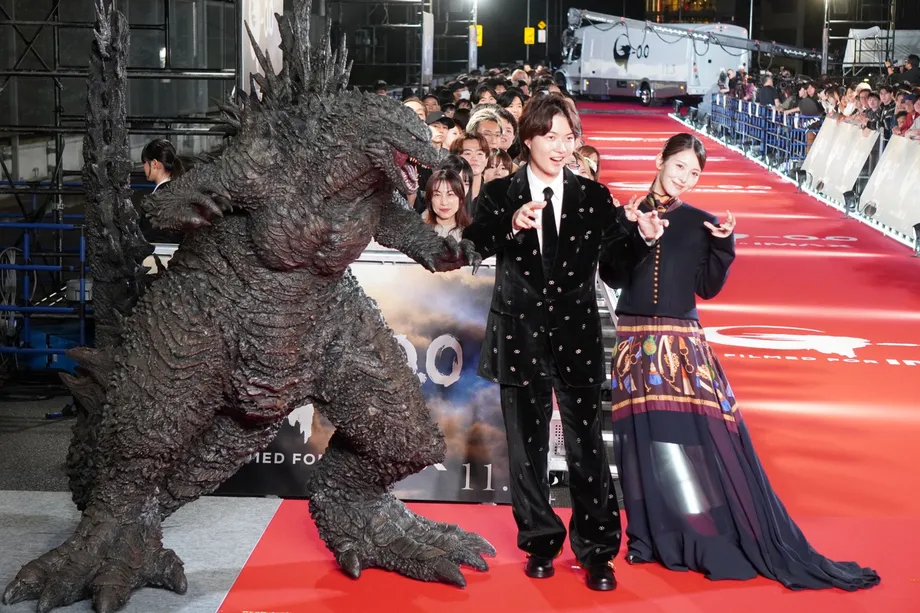
More than 300 spectators watched the cast of Godzilla -0.0 walk an 83 meter red carpet on Tokyo's former KK Line expressway on October 19, bringing the sequel's Japan premiere into Ginza, a district devastated by the monster on screen. The carpet, designed to evoke Godzilla's radioactive heat ray, followed a stage appearance at TOHO Cinemas Hibiya.
Contents
- An 83 Meter Red Carpet in Godzilla's Stomping Ground
- Why Ginza Made the Celebration Personal
- Two Years Later, Koichi and Noriko Are a Family
- Nagasawa Returns After About 22 Years
- A Disaster Bureau and a Professor Scarred by War
- Yamazaki Says the Oscar Brought No Pressure
- The Cast Describes a Heavy Emotional Impact
- A Larger Screen and an International Release
- Recovery Is the Story Behind the Spectacle
- Key Points
Director, screenwriter and visual effects creator Takashi Yamazaki joined Ryunosuke Kamiki, Minami Hamabe, Masami Nagasawa, Hidetaka Yoshioka, Yuki Yamada, Kuranosuke Sasaki, Mio Tanaka and Min Tanaka. Billed as the first Ginza Red Carpet Arrival in the Godzilla film series, the event paired a celebration of the franchise with a setting central to its destruction.
Godzilla -0.0 opens in Japan on November 3 and in North America on November 6. Set in 1949, two years after the attack depicted in Godzilla -1.0, it follows people whose recovery from war and disaster is interrupted by another confrontation with the monster.
The premiere revealed more than a bigger public stage for an Oscar winning filmmaking team. Cast members described a changed family at the center of the story, new specialists joining the response to Godzilla, and a finished film that several said affected them deeply. Hamabe identified Noriko's injury and the family's intervening two years as important parts of the sequel.
Why Ginza Made the Celebration Personal
Ginza gave the event a connection to the films beyond a recognizable Tokyo address. Yamazaki joked about how well the district had recovered after the destruction he had inflicted on it in the story. Around him, fans lined the carpet as the actors waved and greeted the crowd.
Kamiki, returning as Koichi Shikishima, described the unusual scale of the occasion and the feeling of celebrating in a place associated with Godzilla's attacks.
I feel as though I'm in a dream.
Nagasawa also described the event as dreamlike. Walking the carpet in a dress with bare shoulders, she waved to supporters and handed out stickers. She said an event in a location like this was a first for her, and spoke about the pleasure of being part of a film capable of creating such an occasion.
Hamabe said the gathering had already become a happy memory. Her composure on the carpet came with a more personal source of nerves: standing beside Nagasawa, a senior colleague at the same talent agency, for their first project together.
Two Years Later, Koichi and Noriko Are a Family
Kamiki and Hamabe return to characters whose relationship has changed since Godzilla -1.0. Noriko, who survived Godzilla's attack, is now Koichi's wife. Both actors said their performances needed to reflect the time the characters had spent building a life together.
Hamabe explained that viewers should naturally accept that Koichi and Noriko had lived as a family for two years. She adjusted her portrayal with that shared history in mind. Kamiki said they each considered what their characters had experienced during that interval and tried to express it through their relationship.
Noriko's injury also carries forward from the previous film. Hamabe said the detail briefly shown at its ending would be a key part of the sequel, alongside the family's life during the intervening years. The premiere comments left its precise connection to the new crisis undisclosed.
Sasaki, returning as boat captain Seiji Akitsu, pointed to another visible measure of time: Akiko, the child from the earlier film. He praised the growth of the young actress playing her and said she had moved him to tears. He also mentioned a scene in which the Shinseimaru crew drinks together, suggesting that familiar relationships have room to continue before and around the new disaster.
Nagasawa Returns After About 22 Years
Nagasawa plays Makoto Aoyama, a gifted weather forecaster assigned from a meteorological office to the Large Scale Disaster Countermeasures Bureau. Her character brings knowledge of weather into an organization confronting an extraordinary threat.
The role marks Nagasawa's third appearance in the Godzilla series, about 22 years after Godzilla: Final Wars in 2004. She previously played one of the Shobijin, the small twin figures associated with Mothra, in that film and in Godzilla: Tokyo SOS in 2003.
Nagasawa said she was happy to return to a Godzilla production and had long wanted to work with Yamazaki. She described Godzilla as a mirror of its era, with the creature's image changing according to the times. Yamazaki's version, she said, feels vivid and realistic enough to enter the world people inhabit.
Her reunion with the franchise also created a first collaboration with Hamabe. Nagasawa said she was delighted to stand beside an actress she had known since childhood. Hamabe admitted that the occasion made her more nervous than other events and that she had repeatedly stumbled over her words during the earlier stage greeting.
A Disaster Bureau and a Professor Scarred by War
Yoshioka returns as Kenji Noda, now director of the Large Scale Disaster Countermeasures Bureau. That position places a familiar character at the head of an organized response, while Nagasawa's Aoyama joins him through her assignment from the weather service.
Min Tanaka enters the story as Professor Kanji Murakami, a biologist carrying deep psychological wounds from the war. His character adds another person whose experience of the new crisis is shaped by what happened before Godzilla returned.
Tanaka, 81, said his involvement began during a meal with Yamazaki. In a conversation about roles he wanted to play, he expressed interest in a character who openly showed the full range of emotions. An invitation to appear in Godzilla followed.
The role also involved plenty of running. Tanaka joked that he had spent much of his life running away and suspected the filmmakers specifically wanted to capture a man of his age in motion. His account brings a physical detail to a production otherwise discussed largely through its effects and emotional intensity.
Yamada returns as Shinseimaru crew member Shiro Mizushima, Sasaki as its captain Akitsu, and Mio Tanaka as Tatsuo Hotta, former captain of the destroyer Yukikaze. Sakura Ando also returns from the previous film. Together, the returning performers preserve the network of people who faced Godzilla before the new specialists arrive.
Yamazaki Says the Oscar Brought No Pressure
Godzilla -1.0, released in 2023, earned 7.65 billion yen at the Japanese box office and won more than 50 film awards in Japan and abroad. Its visual effects victory at the 96th Academy Awards made it the first Asian film to win that category.
Yamazaki nevertheless said he felt no pressure making the sequel. He again handled directing, writing and visual effects, the work that creates or combines screen imagery beyond what can be captured during filming. His three roles connect the story's conception with the final appearance of its destruction and creature sequences.
Kamiki said Yamazaki's enthusiasm during production exceeded even what he had seen on the previous film. The actor described a team responding to that energy by asking how each person could make something more surprising.
After seeing the finished film, Kamiki called Yamazaki and spent about an hour sharing his reaction. At the premiere, the pair joked about the length of the conversation. Kamiki insisted that the director had been pleased to hear his response and had thanked him.
Yamazaki described the sequel as the Godzilla film he had wanted to make and urged audiences to prepare for its daring content. His remarks, alongside the cast's accounts, presented the new production as an attempt to push further rather than simply repeat the earlier film's success.
The Cast Describes a Heavy Emotional Impact
Yoshioka gave the most striking account of watching the finished film. He said its impact left him unable to eat for about two days and described the result as two to three times more impressive than the screenplay he had received.
Yoshioka also connected his recovery to another Yamazaki film, ALWAYS: Sunset on Third Street 2, describing watching it and an IMAX visit with Mio Tanaka as part of regaining his balance. His comments were personal reactions from a performer seeing the completed work.
Min Tanaka linked his response to his own life. Born in 1945, the year the war ended, he said that history had remained within him since childhood. He trembled during filming and again at the first screening, describing an experience unlike anything he had previously felt with a film.
Nagasawa likewise said the finished production hit her hard. The shared language of shock from several cast members gave the premiere a serious undertone beneath the carpet celebrations, particularly because the story returns to people trying to recover from earlier losses.
Kamiki spoke about a different emotion: reassurance. Before Godzilla -1.0 opened, he had worried about whether fans would accept him. Seeing their anticipation for the sequel made him feel that his place in the series had been welcomed.
A Larger Screen and an International Release
Godzilla -0.0 was made under the Filmed for IMAX program, described as a first for a Japanese film. The designation concerns production for presentation in IMAX theaters, making the large screen format part of the film's release identity.
The Japan premiere followed a screening at the New York Film Festival's Spotlight Gala, where the film received a strong reception. Its next public milestones are the Japanese and North American theatrical openings, separated by three days.
Release plans also cover Europe, Latin America, Asia, the Middle East and Australia on a broadly similar schedule. Specific opening dates for those markets were not given in the premiere details.
November 3 is celebrated as Godzilla Day, giving the Japanese opening a direct connection to the franchise's anniversary. The planned sequence of events is:
- October 19: Japan premiere at TOHO Cinemas Hibiya, followed by the Ginza carpet event on the former KK Line.
- November 3: Nationwide theatrical opening in Japan on Godzilla Day.
- November 6: North American theatrical opening, three days after Japan.
Recovery Is the Story Behind the Spectacle
The sequel's 1949 setting and its two year interval tie together details that otherwise might seem separate: Koichi and Noriko's marriage, Akiko's growth, Noda's new position and Murakami's memories of war. Each gives the returning disaster a different human cost.
For the central family, another attack threatens a home they have had time to build. For the disaster bureau, it becomes a problem requiring organized action and specialist knowledge. For Murakami, the crisis arrives alongside wounds that have persisted since wartime.
Ginza supplied a fitting place to introduce that story. The cast celebrated amid a real, bustling district that Yamazaki had destroyed on screen, while discussing fictional people whose own recovery is again under threat. Mio Tanaka, who plays Hotta, closed the event with a direct invitation to the audience.
Prepare for the impact of Godzilla -0.0!
Key Points
- Godzilla -0.0 held its Japan premiere on October 19, followed by an 83 meter carpet event in Ginza watched by more than 300 spectators.
- The sequel takes place in 1949, two years after the previous film's Godzilla attack.
- Kamiki and Hamabe return as Koichi and Noriko, now married, with their family life and Noriko's injury central to the continuing story.
- Nagasawa returns to the franchise after about 22 years as weather forecaster Makoto Aoyama. Min Tanaka joins as biologist Kanji Murakami.
- Yamazaki again directs, writes and handles visual effects after the previous film's Academy Award victory.
- The film opens in Japan on November 3 and in North America on November 6.