A familiar Hyrule returns with more than new graphics
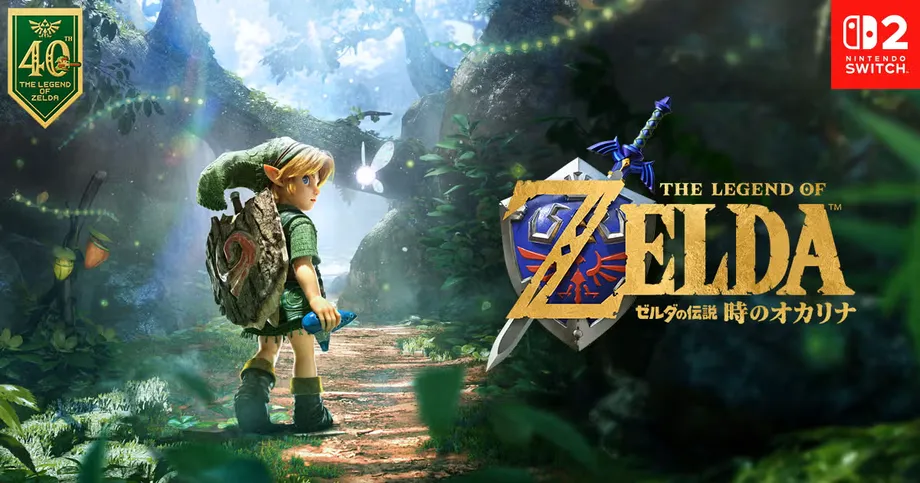
Nintendo will release The Legend of Zelda: Ocarina of Time for Nintendo Switch 2 on November 5, 2026, bringing new movement controls, redesigned puzzles and an unusual musical feature to its 1998 adventure: players can hum into the console's microphone and have Link respond on his ocarina.
Contents
- A familiar Hyrule returns with more than new graphics
- What is Link trying to do?
- Jumping changes the way rooms teach players
- Old puzzles have new answers
- A richer world can also be harder to scan
- The ocarina can answer your own melody
- Threads of Time and a phone companion
- Boss rematches and amiibo rewards
- The dates leading to November 5
- Key Points
Nintendo's official game page lists Japanese prices of 7,980 yen for the download and 8,980 yen for the physical edition, both including tax. The physical version costs 1,000 yen more, about 12.5% above the download price.
A new presentation released on October 14 introduces a place called Banmaden, written as 万魔殿 in Japanese, where players can study monsters they have defeated and challenge dungeon bosses again. Smartphone features and new amiibo figures extend the remake beyond the main adventure, although the two newly announced figures are scheduled for 2027.
The changes reach into the adventure itself. Preview sessions show a sword hidden behind a newly designed jumping challenge, a Forest Temple battle with a different hazard, and expanded conversations that give Hyrule's inhabitants more to say. Link can also sprint, move the camera freely and switch equipment through a quick selection menu.
Zelda series producer Eiji Aonuma described Nintendo's approach to revisiting the Nintendo 64 game with a short phrase:
faithful interpretation
The phrase fits the central choice visible in the previews: Nintendo is preserving the adventure's recognizable route while changing how individual rooms, battles and conversations work. Returning players will recognize the places, but remembering the original solution may not always be enough.
What is Link trying to do?
Ocarina of Time begins in Kokiri Forest, where Link is the one boy living without a fairy companion. His life changes when Navi arrives and leads him to the Great Deku Tree, the forest's guardian. The opening introduces exploration, conversation, equipment gathering and combat before sending him into the wider world.
Link eventually leaves the forest carrying the Spiritual Stone of the Forest and travels toward Hyrule Castle. There he meets Princess Zelda, who has sensed danger facing the kingdom and knows how to reach a sacred realm.
Entry requires three Spiritual Stones and a particular melody played on the royal treasure, the Ocarina of Time. Link's search for the remaining stones becomes part of a larger struggle over the Triforce, a legendary power connected to Hyrule's gods.
The adventure follows Link as both a child and an adult. Its dungeons are enclosed areas filled with enemies, locked doors and puzzles, where progress depends on understanding the space and using the right tools. A slingshot, bow or other item can be as important for opening a route as for winning a fight.
The remake appears to retain a directed sequence of discoveries rather than the freedom of Breath of the Wild or Tears of the Kingdom. Its new movement options allow occasional shortcuts, including reaching a forest hut's roof, while the main journey still guides players through particular destinations and challenges.
Jumping changes the way rooms teach players
Link can now jump at the press of a button and sprint across spaces such as Hyrule Field. In the Nintendo 64 original, running toward an appropriate edge triggered a jump automatically. Giving the player direct control changes both movement and the tasks designers can ask them to perform.
Preview accounts describe different control settings, including jumping with X or B and an option to assign it to Y. One preview described automatic jumping as replaced by button control, while another said players could retain the original control scheme. The practical change demonstrated across the sessions was the ability to choose when Link leaves the ground.
The camera is another major adjustment. Right stick control lets players look around freely, including in Castle Town, where the original used fixed viewpoints. Projectile weapons also support motion aiming, allowing players to adjust their aim by tilting the controller.
One preview described the game running at 60 frames per second, meaning the image updated 60 times each second during that session. Alongside quicker item selection, the new controls bring familiar actions from recent Zelda games into an adventure with an older structure.
Old puzzles have new answers
The Kokiri Sword provides an early example of how Nintendo has redesigned a challenge around the controls. In the original, its chest sat in a corner of a maze patrolled by a rolling boulder. Reaching it helped players learn how to reposition the camera and move safely through a three dimensional space.
The remake places the chest on a raised platform in the center of the room, with the boulder rolling around it. Players must jump to reach the sword. The room now teaches the new movement action at a point when Link needs to learn it.
Inside the Great Deku Tree, a floating platform has become a crumbling bridge built into the environment. Other previewed changes include fewer Skulltulas blocking one route and the removal of vines near a ladder. The first dungeon still introduces combat and puzzle solving, but several details have been rearranged.
The Forest Temple retains much of its familiar layout while changing particular obstacles. An elevator has been added to its block puzzle room, and rotating pillars have been removed from a challenge involving an arrow fired through a torch to thaw a switch.
A battle against Stalfos, sword wielding skeleton enemies, shows a more substantial adjustment. The original arena had a central hole that Link could fall through while the enemies moved across it. The remake replaces the hole with a shallow pool of acid that harms Link while allowing the skeletons to cross.
The revised fight keeps Link near the edges, but later reinforcements now emerge from the acid rather than arriving with a platform that fills the arena. The movement restriction lasts longer, changing the battle even though its basic idea remains recognizable. New cutscenes also give the Forest Temple's antagonists more presence.
A richer world can also be harder to scan
Kokiri Forest now has textured bark, moss, mushrooms, moving water and light filtering between trees. Link's clothes feature stitching, embroidery, fabric and leather details. The remake keeps a stylized, cartoon appearance while making its surfaces and settings much more elaborate.
Castle Town benefits from both the artwork and the free camera. Previewed streets contain banners, flowers, wanted posters and a stable, while some characters have moved to different locations. Conversations add small explanations about daily life, including a shopkeeper blaming Mido's blocked route for difficulties restocking supplies.
The Forest Temple uses mist along the floors, decaying architecture and bright stained glass to strengthen its haunted atmosphere. These details give different parts of the dungeon distinct appearances while retaining its twisting corridors and ghost encounters.
One preview session also exposed a practical cost of the extra detail: a player missed a chest holding a necessary key and needed guidance to continue. Decorative richness can compete with the visual clues that tell players where to go. Across the previewed areas, Nintendo's challenge is to make Hyrule interesting to inspect while keeping important objects easy to find.
The ocarina can answer your own melody
Nintendo describes the ocarina as an instrument with the power to manipulate time, open paths and move people's hearts. Playing melodies is part of how Link changes Hyrule and solves problems, making music a working tool within the adventure.
The remake adds a way to participate through sound. According to Nintendo's game page, humming toward the Nintendo Switch 2's built in microphone makes Link play the ocarina in accordance with that melody. The system also responds to notes played on a real instrument.
Nintendo warns that sound may not be recognized correctly when an external microphone is used. Players planning to experiment with musical input therefore have a specific equipment caution to consider.
The September gameplay presentation also demonstrated play using a physical Ocarina of Time instrument. Two product types, described as an instrument version and an electric version, were mentioned. Prices and release dates for those products have not been given.
The musical interaction adds a different kind of participation from pressing a controller button: a player supplies a tune, and Link answers within the game. It connects a central part of the story with something players can physically perform themselves.
Threads of Time and a phone companion
Threads of Time is the remake's adventure log, accessible from the pause menu. Preview sessions showed it recording key story events and pointing toward the next destination. For someone returning after a break, it offers a way to recover the thread of Link's journey without relying entirely on memory.
The log also fits the adventure's directed structure. Players may need to remember a conversation, find a particular person or travel somewhere before the next stage opens. Keeping those instructions available makes the sequence easier to follow.
ZELDA NOTES, a companion service within the Nintendo Switch App, adds maps and other information on a smartphone. The October presentation also introduced features named Today's Record and Rumor Quests, translated from the Japanese descriptions.
Today's Record lets players look back over that day's play. Rumor Quests use photographs displayed on the phone as clues for finding locations inside the game. This gives players another reason to examine Hyrule's rebuilt scenery, beyond moving toward the next story objective.
Quick item selection and voice language settings were also observed in previews. Together with the adventure log, these changes focus on the repeated actions surrounding exploration: recalling the objective, choosing equipment and navigating information.
Boss rematches and amiibo rewards
Banmaden is a new location somewhere in the game world, containing statues of monsters Link has already defeated. Players can review those creatures' characteristics and return to fights against powerful enemies, including dungeon bosses.
The feature gives completed battles a place in the continuing adventure. A player who wants to practice a difficult encounter or revisit a favorite boss can do so through a dedicated location, rather than only encountering that fight during the main story.
Nintendo also confirms rewards for using amiibo, its collectible figures that compatible games can scan. The new Child Link and Child Zelda figures unlock masks with special designs. Other amiibo from The Legend of Zelda series provide items useful during the adventure.
The two new figures are planned for 2027, after the game's November 2026 launch. Nintendo has described the masks as rewards for scanning them, but has not detailed additional effects for those masks. The existing Zelda figures provide a separate way to obtain adventure items.
The dates leading to November 5
The remake arrives during the Zelda series' 40th anniversary year. The first game was released in 1986, while Ocarina of Time followed on Nintendo 64 on November 21, 1998. The Switch 2 edition launches 16 days before the original game's 28th anniversary.
Nintendo's rollout has combined a September gameplay demonstration with an October introduction video and preview sessions covering selected parts of the adventure. Those sessions ranged from roughly 30 minutes to about 90 minutes, taking players through early areas and portions of the Forest Temple.
- 1986: The Legend of Zelda series begins.
- November 21, 1998: Ocarina of Time launches for Nintendo 64.
- September 8, 2026: Nintendo's Zelda anniversary presentation announces the November 5 release date and shows gameplay.
- October 14, 2026: A new introduction video presents Banmaden, smartphone features and amiibo rewards.
- November 5, 2026: The remake launches exclusively for Nintendo Switch 2.
- 2027: The Child Link and Child Zelda amiibo figures are scheduled for release.
The previews offer a consistent picture of Nintendo's approach: the main adventure remains recognizable, while individual challenges, movement and presentation receive substantial attention. Most of the demonstrated play concerns the opening journey and the Forest Temple; changes across the later dungeons have yet to be detailed.
For returning players, the attraction is a familiar Hyrule with enough altered rooms to require fresh attention. For newcomers, the remake pairs that older adventure structure with freer camera control, an objective log and more flexible movement. Its most distinctive addition remains the simplest to describe: hum a melody, and Link plays along.
Key Points
- Ocarina of Time launches for Nintendo Switch 2 on November 5, 2026.
- Japanese prices are 7,980 yen for the download and 8,980 yen for the physical edition, including tax.
- New controls include manual jumping, sprinting, free camera movement and motion aiming.
- Previewed puzzles and Forest Temple battles have been redesigned while much of the adventure's structure remains familiar.
- Nintendo confirms that humming or playing an instrument can make Link respond on his ocarina.
- Threads of Time tracks the journey, and ZELDA NOTES adds smartphone companion features.
- Banmaden allows players to study defeated monsters and challenge bosses again.
- Child Link and Child Zelda amiibo are planned for 2027 and unlock specially designed masks.