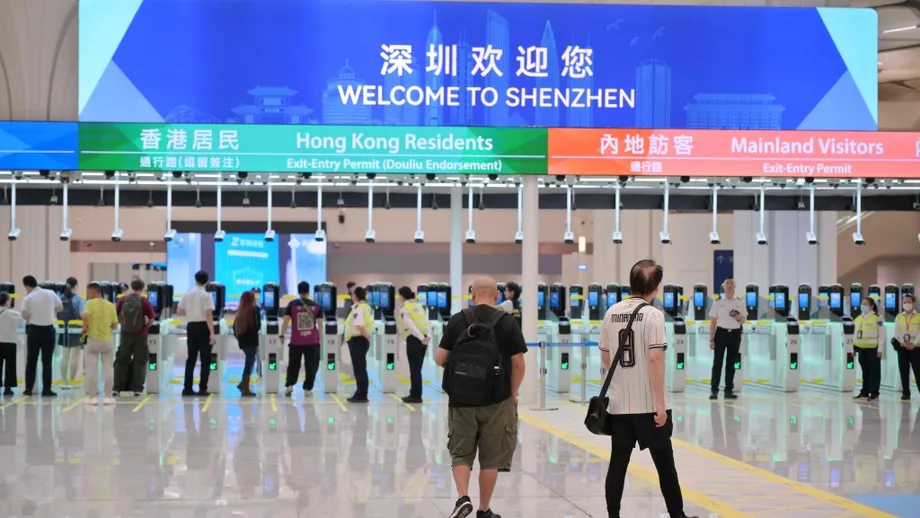
Nearly 10,000 travellers crossed in the busiest hour
Huanggang Port recorded 9,728 departures in a single hour on Sunday, October 18, 2026, as a surge of travellers heading from Hong Kong to mainland China brought queues and crowd controls to the redeveloped crossing during its first weekend of operation.
Contents
- Nearly 10,000 travellers crossed in the busiest hour
- What the departure figures show
- Why passengers encountered more than one queue
- The yellow alert and the afternoon recovery
- Passengers described difficulty finding the right line
- How authorities responded inside the terminal
- A busy Saturday came before Sunday's bottleneck
- More capacity, with different crossings serving different routes
- What travellers can check before leaving
- Key Points
The Immigration Department said more than 30,000 departures were recorded between 10am and 2pm. The Security Bureau gave a more detailed breakdown: about 19,000 people crossed between noon and 2pm, including the busiest hour from 1pm to 2pm.
Travellers faced two stages of waiting inside the building. At the peak, crowd management arrangements on level L2 involved waits of about 30 to 45 minutes, while queues in the departure hall on level L5 remained within 30 minutes, according to the bureau. Police controlled movement between floors as staff worked to clear the crowds.
The government's October 18 statement recorded an 899% increase in departures during the busiest hour compared with the corresponding period previously at Huanggang Port and the Lok Ma Chau control point. That means traffic reached almost 10 times the earlier level.
Queues began easing around 2pm. Authorities ended crowd controls on L2 at 2:10pm, and waiting in the L5 departure hall fell below 15 minutes by 2:40pm. The border waiting information service returned to normal status at about 3pm.
What the departure figures show
The Immigration Department's figure of more than 30,000 departures covers four hours, from 10am to 2pm. An initial figure of about 30,000 had described arrivals and departures together; the department's subsequent account specified that more than 30,000 people had left Hong Kong during that period.
The Security Bureau's narrower figures show how heavily traffic was concentrated around lunchtime. About 19,000 departures in two hours represents an average of roughly 9,500 an hour. The busiest hour, with 9,728 departures, was therefore part of a sustained surge rather than a brief spike.
The bureau said departures between noon and 2pm were 835% above the previous corresponding period. An increase of 835% means the new total was 9.35 times the earlier figure. Its 899% increase for the following hour means 9.99 times the previous level. These percentages compare the new crossing's traffic with the earlier Huanggang and Lok Ma Chau operation.
The government did not identify the exact dates used for that historical comparison. Its figures nevertheless show the scale of the increase that staff had to manage during the busiest part of Sunday.
Why passengers encountered more than one queue
Police and immigration officers managed passengers on both L2 and L5. People arriving by bus or minibus could not always proceed directly up the escalators. They had to wait for instructions and move towards the departure area in groups.
The Immigration Department described the arrangement as releasing passengers in waves. In practical terms, staff held people at an earlier point in the building, then let another group advance when space became available farther along the route.
The bureau listed waiting times separately for the two levels: 30 to 45 minutes for the crowd management arrangements on L2 and within 30 minutes in the L5 departure hall. Passengers moving through both areas could therefore encounter waiting before they reached the immigration queue itself. No single total journey time was published for everyone using the crossing.
Both the automated inspection channels and the staffed counters drew queues after passenger numbers began rising around 11am. For travellers, the delay involved movement through the building as well as the final document check.
The yellow alert and the afternoon recovery
The Security Bureau's border information service displayed a yellow, or busy, status for the departure hall, the first such alert reported since the redeveloped port opened. At about 1:45pm, its estimates were roughly 30 minutes for Hong Kong residents and 45 minutes for visitors leaving Hong Kong.
The sequence of crowd controls and falling waiting times shows how the pressure eased during the afternoon:
- Around 11am: the number of travellers heading towards mainland China began rising sharply.
- Noon to 2pm: about 19,000 people departed through Huanggang.
- 1pm to 2pm: departures reached their hourly peak of 9,728.
- Around 2pm: departure traffic began easing.
- 2:10pm: authorities removed the crowd controls on L2.
- 2:40pm: waiting in the L5 departure hall fell below 15 minutes.
- Around 3pm: the border information service returned to normal status.
The waiting estimates were snapshots of conditions at particular times. A passenger arriving during the lunchtime surge faced a different situation from someone reaching the departure hall after 2:40pm.
Passengers described difficulty finding the right line
Some passengers complained that the entrance to the staffed channels was narrow and that the end of the queue was difficult to find. One traveller described joining what appeared to be the back of the line three times, only to be told to move again.
Other passengers described winding queues and unclear directions. Some said they spent nearly 40 minutes getting through the crossing. Their complaints focused on finding the correct route and understanding where to wait, as well as the time taken to complete immigration checks.
A traveller identified as Ms Ng said her journey from home to completing the crossing took two and a half hours. She compared that with about one hour for a journey through Liantang, which she said she would normally expect. Her account included travel to the port, giving a broader measure of the disruption to her plans than the departure hall waiting estimate alone.
Passengers also said some staffed channels appeared closed. The Immigration Department said it deployed additional personnel and opened all channels and counters to clear the crowds. The passenger accounts and the department's response were not given matching timestamps.
How authorities responded inside the terminal
The Immigration Department said it adjusted staffing in response to passenger and vehicle flows, opened all departure channels and counters, and introduced immediate crowd controls. Police worked with immigration officers to manage the flow on L2 and L5.
Secretary for Security Chris Tang Ping-keung said management at the crossing had been strengthened and signs were being improved. He urged passengers to follow staff instructions and use either staffed counters or automated gates as directed.
Government departments had previously held a large exercise involving about 20,000 participants. Preparations included assessments of heavy passenger traffic, queue management, crowd diversion and coordination between departments. The Security Bureau said those contingency arrangements were activated during Sunday's surge and described operations as broadly smooth.
The passenger complaints show why directions matter alongside the number of open counters. A person who cannot find the correct queue may spend longer moving around the departure area, even while immigration checks continue. Tang's announcement about improving signs addressed that part of the experience.
A busy Saturday came before Sunday's bottleneck
The crossing had already handled about 130,000 passenger trips on Saturday, the opening weekend of the redeveloped port and the start of the Chung Yeung Festival holiday break. The figures included roughly 55,000 arrivals and 74,000 departures, with Hong Kong residents accounting for about 61,000 of those departures.
Across all Hong Kong checkpoints, authorities recorded about 1.35 million passenger trips that day. Hong Kong residents made more than 670,000 departures, while arrivals by mainland visitors exceeded 130,000.
Huanggang's approximately 130,000 trips amounted to roughly one tenth of the total across all checkpoints. Lo Wu remained busier for departures, recording more than 170,000, followed by the Lok Ma Chau Spur Line with more than 130,000.
Tang had described the new crossing's initial operations as smooth and said he expected passenger numbers to rise gradually. Sunday's concentrated lunchtime demand brought a different operating challenge from the total number of people processed across a full day.
More capacity, with different crossings serving different routes
Tang estimated that between 10,000 and 20,000 travellers had switched to the new port. He associated that movement with a reduction of about 3% to 7% in traffic at nearby Lok Ma Chau and Lo Wu since the opening.
Liantang and Shenzhen Bay had not experienced the same effect, he said, because passengers using those crossings tended to have different final destinations. That matters when choosing an alternative: a shorter immigration queue may come with a longer journey to reach the place a traveller actually wants to visit.
Tang said the new Huanggang crossing was intended to increase border capacity and improve the passenger experience, rather than simply draw people away from other checkpoints. He also said there were no immediate plans to close other crossings.
Saturday's large passenger total and Sunday's queues illustrate two separate demands on the new terminal. It must process substantial daily traffic while also accommodating sharp increases within a few hours. The crowd controls were the immediate response to that second demand.
What travellers can check before leaving
The Immigration Department advised passengers to plan early and consider other crossings. Tang also encouraged advance registration through the e-Channel app for access to automated immigration channels, alongside following directions at the terminal.
The Security Bureau's border information service and the Shenzhen iPort app provide waiting information updated every 15 minutes. Travellers can also check the Immigration Department's website and mobile app, and listen for radio or television updates about conditions at individual control points.
A useful comparison includes the route to the crossing, the queue there and the journey after entering the mainland. Ms Ng's account of a journey lasting two and a half hours shows why a departure hall estimate is only one part of the time a passenger needs to allow.
The Immigration Department said it would continue monitoring Huanggang and other checkpoints in real time and remain in contact with the Shenzhen General Station of Exit and Entry Frontier Inspection. The Security Bureau said departments would review conditions and adjust their response as passenger flows changed.
Key Points
- Huanggang recorded more than 30,000 departures between 10am and 2pm on October 18.
- The busiest hour, from 1pm to 2pm, saw 9,728 departures, an 899% increase over the previous corresponding period.
- Peak waits included 30 to 45 minutes for crowd management on L2 and within 30 minutes in the L5 departure hall.
- Authorities deployed extra staff, opened all channels and counters, and moved passengers through the building in groups.
- L2 controls ended at 2:10pm, and departure hall waits fell below 15 minutes by 2:40pm.
- Travellers were urged to check current waiting estimates, register for automated channels in advance and consider alternative crossings.