Household support grows while total spending rises
Mongolia's parliament has approved a revision to the 2026 budget that redirects 1.4 trillion tugriks from selected spending commitments toward pensions, public service salaries, welfare payments and essential supplies. About 435,000 older people are due to receive a new monthly base pension of 100,000 to 300,000 tugriks from November 1.
Contents
- Household support grows while total spending rises
- What changes for pensioners and caregivers?
- Teachers and public service workers receive more funding
- Why savings can accompany a larger deficit
- State companies carry more of the funding burden
- Food reserves and electricity support target living costs
- Investment falls as recurring commitments expand
- How the revision changes the original plan
- Payment dates and details still to settle
- Key Points
The final budget totals put revenue at 31.9 trillion tugriks and expenditure at 33.9 trillion tugriks, leaving a deficit of about 2 trillion tugriks. Total expenditure rises by 971.5 billion tugriks from the previously approved amount, even as the government cuts particular costs to finance its priorities.
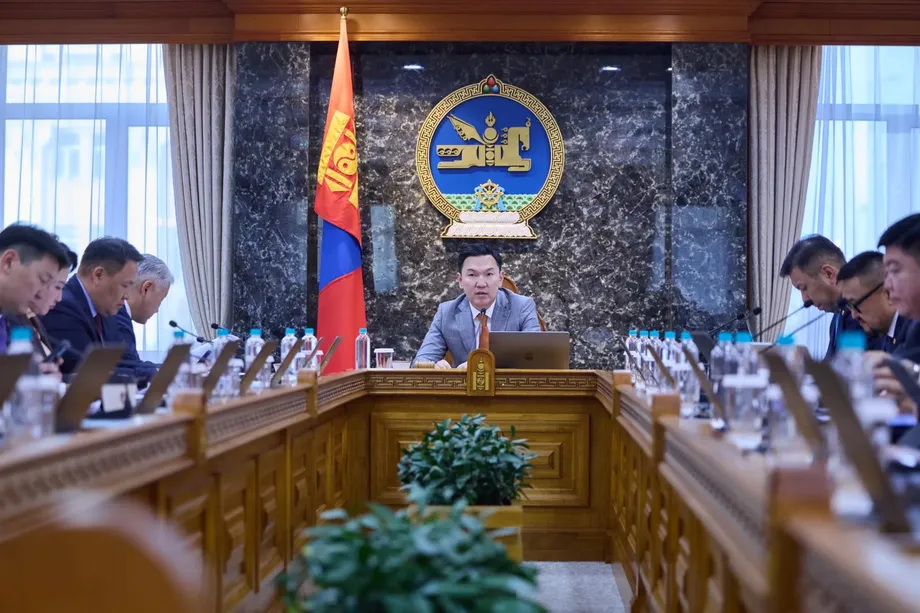
Prime Minister Nyam-Osoryn Uchral presented the revision as a way to protect household income against rising prices. Its practical reach extends from pension payments and teachers' salaries to electricity subsidies, food reserves and storage capacity for three months of fuel.
The central budget choice is a shift in where money goes. Restrictions on travel, vehicles, furniture and consulting release funds for benefits and salaries that households can spend immediately. Those payments also create costs that future budgets will have to carry.
Uchral, explaining the purpose of the revision, connected public spending directly to the people who finance it:
The budget is your tax money. The budget is the life and livelihood of the country and its households.
The package therefore has two measures of success: whether the promised payments reach recipients and whether the government can sustain them alongside public services, investment and debt obligations.
What changes for pensioners and caregivers?
The new base pension has an allocation of 196.3 billion tugriks. Uchral described it as a new form of support introduced through changes to the social insurance system, with monthly payments ranging from 100,000 to 300,000 tugriks for 435,000 older people.
Uchral said seven out of every 10 older pensioners currently receive the minimum pension of 769,000 tugriks. Against that amount, the announced base payment is equivalent to roughly 13% to 39%. The comparison shows the scale of the new support, although individual awards depend on the rules governing the payment.
The prime minister linked pension reform to the length of time people worked and the contributions they paid. He also promised another increase from the first day of the new year, taking price increases into account.
People with disabilities will receive a 26% increase in the social welfare pension, bringing it to 600,000 tugriks a month from November 1. The care allowance rises by 12% to 370,000 tugriks.
The government has allocated an additional 29.7 billion tugriks for these disability and care payments in November and December. Uchral gave a combined coverage figure of 171,400 that includes overlapping recipients, meaning a person counted under more than one category can appear more than once.
For households managing care responsibilities, the measures support both the person receiving care and the person providing it. Their purchasing power will depend on how food, heating, transport and other necessary costs move after the increases take effect.
Teachers and public service workers receive more funding
The revision allocates 170.1 billion tugriks to bring previously uneven salary increases across education, health, science and public services to a common level of 50%. During parliamentary consideration, that target was described as an increase relative to the salary base in 2025.
Another 674.5 billion tugriks covers the funding shortfall for a full year of increased salaries for 93,500 teachers and other education employees. Together, the two allocations described by Uchral amount to 844.6 billion tugriks.
Uchral also said the government had fully moved to a unified system in which supplementary pay is calculated using the increased salary. For an employee whose additional payments depend on their regular salary, the calculation method matters alongside the headline percentage.
The final budget breakdown separately puts the increase in public employee salary expenditure at 651 billion tugriks. That is a different total from the two allocations presented by the prime minister, making the detailed payroll schedules important for understanding how the funding categories fit together.
Schools, hospitals and other public services face the same practical task: turning an approved allocation into regular payments. For education, the 674.5 billion tugrik provision specifically addresses the gap between the salary commitment and the money needed to fund it across the year.
Why savings can accompany a larger deficit
The government's 1.4 trillion tugrik savings figure covers reductions in selected current and capital spending. Current spending pays for recurring needs such as salaries, benefits and subsidies. Capital spending pays for assets such as buildings and equipment.
Total spending can still rise when additions elsewhere are larger than the cuts. The final figures put expenditure at 33.9 trillion tugriks, an increase of 971.5 billion tugriks. With revenue of 31.9 trillion tugriks, the government must finance a gap of about 2 trillion tugriks.
During the fourth reading, the planned deficit stood at 2.048 trillion tugriks, up from 1.05 trillion tugriks, an increase of 998 billion tugriks. A separate figure of 2.2 trillion tugriks described the shortfall at the middle of the year. The final approval figures place the annual budget gap at about 2 trillion tugriks.
Finance Minister Zagdjavyn Mendsaikhan has maintained that the amendment stays within the approved expenditure ceiling and creates room through savings rather than borrowing for new spending. The final expenditure increase and the proposed borrowing arrangements make the accounting behind that position a central part of assessing the package.
The financing plan lists 1.8 trillion tugriks in government securities and 779.2 billion tugriks in foreign loans. Government securities are promises to repay investors who lend the state money. Together, the two financing amounts total 2.5792 trillion tugriks, above the stated deficit.
State companies carry more of the funding burden
Uchral said 1.6 trillion tugriks in dividends from state owned companies would go into the budget to support salaries, pensions and allowances. A dividend is a distribution of company profits to its owners, in this case the state.
The final revenue plan also lowers the tax revenue estimate by 1 trillion tugriks and uses company dividend income to replace that amount. The 1 trillion tugrik replacement and the 1.6 trillion tugrik dividend total describe different parts of the revenue plan.
State companies face restrictions on transport, fuel, furniture, vehicles, domestic and foreign travel, advertising, consulting and training. Uchral said company performance should increasingly be assessed through efficiency and returns, alongside professional management and public oversight.
During parliamentary consideration, 758 billion tugriks of the announced 1.4 trillion tugrik savings was associated with financing involving capital city securities. That represents about 54% of the headline savings figure. Changes to a large financing commitment therefore account for a substantial share of the adjustment, alongside restrictions on everyday operating expenses.
Dividends can help meet this year's commitments, but they depend on the profits companies generate and the cash they can distribute. Salaries and monthly pensions, by contrast, require repeated payments. Matching those recurring obligations with dependable revenue will be a continuing budget task.
Food reserves and electricity support target living costs
The revision assigns 140.9 billion tugriks to food and fuel reserves. Uchral announced plans for the following year to stockpile 20,000 tonnes of meat, 12,000 tonnes of vegetables and 100,000 tonnes of wheat, and to establish storage capacity for three months of fuel.
The three food categories total 132,000 tonnes, with wheat accounting for about 76%. These reserves are intended to provide supplies when shortages, delivery problems or price increases put pressure on households.
Mongolia also plans to continue temporarily setting customs and excise taxes on fuel imports at zero. Uchral described the country as entirely dependent on imported fuel and said efforts to improve border clearance, transport and storage capacity would continue.
Electricity receives 186.2 billion tugriks across two measures. A subsidy of 107.3 billion tugriks is intended to keep increases in imported electricity and generation costs from being passed to households. Another 78.9 billion tugriks goes to repairs and renewal at power stations and transmission and distribution networks.
The subsidy covers about 58% of that energy allocation, with repairs accounting for the remainder. One measure addresses household bills; the other addresses the equipment needed to keep electricity flowing during peak winter demand.
The broader final budget breakdown raises agriculture and energy subsidies by 480 billion tugriks. That covers a wider set of spending than the 186.2 billion tugrik electricity package described by Uchral.
Investment falls as recurring commitments expand
The final breakdown reduces spending on buildings and equipment by 160 billion tugriks. During the fourth reading, the broader investment programme was set to fall from 3.2802 trillion to 3.0307 trillion tugriks, with 36 of 738 projects removed.
That proposed programme reduction was 249.5 billion tugriks, or about 7.6%. The fourth reading also envisaged current spending rising by 1.1521 trillion tugriks. Together, those changes show the direction of the revision: more funding for recurring payments and less for investment.
The Fiscal Stability Council had already raised concerns about project planning in its 2026 budget assessment. Its review concerned the original budget bills submitted by the government on September 1, 2025, rather than the later revision.
The council found that the original draft met the special requirements of the Fiscal Stability Law. It also warned that the money needed to carry out the annual development plan exceeded the country's realistic financing capacity.
The council recommended excluding projects without sufficiently clear feasibility studies, designs, locations, land permissions and cost estimates. It identified weak links between some project costs and their intended results, as well as unclear responsibility for major programmes.
The original draft prioritised education, health and energy investment, including about 1 trillion tugriks for education and 1.3 trillion tugriks for health. Planned health projects included cancer, transplant and cardiovascular hospitals, improvements to hospitals in 17 provinces, emergency services and equipment.
How the revision changes the original plan
The Fiscal Stability Council's review provides a useful starting point for measuring the policy shift. The original draft proposed a 6% increase in social insurance and social welfare pensions. The revision adds the new base pension and sets a larger, 26% increase for the disability welfare pension.
The original draft also projected expenditure growth of 4.5% in 2026, following an expected 3.2% in 2025. The council recorded much faster increases in earlier years, including 24% in 2023 and 35.9% in 2024.
Budget expenditure was projected in that draft to fall from 35.1% of gross domestic product in 2025 to 32.2% in 2026. Gross domestic product, or GDP, measures the value of goods and services produced in the economy. The projected decline was 2.9 percentage points.
Uchral also announced closer coordination of local spending with the consolidated national budget. He said spending from local balances carried over from previous years had grown enough to affect total expenditure and compliance with budget requirements. Local authorities would retain autonomy while facing tighter control over spending expansion.
Payment dates and details still to settle
The main dates connect the original budget process, the parliamentary revision and the promised household payments:
- September 1, 2025: The government submitted the original 2026 budget bills to parliament.
- October 9, 2026: Parliament held the fourth reading of the revision and referred it to the Budget Standing Committee for preparation for the fifth reading.
- November 1, 2026: The announced start date for the new base pension and increased disability and care payments.
- November and December 2026: The period covered by the additional 29.7 billion tugriks for disability and care support.
- January 1, 2027: Uchral's promised next pension increase, taking price growth into account.
The exact final approval date requires confirmation because the date attached to the prime minister's statement is invalid. Further detail is also needed on individual base pension awards, the size of the January increase, the reconciliation of the salary totals and why the listed financing sources exceed the deficit. No expiry date was given for the temporary fuel tax relief.
For recipients, the immediate milestones are the November payments and the next pension adjustment. For the government, the longer task is to fund those commitments while maintaining essential infrastructure and keeping national and local expenditure within budget rules.
Key Points
- Parliament approved a 2026 budget revision with revenue of 31.9 trillion tugriks and spending of 33.9 trillion tugriks.
- The government is redirecting 1.4 trillion tugriks from selected commitments, while total expenditure rises by 971.5 billion tugriks.
- About 435,000 older people are due to receive monthly base pensions of 100,000 to 300,000 tugriks from November 1.
- The disability welfare pension rises to 600,000 tugriks and the care allowance to 370,000 tugriks.
- The package funds public service pay, food and fuel reserves, electricity subsidies and network repairs.
- State company dividends play a larger funding role as investment spending is reduced.