111 private contributions expose a gap in Taiwan's AI ambitions
Taiwan's government AI training collection has accumulated 7,161 data entries, but only 111 come from private contributors. That is about 1.6% of the total, a small share for a project intended to help artificial intelligence understand Taiwan's language, culture and everyday life.
Contents
- 111 private contributions expose a gap in Taiwan's AI ambitions
- What the government collection contains
- Why local language matters
- A criminal complaint changed the calculation
- Where copyright enters AI training
- Voluntary permission, not ownership transfer
- Paid cooperation already has a small precedent
- Legal exceptions and collective licences are competing options
- TAIDE shows why access and resources both matter
- Key Points
The Ministry of Digital Affairs launched the Taiwan Sovereign AI Training Corpus on December 24, 2025, with more than 200 government agencies contributing over 2,000 datasets containing 600 million tokens. Tokens are the small pieces of text that AI systems process, sometimes a character, sometimes part of a word.
Government participation has helped build scale. Bringing in publishers, authors, teaching platforms and news organisations presents a harder problem: developers need permission to copy valuable writing for training, while content owners want payment and control over how their work is used.
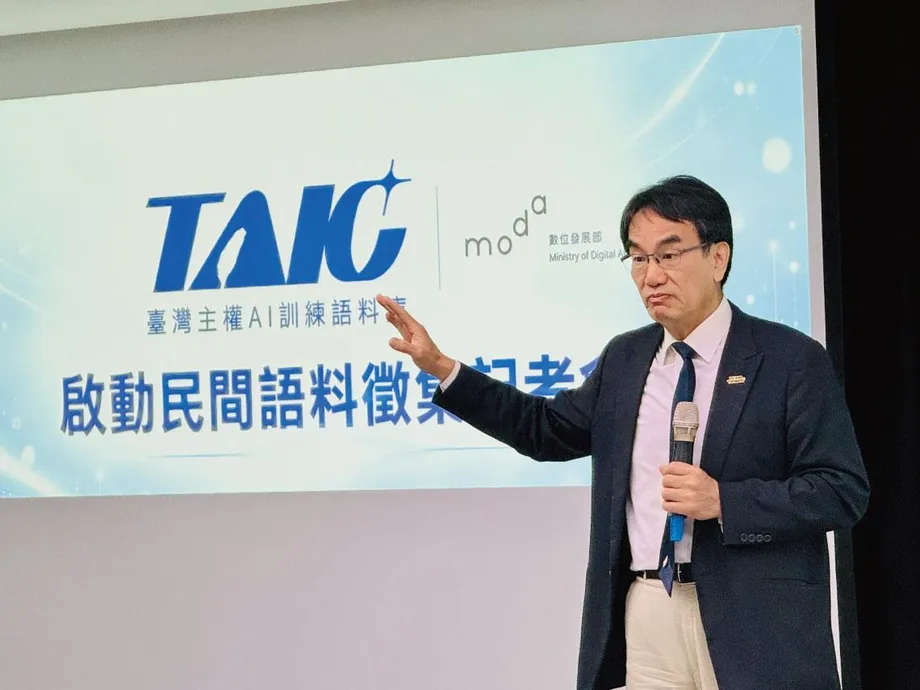
At an October 14, 2026, legislative hearing, Digital Affairs Minister Lin Yi-jing said private participation was voluntary and that the government wanted major AI companies, especially American companies, to pay for training content. News content was outside the current private collection programme.
The practical stakes reach beyond the size of a database. A model trained on Taiwanese writing can learn local vocabulary, explain cultural traditions and answer questions with Taiwan's institutions in mind. Yet the writers and organisations producing that material also depend on its commercial value. Taiwan is trying to expand access to their work while deciding who should pay, what permission covers and where copyright rules need clarification.
What the government collection contains
The ministry's December launch announcement describes a collection covering language, culture, education, biology and geography. It draws on more than ten years of Government Open Data and allows users to search for and download material.
The Ministry of Culture supplied datasets about public art and cultural assets. The Ministry of Education contributed dictionary data covering Taiwanese, Hakka and Mandarin. Those resources give developers material about local meanings and usage, alongside information about places, objects and traditions.
The ministry's corpus programme description also names the Council of Indigenous Peoples and the Hakka Affairs Council among participating agencies. Planned subjects include history, cultural heritage, tourism and local culture. The ministry says useful training text should be coherent, complete and fluent.
The September 2026 figures presented to legislators put the collection at more than 5,000 datasets and over 2.4 billion tokens. Compared with the 600 million tokens announced at launch, that is more than four times as much text measured in tokens. The 7,161 entries and 111 private contributions give another snapshot of its composition.
Why local language matters
Wu Che-yu, the new media artist who founded the community knowledge project Taiwan.md, argues that traditional Chinese writing occupies too little space in mainstream AI training. He puts its share of Chinese training material below 1%, an estimate he cites in explaining his project.
Wu's concern involves more than converting simplified characters into traditional ones. Taiwan and China use different words for some everyday things, and the same expression can carry different meanings. Local knowledge also extends to institutions, history and food, including dishes that receive less international attention than bubble tea or soup dumplings.
Taiwan.md uses AI tools to gather information from the web and edit articles about Taiwan's nature, society and history. Its 1,123 articles draw on publicly accessible academic papers, blogs and government information. Wu wants mainstream models such as ChatGPT, Gemini and Claude to encounter more writing that reflects Taiwanese experience.
The government describes its related ambition as sovereign AI: developing AI resources and capabilities that Taiwan can shape around its own needs. Its corpus supplies training material; projects such as Taiwan.md seek to make local knowledge easier for AI developers to find.
A criminal complaint changed the calculation
In July 2025, a National Taiwan University doctoral student faced a criminal copyright complaint after distributing a traditional Chinese corpus containing 140,000 unauthorised Central News Agency articles. The student had gathered material from an American website hosting open resources and shared the collection without charging.
The parties later settled. The student apologised, urged researchers to check whether their data sources were lawful and removed the entire corpus.
Wu says the case has made independent developers more cautious. His Taiwan.md team discards material when it sees a possible copyright problem, slowing the expansion of its collection. For a small project, the possibility of criminal proceedings adds personal risk to an already difficult task of checking permissions.
Several dates explain how the issue developed:
- Early 2023: The National Science and Technology Council initiated the TAIDE language model project with more than NT$200 million in funding.
- July 2025: The doctoral student faced a complaint over the corpus containing unauthorised news articles.
- December 24, 2025: The Ministry of Digital Affairs announced its sovereign AI corpus with 600 million tokens.
- September 2026: Ministry figures showed more than 5,000 datasets and over 2.4 billion tokens.
- October 14, 2026: Minister Lin told legislators that private contributions were voluntary and that paid content agreements were a policy goal.
Where copyright enters AI training
Chen Chi-tung, a senior lawyer at Luguo Law Firm, identifies copying as a central legal issue. Developers generally need to reproduce text before using it to train a model. Copyright law gives rights holders control over reproduction, subject to exceptions such as fair use.
Fair use allows some uses of protected work without permission under particular circumstances. Chen says Taiwan's existing provisions do not expressly address AI training, leaving developers uncertain about whether a court would accept their use.
Training and generating an answer also involve different acts. During training, a system processes examples to learn patterns. During generation, it produces text for a user. Chen proposes that legislation address the two stages separately, including the risk of outputs closely resembling protected works.
The Intellectual Property Office, under the Ministry of Economic Affairs, says possible legal adjustments remain under study. The Ministry of Digital Affairs identifies that office as responsible for copyright policy. A Control Yuan investigation also urged active work on adapting the legal framework after the Executive Yuan assigned the task to the office.
Voluntary permission, not ownership transfer
Minister Lin told the legislature's Transportation Committee that the private collection programme starts with publishers and electronic book platforms. He described four types of material being sought:
- Books whose copyright protection has expired.
- Book descriptions supplied by publishers.
- Selected preview passages from books.
- Works voluntarily licensed by individual authors.
Lin said the ministry sought permission to use works for AI training, with authors retaining copyright ownership. A licence lets another party perform specified activities under agreed conditions. Its scope can cover such matters as permitted uses and duration.
Democratic Progressive Party legislator Lin Chu-yin questioned how contributors would be paid, what would happen if they later withdrew permission and how their interests would be protected when training led to other products. Taiwan People's Party legislator Hung Yu-hsiang proposed a service covering quality checks, rights clearance, paid acquisition and management of different licensing categories.
The ministry has published the Taiwan Sovereign AI Training Corpus License, Version 1, and worked with the Intellectual Property Office on examples to help agencies apply it. Standard terms aim to reduce repeated negotiations and copyright disputes. The ministry is also planning incentives for contributions. Payment rates, withdrawal arrangements and rules for resulting products have not been settled in the proposals described publicly.
Paid cooperation already has a small precedent
Lee Po-feng, chairman of the Open Culture Foundation, says asking publishers to provide valuable material free of charge is unlikely to produce enough participation. He points to a small training project that secured cooperation from media and education platforms through a negotiated exchange.
The terms included a single licensing payment, a limit of two years on use of the data and priority access to the resulting model for participating content providers. The arrangement gave contributors money, a defined period of use and something useful in return.
Yuan-Liou Publishing chairman Wang Rong-wen also argues that government and commercial developers should budget for content licences. He sees fear of criminal complaints as a constraint on both private developers and officials trying to support AI projects.
Lin told legislators that paid access for major AI companies was the government's eventual goal. He said copyright disputes surrounding new technology could last three to five years, so the ministry was beginning with material carrying fewer disputes. His timetable described the likely duration of controversy rather than a deadline for legislation or a payment scheme.
Legal exceptions and collective licences are competing options
Chen proposes a dedicated AI chapter in Taiwan's Copyright Act. It would establish an exception for text and data mining, require disclosure of training sources and reduce exposure to criminal proceedings for qualifying activity.
Text and data mining means using software to analyse large amounts of material and identify patterns. The European Union, Japan and Singapore have exceptions for certain forms of this activity, although their rules and conditions differ. Chen sees those approaches as models for a Taiwanese discussion.
Lee proposes an earlier administrative step: guidance explaining which training uses authorities consider fair use and which create infringement risks. He cites Japan's Agency for Cultural Affairs and its 2024 AI copyright checklist and guidance as an example of making expectations more practical for developers and creators.
Chen also suggests collective licensing, drawing on the music sector's Music Copyright Society of Chinese Taipei, known as MÜST. Under that model, an organisation manages permissions for many rights holders, collects fees and distributes payments. For AI, a similar service could reduce the work of negotiating separately with hundreds of publishers or authors.
Chang Chung-hsin, an adjunct assistant professor at National Taipei University of Technology's intellectual property institute, takes a different view. He argues that developers should pay under existing copyright rules rather than seek legal changes. His position puts negotiated access to valuable publishing and news content at the centre of the solution.
TAIDE shows why access and resources both matter
Taiwan's earlier Trustworthy AI Dialogue Engine, or TAIDE, illustrates how strongly a model can depend on a few accessible collections. Established as a National Science and Technology Council project in early 2023, its initial development received more than NT$200 million.
TAIDE drew training material from 15 government agencies. Around four million Central News Agency articles accounted for 70% of its textual data. The material was sourced with copyright concerns in mind, showing how organised access to substantial news archives can support a local model.
Principal investigator Yuh-Jye Lee, of the Taiwan Information Security Center at Academia Sinica, explained the value of having a domestic alternative:
In the beginning we are probably not able to match the large engines, but having our own dialogue engine means we have at least a choice.
The early model was built on Meta's Llama 2 and had seven billion parameters, the numerical settings a model adjusts while learning. The National Center for High-performance Computing had 1,028 V100 graphics processors and purchased nine H100 processors in November 2023 for the project, while maintaining its regular services.
National Chung Hsing University's Demeter GPT agricultural question answering project later switched from ChatGPT to TAIDE. Associate Professor Fan Yao-chung described better Chinese accuracy after additional training. The lab had previously paid NT$1 to NT$2 per answer to OpenAI; running TAIDE locally shifted its operating expense to its own computers and electricity.
Taiwan's corpus initiative addresses the text supply behind such applications. Government dictionaries and cultural records provide a foundation. Wider access to publishing, specialist teaching material and journalism will depend on agreements that developers can afford and content owners are willing to accept.
Key Points
- Private contributors supplied 111 of 7,161 corpus entries, about 1.6%.
- The government announced 600 million tokens at launch in December 2025; by September 2026, the total exceeded 2.4 billion.
- Minister Lin says private participation is voluntary and authors retain copyright ownership.
- News content is outside the current private collection programme, while the ministry seeks paid agreements with AI companies.
- A July 2025 criminal complaint over 140,000 unauthorised news articles increased concern among independent developers.
- Proposals include clearer fair use guidance, a data mining exception, collective licensing and direct payment under existing law.