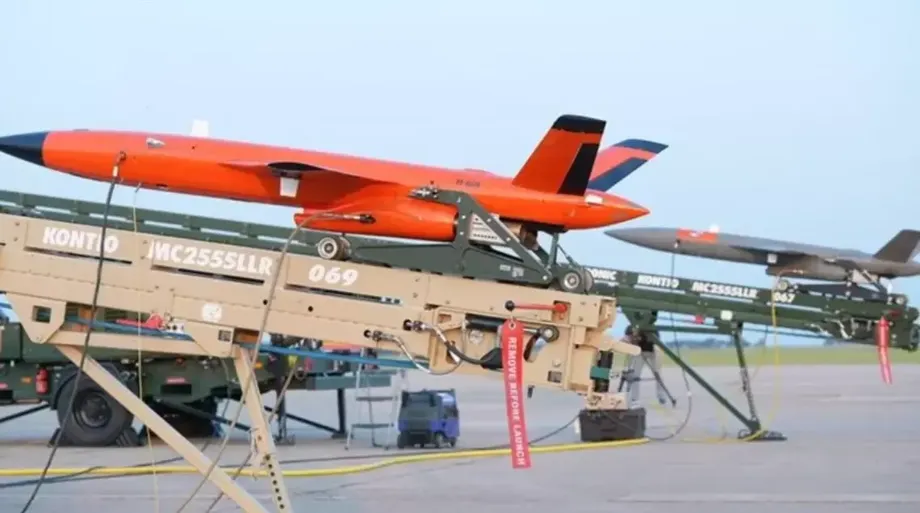
Southern Taiwan Trials Advance a Jet Attack Drone
Taiwan and US defense contractor Kratos have completed flight evaluations of the Mighty Hornet IV attack drone in southern Taiwan, with Kratos executive Steve Fendley saying the aircraft met every evaluation target despite strong winds and severe gusts. Details published on October 16, 2026, describe an aircraft intended to attack landing ships, launch without a runway and cost less than US$500,000 each.
Contents
- Southern Taiwan Trials Advance a Jet Attack Drone
- How the Testing Milestones Fit Together
- Turning a Training Target Into a Weapon
- What the Performance Figures Mean
- Why Coastal Defense Is the Main Mission
- The Cost Calculation Behind Large Numbers
- Interception and Other Proposed Roles
- Three Stages Toward Manufacturing in Taiwan
- Foreign Interest and a Possible Larger Aircraft
- Key Points
The program pairs a modified Kratos MQM-178 Firejet target drone with sensors, mission systems and an explosive warhead developed by Taiwan's National Chung-Shan Institute of Science and Technology (NCSIST). Its reported range reaches 1,000 kilometers, while Fendley puts its endurance at about two hours and its speed between Mach 0.7 and Mach 0.85.
The flight evaluations follow an earlier, narrower milestone. In its February 5, 2026, joint testing announcement, Kratos said the partners had successfully tested Taiwan's payload and mission system with the aircraft, without needing design revisions. That statement scheduled flight testing for later in 2026.
For Taiwan, the attraction is a weapon that could be dispersed along the coast rather than concentrated at airfields. For the partners, the next challenge is turning a successfully tested aircraft into something that can be manufactured in large numbers. Their proposed production plan moves from American supplied airframes to assembly in Taiwan, with eventual technology transfer dependent on US government approval.
How the Testing Milestones Fit Together
The Mighty Hornet IV emerged publicly in September 2025 as an attack aircraft derived from the Firejet, a drone originally built to serve as a target during military training. Its development has involved several kinds of testing, from individual systems to the integrated aircraft.
- September 2025: Kratos and NCSIST unveiled the aircraft, which appeared at the Taipei Aerospace and Defense Technology Exhibition. An account published on September 19 identified an attack role against ships.
- January 2026: An earlier development account described plans for testing in the United States, alongside manufacturing process checks and engineering improvements.
- February 5, 2026: Kratos announced successful integration testing and said flight testing would follow later that year.
- October 2026: Fendley described successful flight evaluations in southern Taiwan. Details published on October 16 said all evaluation targets had been met.
The January entry was a proposed schedule. February's company statement documented the integration milestone and the next planned flight stage; October's account described the subsequent flying results.
Fendley, president of Kratos' Unmanned Systems Division, explained the February achievement in the company's announcement:
The success of this testing by the two organizations represents a significant milestone which enables progression to flight testing.
NCSIST's technical team also traveled to Kratos' design and production facility in Oklahoma City to finalize requirements and design work. The February announcement placed that visit after months of planning, design and subsystem testing at the partners' respective facilities.
Turning a Training Target Into a Weapon
The MQM-178 Firejet supplies the aircraft at the center of the project. NCSIST supplies the equipment that gives the modified aircraft its attack mission, including locally developed sensors, guidance and control equipment, electronic warfare systems and a high explosive warhead.
Fendley's description of the conversion illustrates how the partners are reusing the original design. Equipment in the nose that could simulate another aircraft's radar signals is replaced by sensors. Positions beneath the wings that previously could carry equipment for target training are adapted for warheads.
The resulting aircraft is described as a jet powered loitering munition. A loitering munition can remain airborne while seeking or waiting for a target before attacking it. The Mighty Hornet IV has been described as capable of reconnaissance while cruising and of striking through a final dive.
Kratos' stated approach is to combine an established American aircraft with Taiwanese mission equipment rather than develop every component from the beginning. Its February statement said using mature Firejet technology had shortened the journey from concept to a functioning system. The partners' stated objective is a large quantity of Mighty Hornet IV systems in Taiwan, both to discourage an attack and to be ready for operational deployment.
What the Performance Figures Mean
Fendley puts the aircraft's speed at Mach 0.7 to Mach 0.85, compared with Mach 0.8 in Kratos' February announcement and approximately Mach 0.69 in an earlier development account. Mach expresses speed relative to the speed of sound, so these figures describe fast flight below the sound barrier.
Kratos also lists a service ceiling above 35,000 feet. That is the upper altitude at which an aircraft is designed to operate effectively. Fendley's later description adds the ability to withstand brief loads of 12G and sustained loads of 9G, compared with roughly 2G to 3G for the ordinary slower drones he discussed.
A G is a measure of acceleration relative to Earth's gravity. Higher G limits allow an aircraft to withstand sharper maneuvers, although the loads also put greater demands on its structure. Fendley said the autonomous flight control software performed well during the strong winds and gusts encountered in Taiwan.
The reported 1,000 kilometer range and roughly two hours of endurance describe different aspects of performance: how far the aircraft can travel and how long it can stay airborne. An earlier development account also gave a warhead weight of about 30 kilograms. The exact flight dates, detailed test results, flight profiles behind those figures, delivery quantities and operational deployment schedule have not been publicly specified.
Why Coastal Defense Is the Main Mission
Fendley identifies coastal defense as the Mighty Hornet IV's central role in Taiwan. His proposed deployment concept places launch systems at concealed locations along the shoreline, including wooded areas, from which aircraft could attack ships carrying an invading force.
The drone can launch from a pneumatic rail or with rocket assistance, removing the need for a conventional runway. Fendley says the system can be deployed and airborne within 30 minutes. That makes the launch equipment, its transport and the crews operating it central parts of the coastal defense concept.
Dispersal changes where an opponent would need to look for the weapon. Instead of launching solely from established airfields, aircraft could take off from multiple coastal positions. In Fendley's account, that combination of concealed launch locations and speed would support attacks against landing ships during an attempted assault.
The mission also connects with earlier proposals to operate the drone alongside Taiwan's Hsiung Feng II and Hsiung Feng III anti ship missiles. The proposed combination would give defenders several types of weapons to employ against an approaching naval force, with different costs and flight characteristics.
The Cost Calculation Behind Large Numbers
Fendley estimates a unit price below US$500,000 and argues that the aircraft could deliver close to 90 percent of a conventional fighter's combat effectiveness. He presents that comparison as part of the commercial and military case for buying large numbers; no common measure for the percentage accompanied his statement.
His more concrete comparison concerns interception costs. He cites air defense missiles costing US$1 million to US$2 million each. Against a drone priced below US$500,000, a single such interceptor would cost more than two to four times as much as the attacking aircraft.
The pressure in that example comes from both spending and ammunition stocks. A defender that fires expensive missiles at repeated drone attacks uses weapons that may be difficult to replace quickly. A defender that withholds fire accepts the risk of a strike against a ship or another target.
Kratos calls its approach "affordable mass," meaning enough relatively inexpensive aircraft to make numbers a useful part of the force. For Taiwan, the practical appeal is the possibility of spreading attack capacity across many platforms rather than concentrating all of it in a smaller number of more expensive weapons.
Interception and Other Proposed Roles
Fendley also sees a role against fast attack drones, specifically mentioning Russia's Geran-4 and Geran-5 systems used in the war in Ukraine. His argument is that some slower interceptors powered by electric motors and batteries may struggle to catch fast targets, while the Mighty Hornet IV's jet propulsion gives it greater speed.
That proposal would add an air defense role to a project chiefly presented as a strike weapon. Finding, tracking and reaching a moving aircraft would require the sensors and mission systems to support that task as well as the airframe's speed and maneuverability.
Earlier development descriptions outlined further possible configurations for reconnaissance, electronic warfare, communications relay and target or decoy missions. A communications relay carries signals between users that cannot communicate directly; electronic warfare equipment can detect or interfere with electronic signals.
The longer range strike concept includes pairing the Mighty Hornet IV with the Hsiung Feng IIE cruise missile. An earlier account gave that missile a range of 500 to 700 kilometers, compared with the drone's reported 1,000 kilometers. The proposed pairing would combine a cheaper attack platform with an existing missile system.
Three Stages Toward Manufacturing in Taiwan
Kratos and NCSIST are planning local manufacturing in three stages. The first keeps airframe supply in the United States while Taiwan integrates its mission equipment. The second shifts assembly and testing to Taiwan using component kits supplied by the American partner.
The third stage would involve technology transfer and independent mass production by Taiwanese manufacturers, subject to US government approval. That approval is a stated condition for the final stage, making the manufacturing arrangement as important to the program's expansion as the aircraft's flight performance.
Earlier development work included manufacturing process validation and engineering improvements. Carbon based composite specialist Carbon-Based Technology was identified as providing aerospace carbon fiber manufacturing processes and engineering support, with attention to structural integrity, heat resistance, reliability and repeatable production.
Those requirements become more demanding when a prototype moves into quantity production. Each aircraft needs consistently manufactured structures and components capable of handling the planned speeds and maneuvering loads. The production work therefore addresses how to make many aircraft to the same standard.
An earlier account also said the program was being considered for inclusion in a proposed NT$1.25 trillion special defense budget. That figure refers to the wider proposed spending package, rather than an allocation of that amount to Mighty Hornet IV.
Foreign Interest and a Possible Larger Aircraft
Dozens of countries have made inquiries about the Mighty Hornet IV, according to details released with the October testing account. Seven had advanced to discussions about budgets and quotations, giving the partners potential customers beyond Taiwan as local production develops.
Kratos and NCSIST are also exploring a larger aircraft collaboration based on the XQ-58 Valkyrie. The concept would extend their division of work, combining an American aircraft platform with Taiwanese systems and technology.
The proposed Valkyrie project includes potential cooperation between crewed and uncrewed aircraft. In simple terms, that means aircraft with pilots working alongside aircraft without pilots, with their missions and systems coordinated.
The immediate Mighty Hornet IV program has a more specific task: carry the southern Taiwan flight results into a production arrangement capable of delivering the large numbers the partners want. Its progress brings together flight control, Taiwanese mission equipment, launch flexibility and the economics of repeated attacks. Manufacturing capacity and the approvals needed for technology transfer will shape how far that plan can expand.
Key Points
- The Mighty Hornet IV completed flight evaluations in southern Taiwan, with Fendley saying every evaluation target was met despite strong winds.
- Kratos' February 5, 2026, announcement documented an earlier payload and mission system integration test, with flight testing planned afterward.
- The aircraft combines a modified MQM-178 Firejet with Taiwanese sensors, mission equipment and a warhead.
- Fendley cites speeds of Mach 0.7 to Mach 0.85, about two hours of endurance and a unit price below US$500,000.
- Coastal defense is the main proposed mission, supported by launches without runways and dispersed deployment.
- A three stage manufacturing plan would lead toward production in Taiwan, with technology transfer subject to US approval.