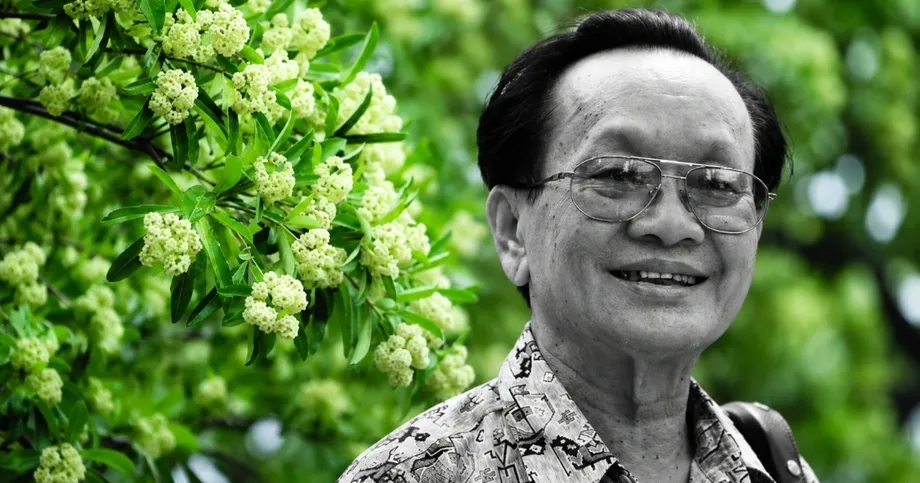
A familiar love song returns through an argument about flowers
Hồng Đăng wrote Hoa sữa in 1978 for director Đức Hoàn's film Hà Nội mùa chim làm tổ, imagining a flower he had never seen or smelled. Nearly half a century later, an argument about that flower's powerful fragrance has brought his song back into public attention.
Contents
- A familiar love song returns through an argument about flowers
- A film commission and a poet's suggestion
- How the flower carries the story
- The singers who gave it a wider audience
- Thanh Lam's memories of recording and Hanoi
- Why the scent divides residents
- What doctors say about headaches and sensitivity
- Choosing where trees belong
- A career much larger than one song
- Key Points
By 1 p.m. on October 15, searches for "Hoa sữa" and "Hoa sữa Hồng Đăng" had risen sharply on Google Trends following several days of social media discussion. The renewed interest has connected three stories: the unlikely creation of a Vietnamese love song, the singers who carried it across generations, and the practical problems of living beside trees whose blossoms can fill a home with scent.
The search phrase "Hoa sữa của Hồng Đăng" was also reported to display more than 200 million results. That number describes displayed search results; the Google Trends observation concerns changes in search interest. No numerical measure of the search increase or corresponding listening figures was given.
For many listeners, Hoa sữa captures autumn in Hanoi through streets, memories and a romance that could not last. For some residents, the real flowers bring a less comfortable experience: hours of strong fragrance through windows and balconies. Both responses help explain why the song keeps returning whenever the trees bloom.
A film commission and a poet's suggestion
Đức Hoàn commissioned Hồng Đăng to write the main music for Hà Nội mùa chim làm tổ in 1978. The film follows memories of an unsuccessful romance against the setting of Hanoi during its early years of reconstruction, when everyday life was modest but retained its own poetry.
Hồng Đăng, originally from Nghệ An, had spent relatively little time in the capital. He struggled for nearly a month to find a subject that would serve the film. The breakthrough came from his friend, poet Nguyễn Hương Trâm, who suggested hoa sữa, a fragrant flower then associated with trees along Nguyễn Du Street.
Her suggestion unlocked the song within a few dozen minutes. Hồng Đăng relied on imagination: he had yet to see the flower, learn its appearance or experience its fragrance. The image that later became so closely connected with Hanoi began as a way to express the film's emotional world.
The contrast between a month of searching and minutes of writing is central to the song's history. Nguyễn Hương Trâm supplied a concrete detail of the city, and Hồng Đăng turned it into a setting for love and remembrance.
How the flower carries the story
Hoa sữa opens with familiar images from nature: flowers waiting for sunlight, wind seeking trees and the sky longing for white clouds. Those images give listeners a simple way into the feelings of two people who cannot be together but continue to treasure what they shared.
The woman's longing is expressed through nature. The man's memories gather around familiar roads, singing and a passing trace of fragrance. The flower repeatedly connects those feelings to a place, making a street corner part of the remembered relationship.
Hồng Đăng's gentle melody supports that movement between affection and sadness. The closing questions return to the fear of being forgotten, leaving the relationship unresolved rather than giving it a happy ending.
Students and other young listeners shared the song by word of mouth and copied its lyrics into keepsake notebooks. Its early circulation was personal and informal, built around words people wanted to remember. The same connection between lyrics and private memory now appears when social media users borrow the song to express their longing for Hanoi.
The singers who gave it a wider audience
Lê Dung first performed Hoa sữa in Hà Nội mùa chim làm tổ. Some young listeners responded warmly, but the song initially attracted less attention than expected. It gradually faded from discussion, and relatively few singers chose to record it.
Nhã Phương changed its fortunes during the 1980s. When Hồng Đăng visited southern Vietnam for work, she sought his permission to make a recording. She and Bảo Yến were then among the most popular singers in the southern music scene, giving her interpretation a route to a much larger audience.
Hồng Đăng later credited Nhã Phương with bringing Hoa sữa onto the music stage, while identifying Thanh Lam's video performance, directed by Phạm Hoàng Nam, as another step in reaching the wider public. Their contributions came at different stages: Nhã Phương revived the song through recording and performance, and Thanh Lam helped extend its reach through video.
Thanh Hoa, Hồng Nhung, Hồ Quỳnh Hương, Mỹ Linh and Lệ Quyên also performed it. Hồng Đăng welcomed the different qualities singers brought to his composition. He described Hồng Nhung's interpretation as clear and bright and Thanh Lam's as passionate and alluring.
Hồng Đăng, the song's composer, expressed particular affection for Thanh Lam's recording:
No one can sing it like Thanh Lam!
His enthusiasm accompanied a broader appreciation of individual interpretations. Over time, the song became a shared repertoire rather than a work attached to a single voice.
Thanh Lam's memories of recording and Hanoi
Thanh Lam first connected with Hoa sữa through a recording program by Phương Nam Film. She later sang it regularly at events devoted to Hanoi, and the song became closely associated with her name.
After Hồng Đăng died on March 21, 2022, she recalled that she had been pregnant with her daughter Nguyễn Thiện Thanh while filming it. She affectionately described the child in her womb as her first audience for that performance. The recollection places a family memory inside a song already concerned with memory and affection.
Quang Trung Street also formed part of Thanh Lam's relationship with the work. She remembered returning from performances on quiet autumn nights, encountering the faint scent of hoa sữa and feeling a deeper connection to Hồng Đăng's lyrics.
For Thanh Lam, the song preserves something of Hanoi's spirit through an unassuming piece of music. Her recollections help explain its durability: audiences can connect its imagined romance with their own routes through the city, their own youth and their own moments of separation.
Why the scent divides residents
Hoa sữa is the tree species Alstonia scholaris. Singapore's National Parks Board, known as NParks, records that it can grow to 60 metres and that its flowers have a very strong scent when blooming. Its size and fragrance are practical considerations for street planting, alongside its shade and cultural associations.
A person walking past a flowering tree may experience the scent for a few minutes. A family living beside several trees may encounter it for hours through a bedroom window or balcony. The difference in exposure helps explain why one person describes a romantic autumn fragrance while another wants the windows shut.
Hồng Đăng himself encountered the argument. He recalled receiving joking complaints each autumn from people who blamed his song for the popularity of planting hoa sữa along roads. He treated the complaints as a humorous part of his working life and valued the fact that audiences continued to embrace the music.
Today's social media discussion repeats that mixture of affection and irritation. Some users quote the lyrics to recall Hanoi; others turn the same words into complaints about overpowering blossoms. The flower keeps the song in public conversation, even when the conversation begins with discomfort rather than nostalgia.
What doctors say about headaches and sensitivity
Dr Nguyễn Huy Hoàng, a member of the Vietnam Underwater and Hyperbaric Medical Society, explains that reactions to fragrance depend on its intensity, the length of exposure, personal sensitivity and health. People on the same street can therefore have very different experiences, including pleasure, headache, dizziness or nausea.
The nose contains both the system that detects smells and sensory branches of the trigeminal nerve, which carries sensations from parts of the face. Irritating substances can stimulate those branches. Smell and sensation also connect with networks in the brain involved in emotion and pain.
Migraine is one relevant condition. It is a neurological disorder that can involve nausea and sensitivity to light, sound and smells, as well as head pain. A systematic review published in 2025 combined 58 studies involving 22,299 patients with migraine. It estimated that 47.8% experienced sensitivity or aversion to smells, while 40.1% reported migraine associated with odor triggers.
Those percentages describe patients with migraine and their responses to smells generally. Assessing the experience of Hanoi residents during hoa sữa season requires local information about exposure and symptoms. Dr Hoàng also explains that sensitivity to smell can develop during the warning stage of a migraine, before the headache begins.
Pollen allergy involves a different process: the immune system reacts to pollen proteins. A study in eastern India examined 140 patients who already had respiratory allergies; 40, or 28.57%, had a positive skin prick test to Alstonia scholaris pollen extract. A doctor assesses such a result together with the person's medical history and symptoms during exposure.
Dr Hoàng advises people who feel unwell around strong fragrance to move to a more comfortable place and reduce exposure. At home, temporarily closing windows facing the scent may help. Adding perfume or room spray can introduce another strong smell. People with existing conditions should continue treatment as directed and seek assessment for symptoms such as wheezing or breathlessness.
Choosing where trees belong
Architect Trình Phương Quân argues that the response should focus on planting design: how many trees occupy a street, how close they stand to homes and whether they are mixed with other species. A tree suitable for a spacious park may create a different experience beside apartment windows on a narrow pavement.
His proposed approach combines selective preservation, limits on new planting and adjustments based on actual effects and community consultation. Mature trees retain landscape value, while residents living beside dense rows need their daily experience considered when planting decisions are made.
Shade, space for growth, maintenance, safety, biodiversity and effects on nearby households all belong in that assessment. Mixing species can distribute those functions across an urban landscape instead of expecting one tree to meet every need.
For residents, the concrete issue is whether they can use their homes and streets comfortably. For people attached to hoa sữa, it is also the preservation of trees tied to decades of memories. Careful placement offers a way to take both concerns seriously.
A career much larger than one song
Hồng Đăng was born Phan Đăng Hồng on January 1, 1936, in Nghệ An and died on March 21, 2022, aged 86. His catalogue contains more than 700 works across songs, choral music, instrumental compositions, film and theatre music. He composed music used in more than 70 films.
His other familiar film songs include Lênh đênh for Đời hát rong, Biển hát chiều nay for films about the sea, and Nỗi nhớ đêm đại dương for Những hạt muối của biển. He also served as deputy secretary general of the Vietnam Musicians Association and edited music publications.
The main dates in the song's development and his recognition trace a career extending far beyond its current return to attention:
- 1978: Hồng Đăng wrote Hoa sữa for Hà Nội mùa chim làm tổ, with Lê Dung performing it in the film.
- 1980s: Nhã Phương's recording helped bring the song to a wider audience.
- 2001: He received the State Award for Literature and Arts.
- October 28, 2021: He received the Bùi Xuân Phái – For the Love of Hanoi Award for contributions to the capital's music, including Hoa sữa.
- March 21, 2022: He died aged 86. He was posthumously awarded the Hồ Chí Minh Prize for Literature and Arts that year.
Singer Tùng Dương, composer Quốc Bảo and screenwriter Trịnh Thanh Nhã were among those who shared tributes after his death, remembering his kindness, work and friendship. The current attention brings listeners back to a composition that travelled from a film commission to notebooks, recordings, video performances and autumn conversations.
Key Points
- Search interest in Hoa sữa rose on October 15 amid debate about the flower's strong fragrance.
- Hồng Đăng wrote the song in 1978 for a film before seeing or smelling the flower himself.
- Nhã Phương's recording and Thanh Lam's video performance helped expand its audience.
- Reactions to the scent vary with exposure, sensitivity and health; migraine and pollen allergy involve different processes.
- Architect Trình Phương Quân recommends considering tree density, distance from homes and a mix of species.
- Hồng Đăng left more than 700 works, with music used in more than 70 films.