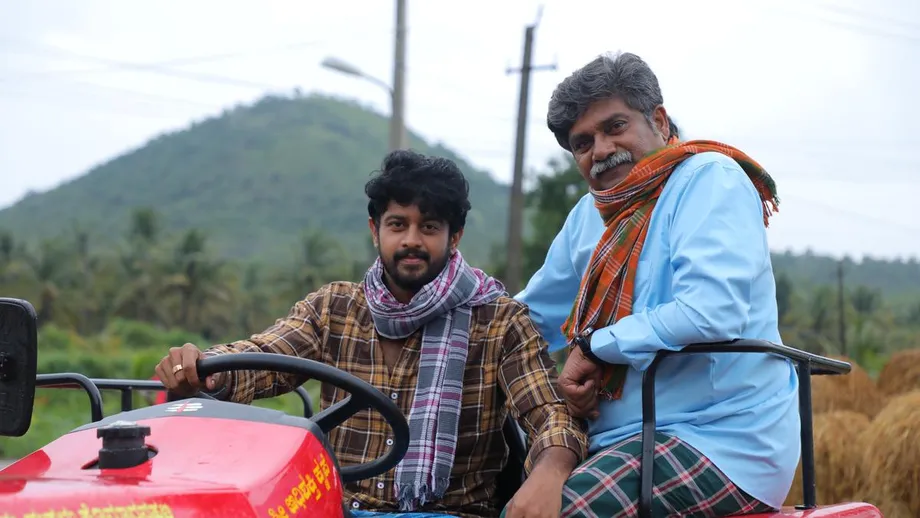
A modest opening becomes a major Kannada cinema success
Premada Oorali, a Kannada family drama that began with just 60 screenings on September 25, 2026, reached an estimated Rs 75.57 crore in Karnataka gross collections after 19 days, according to box office tracker Jerin Georgekutty. His October 14 update put its third Tuesday takings at Rs 6.42 crore, extending a theatrical run built around audience recommendations rather than a large advertising campaign.
Contents
- A modest opening becomes a major Kannada cinema success
- How the audience grew after September 25
- The timeline from a small release to the third week
- What the collection figures mean
- A father, a son and a changing household
- The funding crisis behind the film
- Wedding invitations and a song children could sing
- From an usher's torch to praise from Upendra
- Ticket sales show the size of the audience
- Key Points
Director Manoj Kumar made the film with veteran actor Rangayana Raghu and younger performers Shree Raam, Thapaswini Poonacha and Ramika Shivu. Its story follows a father and son in a rural household whose relationships change when a daughter-in-law joins the family. The film was also released in Telugu as Premane Oorilo.
The production budget is generally reported as Rs 2.5 crore, although other estimates put it at Rs 2 crore or Rs 3 crore. Even at the highest of those figures, the scale of ticket sales is striking. An estimate attributed to Sacnilk placed India gross collections at Rs 43.45 crore after 16 days, more than 17 times the commonly cited Rs 2.5 crore budget.
The money story began much less comfortably. During production, Manoj considered borrowing his mother's mangalsutra, a necklace traditionally associated with marriage, to pawn it and meet a funding shortage. Before release, the team distributed cards resembling wedding invitations to strangers on buses, asking them to give the film a chance.
By its third week, the conversation had shifted from finding an audience to accommodating one. The film's expanding screenings, accessible music and family performances offer a detailed picture of how a small release gathered momentum.
How the audience grew after September 25
Premada Oorali opened with about Rs 9 lakh across 60 shows. Georgekutty's Karnataka gross estimate puts the opening at Rs 10 lakh, while another collection estimate gives a range of Rs 8 lakh to Rs 9 lakh. All describe a modest start before positive audience responses brought more people into cinemas.
By day 15, the film was playing across 1,178 shows, with reported occupancy of 57%. Occupancy measures the share of available seats sold. The screening count was almost 20 times the opening day's 60 shows, giving the film far more opportunities to sell tickets even before allowing for changes in attendance at each screening.
The reported day 15 collection was Rs 4.5 crore net in India. That figure measures ticket revenue after applicable taxes are removed. A day 16 update counted 831 shows and, by 5 pm, estimated cumulative India net collections of Rs 37.20 crore. The changing show count reflects a theatrical schedule that continued to evolve as the run progressed.
Family audiences became an important part of that growth. By the third week, more than 1,100 screenings were reported as full. The expansion gave a film with limited initial visibility a much wider presence across Karnataka's cinemas, including individual theatres and multiplexes.
The timeline from a small release to the third week
September 25 was the starting point for a rapid change in the film's fortunes. The most useful milestones show how its audience grew through the second week and remained substantial into the third.
- September 25, day 1: The film opened across 60 shows, collecting about Rs 9 lakh.
- October 9, day 15: Screenings reached 1,178, with reported occupancy of 57% and India net collections of Rs 4.5 crore for the day.
- October 11, day 17: India net collections reached Rs 8 crore for the day, the strongest daily result in the reported national breakdown.
- October 12, day 18: Georgekutty estimated cumulative Karnataka gross collections at Rs 69.15 crore.
- October 13, day 19: His Karnataka gross estimate rose to Rs 75.57 crore, while the national collection tally put cumulative India net at Rs 57.72 crore.
- October 14, day 20: The tracker projected that Karnataka gross could pass Rs 80 crore.
The national weekly figures show the acceleration particularly well: Rs 5.32 crore net in the first week and Rs 23.65 crore in the second. Week two therefore brought in roughly 4.4 times as much as week one.
What the collection figures mean
Georgekutty's Rs 75.57 crore Karnataka estimate and the Rs 57.72 crore India net tally measure different things. Gross is the ticket money collected before applicable taxes are deducted. Net removes those taxes. Karnataka figures cover one state, while India figures cover the national market.
The tracker says his estimates combine online ticket sales with estimates from theatre counters, including some cinemas absent from listed ticketing data. His Karnataka series gives daily gross collections of Rs 5.94 crore on day 15, Rs 8.74 crore on day 16 and Rs 10.24 crore on day 17, followed by Rs 6.74 crore and Rs 6.42 crore on days 18 and 19.
The national series gives Rs 8 crore net on day 17 and Rs 4.75 crore on each of days 18 and 19. An earlier national update placed cumulative India net at Rs 48.22 crore and gross above Rs 56.39 crore after day 17.
The producers have not confirmed the tracker estimates, and a final day 20 total was not given. Passing Rs 80 crore in Karnataka was the next forecast milestone, requiring another Rs 4.43 crore above the day 19 estimate.
Distributor share is another measure: the portion of theatrical revenue that reaches distribution after cinema arrangements. Georgekutty estimated that share at approximately Rs 30.11 crore through day 18. Assessing the producers' eventual earnings also requires the film's distribution agreements, promotion expenses and other costs, alongside production spending.
A father, a son and a changing household
Rangayana Raghu plays Naganna, the father at the centre of the rural family story. Shree Raam plays his son, Santhu, while Thapaswini Poonacha appears as Rukmini and Ramika Shivu as Vasantha. Romance and the arrival of a daughter-in-law reshape the household's relationships.
Raghu gives the ensemble an experienced anchor. Shree Raam described him as someone who made an effort to connect with the younger actors and become part of their group. The film's appeal rests partly on that family dynamic, with humour and affection giving way to more demanding emotional scenes.
Shree Raam, who had previously been offered roles centred on urban college life, prepared for Santhu by practising farming and spending time around cattle. His aim was to make the character's movements and habits fit someone who works in the countryside.
Thapaswini said her performance depended increasingly on expression rather than speech as the story became more intense. The actor explained the demands of playing Rukmini:
As the film became more intense, I had to express myself through my eyes. I had very few dialogues. I am glad people were able to emotionally connect with my character.
Those choices connect the film's broad family premise to specific performances: a farmer's physical routine, a father's behaviour and a woman's feelings conveyed with limited dialogue.
The funding crisis behind the film
Manoj's most difficult production moment involved the possibility of pawning his mother's mangalsutra. The actors recalled that he called her when the money had run out and asked to borrow the jewellery to raise funds.
The cast said the situation moved them deeply. They completed the scene being filmed in a single take, after which Manoj hugged the actors. He later called his mother again to say he no longer needed to pawn the necklace.
Devendra Medarametla, the film's co-writer and co-producer, backed the project with his savings. His contribution helped support a director who had already won national recognition but still struggled to secure opportunities.
The production credits include Mamatha Devendra M and Suresh Kondeti, with Vanilla Entertainments and Janakamma Productions named as the banners. Devendra co-wrote the screenplay, Rajkanth SK handled cinematography and Harshith Prabhu edited the film. Their work supported a production whose financial limits continued into its release campaign.
Wedding invitations and a song children could sing
The team began distributing invitation cards on buses a day before release. Designed to resemble wedding invitations, the cards turned a promotional appeal into something familiar and personal. Auto-rickshaw drivers also helped publicise the film through posters.
Composer Sunaad Gowtham gave the film another way to travel beyond its initial screenings. Manoj had wanted a musical hit from the beginning, and the title track became a central part of the film's identity.
Sunaad said he designed the melody with children in mind. The composer explained the thinking behind its simplicity:
We wanted children to sing it.
Sunaad drew on his experience composing for television serials, where a title song has to make an immediate connection and remain memorable through repeated listening. He cited his work on Jothe Jotheyali as experience in weaving a programme's title into a musical hook.
The invitation cards asked people to attend, the posters kept the film visible, and the song gave them something easy to remember. Audience recommendations then helped carry the film into more screenings. Together, those details explain how its promotion worked despite the lack of money for a conventional campaign.
From an usher's torch to praise from Upendra
Manoj once watched films while holding an usher's torch at Santhosh Theatre. His earlier film Akshi, about eye donation, won a National Film Award in 2021. Recognition brought prestige, but he said it also led people to expect more work in the same style.
Manoj described Premada Oorali as an opportunity to move beyond those expectations. The director explained his experience after starting in parallel cinema, a term commonly used for films outside the commercial mainstream:
The challenge for someone who begins with an arthouse or parallel movie is that he will be typecast. People expected similar stories from me. I am happy I was able to break my mould and give a total entertainer.
Actor and director Upendra later praised the film in a voice note to Manoj. He singled out its performances, writing, screenplay, dialogue delivery and music, and expressed a wish to meet the filmmaker.
Upendra's message included a personal response to the film:
I really want to meet you in person, give you a tight hug, and convey my appreciation.
Ticket sales show the size of the audience
Premada Oorali was estimated to have sold 27.08 lakh tickets by day 19, compared with 21.6 lakh for Toxic. Those figures place it ahead by 5.48 lakh tickets, or about 25%, in the reported comparison.
The ticket tally helps explain the film's reach alongside its revenue. Its reported ticket prices stayed at or below Rs 250. A film selling cheaper tickets can attract more admissions while taking less money than a film with higher prices, so attendance and revenue answer different questions about its performance.
The contrast with Toxic also extends to production spending. Toxic's reported budget exceeds Rs 500 crore, compared with the Rs 2.5 crore most often cited for Premada Oorali. The smaller film's second week growth and sustained third week attendance show how widely a modest production can travel once audiences begin recommending it.
Key Points
- Premada Oorali opened on September 25, 2026, across 60 shows and expanded to 1,178 shows by day 15.
- Jerin Georgekutty estimated Karnataka gross collections at Rs 75.57 crore after 19 days.
- The reported India net total reached Rs 57.72 crore over the same period.
- The commonly cited production budget is Rs 2.5 crore, with other estimates ranging from Rs 2 crore to Rs 3 crore.
- Rangayana Raghu, Shree Raam, Thapaswini Poonacha and Ramika Shivu lead the rural family drama.
- Audience recommendations, invitation cards, posters and Sunaad Gowtham's title song helped the film reach viewers.
- The tracker projected Rs 80 crore in Karnataka by day 20; the next collection update would determine whether it reached that mark.