A persistent gap with consequences lasting decades
Vietnam's National Report on Civil Registration and Statistics puts the sex ratio at birth at 109.8 boys for every 100 girls during 2021 to 2024, with a projected figure of 110.7 for 2024. In Bac Ninh, the reported ratio reached 119.6. Those figures show how a national imbalance becomes more severe in parts of the north, where pressure to produce a son continues to shape reproductive decisions.
Contents
- A persistent gap with consequences lasting decades
- What the different birth figures show
- The north carries the largest imbalance
- How the imbalance developed
- Why fewer births can intensify pressure for sons
- Technology and the estimate of missing girls
- A forecast of recovery is not a guarantee
- The adult imbalance will outlast changes at birth
- Changing attitudes and improving oversight
- Better records are needed to measure progress
- Key Points
A separate Statistics Office figure puts Vietnam's 2024 birth ratio at 111.4 boys per 100 girls. The difference between that figure and the civil registration estimate needs to be preserved, rather than treated as a single agreed measurement. Both are above the biologically typical level of about 105 boys for every 100 girls.
The United Nations Population Fund (UNFPA) estimated in 2020 that Vietnam had 40,800 missing female births each year. This is a statistical estimate of girls who would be expected to be born without selection based on sex, not a count of individually documented abortions or embryo selection procedures.
The consequences are already visible beyond maternity wards. Vietnam's 2024 midterm population census found about 415,200 more men than women aged 20 to 39. Officials warn that continued imbalance could produce a surplus of 1.5 million men in the 15 to 49 age group by 2034, rising to 1.8 million by 2059. Correcting the ratio among newborns would not immediately remove the imbalance among people already born.
What the different birth figures show
The civil registration findings were presented at a workshop in Hanoi on April 25, 2025. Nguyen Thi Thanh Mai, deputy head of the Population Statistics and Dynamics Department, gave the 2021 to 2024 ratio as 109.8 and described the 2024 figure of 110.7 as projected. The report was compiled by the General Statistics Office using the national electronic civil registry database, with support from UNFPA and a public health organization.
The reported annual sequence was 109.5 in both 2021 and 2022, 109.7 in 2023 and 110.7 in 2024. On that measure, the ratio rose by 1.2 boys per 100 girls between 2021 and 2024. The separate 2024 estimate of 111.4 is 0.7 above the civil registration projection. No explanation establishing why those two measurements differ has been published in the accounts of these findings.
Birth ratios also differ from the sex balance of a whole age group. The reported figure of 109.7 boys for every 100 girls among children aged 0 to 14 combines many birth cohorts and is affected by survival and migration. It should not be substituted for the ratio among newborns in a particular year.
UNFPA's 2018 policy brief gives the biologically normal range as 102 to 106 boys per 100 girls. A small male majority at birth is therefore expected. Vietnam's problem is the persistent excess beyond that range, rather than any departure from an exact balance of 100 boys and 100 girls.
The north carries the largest imbalance
The civil registration findings show ten of the Red River Delta's eleven localities with ratios above 110. Bac Ninh's 119.6 was followed by Vinh Phuc at 118.5, Hanoi at 118.1 and Hung Yen at 116.7. These figures identify a concentration around the capital and nearby northern provinces, rather than an evenly distributed national pattern.
High ratios were also reported in Bac Giang at 116.3, Son La at 115, Lang Son at 114.5 and Phu Tho at 113.6. Southern provinces and cities were generally reported between 105 and 108, closer to the expected biological range, although some still exceeded it.
Separate regional figures put the Red River Delta at 113.2 and the Northern Midlands and Mountains at 115.3. Regional averages and individual provincial ratios measure different populations, so a province approaching 120 can coexist with a lower regional figure. The General Statistics Office recommended giving priority to northern regions when designing policies to reduce the imbalance.
How the imbalance developed
Vietnam's shift was relatively late compared with several other Asian countries. UNFPA says the imbalance was first identified in 2004 and increased rapidly from 2005. Its 2018 brief records a rise from a biologically normal level in 2000 to 110.5 in 2009 and 112.2 in 2016.
The progression is easier to understand when the measures and their dates are kept separate:
- 2000: UNFPA describes Vietnam's birth ratio as still within the biological range.
- 2004 to 2005: The imbalance was identified, followed by a rapid increase.
- 2009: The national ratio reached 110.5 boys per 100 girls.
- 2016: UNFPA records a national ratio of 112.2.
- 2019: A UNFPA statement cites the census figure of 111.5.
- 2021 to 2024: Civil registration figures move from 109.5 to a projected 110.7.
- April 25, 2025: The civil registration report was presented in Hanoi.
These figures do not describe an uninterrupted rise. The civil registration projection for 2024 is below the 2016 figure in UNFPA's brief, while the recent annual sequence shows an increase. Because the series draw on different statistical systems, they establish persistence more securely than they establish the exact size of changes between every year.
Why fewer births can intensify pressure for sons
A regional academic study identifies three interacting conditions behind sex selection: preference for sons, access to prenatal sex detection and abortion, and declining fertility. Smaller families do not create son preference, but they reduce the number of opportunities parents have to produce a boy without intervention.
The study places fertility at about 2.1 children per woman in the 2019 census. More recent reporting cites 1.91, below that replacement level. Replacement fertility is the approximate average needed for one generation to replace itself over time, without migration. For families determined to have a son, a decision to have only one or two children can increase pressure to select the child's sex.
Mai Xuan Phuong, deputy director of communication and education at the Department of Population, linked that pressure to expectations that sons continue the family line and perform ancestor worship. Phuong also pointed to the low value assigned to women in families and society, together with easy access to services that identify or select fetal sex.
The academic study describes family traditions in which married couples live with the husband's family, sons are expected to support parents in old age, and property or family identity passes through the male line. These are social expectations, not proof that daughters cannot provide care or support. Their persistence helps explain why rising incomes and access to modern medicine have not automatically ended preference for boys.
Technology and the estimate of missing girls
Doctors describe couples seeking reproductive services to select male embryos, including during in vitro fertilization (IVF) treatment for infertility. IVF involves fertilizing eggs outside the body before transferring an embryo to the uterus. Embryo chromosome screening can reveal sex chromosomes, creating an opportunity for selection when results are used for that purpose.
Reports describe this demand as more common in northern Vietnam, with cases also appearing in the south. They do not establish how much of the national imbalance comes from embryo selection, as opposed to termination of pregnancies after fetal sex is identified. Treating the entire estimated shortfall as an IVF issue would therefore misrepresent what is known.
UNFPA's 2020 launch statement places the annual estimate of 40,800 missing female births alongside the census ratio of 111.5. The figure should be understood as an estimate published at that time, not a newly verified total for 2024 or 2025.
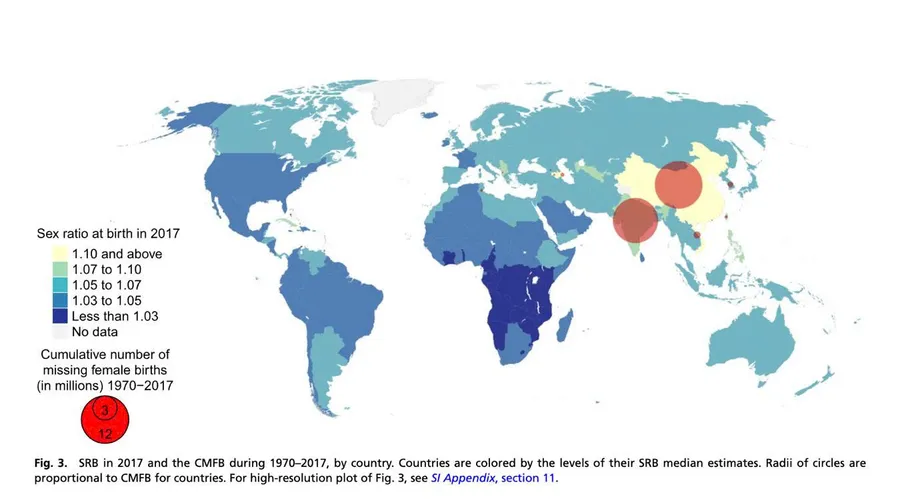
International comparisons also require care. A 2019 study estimated 11.9 million missing girls in China and 10.6 million in India over 1970 to 2017. UNFPA's 2020 global estimate of 140 million missing females included both sex selection and deaths associated with extreme neglect. Those cumulative measures cannot be directly compared with Vietnam's annual estimate of missing female births.
A forecast of recovery is not a guarantee
The regional modelling study combined 526 observations covering at least 2,933,093 birth records from 1972 to 2019. It drew on censuses, Demographic and Health Surveys, the Multiple Indicator Cluster Survey, and population and family planning surveys to estimate regional trends and project them through 2050.
The researchers found evidence of imbalance in four of Vietnam's six regions: the Northern Midlands and Mountain Areas, Northern Central and Central Coastal Areas, Red River Delta, and South East. The Red River Delta had the fastest estimated rise, reaching a peak of 114.6 boys per 100 girls in 2013. The study's 95% credible interval was 112.9 to 116.3, expressing uncertainty around that estimate.
The model projected a return to its national baseline of 106.3 by the middle of the 2030s, with the Red River Delta and South East reaching it in 2034. That baseline differs from the commonly cited benchmark of 105 because it is the specific reference value used in the model.
A Bayesian model combines observations and assumptions while estimating uncertainty. Here, the researchers modelled a rise, a plateau and an eventual decline. The projected recovery is consequently a statistical result, not a commitment or an observed outcome. Recent civil registration figures showing an increase from 2021 to 2024 mean that progress toward the projected decline must be checked against newer data.
The adult imbalance will outlast changes at birth
Deputy Health Minister Tran Van Thuan addressed the problem at the launch of National Action Month for Population on December 10, 2024. He described the demographic pressures facing Vietnam:
declining birth rates, excess males, and a shortage of females.
Thuan warned that, if the imbalance remained high, Vietnam could have 1.5 million more men than women aged 15 to 49 by 2034 and 1.8 million by 2059. The age range matters: these projections refer to a broad population group, not a count of men who will necessarily remain unmarried.
The existing surplus of about 415,200 men aged 20 to 39 is another measure, covering a narrower age group at an earlier point in time. It cannot be directly subtracted from the 2034 projection to calculate how many additional unmarried men Vietnam will have.
Warnings about difficulty finding partners, delayed or forgone marriage, violence against women and human trafficking describe potential risks, not inevitable outcomes. Marriage patterns also depend on migration, age differences between partners and personal choices. The central demographic fact is simpler: cohorts born with disproportionately few girls carry that imbalance into adulthood, even if later birth ratios improve.
Changing attitudes and improving oversight
The government's reported target is to bring the ratio below 109 boys per 100 girls by 2030. Although described in some statements as a return to natural levels, 109 remains above UNFPA's biological range of 102 to 106. Other government messaging describes the 2030 objective as restoring the natural ratio without giving that numerical threshold. Those formulations should not be treated as identical.
The regional study discusses the 2006 Law on Gender Equity, the 2011 to 2020 Strategy on Reproductive Health, and health sector regulations introduced in 2013 and 2014. It does not establish how effective those measures were. Recommendations now include monitoring embryo chromosome screening, controlling the reporting of results, and applying oversight and penalties against misuse for sex selection.
Public communication is another part of the response. A reported Ministry of Health online competition dated August 20 to September 20, 2026 attracted 94,752 participants and 86,715 valid entries. Deputy Health Minister Do Xuan Tuyen said it reached nearly 16 million times on social media. These are participation and reach figures, not evidence of a measured reduction in sex selection.
The reported winner, La Thi Hue, a population worker in Hoanh Mo, a border commune in Quang Ninh, described pressure on mothers to produce sons and the unequal welcome some girls receive at birth. Hue also described fathers increasingly expressing pride in daughters. That local experience points to the daily family decisions that national targets seek to change.
Naomi Kitahara, UNFPA's representative in Vietnam at the 2020 launch, called for men to take responsibility for equal treatment:
I call on Vietnamese men to raise the value of girls and demand equal treatment and equal rights. In particular, we need men and boys to support this effort.
Better records are needed to measure progress
The civil registration report says 84.9% of births in 2024 were registered within 60 days. That leaves 15.1% outside the timely registration category, but does not mean those births were never registered. Late registration was reported as high as 56% among some ethnic minority groups.
Timeliness matters when interpreting annual statistics. A birth registered late may enter the administrative system after the period in which it occurred, depending on how statistics are compiled. The academic researchers likewise warned that incomplete birth registration and differences between censuses and surveys complicated estimates, especially where regional samples were small.
The report recommends upgrading the electronic registry, training local registration officers, improving access for vulnerable groups and connecting civil registration with population, health and education databases. These measures would help distinguish real changes in births from changes in how promptly events are recorded.
The next stated policy benchmark is 2030, followed by the regional model's projected return to baseline in the middle of the 2030s. There is no established explanation here for the competing 2024 national figures, no quantified share attributable to IVF, and no demonstrated birth ratio effect from the reported communication competition. Tracking those gaps is essential to judging whether Vietnam is reducing sex selection rather than simply changing how it measures or discusses it.
Key Points
- Civil registration data put Vietnam's 2021 to 2024 birth ratio at 109.8 boys per 100 girls, with 110.7 projected for 2024.
- A separate Statistics Office figure gives 111.4 for 2024; the difference has not been reconciled.
- Bac Ninh's reported ratio of 119.6 illustrates the more severe imbalance in northern provinces.
- UNFPA estimated 40,800 missing female births annually in Vietnam in 2020.
- Officials warn of 1.5 million excess men aged 15 to 49 by 2034 if the imbalance stays high.
- The reported 2030 target of below 109 remains above UNFPA's biological range of 102 to 106.
- Medical oversight, equal treatment of daughters and more timely birth registration are central to the proposed response.