A pause after two rounds of tightening
The Monetary Authority of Singapore (MAS) left monetary policy unchanged on October 14, 2026, despite all 10 analysts in a predecision poll expecting further tightening. The decision came as advance estimates showed Singapore's economy grew 5.4% in the third quarter from a year earlier, while renewed energy price pressures threatened to keep inflation elevated into 2027.
Contents
- A pause after two rounds of tightening
- What changed, and what stayed in place?
- Why Singapore manages the currency rather than interest rates
- A lower forecast does not mean prices are already cooling
- Energy is the main threat to the inflation outlook
- GDP beat expectations, but growth also slowed
- The AI cycle supports growth now, but may cool later
- Economists see a pause, not the end of tightening
- What to watch before the next review
- Key Points
The central bank maintained the rate of appreciation, width and centre of its Singapore dollar nominal effective exchange rate policy band, known as S$NEER. It also narrowed its forecast for average core inflation in 2026 to 1.5% to 2%, from 1.5% to 2.5%. Inflation across all consumer prices is expected to average around 2%.
This was a pause in additional tightening, not a move to weaken the currency. The policy band still follows an appreciating path, allowing the Singapore dollar to strengthen against a basket of trading partners' currencies and restrain imported inflation.
MAS expects growth to remain firm in the coming quarters before moderating as the artificial intelligence investment cycle cools and global financial conditions tighten. It expects core inflation to ease more visibly from the middle of 2027, although risks to prices remain tilted upward.
What changed, and what stayed in place?
MAS increased the policy band's rate of appreciation in April and July, with a smaller increase in July. Neither decision changed the band's width or centre. Since July, S$NEER has strengthened modestly within the upper half of the appreciating band.
The October decision leaves those earlier adjustments working through the economy. A stronger currency can lower the local cost of imports, but businesses may take time to adjust contracts, inventories and consumer prices. Keeping the settings unchanged therefore does not mean the effects of earlier tightening have stopped.
The sequence of decisions and forthcoming milestones is:
- April 2026: MAS increased the policy band's rate of appreciation.
- July 2026: MAS increased the appreciation rate again, by a smaller amount.
- October 14, 2026: MAS left the slope, width and centre unchanged and narrowed its core inflation forecast.
- November 2026: The government is due to update its 2026 growth forecast and announce its first projection for 2027.
- Second half of 2027: MAS expects activity linked to artificial intelligence to moderate.
Why Singapore manages the currency rather than interest rates
Singapore's exchange rate approach reflects how much its economy depends on trade. Gross exports and imports of goods and services exceed three times gross domestic product. Almost 40 cents of every Singapore dollar spent domestically goes toward imports, making currency movements a powerful influence on prices.
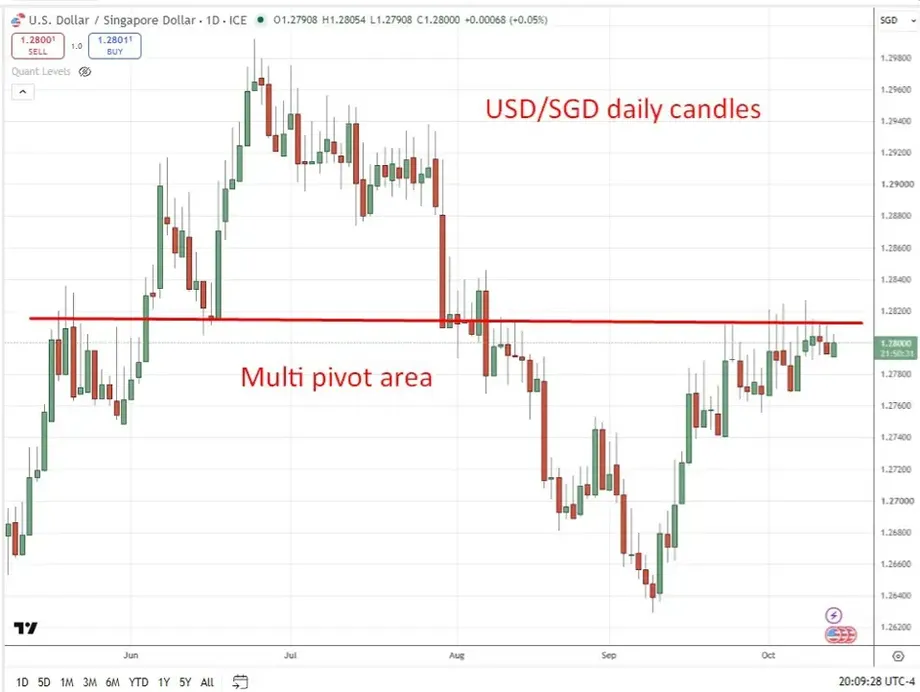
S$NEER measures the Singapore dollar against a basket of currencies belonging to its major trading partners. It is not the same as the exchange rate against the US dollar alone. The currency can move differently against individual currencies while still following the intended path against the basket.
MAS controls three features of the band. The slope determines the pace of appreciation or depreciation. The centre sets its level, while the width determines how much movement is permitted around that path. A steeper upward slope represents additional tightening; shifting the centre upward can deliver an immediate adjustment.
The precise band settings and currency basket weights are not published. MAS can buy or sell Singapore dollars to keep the index within the band. Singapore adopted exchange rate targeting in 1981, and domestic interest rates largely follow global rates, particularly those in the United States.
Regular policy announcements now take place in January, April, July and October, following a shift to quarterly reviews in 2024. Before that, scheduled reviews usually occurred in April and October. MAS can also act between scheduled reviews, as it did twice during the inflation surge in 2022.
A lower forecast does not mean prices are already cooling
The revised 2026 core inflation range lowers the upper bound by 0.5 percentage points while leaving the lower bound unchanged. That makes the forecast narrower rather than uniformly lower. It also describes an annual average, not the inflation rate households will necessarily experience in the next few months.
Core inflation excludes accommodation and private transport costs. MAS expects both core inflation and inflation across all consumer prices to remain slightly elevated in the immediate quarters, before easing as imported cost pressures fade.
The recent figures require care. Several reports describe core inflation at 2.1% over July and August, compared with 1.5% in the second quarter. Another account gives August's individual reading as 2.2%, its highest since September 2024. A combined July and August figure and an individual monthly reading can differ, although reports are not consistent about whether 2.1% applies to the period or to each month.
For 2027, MAS forecasts both core and total inflation at 1.5% to 2.5%. The higher upper bound compared with the revised 2026 core forecast does not contradict an expected easing from midyear. Prices could remain elevated early in 2027 and decline later, leaving the annual average within that wider range.
Higher import costs have already spread across electricity and gas tariffs, transport services and food. Healthcare subsidies and competition among telecommunications providers have helped restrain services inflation, limiting the extent to which those imported pressures feed into the broader price basket.
Energy is the main threat to the inflation outlook
Brent crude was trading at around US$106 a barrel on October 14, more than 70% above its level at the start of the year. Constraints on Middle East supplies linked to the Iran war and conflict involving Saudi Arabia and Yemen have kept energy costs under pressure.
In explaining its assessment, MAS pointed to a fresh increase in energy prices following earlier disruptions:
"Since September, energy commodity prices have risen anew and are projected to remain high in the near term," said the central bank.
Costlier energy affects more than petrol or electricity. It can raise production, refrigeration and transport costs, which then feed into food and other goods. Adverse weather affecting food production adds another source of pressure.
MAS expects supply disruptions affecting energy and food commodities to ease gradually during 2027. A faster recovery in Middle East energy production and shipments could bring prices down sooner than expected. A sharp, sustained increase in global energy or food prices would push Singapore's import costs in the opposite direction.
That leaves the currency policy facing two possible paths. If imported costs settle, the existing appreciating band may be enough to help inflation ease. If energy prices climb again and remain high, the case for another tightening becomes stronger. Neither outcome has been decided.
GDP beat expectations, but growth also slowed
Singapore's third quarter GDP increased 5.4% from a year earlier, above the 5% forecast cited in one account. Growth from the preceding quarter was 1.1%, below the 1.2% expected. The figures describe different comparisons: annual growth exceeded expectations even as the latest quarterly expansion was weaker than forecast.
Reports differ on the preceding quarter's growth figures. One gives earlier annual growth as 5.9% and quarterly growth as 1.4%. Another gives 6.2% and 1.5%, respectively. Without a reconciled estimate, either pair should not be presented as the sole comparison. Both accounts nevertheless indicate slower growth in the third quarter.
The sector picture was also uneven. Strong orders for products linked to artificial intelligence and expanded production capacity supported technology activity. Construction, financial services and real estate remained firm, while businesses serving consumers were weaker.
Manufacturing output fell 0.9% from the previous quarter in one account, even as technology sectors helped support annual GDP growth. Those developments can coexist: output may remain above its level a year earlier while declining from the immediately preceding quarter.
The government's existing 2026 growth projection is 4.5% to 5.5%. The November update will provide a fresh assessment of whether the strong technology cycle can sustain that pace and how much moderation to expect in 2027.
The AI cycle supports growth now, but may cool later
MAS expects strong orders and greater production capacity to support technology sectors in the immediate quarters. The same investment cycle is helping industrial production and trade among Singapore's major trading partners.
The central bank expects activity linked to artificial intelligence to moderate in the second half of 2027. Major infrastructure construction and financial services are expected to continue, providing support even as technology growth loses some of its exceptional pace.
MAS also expects the economy's positive output gap to narrow through 2027. An output gap compares actual production with the level an economy can sustain without excessive price pressure. A positive gap suggests activity is running above that sustainable level; narrowing it can help reduce pressure on wages and prices.
Productivity gains are expected to contain labour costs per unit of output in services. Greater government support for healthcare and education should also keep services inflation low. Conversely, a broader spread of demand from the AI boom or faster labour cost increases could keep domestic inflation elevated.
Higher interest rates and persistent inflation in advanced economies may weaken demand. A sharper retreat in AI investment would pose a separate risk to growth and could reduce inflation more quickly than MAS currently expects.
Economists see a pause, not the end of tightening
ANZ was among the forecasters that anticipated an unchanged decision, despite the unanimous tightening call among the 10 analysts in the poll. The difference reflects separate groups of forecasters, rather than evidence that every economist expected MAS to act.
Khoon Goh, ANZ's head of Asia research, assessed that the April and July adjustments were still feeding through the economy. He said MAS could tighten again in 2027 if upward inflation risks materialise, particularly through renewed increases in oil or refined petroleum product prices.
Charu Chanana, chief investment strategist at Saxo, also described the decision as a pause rather than a policy pivot:
"After two rounds of tightening in 2026, policymakers appear comfortable giving earlier measures more time to work rather than responding aggressively to every inflation risk," Chanana said.
DBS senior economist Chua Han Teng linked the hold to the softer 2026 inflation outlook, while pointing to the wider 2027 range as a sign of continuing energy uncertainty. He described the possibility of another adjustment:
"MAS likely kept the door open for another calibrated tightening if needed," he said.
These assessments are conditional forecasts, not announced policy. MAS has committed to monitoring economic developments and responding to risks to price stability, but has not specified a trigger for its next move.
What to watch before the next review
The surprise hold could prompt investors who had positioned for faster currency appreciation to reassess those positions. However, no quantified currency reaction establishes how much the Singapore dollar moved after the announcement. The unchanged appreciating band also limits any reading of the decision as an outright easing.
Global interest rate expectations matter because Singapore's domestic rates remain exposed to international conditions. A reported snapshot of CME Group's FedWatch Tool put the probability of no change at the US Federal Reserve's October 27 to 28 meeting at 77%, compared with 51% a month earlier, a rise of 26 percentage points.
Upcoming US inputs included September consumer price inflation, expected at 0.6% from the previous month and 3.6% from a year earlier, and the Federal Reserve's Beige Book assessment of economic conditions. Those figures were expectations, not released results, and the FedWatch comparison does not establish that Singapore's decision caused the change in US policy pricing.
For Singapore, the nearer tests are energy and food costs, the strength of technology orders, labour cost developments and the government's November growth forecasts. The next regular MAS review under its quarterly schedule would be in January 2027, although an exact announcement date was not given.
Key Points
- MAS kept the slope, width and centre of its exchange rate policy band unchanged on October 14, 2026.
- The Singapore dollar remains on an appreciating policy path after tightening in April and July.
- The 2026 core inflation forecast narrowed to 1.5% to 2%; total inflation is expected at around 2%.
- Both inflation measures are forecast at 1.5% to 2.5% in 2027, with easing expected from midyear.
- Advance estimates put third quarter GDP growth at 5.4% from a year earlier and 1.1% from the previous quarter.
- Energy prices and the strength of the AI investment cycle are central risks to the outlook.
- The government is due to update its 2026 growth forecast and announce its 2027 projection in November.