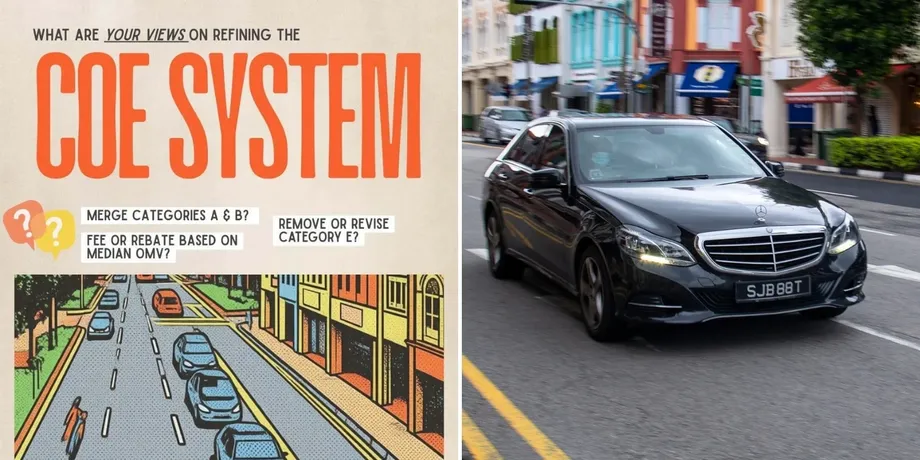
A S$99 price gap puts car categories under scrutiny
Singapore's two main car Certificate of Entitlement (COE) categories finished the 7 October 2026 bidding exercise just S$99 apart: S$130,001 for Category A and S$130,100 for Category B. A day later, the Land Transport Authority (LTA) launched a consultation on replacing them with one passenger car category, accompanied by rebates and surcharges that could create a S$30,000 difference between the cheapest and most expensive bands.
Contents
- A S$99 price gap puts car categories under scrutiny
- Why engine power no longer separates the market
- How the value based adjustment would work
- Three bands or five, with different results for the same car
- A guaranteed payment gap, not guaranteed affordability
- Dealers question the surcharge and the model boundaries
- Existing owners face a separate renewal decision
- Category E could be removed or reserved for cars
- Family support and other proposals remain separate
- Buyers weigh the deadline against other cost changes
- Key Points
The proposal would move the distinction between mass market and higher value cars away from engine capacity and power output. All buyers would compete for the same pool of certificates and face the same auction premium, but their final COE cost would be adjusted according to the value of their chosen model.
The consultation runs until 11.59pm on 2 November 2026. In its public consultation announcement, LTA says it expects to complete the review by the end of 2026 and publish findings and recommendations in the first half of 2027. Neither a merger nor an implementation date has been confirmed.
The distinction matters for buyers expecting cheaper cars. LTA is proposing a different way to distribute COE costs, not an increase in the number of certificates. A rebate would reduce a buyer's payment relative to the common premium, but would not guarantee a saving against today's prices.
The review follows discussions with more than 200 members of the public, academics and automotive industry representatives, including focus groups held in April and May 2026. Their suggestions also covered renewals, urgent purchases through Category E and support for families.
Why engine power no longer separates the market
Category A currently covers cars with an internal combustion engine capacity of no more than 1,600cc and maximum power output of 130bhp. Electric vehicles qualify if their power output does not exceed 110kW. More powerful cars fall into Category B.
Those limits increasingly fail to separate cheaper models from premium ones. Electric car manufacturers can adjust power through software, allowing a higher value vehicle to qualify for Category A without fundamentally changing its market position. The Tesla Model Y, for example, can fall into either category depending on its power rating.
LTA introduced an engine power criterion in 2014 and adjusted the Category A threshold for electric vehicles in 2022. Yet Category A premiums exceeded Category B premiums three times between February and June 2026. The almost identical October prices show how little separation the categories now provide.
Reported import values illustrate the mismatch. The Tesla Model Y RWD 110 has an Open Market Value (OMV) of S$45,195, compared with S$27,889 for the BYD Atto 3, a difference of S$17,306. Both can qualify for Category A today, despite that difference in value.
LTA's consultation paper also makes a road space argument: a mass market car and a higher value car have broadly the same effect on congestion. Combining their quotas would create a larger bidding pool, which the authority says could reduce price volatility.
How the value based adjustment would work
The proposed fee and rebate system, called a feebate, would apply a fixed adjustment to the common COE premium. Lower value models would receive a rebate, higher value models would attract a surcharge, and models in the middle would have no adjustment.
OMV is the value of a vehicle when imported into Singapore, assessed by Singapore Customs. It includes the purchase price, freight, insurance and other charges associated with sale and delivery. It is not the showroom price and already forms the basis for calculating the Additional Registration Fee (ARF).
LTA proposes using each model's median OMV from past registration data. The median is the middle value when figures are arranged in order, limiting the effect of unusually high or low individual import values. For a new model without sufficient history, the specific vehicle's OMV could serve as a proxy.
The authority would review and publish model bands annually, allowing buyers to check the adjustment before choosing a car. Retailers could appeal a band assignment. Imported used cars would be excluded from the median OMV calculation.
LTA considered selling price, but concluded that discounts, financing arrangements and trade in deals could alter declared prices without changing the vehicle itself. Physical size was also considered an unreliable guide to value. Importers already have to provide Customs with supporting documents for OMV declarations, and false declarations can draw enforcement action.
Three bands or five, with different results for the same car
Both structures under consultation have a maximum rebate of S$15,000 and maximum surcharge of S$15,000. The difference lies in how many intermediate steps separate them. The examples use the distribution of cars registered in 2025, rather than fixed dollar thresholds for OMV.
- Three bands: the lowest 35 per cent by OMV would receive a S$15,000 rebate; the next 15 per cent would have no adjustment; the upper half would pay a S$15,000 surcharge.
- Five bands: the lowest 10 per cent would receive S$15,000; the next 25 per cent would receive S$7,500; the next 15 per cent would have no adjustment; the next 25 per cent would pay S$7,500; and the highest 25 per cent would pay S$15,000.
A Honda Jazz would receive the maximum rebate under either illustration. A Toyota Sienta or BYD Atto 3 would receive S$15,000 under three bands, but S$7,500 under five. The Audi A3, Nissan Serena and Toyota Corolla Altis would remain in the neutral band under both.
At the other end, a Tesla Model Y RWD, Mercedes Benz GLC or Toyota Alphard would attract S$15,000 under either option. A Honda Odyssey or Mercedes Benz A180 would attract S$15,000 under three bands, but S$7,500 under five. The examples show that family vehicles, not just luxury badges, can fall into surcharge bands.
At an illustrative common premium of S$100,000, a Honda Jazz buyer would pay S$85,000 for the COE, while a Toyota Alphard buyer would pay S$115,000. That S$30,000 spread concerns the COE component, not the total difference in car prices.
LTA says the historical gap between Category A and B premiums, generally around S$20,000 to S$30,000 before their recent convergence, is one reference point for the proposed amounts. Three bands would be simpler to administer, while five would reduce each adjacent step from S$15,000 to S$7,500.
The registration dataset used for the illustration covers 52,678 new cars in 2025. A separate report on supply trends gives 52,381 registrations for that year. The figures differ by 297, and the reason is not explained. The consultation illustration should therefore be understood using its stated 52,678 figure, under which about half would receive a rebate or no adjustment and half would pay a surcharge.
A guaranteed payment gap, not guaranteed affordability
The proposal leaves the COE bidding process, vehicle taxes and other fees unchanged. It also does not create additional certificates. Supply still depends on the permitted vehicle growth rate, deregistrations and any special quota adjustments.
Walter Theseira, an associate professor at the Singapore University of Social Sciences, says the common premium would still be determined by the marginal buyer, meaning the buyer whose bid sets the price at the boundary between successful and unsuccessful bids. If that buyer can pay amounts associated with today's Category B market, the merged premium could approach those levels.
Theseira distinguished a guaranteed difference in payments from a reduction in the underlying premium:
"At the end of the day, this policy can deliver you the price difference between mass-market and luxury cars, but it cannot deliver you lower COE prices," he said.
Samuel Chng, an assistant professor at the Singapore University of Technology and Design, identifies two possible responses. Existing buyers might simply switch to models with lower OMVs, without increasing bidder numbers. Alternatively, rebates could attract additional buyers or give existing buyers more money to bid, pushing the common premium higher and absorbing some of the saving.
Supply pressures would also persist. The permitted car population growth rate has been set at zero since February 2018, through 31 January 2028. Reported deregistrations reached 44,364 in the first eight months of 2026, compared with 49,550 for all of 2025. LTA's use of a rolling average across four quarters smooths quota changes, so more deregistrations do not translate immediately into an equivalent increase in auction supply.
These figures help explain why a change in categories cannot by itself resolve affordability. The merger would change who competes together and how much each successful buyer ultimately pays, while leaving the main supply calculation intact.
Dealers question the surcharge and the model boundaries
Anson Lee, managing director of Euro Performance Asia, argues that S$15,000 may be too small to influence buyers spending upwards of S$400,000 on a luxury car. He suggested S$25,000 instead. At S$400,000, the proposed surcharge represents 3.75 per cent of the purchase price, illustrating why its influence could vary widely between buyers.
Raymond Tang, first vice president of the Singapore Vehicle Traders Association and managing director of Yong Lee Seng Motor, supports replacing the existing distinction but also believes the surcharge must be large enough for buyers to feel a difference. CarTimes Group chief operating officer Benjamin Loo expects stronger demand for new mass market models and premium used vehicles.
The design could change which cars dealers import. Timothy Wong, an associate professor at the National University of Singapore, says models with lower OMVs could become more attractive for retailers to bring into Singapore. Theseira says dealers might remove features, or offer some through subscriptions, to bring a vehicle below a band boundary.
Several academics favour five bands because smaller steps reduce the abrupt change in payment for cars just above and below a boundary. They would not eliminate incentives to adjust specifications, but would reduce the reward for crossing one threshold.
Practical concerns remain. Tan Chong Motor Sales sales and marketing head Ron Lim questions the transparency of the median calculation and how exchange rates, supply changes and parallel imports could affect it. Vantage Automotive managing director Adelene Tan asks how updated models with different equipment and OMVs would be treated.
Premium Automobiles managing director Lee Hoe Lone warns that lowering an electric car's OMV could mean choosing a smaller battery. He described a possible reduction in range from around 400km to 300km, a reminder that qualifying for a rebate could involve sacrificing features buyers value.
Existing owners face a separate renewal decision
A car COE normally lasts 10 years. Owners renewing it pay the Prevailing Quota Premium (PQP), calculated from the preceding three months' COE prices for the relevant category. A merger would create one passenger car premium and one PQP.
Whether the proposed rebates and surcharges would apply to renewals is still open. LTA says the recent convergence of Category A and B prices means owners already face broadly similar renewal premiums, so applying the feebate to renewals may not be necessary.
The authority nevertheless recognises that existing owners could be affected differently. It may consider transitional arrangements, including for owners of mass market cars, if the merger proceeds. No exemption or transition package has been approved.
For Gina Koh, an education sector worker whose Nissan Note COE expires at the end of 2027, that uncertainty affects whether renewing or replacing her car makes more financial sense. Buyers and existing owners are therefore weighing different decisions: the cost of entering the merged pool versus the treatment of a vehicle they already own.
Category E could be removed or reserved for cars
The Open Category, Category E, currently permits registration of any vehicle except motorcycles. Its supply includes 10 per cent of deregistrations from car Categories A and B and Category C, which covers goods vehicles and buses.
Open certificates tend to be used for whichever eligible category has the highest premium, recently mostly Category B cars. Transferable temporary Category E certificates also give urgent buyers a way to register a car without waiting for another tender.
LTA is seeking views on abolishing Category E or retaining it for cars only. Removing it would simplify the framework but reduce flexibility for urgent buyers. Restricting it to cars could preserve that option without drawing on Category C supply.
This is a separate decision from merging Categories A and B. References to removing the Open Category describe an option under consultation, not an adopted policy. Kah Motor chief executive Nicholas Wong supports abolition, arguing that the category encourages speculation rather than benefiting genuine buyers.
Family support and other proposals remain separate
The consultation also records suggestions for allocating COEs according to family needs, supporting direct bidding, changing to a system in which each successful bidder pays their own bid, creating a separate category for private hire cars and charging households that own multiple cars.
LTA says prioritising families with young children would leave fewer certificates for other groups, such as caregivers and households spanning several generations. Household needs can also change during a COE's life. The authority is instead developing a transport grant for large families with three or more Singaporean children, which could help with taxi or public transport costs.
A separate private hire category would require quota to be taken from other car buyers. Chng warns that too little quota could increase rental costs, raise fares or make rides harder to obtain. Theseira notes that weakening those services could persuade some users to buy private cars instead.
LTA says multiple car households are not a major driver of COE demand. Their number fell from about 87,000, or 19 per cent of car owning households, in 2012 to about 66,000, or 13 per cent, in 2025. Academics also warn that a surcharge could be avoided by registering vehicles under different people or companies.
The current bidding system is not scheduled to change under the merger proposal. In 2025, three in four successful Category A and B bids were within 5 per cent of the clearing price, a relevant detail when considering whether charging each bidder their own bid would produce much different payments.
Buyers weigh the deadline against other cost changes
Motorists have not responded uniformly. Finance manager Ng Yong Hua, 39, considered reconsidering a Jaecoo 6 purchase after hearing about possible surcharges, but proceeded because financing costs also mattered. Retiree Steven Chen, 59, is waiting and says his decision depends on the final package a dealer offers.
Roy See, 47, bought a Zeekr 7X for S$236,000 in 2025. He says a further S$15,000 charge at current COE levels would change his decision, particularly after electric vehicle incentives have tapered. Independent broker Steven Lim expects affordability to remain the main consideration, with buyers paying closer attention to OMV.
Separate emissions policy changes further complicate comparisons. Mazda Singapore managing director Jason Lim says the Mazda 3's Vehicular Emissions Scheme surcharge is due to rise from zero to S$7,500 from 1 January 2027. Even a model illustrated in a COE rebate band could face a higher charge elsewhere in its purchase price.
Forecasts also differ. Anson Lee expects waiting buyers to soften COE prices temporarily, whereas academics warn that uncertainty could prompt some buyers to purchase before new bands take effect. Neither outcome is assured. The confirmed timetable is:
- April and May 2026: LTA held focus group discussions during stakeholder engagement.
- 7 October 2026: Category A and B premiums closed at S$130,001 and S$130,100.
- 8 October 2026, 5pm: public consultation opened.
- 2 November 2026, 11.59pm: consultation closes.
- End of 2026: LTA expects to complete its review.
- First half of 2027: findings and recommendations are due to be published.
Some reports describe the review itself as concluding in the first half of 2027. LTA's official timetable separates completion by the end of 2026 from publication in 2027. There is no confirmed start date for a merged category, final model bands or decision on renewal adjustments.
Key Points
- LTA proposes merging Categories A and B into one passenger car COE pool.
- Model value would determine rebates or surcharges of up to S$15,000 each.
- Three bands offer simplicity; five bands provide smaller S$7,500 steps.
- The maximum payment difference would be S$30,000, without a guarantee of lower premiums.
- Renewal treatment, transitional arrangements and Category E changes remain undecided.
- Feedback closes on 2 November 2026, with recommendations expected in the first half of 2027.