
A national tourism network with a phased start
India plans to bring 14,000 tourism experiences and 9,000 homestays onto a National Digital Tourism Stack by the end of 2028, creating shared infrastructure through which travellers could discover and book services across participating applications. The Ministry of Tourism and the Open Network for Digital Commerce (ONDC) are developing the initiative with support from the International Centre for DPI Innovation and Advancement (ICDIA).
Contents
- A national tourism network with a phased start
- Shared infrastructure, not another marketplace
- What the 23,000 target includes
- When services are expected to go live
- AI and the ambition for one booking journey
- Trust will depend on verification and complaint handling
- A parallel push toward less visited destinations
- Five agreements support hosts, transport and local experiences
- The economic stakes and the limits of the launch
- Key Points
Union Minister of Tourism and Culture Gajendra Singh Shekhawat presented the project at Bharat Mandapam in New Delhi for World Tourism Day 2026. The launch accounts differ on the date: accounts tied to the event place it on September 27, while another gives September 28. The detailed implementation schedule separates the announcement from the start of services, with a pilot planned for January through June 2027 and nationwide expansion from July 2027.
The programme has an existing foundation. More than 1,000 tourism experiences are already transacting on the ONDC network, including 170 Archaeological Survey of India (ASI) monuments and 29 museums. Those transactions should not be confused with the launch of the new Stack itself, whose development and pilot phases are still ahead.
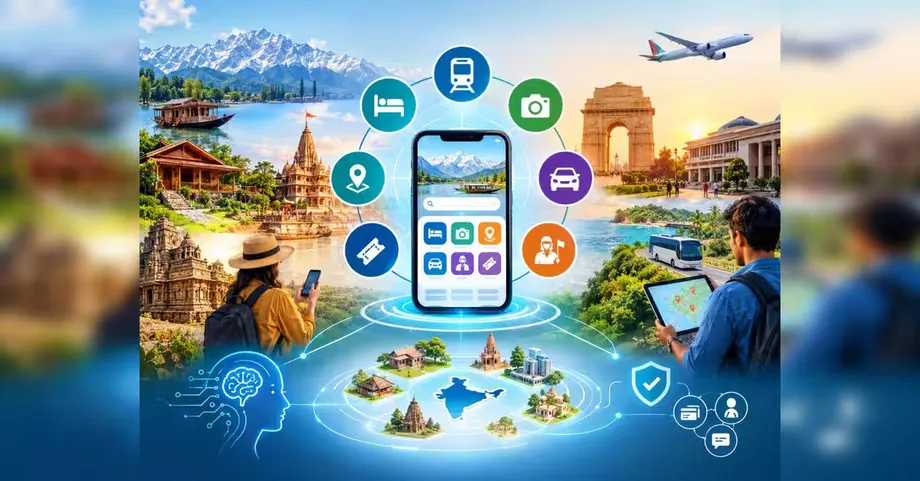
The central ambition is to connect accommodation, guides, attractions, transport and local activities without creating another standalone booking website. For small tourism businesses, the proposed benefit is access to several digital sales channels through a single listing. For travellers, it is a less fragmented journey from finding a destination to booking its services.
Shared infrastructure, not another marketplace
The Stack is being designed around a model described as "list once, reach multiple platforms". A homestay, guide or attraction would publish its services once and become discoverable through applications participating in the network, rather than arranging a separate technical connection with every platform.
A digital stack is a set of connected digital capabilities that other services can use. Here, those capabilities are intended to include search, supplier verification, payments, ratings and complaint handling. Travellers may still use different applications, but those applications would draw on shared infrastructure to connect them with tourism providers.
This distinction matters because some descriptions of the launch refer to a common or unified platform. The stated design is broader than a single consumer website: ONDC provides infrastructure for businesses and platforms to connect and transact, rather than operating a marketplace that competes with them. The range of services travellers can actually access will depend on which providers and applications join.
What the 23,000 target includes
The detailed onboarding target is 23,000 listings by the end of 2028, comprising 14,000 tourism experiences and 9,000 homestays. Experiences therefore represent about 61% of the target, while homestays account for about 39%. The programme is intended to connect places to stay with activities that give travellers a reason to visit.
Broader descriptions refer to an ecosystem spanning more than 23,000 experiences and homestays. That wording differs from the precise implementation target of 23,000, and neither should be read as the number already available through the new Stack.
The existing ONDC tourism inventory offers a starting point, especially for heritage attractions. The ministry also intends to bring in experiences that are not currently online or have only a limited digital presence. Reaching that group will require identifying and validating providers, rather than simply collecting services already sold through established booking channels.
When services are expected to go live
The implementation roadmap sets out three stages. Preparation comes first, followed by a pilot in which the initial batch of experiences and homestays is expected to become available. A nationwide drive to bring suppliers onto the network follows.
- September 2026: The initiative is announced at Bharat Mandapam for World Tourism Day, with reports differing between September 27 and September 28.
- October to December 2026: Project preparation and development are scheduled.
- January to June 2027: The pilot is planned, including the first batch of experiences and homestays.
- July 2027 to December 2028: Nationwide scaling and supplier onboarding are scheduled.
- By the end of 2028: The programme aims to reach 14,000 experiences and 9,000 homestays.
One account describes rollout as beginning in June 2027. The more detailed roadmap places June at the end of the pilot and July at the start of nationwide expansion. These are different rollout milestones, not evidence that the entire network will be available in June.
No pilot destination list or participating application roster has been announced in the launch accounts. For travellers, the announcement therefore establishes a development schedule rather than an immediately available national booking service.
AI and the ambition for one booking journey
Artificial intelligence is planned for the front end of the Stack, helping travellers find services and plan journeys in their preferred languages. The infrastructure is also intended to support personal digital agents, software that can search and organise options on a traveller's behalf.
Bhuvnesh Kumar, Secretary in the Ministry of Tourism and Culture, described the present booking problem as a series of disconnected transactions covering transport, accommodation and activities. He explained:
Currently, flights, hotels, cabs, boat rides, or even an 'aarti' at a temple, etc., need to be booked through different websites. This fragmentation makes the process a digitally painful experience for a tourist planning to visit places,
Kumar described the vision as "One ticket, One pass". That is an ambition to connect different elements of a journey, not an announced nationwide pass with published prices, conditions or participating operators. The launch accounts do not explain whether a combined booking would carry common cancellation terms or how refunds across several suppliers would work.
Trust will depend on verification and complaint handling
The proposed infrastructure includes verified identities, supplier credentials, reliable tourism information, service standards, digital payments, ratings, reviews and grievance mechanisms. These are intended to address the uncertainty travellers face when booking an unfamiliar provider, especially one with little existing online presence.
The ministry will work with states and union territories to curate and validate tourism experiences. Kumar also said a steering committee would be established. This gives governments a role in deciding which experiences enter the programme and checking the information attached to them, rather than treating supplier discovery as a purely technical task.
The announcements do not set out detailed verification rules, complaint deadlines or responsibility for resolving disputes involving several providers. They also do not specify how identity information will be handled across participating applications. Those details will determine what the promised trust framework means in practice.
Discovery and protection are different tasks. Making a homestay visible across several applications can widen its market, but visibility alone does not establish service quality. The planned credentials, standards and grievance mechanisms are therefore central to the programme, particularly as AI interfaces begin presenting options to travellers.
A parallel push toward less visited destinations
The Stack was launched alongside the National Mission for Alternative Destinations and the Dekho Apna Desh 2.0 campaign. The mission aims to redistribute tourism demand toward less visited cities, villages and destinations, rather than concentrating growth in places that are already popular.
Four destination categories have been identified: hill and mountain destinations, coastal and waterfront destinations, heritage and cultural towns, and regional pilgrimage destinations. States and union territories are expected to develop bookable packages combining accommodation, transport, food and local experiences, with participation from artisans and self help groups.
Shekhawat linked that effort to opportunities for residents, entrepreneurs, women and young people. In describing the intended direction of tourism growth, the minister said:
The next phase of India's tourism journey must ensure that growth reaches beyond popular destinations, creating opportunities for local communities,
The destination mission and the digital Stack address different parts of the same objective. The mission seeks to develop and promote places and experiences; the Stack seeks to make tourism services easier to find and transact across applications. No destination list or budget for the new mission was identified in the launch accounts.
Five agreements support hosts, transport and local experiences
The ministry exchanged five memoranda of understanding covering host training, destination promotion, visitor information and community tourism. Their stated focus areas show how the wider programme extends beyond booking technology:
- Airbnb India: Homestay development and training for hosts.
- FlixBus India: Destination promotion and responsible travel through intercity transport.
- Glance Digital Experience: Digital tourism content and responsible visitor messaging.
- Eicher Group Foundation: Community participation, heritage and sustainable tourism in the Himalayan region.
- MakeMyTrip: Promotion of unexplored villages, authentic local shopping and travel initiatives identified by the ministry.
Reports differ on the name of the digital content partner. One calls it Glass Digital Experience, while the more detailed accounts identify Glance Digital Experience, part of the InMobi Group.
The ministry describes all five agreements as noncommercial, nonfinancial, nonbinding and nonexclusive. They should therefore not be treated as procurement contracts, funding commitments or guarantees that those organisations will provide a particular Stack service. Their stated role is cooperation on promotion, participation and responsible tourism.
The economic stakes and the limits of the launch
According to Ministry of Tourism figures cited in the launch accounts, tourism contributed 5.22% of India's gross domestic product and supported 8.46 crore jobs in 2023–24. A crore is 10 million, making the employment figure 84.6 million. The ministry also released India Tourism Statistics 2026 at the event, although the launch accounts do not give a newer GDP or employment figure from that publication.
ONDC's tourism work sits within a wider infrastructure programme in which retail remains its core mandate. Its DigiDukaan initiative has brought more than 18,000 retailers in Hyderabad, Jaipur and Mumbai into digital procurement between businesses. Its Amazing India initiative helps farmers, artisans and other small producers prepare products for electronic commerce. These are separate programmes, not tourism onboarding totals or proof that the Stack's targets have been achieved.
Karthick Prabhu, Vice President for Travel at ONDC, connected the tourism initiative to changes in how people search for trips. He said:
As travel discovery increasingly moves towards AI-led interfaces and personal digital agents, that infrastructure also needs to remain trusted and adaptable to new forms of traveller experience.
The pilot will provide the first opportunity to assess the new Stack itself. The announced tests are practical: which suppliers join, which applications display them, whether travellers can complete bookings and payments, and how problems are resolved. The launch sets the target and schedule, but does not yet establish nationwide availability or a finished set of traveller protections.
Key Points
- The Ministry of Tourism and ONDC are developing shared tourism infrastructure with ICDIA support, rather than a standalone marketplace.
- The target is 23,000 listings by the end of 2028: 14,000 tourism experiences and 9,000 homestays.
- The pilot is scheduled for January to June 2027, followed by nationwide scaling from July 2027 to December 2028.
- More than 1,000 tourism experiences already transact on ONDC, including 170 ASI monuments and 29 museums. These predate the new Stack's pilot.
- Planned capabilities include AI travel planning, language access, supplier verification, payments, ratings and grievance handling.
- Dekho Apna Desh 2.0 will promote less visited destinations, but no destination list or mission budget was identified in the launch accounts.
- Five cooperation agreements cover hosts, transport, digital content, Himalayan heritage and village experiences, without binding financial commitments.