
A $5.5 million road reaches the Chinese frontier
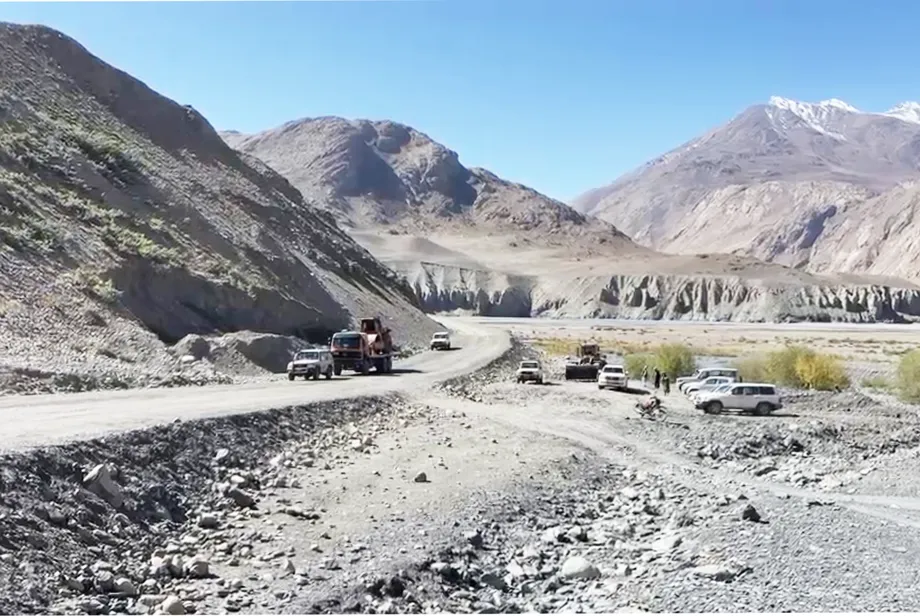
Afghanistan has inaugurated a 121 kilometer unpaved road through northeastern Badakhshan province to its border with China, spending 365 million afghanis, reported as about $5.5 million, on a route intended to give Afghan traders an alternative to transit through neighboring countries. The road runs from the Boroghil border area, also spelled Broghil, toward the Chinese frontier in the remote Wakhan district.
Contents
- A $5.5 million road reaches the Chinese frontier
- What the road opens, and what it does not
- How the project developed
- The trade figures show a large imbalance
- Why Kabul wants an alternative to Pakistan
- China's engagement does not guarantee an open pass
- Mountain conditions make reliability the real test
- Wakhan would complement other routes, not replace them
- What must happen before economic gains can be measured
- Key Points
The distinction between reaching the border and opening it to commercial traffic is central to the project. The inauguration accounts describe a completed Afghan road, not a functioning international freight crossing. An April 2025 study by the Observer Research Foundation says China has no customs facilities at Wakhjir Pass and describes Beijing as skeptical about the economic case for developing the corridor.
Construction began two years before the inauguration, according to the opening announcements. Reports differ on the ceremony date: two describe it as taking place on Sunday, while another gives 4 October without specifying a year. They also describe the length slightly differently, as either 121 kilometers or more than 121 kilometers. Neither discrepancy changes the principal achievement, a road reaching the frontier, but the accounts do not establish a single precise inauguration date.
Abdul Latif Mansour, Afghanistan's minister of rural rehabilitation and development, said at the ceremony that the project had strategic, political and economic importance. He also credited domestic engineering capacity:
"The Islamic Emirate of Afghanistan has prioritized such public projects, especially in provinces that are most in need. There are no foreign engineers or advisers; all the engineers are Afghans," Mansour said.
Badakhshan Governor Rahmatullah Najib described the completion as a major achievement for a remote region after 45 years of war. Its commercial value, however, will depend on decisions and infrastructure beyond the Afghan construction site.
What the road opens, and what it does not
The Wakhan Corridor is the strip of Afghan territory between Tajikistan to the north and Pakistan to the south that reaches China's Xinjiang region. Building a road through it creates physical access to the frontier. Opening a trade corridor requires both countries to authorize traffic, process goods and provide connecting transport services.
Ayjaz Wani's ORF Issue Brief, No. 796, published on April 21, 2025, describes Wakhjir Pass as China's only access point to the corridor and identifies Tashkurgan in Xinjiang as the nearest major town. The study says Beijing considers development economically unviable because of the mountainous terrain and sees more security risks than economic opportunities.
That is the assessment of a research institution, rather than a new Chinese government announcement accompanying the inauguration. Even so, it exposes the gap between Kabul's ambitions and a confirmed agreement to operate the border. The opening reports do not establish a date for Chinese customs operations, routine freight movements or a connecting road service on the Chinese side.
The road should therefore be understood as an Afghan infrastructure milestone. Describing it as an operating international trade route would go beyond what has been established.
How the project developed
Efforts to build a direct route have unfolded through several governments, funding proposals and construction phases. Earlier reports refer to sections of roughly 49 or 50 kilometers, whereas the inauguration accounts describe a 121 kilometer road. Those figures may concern different stretches or project stages, but a detailed reconciliation has not been published in these accounts.
- 1963: Afghanistan and China reached a formal border agreement, but no official border checkpoint was established, according to the historical accounts.
- 2017: China pledged approximately $90 million for infrastructure in northeastern Afghanistan, including fiber optic connections and a Wakhan road segment. One account describes the pledge as more than $90 million.
- 2021: Plans were announced for a road linking Ishkashim district with Xinjiang through Wakhan. The ORF study says work on a 50 kilometer Little Pamir road was subsequently suspended because of security concerns.
- September 2023: Taliban authorities announced reconstruction of a 50 kilometer section at a reported cost of $5.16 million, funded by the Ministry of Rural Rehabilitation and Development.
- January 2024: Officials described the road as nearly complete. Deputy Prime Minister for Economic Affairs Mullah Baradar said on January 2 that construction remained underway.
- August and December 2024: Reported visits and diplomatic meetings brought renewed attention to the corridor, including discussions between Interior Minister Sirajuddin Haqqani and Chinese Ambassador Zhao Xing.
- Latest inauguration: Authorities announced completion of the unpaved route from Boroghil to the Chinese border at a cost of 365 million afghanis.
An earlier progress account described five months of work, a 49 kilometer section and completion of nearly 40 percent of that section. These are progress snapshots, not evidence that the later 121 kilometer project was already complete. Similarly, the earlier dollar estimates should not be added to the inauguration cost without knowing whether the budgets overlap.
The trade figures show a large imbalance
The strongest economic argument for Wakhan is access to a market with which Afghanistan already trades. The ORF brief records bilateral trade of $1.3 billion in 2023, up 125 percent from 2022. That growth rate implies a 2022 total of roughly $578 million, calculated by dividing $1.3 billion by 2.25.
Afghan exports to China amounted to only $64 million in 2023, about 4.9 percent of the bilateral total. Nearly 90 percent of those exports consisted of shelled pine nuts, according to the brief. Applying that share to the export figure gives roughly $57.6 million in one product category.
These numbers show why a new route alone cannot produce a balanced trading relationship. Afghanistan would need to expand the volume and variety of goods it can sell, rather than simply make Chinese imports easier to bring in. Agricultural products, gemstones, minerals and handicrafts are among the export opportunities identified in the economic case for Wakhan, but no forecast establishes how much additional trade the road would generate.
The ORF study also reports that Beijing granted Afghan products 100 percent duty free access from December 2024. Removing import duties can improve market access, but it does not remove transport costs, product requirements or border procedures. Wakhan would address only part of that chain.
Why Kabul wants an alternative to Pakistan
For Afghanistan, the project is also about reducing exposure to disruptions outside its borders. Torkham and Chaman are the main trade channels with Pakistan, whose ports provide access to maritime commerce. Repeated closures have imposed losses on Afghan traders and strengthened the case for routes through Iran, Central Asia and China.
The ORF brief records a ten day closure at Torkham in January 2024 and describes prolonged restrictions at other crossings. It places these disruptions within worsening relations between Kabul and Islamabad over militancy, border security and the presence of Afghan nationals in Pakistan.
Pakistan accuses Afghanistan of allowing threats to its security to persist, allegations Kabul rejects. The brief reports a 73 percent increase in terror attacks in Pakistan during the first 21 months after the Taliban returned to power. It also gives 572 incidents in Khyber Pakhtunkhwa in 2021 and 2,173 in 2024, an increase of about 280 percent.
The same study reports that Pakistan had repatriated around 800,000 Afghans and approved a plan in January 2025 to deport another 3 million. These developments help explain the political urgency behind Kabul's search for alternatives, although they do not prove that Wakhan can carry enough freight to replace established crossings.
China's engagement does not guarantee an open pass
China has maintained extensive contact with the Taliban administration. Between August 2021 and February 2024, the Taliban held 1,382 diplomatic meetings with 80 countries, according to the ORF brief. China accounted for 215, approximately 15.6 percent of the total.
Investment and security are both part of that relationship. The brief records a 2023 contract under which Xinjiang Central Asia Petroleum and Gas Company committed to invest $550 million over three years in oil extraction. It separately cites Taliban officials describing Chinese interest in a $10 billion lithium investment. The latter is an expression of interest attributed to Afghan officials, not equivalent to a completed investment or a Wakhan financing commitment.
China's concerns include the East Turkestan Islamic Movement and Islamic State Khorasan Province, alongside threats to Chinese personnel and projects in Pakistan. The ORF analysis argues that Beijing may prefer Wakhan as a security buffer rather than a busy commercial crossing into Xinjiang.
Reports also describe alleged Pakistani and Chinese activity on the Afghan side of Wakhan in early 2022, followed by a Taliban response. Those accounts do not provide independent confirmation or a shared official explanation of the alleged border activity. They should not be treated as proof of a territorial change.
The practical tension is straightforward: Kabul wants traffic and investment, while the research assessment describes Beijing as cautious about both security and commercial returns. Frequent diplomatic contact does not by itself resolve that difference.
Mountain conditions make reliability the real test
The ORF brief describes Wakhan as about 350 kilometers long and 20 to 60 kilometers wide, with 110 villages and roughly 12,000 inhabitants. It places the border area at about 5,000 meters above sea level. Another account puts Wakhjir Pass at nearly 4,900 meters.
Geographical figures differ elsewhere too. The original economic study gives an Afghan Chinese border length of 96 kilometers, while ORF describes it as approximately 75 kilometers. Width estimates also vary, with the original study giving 16 to 66 kilometers. Without a common measurement method, these should be presented as differing descriptions rather than interchangeable exact figures.
The transport obstacles are less ambiguous. Heavy snow, extreme cold, avalanches and landslides can interrupt travel and shorten the construction season. An unpaved road reaching a high mountain frontier is not evidence of dependable access throughout the year.
Afghanistan would also need bridges, communications, freight handling, customs capacity and maintenance arrangements. Banking services and cargo insurance matter because traders must be able to pay suppliers and manage the risk of loss or delay. No verified freight capacity, seasonal operating schedule or maintenance budget accompanies the inauguration figures.
Wakhan would complement other routes, not replace them
The proposed route serves a different purpose from several regional projects often grouped with it. The China Pakistan Economic Corridor, or CPEC, connects Chinese interests with Pakistan's transport network and Gwadar port. Wakhan would give Afghanistan a direct land connection to China, but not direct access to the sea.
A report on the road says China, Pakistan and Afghanistan agreed in 2025 to extend CPEC into Afghanistan. That creates a possible overlap between direct access through Wakhan and access through Pakistan. It does not establish that one route makes the other unnecessary. Freight capacity, destinations, reliability and price would determine which route traders choose.
The Lapis Lazuli route, inaugurated in 2018, points west through Turkmenistan, Azerbaijan, Georgia and Turkey toward European markets. Iran's Chabahar port provides a maritime option without transit through Pakistan. These routes address needs that a road into Xinjiang cannot meet on its own.
The Turkmenistan Afghanistan Pakistan India project, known as TAPI, is different again: it is a gas pipeline proposal, not a general freight corridor. Comparing it with Wakhan is useful for understanding regional cooperation, but not for measuring competing cargo capacity.
China already has another connection with Afghanistan. The ORF brief records a train service launched in September 2022 from Kashgar to Hairatan through Kazakhstan and Uzbekistan. Wakhan would therefore add a direct option to existing indirect links, rather than create bilateral transport from nothing.
What must happen before economic gains can be measured
The Asian Development Bank's CAREC performance report, published in December 2022, provides a useful framework for judging corridor performance. It examines trade procedures and transport efficiency from 2010 to 2020 across six corridors involving 11 member countries, including Afghanistan and China.
The report uses Corridor Performance Measurement and Monitoring, a method for assessing how goods actually move through transport routes and borders. It examines structural barriers and the disruption caused by COVID 19. It is not a feasibility study for Wakhan and does not validate a particular forecast of savings or trade growth there.
That distinction matters for the economic claims surrounding the road. A shorter geographical connection may still be slower or more expensive if mountain closures, transshipment or border delays interrupt deliveries. Reliable evidence would require journey times, freight charges, operating seasons and customs performance, none of which is established for routine Wakhan trade.
Construction and future transport services could create jobs in Badakhshan. Wakhan also includes part of a national park and already attracts domestic and international visitors. Better access may help local commerce and tourism, but no employment or visitor forecast has been confirmed.
The next meaningful milestones are an agreed border operating arrangement, Chinese customs facilities, usable connecting infrastructure and demonstrated commercial traffic. No confirmed deadline for those steps is given. Until then, the road's strongest established value is improved physical access and a new negotiating option, rather than measured export growth or transit revenue.
Key Points
- Afghanistan has inaugurated an unpaved road of about 121 kilometers from Boroghil to the Chinese border in Wakhan.
- The reported construction cost was 365 million afghanis, approximately $5.5 million, with work beginning two years before the opening.
- Reports differ on the inauguration date, describing either Sunday or 4 October without a specified year.
- The April 2025 ORF brief says Wakhjir Pass lacks Chinese customs facilities and describes Beijing as cautious about the route's economic and security costs.
- Bilateral trade reached $1.3 billion in 2023, but Afghan exports accounted for only $64 million, roughly 4.9 percent.
- Mountain weather, border procedures, financing and connecting infrastructure will determine whether the road becomes a dependable freight corridor.
- No confirmed date for routine commercial border operations has been established.