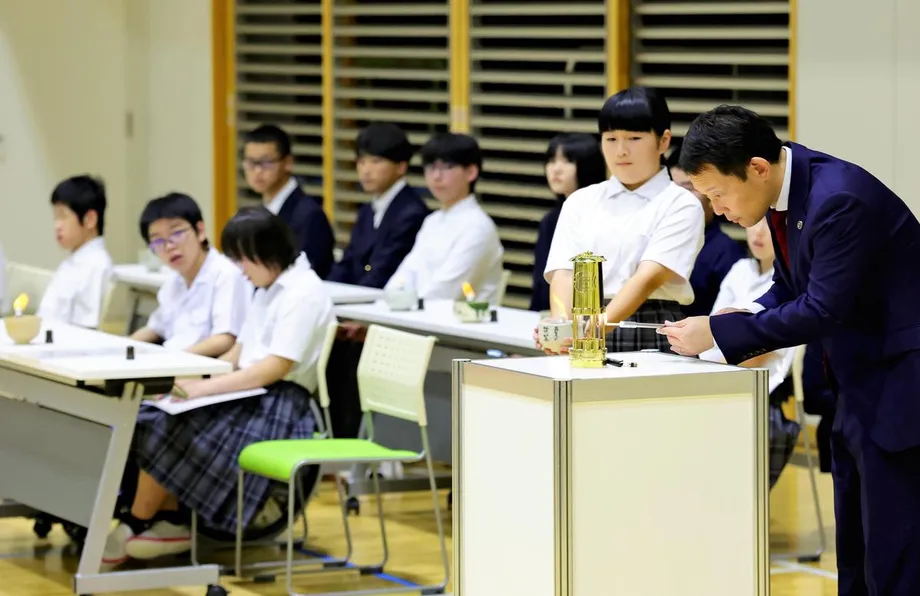
Students send a message of support as the flame journey begins
NISHIO, Japan — Students at Aichi Prefectural Nishio Special Needs School helped launch preparations for the Aichi-Nagoya 2026 Asian Para Games on Oct. 6, taking part in a ceremony to light a flame that will become part of the event’s torch relay. The Games are scheduled to open on Oct. 18.
Contents
The Nishio ceremony was the first in a series planned across 31 municipalities in Aichi Prefecture. Fires collected in participating communities will be brought together as the Games’ sacred flame, connecting local events with the regional competition.
Twelve participants, including student council members, read messages of encouragement for athletes. One urged competitors to “turn differences into strength” and do their best. Other messages wished athletes success in setting personal records and drawing on the results of their training.
Strong winds forced organizers to move the ceremony from the school’s athletic field into its gymnasium. More than 100 students and family members attended, according to Japanese media reports. Alcohol lamps arranged inside tea bowls gave the ceremony a local touch, reflecting Nishio’s reputation as a tea-producing area.
Ken Nakamura, Nishio’s mayor, used an ignition rod to take the flame from a lamp held by a third-year high school student representing the student body. He then transferred it into a lantern bearing the Games emblem. The handover drew applause from those gathered.
How will local flames become the Games flame?
The ceremony in Nishio marks the beginning of a broader series of flame-gathering events. Municipalities across Aichi are set to conduct their own ceremonies through Oct. 14, using approaches that reflect local settings and traditions. The collected fires are due to be brought together at Tsuruma Park in Nagoya on Oct. 15 to form the Games flame.
That process gives the relay a regional character. Rather than beginning with a single ceremony at the main venue, the flame’s preparations involve communities across the prefecture. The fires gathered in each municipality will contribute to the shared flame before runners carry it along planned routes.
Some local ceremonies are expected to draw on distinctive community features. In Takahama, a fire was planned using a kiln at Yamamoto Onigawara Kogyo, a maker of traditional Sanshu roof tiles. The approach reflects a wider aim of tying the flame events to the places hosting them.
The relay itself is scheduled to begin in Okazaki on Oct. 10, then pass through other cities and towns, including Kariya, Chiryu, Inuyama, Toyota and Higashiura. The route is planned to reach a grand finish at Meijo Park in Nagoya on Oct. 17, the day before the opening ceremony. Together, the local collections and relay are intended to build momentum toward the Games.
Why was Nishio’s school chosen for the first ceremony?
Holding the opening collection at a special needs school placed students with disabilities at the center of a public event connected to a major para-sport competition. Their role was active: they delivered the messages, represented the student body during the flame transfer and helped set the tone for the Games’ approach to athletes and audiences.
The messages focused on effort, achievement and the value of difference. Such language is closely associated with para sport, where athletes compete across a wide range of physical and sensory impairments, with classifications designed to group competitors in ways that support fair competition. The Games bring together athletes from across Asia in events adapted to different disciplines and impairment classes.
For students, the ceremony also offered a chance to express what they hope to see from the event. Misuzu Yamauchi, a 17-year-old third-year student who handed the lamp to the mayor, said she was looking forward to wheelchair basketball. She hoped the Games would be an event that both the public and athletes could enjoy with full commitment.
Wheelchair basketball is one of the best-known para sports. Players use specially designed wheelchairs and maneuver, pass and shoot while following rules adapted for wheelchair movement. The sport’s speed and teamwork have helped make it a popular event at international competitions.
A local setting gave the ceremony its character
The tea bowls and alcohol lamps connected the formal flame ritual to Nishio’s identity as a tea-producing community. Organizers arranged the lamps on tables, using the bowls as holders rather than relying on a generic display. The detail made the ceremony recognizable as a local event while keeping attention on the flame and the students’ messages.
Weather changed the planned setting, but not the ceremony’s central sequence. After moving indoors because of strong winds, participants continued in the gymnasium, where students read their messages before the mayor collected and placed the flame in the lantern.
The choice of a lantern provides a practical way to preserve and transport the collected fire during the larger ceremony process. Once the local fires are assembled, the resulting Games flame can be carried as part of the relay. This symbolic continuity links the separate municipal events to the opening of the competition.
What the relay means before the opening
The flame relay is one of the public rituals that precede a major multi-sport event. It gives host communities a visible role in the preparations and creates opportunities for residents to encounter the Games outside the competition venues. In Aichi, that reach extends across 31 municipalities for the collection ceremonies, followed by relay events in seven cities and towns.
The schedule moves from local flame collections to a gathering in Nagoya and then to the relay’s final destination at Meijo Park. The sequence allows the organizers to present the Games as a prefecture-wide event, even though competitions and ceremonies will take place at specific venues.
The Aichi-Nagoya Asian Para Games are a regional competition for para athletes, and the Oct. 18 opening date gives the flame events a short, defined lead-up. Nishio’s ceremony began that period with a message from students to athletes: differences can be a source of strength, and preparation should be turned into performance.
What to Know
- The Aichi-Nagoya 2026 Asian Para Games are scheduled to open on Oct. 18.
- Nishio held the first flame collection ceremony on Oct. 6 at Aichi Prefectural Nishio Special Needs School.
- Flame ceremonies are planned in 31 Aichi municipalities through Oct. 14.
- The fires are due to be brought together at Tsuruma Park in Nagoya on Oct. 15.
- The torch relay is scheduled to start in Okazaki on Oct. 10 and finish at Meijo Park on Oct. 17.
- Twelve students and other participants took part in Nishio, where students shared messages of support for athletes.