A narrow strait puts Asia under pressure
About 80 percent of the oil and petroleum products and nearly 90 percent of the liquefied natural gas passing through the Strait of Hormuz went to Asian markets in 2025, according to International Energy Agency figures. That dependence has placed Asia at the centre of an energy emergency following the war in Iran, with governments cutting working days, rationing fuel and restarting coal plants.
Contents
- A narrow strait puts Asia under pressure
- How the emergency spread
- Drivers and workers lose their earnings
- Schools and offices cut fuel use
- Reserves buy time, but protection is uneven
- Emergency lending meets a physical shortage
- Factories close as cooking and travel become costly
- Coal returns as countries protect electricity supplies
- Fertilizer shortages threaten the next harvest
- China's clean technology position grows stronger
- Energy producers outside Hormuz gain an opening
- Key Points
The war began in late February, when the United States and Israel launched strikes against Iranian targets. Within days, Iran effectively closed the strait, a passage only about 33 kilometres wide at its narrowest point that normally handles roughly 20 percent of world oil consumption. By April 14, the disruption had become the most severe energy crisis since the Arab oil embargo of the 1970s.
Tanker traffic fell from approximately 100 to 150 vessels a day to single digits on some days. Eighteen ships had already been struck by military attacks in or near the strait. For Asian importers, the immediate problem was both the rising price of fuel and the difficulty of getting physical shipments delivered.
Brent crude, a widely used benchmark for oil prices, rose from approximately $71 a barrel before the conflict to more than $100 in the following weeks, briefly reaching peaks not seen in years. The International Energy Agency coordinated its largest ever strategic petroleum reserve release, with member countries drawing down up to 400 million barrels.
Those reserves are emergency stores of oil intended to cushion supply shocks. Their release has brought only temporary relief because the continuing loss of shipments is outpacing the emergency supplies. Across Asia, governments are being forced into energy triage: deciding which activities receive scarce fuel and which must reduce consumption or stop.
How the emergency spread
The crisis moved rapidly from a military confrontation to an economic emergency. The sequence explains why measures affecting schools, offices and factories followed so quickly after the first attacks.
- Late February: The United States and Israel launched strikes against Iranian targets, beginning the war.
- Within days: Iran effectively closed the Strait of Hormuz, sharply reducing tanker movements.
- The following weeks: Brent crude climbed from approximately $71 a barrel to more than $100, while the International Energy Agency coordinated releases of up to 400 million barrels.
- The first three weeks of March: Demand for electric vehicle leasing in the United Kingdom increased by more than a third as fuel costs rose.
- By April 14: Asian governments had introduced conservation measures, fuel rationing, reserve releases and changes to electricity generation.
Japan, South Korea, Singapore and Hong Kong entered the emergency with substantial foreign exchange reserves and strategic stockpiles. Foreign exchange reserves are funds held in foreign currencies that can help a country pay for imports when its own economy comes under pressure.
Pakistan, Bangladesh, Sri Lanka and Myanmar face a more dangerous combination: heavy dependence on imported fossil fuels, limited room in government budgets and energy systems that cannot quickly switch to other supplies. Their exposure extends to social unrest, food insecurity and political instability, recalling the pressures that toppled governments during the 1997 Asian Financial Crisis.
Drivers and workers lose their earnings
The Philippines has declared a national energy emergency, but the impact is already visible in the earnings of jeepney drivers who provide a core part of public transport. Carlos Bragal Jr. previously earned 1,000 to 1,200 pesos for a shift lasting 12 hours. His daily income has fallen to 200 to 500 pesos, while government fuel subsidies cover barely two days of driving.
Bragal described how the work had supported his daughters through school and how the fuel crisis now threatened that security:
I have sent my daughters to school because of this job, one just graduated and the other one is a graduating student. We had a good life. But now, we do not know what will happen to us in the next few weeks. If this continues, it will definitely kill us and our family.
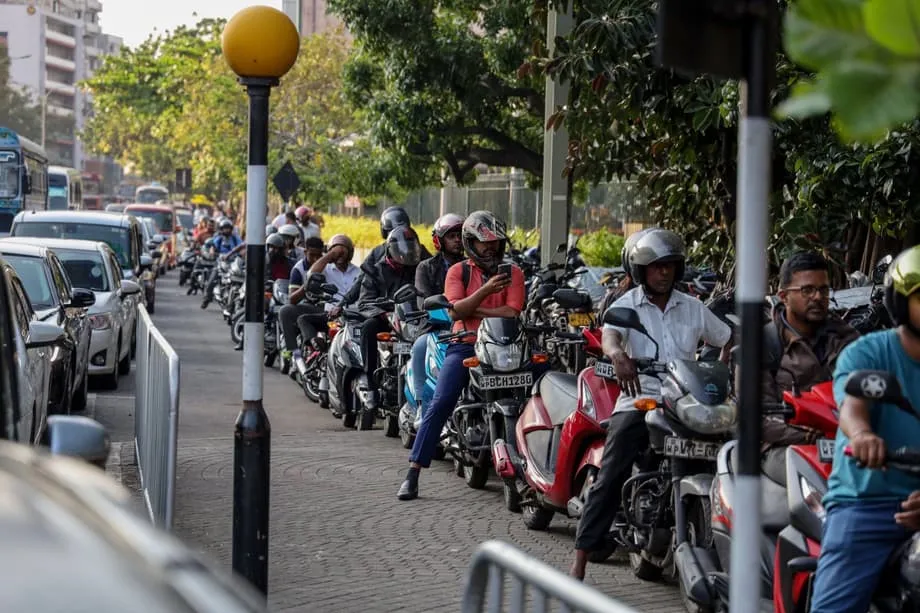
Sri Lanka has declared Wednesdays a public holiday to conserve fuel. For workers who remember the financial crisis of 2022, the queues carry a familiar anxiety, even though the immediate cause is different. In 2022, the country lacked foreign reserves to buy fuel. Now, fuel availability itself is the problem.
A Colombo resident described that change:
During the previous time, the country did not have money to buy fuel. Now, the country has money, but there is no fuel for us to buy.
Nimal, a lawnmower operator, spends so long waiting at petrol stations that other workers can take the jobs he was expecting to do. He explained how the queues affect his income:
We are fulfilling our daily needs with great difficulty. By the time I get back to work after getting fuel, someone else may be there as a replacement for the job.
Thailand has made conservation visible on television. News presenters at public broadcaster Thai PBS removed their blazers on air, while government offices set temperatures at 26 to 27 degrees Celsius and officials were urged to take stairs instead of elevators. Keeping air conditioning at a warmer setting reduces electricity demand.
Sirima Songklin, a news anchor who took part in the change of clothing, described the connection between that small adjustment and the war:
unbelievable that something so small could reflect the clear impact of the current conflict on us.
Schools and offices cut fuel use
Asian governments have introduced stringent conservation measures that recall the changes to daily life during the COVID-19 pandemic. The Philippines moved government employees to a working week of four days and ordered computers switched off during lunch breaks. Pakistan closed schools for two weeks and introduced hybrid working arrangements for public employees.
Bangladesh brought university holidays forward to coincide with Ramadan. Sri Lanka introduced a week of four days for schools and public sector operations. Vietnam urged wider adoption of remote work. These measures reduce journeys and energy use in buildings, while shifting the disruption into education and employment.
Myanmar's military authorities imposed strict fuel rationing based on licence plate numbers, allowing private vehicles to travel on alternating days. That system limits access to driving directly, rather than relying only on higher prices to reduce demand.
Indonesia faces a particularly difficult test during Eid al-Fitr, when 143.9 million journeys are anticipated. The government is trying to maintain fuel subsidies through the travel period, even as their cost threatens to push the national budget deficit above its legal ceiling of three percent of gross domestic product. A deficit is the gap when government spending exceeds revenue.
Indonesia has allocated tens of billions of dollars to keep fuel and electricity affordable, but its finances limit how long that support can last. Pakistan initially introduced targeted subsidies for farmers and transport workers, then scaled them back as the crisis continued. Thailand faces a similar choice: ending subsidies risks public panic if reserves fall further, while keeping them drains limited government funds.
Putra Adhiguna of the Energy Shift Institute described the uncertainty surrounding Indonesian fuel pricing after Eid:
There is no clarity about what will happen after that.
Reserves buy time, but protection is uneven
Japan maintains roughly 254 days of oil supplies. South Korea has released 22.46 million barrels from its reserves under the International Energy Agency programme. Both countries also have approximately 200 days of national reserves, a measure presented separately from Japan's broader supply figure.
Japan and South Korea have the financial resources and institutions to manage months of disruption, but their stockpiles were never designed to replace prolonged losses of supply. Both still face industrial slowdowns and the risk of stagflation, a combination of rising prices and weak economic growth.
China holds vast stockpiles equivalent to 130 days of consumption and receives additional supply through Russian pipelines. It has prohibited petroleum exports to protect domestic supplies, while making strategic exceptions for key trading partners in Southeast Asia and Australia.
Pakistan's financial position is much tighter. Its gross foreign reserves stand at $16.4 billion, but those reserves are effectively negative when foreign currency liabilities are taken into account. The country must repay a $3.5 billion loan to the United Arab Emirates while maintaining a $7 billion International Monetary Fund programme.
Pakistan's fuel prices have risen 40 percent, and remittances from workers based in the Gulf are expected to decline. Remittances are money workers send home to their families. A reduction would weaken another source of foreign currency at the same time that imported energy becomes more expensive.
Sri Lanka has negotiated temporary easing of IMF bailout terms and reintroduced fuel subsidies. Its tourism industry is also suffering. Tourism operator Sanoj Weeratunge reports business down by a third, undermining hopes for a recovery after COVID-19. Pakistan, Bangladesh and Sri Lanka all confront the crisis with financial scars from earlier periods of economic stress.
Emergency lending meets a physical shortage
The International Monetary Fund has indicated that it is ready to provide between $20 billion and $50 billion in emergency support to affected countries. Such assistance could help governments meet urgent foreign currency needs as import bills rise and other sources of income weaken.
Kristalina Georgieva, the IMF's managing director, acknowledged the need for flexibility in the conditions attached to assistance:
it is in no one interest to be rigid in the conditionality and allow these countries to fail.
Reza Baqir, a former governor of Pakistan's central bank, called for a credible statement from international institutions that support would be available:
a credible statement from institutions like the IMF and others that they are ready to backstop these countries, and I think the sooner, the better.
The comparison with 1997 helps explain both Asia's greater financial protection today and the different nature of the present emergency. The earlier Asian Financial Crisis grew from a dangerous combination of fixed exchange rates, high levels of foreign debt requiring repayment soon and low foreign exchange reserves.
Asian economies now generally have larger reserves and more flexible exchange rates, providing cushions that were absent three decades ago. Currency pressure and capital outflows still echo 1997, but the current shock begins with disrupted physical supplies.
Higher energy import bills put pressure on the current account, which records trade and income flowing between a country and the rest of the world. The 1997 crisis centred more on the capital account, involving borrowing, investment and money moving across borders. Central banks struggle with today's stagflation risk because changing interest rates cannot restore blocked fuel shipments.
Factories close as cooking and travel become costly
India's ceramics industry in Gujarat has shut down for weeks because of gas shortages, idling approximately 400,000 workers. Migrant workers face immediate difficulty paying for food when factory wages disappear.
Sachin Parashar, one of the workers affected by the closures, described the consequence of staying without employment:
I will have to go hungry if I continue staying here without work.
Liquefied petroleum gas, widely used for cooking across the subcontinent, has also become scarce. Restaurants in Mumbai have removed curries that require long cooking times and foods cooked by deep frying from their menus. Those changes reflect the need to conserve cooking fuel as well as manage costs.
Hotels report occupancy as low as ten percent as rising jet fuel costs and frightened travellers weaken demand. The pressure connects several parts of the economy: costly fuel affects flights, reduced travel affects hotels, and shortages affect the meals restaurants can prepare.
Naphtha shortages create another industrial threat. Naphtha is a material derived from crude oil that is used to make chemicals and other products. Its scarcity has created a near immediate crisis for semiconductor and advanced electronics production across Asia.
South Korean households have stockpiled plastic rubbish bags because of fears about naphtha supplies. Japanese hospitals are worried about dwindling stocks of syringes, gloves and dialysis equipment made from materials derived from petroleum. Dialysis equipment helps treat people whose kidneys cannot adequately filter their blood, making these supplies a direct concern for patient care.
Coal returns as countries protect electricity supplies
Thailand has restarted two decommissioned units at the Mae Moh power plant, which burns coal. South Korea and Japan have lifted restrictions on coal generation, allowing older plants to operate at higher capacity. India has ordered plants burning coal to run at full capacity and avoid planned outages.
China is less exposed because of its domestic energy production, but it is also burning more coal and using renewable electricity to replace natural gas wherever possible. Across the region, governments are prioritising power availability as imported fuel becomes harder to secure.
The return to coal amounts to a temporary retreat from climate commitments. Reopening units and increasing output can help sustain electricity supplies now, while risking a longer reliance on fossil fuels if emergency changes persist.
The same emergency is strengthening interest in renewable energy. Asia's response therefore includes two directions at once: using existing coal capacity to meet immediate needs and turning towards solar power, batteries and electric vehicles to reduce future dependence on imported fuel.
Fertilizer shortages threaten the next harvest
Roughly 30 percent of global fertilizer trade passes through the Strait of Hormuz. Fertilizer prices have risen 35 percent since the war began, creating a second route through which the energy crisis can reach household food budgets.
The Northern Hemisphere planting season is underway. Farmers facing higher prices and reduced availability may apply less fertilizer, threatening lower crop yields across South Asia. Fertilizer provides nutrients crops need to grow; using less can reduce the amount harvested.
South Asian populations spend nearly half their income on food, leaving limited room to absorb further increases. Higher fuel costs, weaker earnings and pressure on agricultural production can therefore affect families at the same time.
The World Food Programme reports that ships taking alternative routes are already slowing humanitarian responses in areas facing food insecurity, including South Sudan and Somalia. The effects of the blocked passage extend beyond the Asian economies receiving most of its energy shipments.
Gwyn Lewis, the UN Resident and Humanitarian Coordinator ad interim in Myanmar, described the growing pressure on families:
prices are rising, essential goods are harder to find, and families purchasing power continues to fall.
China's clean technology position grows stronger
China dominates global manufacturing of solar panels, electric vehicle batteries and electric vehicles themselves. It accounts for more than 70 percent of electric vehicle manufacturing and 85 percent of battery cell production worldwide. Rising interest in alternatives to imported fossil fuels is accelerating demand for Chinese clean technology.
Pakistan illustrates that shift. Although it still imports a third of its energy, its renewable energy expansion since 2017 has installed more than 50 gigawatts of Chinese solar panels. Analysis suggests solar power could save Pakistan $6.3 billion in fossil fuel imports over the next year if prices remain elevated.
The condition attached to that estimate matters for household and national budgets: the projected savings depend on fossil fuel prices staying high. Solar generation replaces some fuel purchases, reducing exposure to the cost of imported energy.
Demand is changing beyond Pakistan. Electric vehicle leasing demand in the United Kingdom rose by more than a third in the first three weeks of March, while rooftop solar sales surged. Vietnamese electric vehicle maker VinFast is offering discounts to offset the fuel price shock, and Indonesian President Prabowo Subianto has announced a major push into electric vehicle production.
China's manufacturing strength gives it a strategic advantage as countries seek different ways to power transport and buildings. The urgency comes from the same supply vulnerability that has forced governments to ration fuel and draw down reserves.
Energy producers outside Hormuz gain an opening
The United States, Canada, Brazil and Guyana stand to benefit from greater attention to energy security and supply diversification. Their output does not depend on the vulnerable Hormuz route, making it relevant to importers seeking additional sources.
Mexico and Venezuela also have energy resources, but political uncertainty and operational challenges limit their ability to attract the investment surge benefiting other producers in the Americas. Resources alone are insufficient when investors also need confidence that projects can operate reliably.
The crisis has increased interest in what the Western Hemisphere can supply. Turning that interest into dependable alternatives requires groundwork now, while Asian governments continue to manage the immediate strain on fuel availability, public finances and household incomes.
Key Points
- The Iran war began in late February, followed within days by the effective closure of the Strait of Hormuz, which normally handles roughly 20 percent of world oil consumption.
- Asia received about 80 percent of the oil and petroleum products and nearly 90 percent of the liquefied natural gas passing through the strait in 2025.
- Brent crude rose from approximately $71 a barrel to more than $100. The International Energy Agency coordinated emergency releases of up to 400 million barrels.
- Governments have shortened working weeks, closed schools, encouraged remote work and rationed driving to conserve fuel.
- Pakistan, Bangladesh, Sri Lanka and Myanmar face especially difficult choices because of import dependence and limited financial resources.
- Factory closures, falling transport earnings, fertilizer shortages and disrupted humanitarian shipping are spreading the damage beyond energy markets.
- Several countries have increased coal generation, while demand for solar power, batteries and electric vehicles is strengthening China's manufacturing advantage.
- The IMF has indicated readiness to provide $20 billion to $50 billion in emergency support to affected countries.