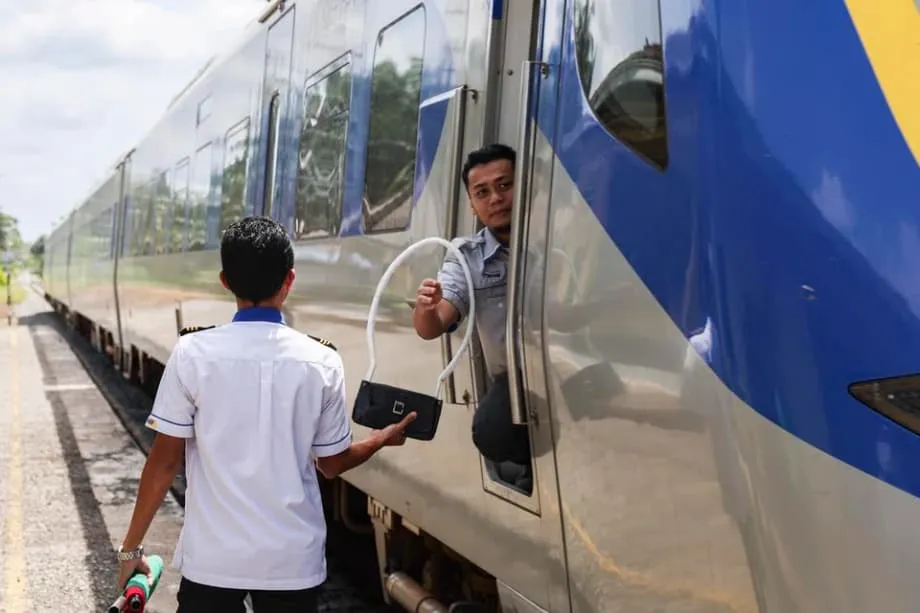
A Leather Pouch Still Controls the Journey
At Kuala Krau railway station in Pahang, a leather pouch with a horseshoe shaped handle remains part of the equipment used to keep trains moving safely. The station sits on Malaysia's 526 kilometer Jungle Railway, running from Gemas in Negeri Sembilan to Tumpat in Kelantan. Here, a physical token passed between railway staff and a driver authorizes a train to enter the next section of track.
Contents
- A Leather Pouch Still Controls the Journey
- Why a Single Track Needs a Token
- The Machinery Behind the Exchange
- How the Raised Elbow Became Practical
- New Trains, an Older Safety Principle
- A Connection for Railway Enthusiasts
- Preserving Buildings and Working Equipment
- The Dates Behind the Continuing Ritual
- Key Points
The exchange, known locally as the cota system, has governed movements along the eastern seaboard of the Malay Peninsula since 1885. As of April 12, 2026, it remains one of the last surviving examples of colonial railway safety procedures in Southeast Asia, combining equipment inherited from an earlier railway age with the daily responsibilities of a working station.
The morning ritual involves station master Mohd Akmal Jamal, his assistant and the driver of an approaching train from Tumpat. Akmal stands at the edge of the weathered platform holding the pouch, its leather darkened by decades of use. Farther along the platform, his assistant raises an elbow in a stance resembling that of a boxer.
As the train approaches slowly, the driver leans out of the cockpit door and hooks a matching pouch onto the assistant's raised arm. The driver then extends an elbow to receive the pouch held by Akmal as the locomotive continues northward. The coordinated movements exchange the authority for one section of track for the authority needed to travel through the next.
Kuala Krau's surroundings give the procedure its distinctive setting. The railway passes through some of the peninsula's most remote terrain and alongside Taman Negara national park. Dense vegetation presses against the rails, wildlife occasionally interrupts services, and humid air and morning mist surround a route first laid through the tropical landscape by British engineers nearly a century and a half ago.
Why a Single Track Needs a Token
The Gemas to Tumpat route remains Malaysia's sole single track mainline where the cota procedure applies. Trains traveling in opposite directions share the same rails, making control of entry into each section essential. A driver needs permission to proceed before another train can be allowed onto that stretch.
The token system divides the railway into sections called blocks. Each block is the stretch of track between stations. Under the principle described for the cota system, one token governs each block, and the train carrying it has the exclusive right to use that section.
A driver without the physical token cannot proceed. The procedure is intended to prevent both collisions between trains approaching each other and crashes involving a train following another onto the same undivided line. Its central rule is simple enough to understand without knowing how the machinery works: one train, one token, one block at a time.
The pouch makes that permission something railway workers can pass from hand to hand. Its contents matter more than its appearance. The metal token inside supplies the physical authority to enter the next block, while the exchange returns the token associated with the section the train has just used.
Modern railway networks typically manage movements through centralized traffic control, electronic sensors, radio communications and computerized switching. At Kuala Krau, the railway still requires human contact and a physical object as part of that process. The procedure links the practical task of preventing conflicting train movements with a visible piece of industrial history.
The Machinery Behind the Exchange
Akmal keeps two red cast iron token boxes in his office. The equipment bears the label of Tyer and Company, the British manufacturer that had been producing railway instruments since the 1870s. The apparatus is known as the Tyer No. 9 signalling system.
The procedure traces its origins to the Federated Malay States Railways under British colonial administration. Engineers laying tracks through the eastern jungle in the late nineteenth century needed a way to manage trains sharing a single track. Tyer's equipment supplied a means of coordinating permission between neighboring stations.
The boxes at Kuala Krau connect to adjacent stations through dedicated telephone lines and electrical cables. Before a train departs, station staff remove the appropriate metal token, put it in the leather pouch and pass it to the driver. Akmal explained that taking a token from the box and giving it to the driver signals to the next station that a train is approaching.
The system combines mechanical interlocks with human verification. An interlock is a mechanism that restricts an action until the required conditions have been met. In this setting, the equipment and checks between staff work together to control access to the shared railway section.
The red boxes, their manufacturer's labels and the cables connecting stations remain working components rather than display objects. Their worn surfaces carry the marks of nearly a century and a half of continuous service, while communications between stations retain the role they have performed for generations.
How the Raised Elbow Became Practical
Akmal's account of the exchange explains why railway workers adopted such an unusual movement. During the steam era, trains were often longer than station platforms. A station master trying to reach the locomotive could have to walk a considerable distance, sometimes beyond the station boundary, to collect or deliver a token.
The raised elbow allows a pouch to be transferred between a moving train and a worker who remains on the platform. The horseshoe shaped handle helps make that handover possible. What looks like a carefully rehearsed performance serves a practical purpose: completing the exchange without requiring the station master to follow the locomotive away from the working area.
At Singapore's former Tanjong Pagar terminal, station masters reportedly used bicycles to travel alongside trains and complete token exchanges. That station closed in July 2011, ending the direct rail link between Singapore and the Malay Peninsula associated with the terminal.
Kuala Krau has another reason for keeping staff close to their posts. Villagers along the eastern route sometimes cross the rails or walk along them, using the track as a path through the jungle. Akmal explained that leaving the platform to retrieve a token could create risks for passenger safety in places where local people also use the railway corridor.
New Trains, an Older Safety Principle
Keretapi Tanah Melayu modernized its fleet in 2021, replacing traditional locomotives with diesel powered engines equipped with contemporary safety features. The change brought newer trains to a route where parts of the operating procedure still depend on older signalling equipment.
Today, the daily overnight sleeper service from Tumpat to Johor Bahru and seasonal specials during festive holidays retain the older rolling stock that complements the manual signalling tradition. Rolling stock means the locomotives and passenger vehicles that run on the railway, distinct from the track and signalling installations.
A newer engine and a newer signalling system are different parts of railway modernization. The cota procedure continues because trains still need a controlled way to enter sections of shared track where modern electric signalling has not fully replaced the older arrangements.
Chief operating officer Afzar Zakariya explained why the token principle remains relevant even as railway equipment changes. He described its continuing role on routes that have yet to move completely to modern electric signalling:
Even though rail systems and equipment have evolved according to the times, the foundation of the one train, one token, one block at a time token system is still being used. This is to ensure safety in railways that have yet to transition fully to modern electric signalling systems.
Afzar's explanation places the ritual within the railway's current safety operation. The pouch, the token boxes and the checks between stations still perform a transport function, even as their age and appearance attract visitors interested in railway heritage.
A Connection for Railway Enthusiasts
Railway enthusiasts, particularly visitors from Singapore, travel to the Jungle Railway to see the exchange. For those familiar with Tanjong Pagar, Kuala Krau recalls a procedure once performed at the Singapore terminal before its closure in 2011.
Zac Cheong, a railway enthusiast aged 47 who joined a media tour earlier in 2026, welcomed the survival of the older railway atmosphere. He also expressed concern that future track upgrades could replace the manual procedure with modern electric railroad switches.
The attraction depends on the railway continuing to operate. Visitors come to see railway employees transfer tokens in the course of moving trains, rather than to watch a demonstration detached from a journey. The station's daily work gives the ritual its character.
The Jungle Railway also remains a transport link for rural communities. Its continued economic viability depends on that practical role alongside its appeal as a heritage tourism attraction. The same route that draws enthusiasts through remote rainforest provides connections for people living along the eastern corridor.
Preserving Buildings and Working Equipment
Malaysia's Railway Assets Corporation has shown increasing interest in protecting railway heritage through projects that give historic Malayan Railway buildings new uses. This approach, called adaptive reuse, keeps an older building in service by adapting it to a different purpose.
Conservation efforts involving a historic Penang station illustrate that interest. The building sold tickets to passengers connecting with ferries to Butterworth and served as an early example of transit oriented development, where a place is organized around access to transport.
The Penang building represents another part of the colonial railway legacy: the stations and connecting services that helped passengers complete journeys beyond the rails themselves. Its conservation reflects institutional recognition that railway infrastructure can retain cultural value alongside, or after, its original transport function.
Kuala Krau presents a different preservation challenge because its historic equipment remains part of an active safety procedure. Eventual electrification and track doubling would remove the operational justification for manual tokens described for this route. Railway historians hope at least one section could retain the traditional procedure as a living museum piece. No date has been given for replacing the cota system or for establishing such a preserved section.
The Dates Behind the Continuing Ritual
The history of the exchange stretches from British railway manufacturing to recent changes in Malaysia's train fleet. Several dates help explain how an old operating method has survived while the railway around it has changed:
- Since the 1870s: British firm Tyer and Company manufactured railway instruments, including the equipment associated with the token system.
- 1885: The cota procedure began governing train movements along the eastern seaboard of the Malay Peninsula.
- July 2011: Singapore's Tanjong Pagar station closed, ending the token exchanges associated with that terminal.
- 2021: Keretapi Tanah Melayu modernized its fleet with diesel powered engines carrying contemporary safety features.
- Earlier in 2026: Railway enthusiast Zac Cheong joined a media tour and discussed both the system's charm and the prospect of its replacement.
- April 12, 2026: The manual token ritual remains part of railway operation at Kuala Krau.
Kuala Krau's continuing routine brings those dates together in a single working process. Leather pouches change hands, cast iron token boxes open and close, and telephone lines carry confirmations between stations. Equipment rooted in the 1880s still helps organize journeys through the jungle corridor.
The procedure's future is tied to decisions about track capacity, signalling and the preservation of railway heritage. For now, the station retains both its transport responsibility and its connection to the engineering that first linked the peninsula's remote eastern states.
Key Points
- The 526 kilometer Jungle Railway runs from Gemas in Negeri Sembilan to Tumpat in Kelantan.
- Kuala Krau station in Pahang continues the cota token exchange, a procedure dating to 1885.
- A physical token authorizes a train to enter a block of shared track under the rule of one train, one token, one block at a time.
- Station master Mohd Akmal Jamal uses leather pouches and red Tyer No. 9 token boxes connected to neighboring stations.
- The raised elbow exchange developed to transfer tokens when trains extended beyond station platforms.
- Keretapi Tanah Melayu modernized its fleet in 2021, while the overnight Tumpat to Johor Bahru sleeper and festive specials retain older rolling stock.
- Railway enthusiasts value the working ritual, and Railway Assets Corporation projects show wider interest in conserving railway heritage.
- Future track and signalling changes could replace manual tokens; no replacement or preservation date has been given.