A 40 Metre Drone Puts Pacific Security in Focus
China is testing underwater drones exceeding 40 metres in length, a scale that has prompted warnings about possible attacks on Seattle, Oakland, Los Angeles and even the Panama Canal. Yet Yan Zheping, a leading Chinese submersible researcher, has described a different priority: regional security, reconnaissance near the coast, civilian research and environmental monitoring.
Contents
- A 40 Metre Drone Puts Pacific Security in Focus
- What Yan Zheping Said About Their Purpose
- How the Program Came Into View
- Why Their Size Creates Such Long Reach
- What the Drones Could Carry
- Why Undersea Cables Feature in the Debate
- Regional Defence Could Still Involve Attacks
- Two Designs Are Being Tested Near Hainan
- How the Program Compares With Western Efforts
- Autonomy Brings New Options and Limitations
- The Bottom Line
Writing in the Chinese Journal of Ship Research in March 2026, Yan offered what was described as the first public clarification of the strategic purpose of these giant vessels. His explanation points toward operations connected to the Taiwan Strait and South China Sea, rather than strikes across the Pacific against American cities.
The vessels have attracted attention because their estimated reach extends far beyond those regional waters. Calculations based on shipbuilder specifications and hull dimensions suggest an operational range of about 10,000 nautical miles, with some assessments putting it higher. That reach has encouraged speculation about missions close to the United States.
Satellite imagery reviewed by Western media showed a classified variant longer than 40 metres at a naval installation. The vessels occupy a category described as XXLUUVs, meaning exceptionally large unmanned underwater vehicles. They are the largest underwater drones described in the program, dwarfing the 15 metre Orca developed by Boeing for the United States.
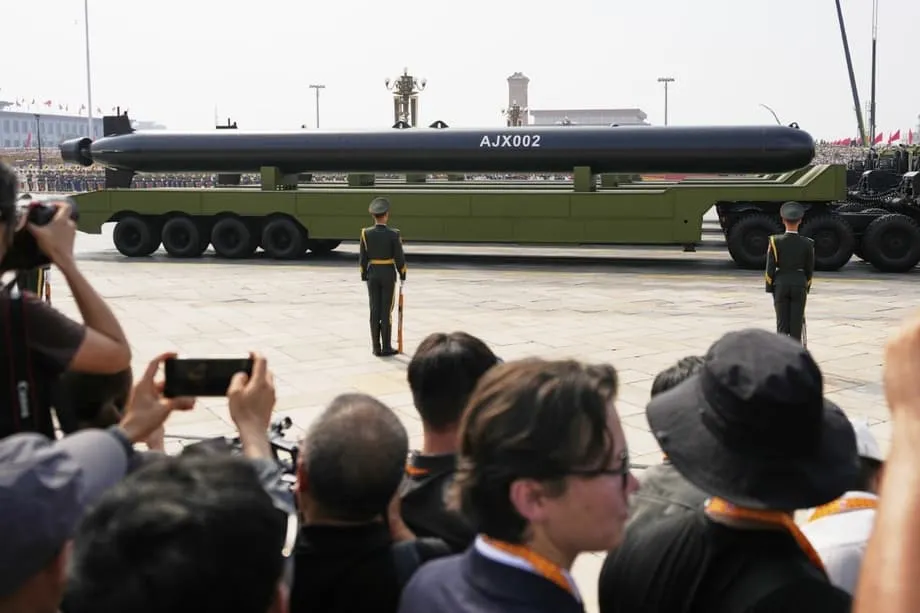
China had already displayed the HSU001 and AJX002 during a military parade in 2025, with each described as nearly 20 metres long. The much larger prototypes now being tested suggest a further expansion in the size, endurance and possible responsibilities of autonomous vessels.
As of April 12, 2026, the central tension is between their stated regional purpose and the missions their size might allow. Yan has explained the intended priorities, while questions about weapons, long distance operations and deployment continue to draw attention.
What Yan Zheping Said About Their Purpose
Yan is director of unmanned systems at the College of Intelligent Systems Science and Engineering at Harbin Engineering University. His peer reviewed research addressed concerns that China's largest drones could become platforms for attacks far beyond Asian waters.
Yan described the intended balance between military and civilian work in the Chinese Journal of Ship Research:
China's ultra large models prioritise regional security and near coast defensive reconnaissance while simultaneously supporting civilian research and environmental monitoring.
His explanation places the drones primarily in a regional security role, potentially countering American military operations during a Taiwan Strait or South China Sea contingency. The statement was presented as Beijing's first direct response to speculation about threats to the American West Coast.
Reconnaissance means collecting information about an area or an opponent. For an underwater drone, that could involve monitoring submarine movements or gathering information in waters where a navy expects to operate. Environmental monitoring and oceanographic research would give the same vessels work during peacetime.
China's description therefore combines military utility with scientific tasks. A vessel used to study the ocean can also carry equipment useful to naval operations, giving it different responsibilities as circumstances change.
How the Program Came Into View
Public displays, satellite observations and Yan's research have revealed different parts of the program. The sequence runs from the appearance of large drones at a military parade to the public explanation of their intended missions.
- In 2025, China displayed the HSU001 and AJX002 at a military parade, with both described as nearly 20 metres long.
- Satellite imagery later revealed a classified variant exceeding 40 metres at a naval installation. No exact date was given for that observation.
- In March 2026, Yan published his explanation of the vessels' priorities in the Chinese Journal of Ship Research.
- By April 12, 2026, imagery showed testing of two distinct XXLUUV designs near Hainan Island.
The parade displays also included eight large underwater drones, described as five smaller AJX002 vehicles for laying mines and three HSU 100 vehicles. The names HSU001 and HSU 100 appear in the descriptions of the displays, alongside the AJX002 designation.
Why Their Size Creates Such Long Reach
China's XXLUUVs use diesel electric propulsion, a system similar to that of conventional submarines. Diesel generators produce electricity, while batteries allow the vessel to travel submerged without running those engines.
Models displayed by builders at defence exhibitions show diesel generators and large battery banks occupying the hull. With no crew compartments, more of the vessel's internal space can be devoted to fuel, batteries and equipment. Endurance and range take priority over accommodation for people.
Analysts estimate that the drones could travel roughly 7,000 nautical miles while using diesel engines and snorkeling at periscope depth, followed by another 3,000 nautical miles fully submerged on battery power. A snorkel allows a diesel engine to draw air while most of the vessel remains below the surface.
The battery configuration uses lithium iron phosphate technology. The stated performance would allow roughly six times as much underwater travel on quiet electric propulsion as conventional diesel submarines, giving the drones a long submerged approach to a coastline.
Those figures explain why assessments have raised the possibility of crossing the Pacific and reaching distant targets. The estimated operating profile combines a long snorkeling stage with a final stretch entirely underwater, during which a drone could try to avoid patrols.
Some warnings describe the vessels as theoretically capable of crossing the Pacific entirely submerged. The more detailed range estimate assigns about 3,000 nautical miles to battery operation and about 7,000 to snorkeling. Readers therefore need to distinguish the broad concern about trans Pacific reach from the specific propulsion stages used to calculate that reach.
The range figures come from published shipbuilder specifications and calculations based on hull dimensions. They remain estimates of capability, while the disclosed mission priorities centre on waters much closer to China.
What the Drones Could Carry
Defence analysts have identified modular payload bays as a central feature of the giant drones. A modular bay allows equipment to be changed according to the mission, rather than giving a vessel only one permanent task.
Possible payloads include torpedo tubes, naval mines and smaller underwater vehicles. Those options could allow the drones to attack surface ships, lay minefields or release groups of smaller drones, taking on work traditionally assigned to submarines carrying crews.
The AJX002 has been described specifically as a drone for laying mines and has also been tested near Hainan. Its role points toward possible mining campaigns around Taiwan or at naval choke points, narrow passages through which ships must travel.
Mines can make a passage dangerous without requiring the vessel that placed them to remain nearby. That gives an autonomous minelayer a different role from a drone sent to observe a submarine or collect environmental data.
Seattle, Oakland, Los Angeles and the Panama Canal have appeared in warnings about possible distant targets because long range and adaptable payloads could create several mission options. Yan's explanation instead places the primary focus on regional operations.
Why Undersea Cables Feature in the Debate
Taiwan depends on just 24 undersea cables for internet connectivity, according to analysis by the Global Taiwan Institute. Damage to those connections could disrupt banking, emergency services and other activities that depend on communications.
The Trans Pacific Cable network linking Japan, Guam and Hawaii has also been identified as a potential target. Sabotage could damage regional economies and weaken the communications used for American military command and control in the Pacific.
China has reportedly developed specialised equipment for cutting armoured undersea cables. The equipment includes devices mounted on robotic arms, using diamond coated grinding wheels and designed to operate at depths of up to 4,000 metres.
Such tools have raised concern that an XXLUUV could attack infrastructure while making responsibility difficult to establish. The combination of underwater operation, autonomy and distance from an operator could allow the party responsible to deny involvement.
Cables consequently sit alongside ships and ports in discussions of possible missions. Their importance comes from the civilian services and military communications they carry, meaning a single type of infrastructure can have consequences across several parts of society.
Regional Defence Could Still Involve Attacks
Yan's description suggests that the drones would primarily operate within the First Island Chain, the line of islands stretching from Japan through Taiwan to the Philippines. That setting places them near waters central to potential Taiwan Strait and South China Sea confrontations.
The drones could support China's Underwater Great Wall sensor network, which monitors the movements of American and allied submarines. Mobile underwater vehicles could contribute to that effort by conducting reconnaissance in areas of interest.
Possible missions also include action against American undersea sensor infrastructure. The Fish Hook network, described as spanning Japan, Taiwan, the Philippines and the Java Sea, has been identified as infrastructure that the drones might seek to disable.
Planting explosive charges or severing cables could be used to neutralise sensors before Chinese naval forces attempted to move into the open Pacific. In that scenario, a mission presented as supporting regional defence would still involve attacks on an opponent's equipment.
The practical meaning of Yan's explanation is therefore geographical as well as strategic. He places the priority near China, where the drones could support surveillance and naval operations during a crisis, while retaining civilian research responsibilities during peacetime.
Two Designs Are Being Tested Near Hainan
Recent satellite imagery shows two distinct XXLUUV designs undergoing testing near Hainan Island. The locations include Gangmen Harbour and Yinggezui, west of the People's Liberation Army Navy's Sanya nuclear submarine base.
The vessels have been seen partially submerged in floating dry docks. That arrangement conceals parts of their shape and resembles methods used by the United States Navy to shield experimental vessels during development.
The secrecy stands out against the usual promotional approach of Chinese shipyards, which often publicise prototype projects to attract attention. Concealment has therefore encouraged the assessment that the tests form part of a competitive procurement effort intended to produce deployable vessels.
The 705 Research Institute under China Shipbuilding Industry Corporation, an organisation associated with naval weapons development, has been linked to one of the variants. Testing two designs at the same time suggests an evaluation of competing configurations.
China used a similar approach while developing earlier generations of large displacement underwater drones that are now operational. The present tests fit that pattern, although no selection date or deployment timetable has been given for the giant prototypes.
How the Program Compares With Western Efforts
The eight large drones displayed in Beijing illustrate the scale of China's investment in autonomous undersea systems. The mix of five AJX002 vehicles for laying mines and three HSU 100 vehicles also indicates an interest in more than one mission.
The United States Navy is still cautiously testing Orca XLUUV prototypes. China's larger vehicles have challenged earlier Western assumptions that it lagged in advanced uncrewed systems, while its operational earlier generations show that the effort extends beyond experimental models.
China's program has consequently been presented as a leap toward full scale operational platforms. At the same time, the largest XXLUUV variants remain associated with the testing observed near Hainan, making their development status an essential part of the comparison.
Length is the simplest visible measure: a prototype exceeding 40 metres is more than twice as long as the nearly 20 metre drones described at the parade. Against the stated 15 metre length of Boeing's Orca, the giant Chinese prototype is more than two and a half times as long.
Those differences help explain the attention, because a larger hull provides room for the fuel, batteries and payloads behind the proposed missions. The program's strategic importance rests on how that capacity is used, including reconnaissance, mining and operations against underwater infrastructure.
Autonomy Brings New Options and Limitations
Uncrewed submarines allow commanders to consider missions involving a high risk of loss, including journeys from which a vehicle would not return. Removing a crew changes the human cost of sending a vessel into heavily defended waters.
Large numbers of autonomous vehicles could also support saturation tactics, in which several simultaneous threats stretch an opponent's ability to detect and stop them. Their potential use challenges traditional methods of locating and countering submarines.
Autonomy also creates limitations. An uncrewed submarine lacks the adaptability of people aboard a vessel, especially when identifying a target or responding to an unexpected situation.
Jamming, errors in artificial intelligence and compromised control links are among the vulnerabilities an opponent could try to exploit. A drone's ability to travel far therefore sits alongside the difficulty of making reliable decisions and maintaining control during a complicated mission.
The United States, Japan and Australia are already investing in technologies to counter underwater drones, including seabed sensors and directed energy weapons. Their response reflects concern about both the vessels themselves and the pressure that autonomous operations could place on existing defences.
China's stated regional priorities narrow the intended focus of the giant drones, but they still place the vessels in waters where Chinese, American and allied military interests meet. The immediate development to follow is the testing near Hainan, where competing designs are being evaluated for a program with both military and civilian roles.
The Bottom Line
- China is testing the world's largest underwater drones, including prototypes exceeding 40 metres.
- Yan Zheping said their priorities are regional security, reconnaissance near the coast, civilian research and environmental monitoring.
- Estimated range is about 10,000 nautical miles, combining roughly 7,000 miles while snorkeling with 3,000 miles on submerged battery power.
- Possible payloads include torpedoes, mines and smaller underwater drones, while potential missions include operations against cables and sensors.
- Two distinct giant designs are undergoing tests near Hainan, with no announced selection or deployment timetable.
- The program challenges Western assumptions about China's autonomous naval capabilities, while target identification, jamming and control remain operational concerns.