Families Leave as Cooking Fuel Runs Out
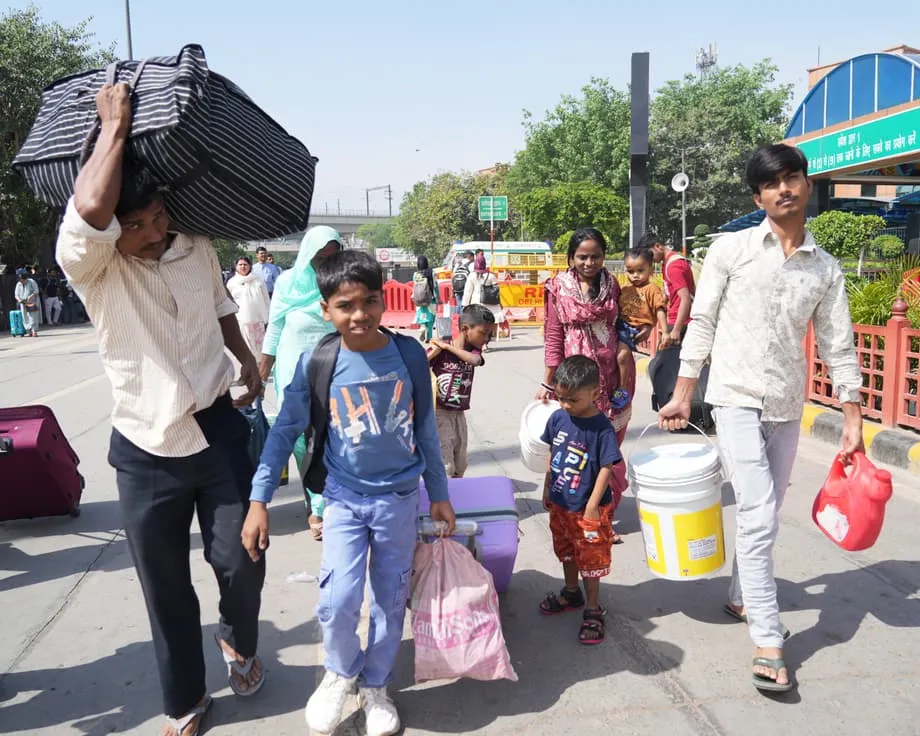
At Delhi's Anand Vihar railway station, 35-year-old Raju Prasad is leaving for Gorakhpur in Uttar Pradesh after nine months of struggling to support his family in the capital. His last gas cylinder ran out 15 days ago. Collecting firewood helped briefly, but his savings have gone and black market liquefied petroleum gas (LPG) costs four or five times the normal price.
Contents
- Families Leave as Cooking Fuel Runs Out
- A Cylinder Can Cost Several Days of Wages
- Why Migrants Depend on Informal Gas Sellers
- Students Lose Meals and Affordable Food
- Restaurants Cut Hours and Return to Open Fires
- Garment Production and Vegetable Markets Slow
- How a Distant Conflict Reaches Delhi's Kitchens
- Government Cites Deliveries and Expands Small Cylinder Quotas
- Political Disputes and Fears of Another Lockdown
- Alternatives Are Expensive or Unavailable
- Workers Hope to Return When Costs Fall
- Key Points
At 9am on a Saturday, families carry mattresses, steel pots and bundles of clothing through the station, with children carrying whatever they can manage. The scene recalls departures during the COVID-19 crisis in 2020. Prasad hurries alongside his wife, who holds their youngest daughter and a white plastic bucket. Three other children follow, one dragging a trolley bag. The family of seven, joined by Prasad's brother, is heading home.
Prasad came to Delhi seeking daily wages and schooling opportunities for his children. He describes hunger as the immediate reason for leaving:
If we stay here even a few more days, our children might die of hunger. They don't understand what this crisis is. We just see them crying for food.
By April 12, 2026, similar departures are taking place at New Delhi Railway Station. Workers from Bihar, Jharkhand, West Bengal and Rajasthan arrive with bulging rucksacks larger than suitcases. Thousands are described as leaving Delhi and other major cities as fuel shortages and rising prices make daily life harder, although no confirmed total for the departures is given.
Some workers conceal why they are going. Suman Verma, 29, says he is travelling for a wedding. His young son Anshu describes the family's exhausted gas supply and his father's fear of another lockdown:
We all know the real reason. A lockdown is about to happen. My father said all shops will shut and we won't be able to return later. We had already run out of gas, and my mother was cooking on a makeshift stove.
A Cylinder Can Cost Several Days of Wages
Sarfaraz, 25, waits beside his bags at Anand Vihar for his family to send Rs 300 so he can buy a ticket to Bihar. He married at 18, has four children and came to Delhi to work on construction at Jewar Noida International Airport, earning Rs 550 a day. His cooking gas ran out 20 days ago.
Sarfaraz describes how his reason for coming to the city has been reversed:
I came here to support my family, but now I am asking them to send me money so I can return.
A cylinder that previously cost Rs 900 now costs Rs 4,500 on the black market, according to his account, while food prices have doubled. That cylinder price is five times the earlier amount and equals more than eight days of his Rs 550 wage, before rent, food or travel.
Workers commonly earning Rs 500 to Rs 800 a day face meals that can consume half a day's pay. Across the workers described, daily earnings range from Rs 200 to Rs 800, black market cylinders cost Rs 3,000 to Rs 4,500, and informal refill prices range from Rs 300 to Rs 1,000 per kilogram.
Lalita Devi, a daily wage worker from Bihar, lives in Delhi with her family on a monthly household income of Rs 10,000. With local LPG prices reaching Rs 400 to Rs 500 per kilogram, she is surviving on raw chickpeas. She cannot afford a train ticket home.
Uday Kumar, a construction worker from Bihar earning Rs 800 daily, describes the competing demands on his wages:
If a man earning Rs 800 a day has to spend Rs 400 to Rs 500 just to refill a single gas cylinder, how is he supposed to provide for his children? I have to pay room rent, buy lentils, rice, and vegetables, and also pay school fees for my children. How can all of this possibly be managed?
Why Migrants Depend on Informal Gas Sellers
Authorised LPG distributors require identity and address documents for formal household connections, and customers must book cylinders in advance. Many migrants working in the informal economy lack local paperwork. Frequent moves make records difficult to update, while some landlords refuse to provide proof of address.
Rajesh Kumar, a trade unionist in Delhi, explains the difficulty:
Migrant workers relocate frequently and cannot keep updating documents. Some landlords also refuse to provide proof of address, so getting formal documents in the cities where they migrate often becomes difficult.
Many workers consequently use informal refilling centres for smaller cylinders, typically containers holding 5kg, without permanent connections. Since the Middle East conflict disrupted shipping routes, some centres have closed and others have multiplied prices fourfold. Migrants without permanent local addresses struggle to obtain subsidised government LPG connections and become dependent on these informal sellers.
Shakuntala Devi and Shakiba Bibi, neighbours in a Delhi slum, work as domestic helpers earning Rs 15,000 monthly. They have spent three weeks looking for gas. Shakuntala describes the possibility of leaving:
If it continues like this for a few more days, we will run out of gas in our kitchens and have to return to our villages.
Students Lose Meals and Affordable Food
Farheen Naaz, a media student at Jamia Millia Islamia University from West Bengal, shares lodgings with 50 other women. Without cooking gas, she has begun missing meals, while campus canteen closures have reduced access to affordable food.
Naaz describes the shortage and its effect on students from families with low incomes:
I have not had gas for the last 10 days, and most of the time now I skip breakfast," she says. "Many canteens in the university have closed, and the food that is available has become expensive. We come from low-income families and cannot afford this. It is starting to affect our health.
Saeed Khurshid, a BTech student from Kanpur living in Ghaziabad, says his hostel mess now serves only dal and rice. Rotis and vegetables have disappeared from the menu, prompting student protests. Dal is a dish made with lentils, while rotis are flatbreads.
Delhi's affordable food network is also under pressure. Dhabas, street vendors and small eateries that feed labourers are cutting menus, raising prices, dismissing workers or closing as cooking fuel becomes scarce and food costs rise. Workers who cannot cook at home are therefore also losing cheaper places to eat.
Restaurants Cut Hours and Return to Open Fires
Anil has run a restaurant in Nehru Place for 30 years. He has returned to cooking on a chulha, a traditional stove using an open fire, as black market gas becomes unaffordable.
Anil describes the price increase and the slower cooking process:
It is the first time in my life that the gas cylinder price on the black market has reached Rs 4,500," he states. "We have shifted back to traditional open-fire cooking on a chulha. It takes more time, and if this situation continues, it will affect my workers too.
His 10 employees face uncertain prospects as customer numbers decline. In Shakur Basti, biryani shop owner Tajdar Ahmed has increased his price from Rs 240 to Rs 280 per kilogram and now closes by 5pm to control costs. Sales have fallen 50 percent.
Haji Sahib, who runs a nearby tea and sweets stall, is paying three workers from his own pocket while struggling to secure commercial cylinders. He describes an irregular supply after a month of disruption:
We need one cylinder every day, but supply is irregular," he says. "The government had yet to find a solution even after a month.
Households and businesses face connected pressures: workers lose affordable meals, restaurants lose customers, and employees risk losing wages. For families already weighing rent, school fees and food purchases, reduced earnings make the fuel shortage still harder to manage.
Garment Production and Vegetable Markets Slow
Gandhinagar, described as Asia's largest market for ready made garments, is losing workers as migrants return to their villages. Shri Kishan Goyal, president of the Readymade Garments Merchants Association, says 70 to 80 percent of shops and small factories have closed because of labour shortages.
Goyal gives separate figures for the effect on production and individual businesses:
"Production in the manufacturing units here are affected by more than 30 per cent, while some businesses have seen a 50-60 per cent impact," Goyal explains.
Mohammad Salim Akhtar, who owns a small tailoring unit, says all five employees have returned to their villages. Working alone, he faces daily losses of Rs 10,000 to Rs 12,000. He has stopped buying cooking gas and relies on hotel food.
In Ludhiana's Sabzi Mandi, wholesale traders report a 30 percent fall in business as migrant workers leave. These workers move vegetables from warehouses and help connect wholesale supplies with street vendors. Departures during the harvesting season, alongside the fuel crisis, have reduced both the available labour and the network distributing food.
Damanpreet Singh, a tomato wholesaler, describes the effect within the city:
The supply chain within the city is being affected because there are fewer vendors to take the product to the streets.
Arvind Goel, co-chairman of the Confederation of Indian Industry's industrial relations committee, warns that continued departures could affect businesses that depend heavily on workers rather than machinery:
If this reverse migration continues, it will have significant impact, especially on micro, small and medium enterprises, particularly in labour-intensive sectors such as construction, textiles and manufacturing.
How a Distant Conflict Reaches Delhi's Kitchens
The fuel disruption begins about 8,000 kilometres away, with the military conflict between Iran and the US-Israel alliance. India imports nearly 60 percent of the LPG it consumes, and 90 percent of those imports pass through the Strait of Hormuz, a narrow shipping passage.
Those figures mean that roughly 54 percent of India's total LPG consumption depends on imports moving through that route: 90 percent of the nearly 60 percent bought abroad. When Iran closed the passage in retaliation for attacks, the disruption reached an essential fuel used in Indian homes and businesses.
A fragile ceasefire is now holding, but the strait remains closed to many vessels and oil prices are hovering near $100 a barrel. Iranian authorities are allowing Indian vessels through, while several ships are waiting near the passage. The uncertainty continues to affect supplies.
The sequence connects international events with household decisions:
- During the Middle East conflict, Iran closed the Strait of Hormuz in retaliation for attacks, disrupting a major route for India's LPG imports.
- From March 1, the government says more than 180 million cylinders have been delivered, averaging five million daily.
- On March 23, Prime Minister Narendra Modi addressed Parliament about difficult global conditions and preparation.
- By April 12, workers, students and business owners were describing weeks without dependable cooking gas, while a fragile ceasefire held and shipping restrictions continued.
Government Cites Deliveries and Expands Small Cylinder Quotas
The government maintains that LPG supply is stable. It cites more than 180 million cylinder deliveries since March 1, averaging five million a day, and says 97 percent of bookings are now made online.
Authorities have doubled daily quotas for cylinders holding 5kg and sold at market prices, specifically to reach migrant workers. They have also conducted raids on black market storage points. These steps address the smaller cylinder category on which many households without formal connections depend.
Praveen Shankar Kapoor, the BJP's Delhi spokesperson, acknowledges difficulties in household and commercial supplies, particularly for migrants using smaller cylinders:
We are actively trying to resolve the shortages being faced in both household and commercial LPG supply chains. Yes, the 5kg LPG category is facing more acute challenges at the moment, especially among migrant and low-income groups who depend on it for daily cooking. We are hopeful that these issues will be addressed soon.
National delivery figures describe the volume moving through the supply system. Families such as Prasad's and Sarfaraz's describe another part of the problem: whether they can obtain fuel through the sellers they use, at a price their wages can cover. Documentation barriers and dependence on informal refills leave those workers especially exposed.
Political Disputes and Fears of Another Lockdown
The Delhi BJP has rejected descriptions of mass migration as "misleading" and "imaginary". Delhi BJP Vice President Dinesh Pratap Singh and Purvanchal Morcha President Santosh Ojha say only negligible numbers have left. Officials also cite railway footfall data in disputing the scale of departures.
Singh and Ojha accuse Aam Aadmi Party (AAP) MLA Sanjeev Jha of creating a misleading narrative. They refer to the COVID-19 period, when they say Delhi government announcements triggered earlier migrant returns.
Jha alleges that the BJP centrally engineered the LPG crisis to push poor migrants back to their home states, where their votes could be manipulated. His accusation includes claims about government protection for black market sales:
Black marketing is being enabled under government protection," Jha claims, "with gas selling at Rs 500 to Rs 1,000 per kilo, leaving migrant workers without fuel or work and pushing them to leave the city.
Prime Minister Narendra Modi urged calm in Parliament on March 23 while referring to India's experience during the pandemic:
We have faced such challenges with unity during the Covid period and now we have to be prepared again.
Modi also warned that "difficult global conditions may persist." His remarks prompted anxiety on social media, where "India lockdown again" trended on X. Anshu's account at the railway station reflects how fears about closures have become part of some families' decisions to leave.
Labour advocates criticise the government for failing to establish community kitchens or provide ration supplies during the disruption. Nirmal Gorana, convener of the National Campaign Committee for Eradication of Bonded Labour, calls the situation an "absolute injustice" and points to the continuing failure to register unorganised workers under the Interstate Migrant Workmen Act of 1979.
Alternatives Are Expensive or Unavailable
About 54 million interstate migrants were recorded in the 2011 census. Analysts believe the present number is much higher. Many workers remain outside administrative systems that provide subsidised utilities and social security protections, often because they lack the required documents.
Pushpendra Kumar, a social scientist, says poorer migrants have little ability to cope with disasters and receive limited political attention:
Migrants have no political voice, especially poorer migrants," Kumar explains. "There is no pressure on those in power to cater to this constituency or address its problems.
Alternatives to LPG are also costly. Induction cooktops that previously sold for Rs 1,300 now cost Rs 5,000. Installing piped natural gas (PNG) costs about Rs 7,000 and requires a landlord's cooperation, which tenants in unauthorised colonies often cannot obtain. One-third of Delhi's population lives in those colonies.
Firewood is difficult to use in cramped slum homes and dangerous in densely packed rental clusters, where landlords prohibit open flames. For households without space or permission to cook this way, returning to a village can appear more practical than staying in the city.
Zareena Khatun, a 43-year-old migrant from Bihar working as domestic help in Palam Colony, received only 10kg of gas from an agency owner. Usually arriving by truck, he came by bicycle. She doubts the supply will last a month.
Workers Hope to Return When Costs Fall
Brij Kumar, an Amazon warehouse worker from Jharkhand, expects to return when a resolution to the conflict stabilises markets. Other workers are less certain about whether life in the city will become manageable again.
Lakhe Chauhan, a construction labourer, faces his second forced departure after leaving during COVID-19. He describes the loss of fuel, work and affordable food:
There is no gas, no work and no hope here," Chauhan states. "We don't want to die here starving, as we cannot afford outside food every day.
Radhey Sham, 38, works as both a gig worker and a security guard. He is returning to Bithoor in Uttar Pradesh with the hope that cheaper cooking at home will allow his family to manage until conditions improve.
Sham explains his household income, responsibilities and intended return:
Even after doing multiple jobs, I don't make more than Rs 20,000. My wife works in nearby houses and adds another Rs 5,000. I have two grown-up children to look after. How can I afford Rs 3,000 for an LPG cylinder? In the village, we can still cook on a chulha. Hopefully, things will improve in a month, and I'll be back.
His household earns Rs 25,000 a month, making a Rs 3,000 cylinder equal to 12 percent of that income before rent, food and other expenses. For workers waiting in their villages, returning depends on cooking fuel becoming available at prices their wages can cover.
The duration of the disruption will help determine whether these departures are temporary or become a longer withdrawal from urban life. Diplomatic efforts to address Middle East tensions continue, while businesses in Delhi and other cities face the immediate loss of workers they depend on.
Key Points
- Migrant families are leaving Delhi amid LPG shortages, higher food costs and reduced work, while BJP officials dispute descriptions of mass migration.
- Workers describe black market cylinder prices of Rs 3,000 to Rs 4,500 and informal refill prices reaching Rs 1,000 per kilogram.
- Missing address documents leave many migrants dependent on informal sellers rather than formal LPG connections.
- India imports nearly 60 percent of its LPG, with 90 percent of those imports passing through the Strait of Hormuz.
- The government cites more than 180 million cylinder deliveries since March 1 and has doubled daily quotas for cylinders holding 5kg.
- Garment businesses, restaurants, students and vegetable markets report disruption as fuel becomes harder to obtain and workers depart.
- Some migrants hope to return within a month, once cooking fuel and city living become affordable again.