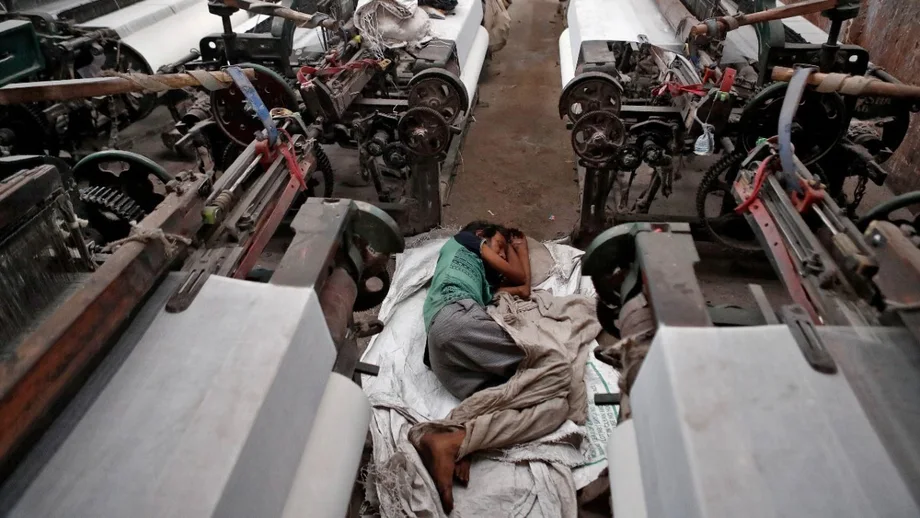
The Pay Question at the Factory Gate
New Delhi, November 19, 2026: Prime Minister Narendra Modi stood before the Federation of Indian Chambers of Commerce and Industry (FICCI) centenary conference with a question for India's biggest business leaders. After years of tax cuts, easier rules and lower goods and services tax (GST), had companies raised salaries and created jobs? The question landed because the numbers behind factory pay are unusually flat.
Contents
- The Pay Question at the Factory Gate
- Two Workers, One Labour Market
- How the Wage Slice Changed Over Four Decades
- Why Productivity Does Not Reach the Pay Packet
- Profits Tell a Different Story
- Why Companies Say the Money Is Not There
- The Argument Against Blaming India Inc Alone
- Government as Employer and Rule Maker
- The Bargaining Gap Goes Beyond Factories
- What Could Lift Wages WithoutWaiting for Luck
- Key Points
Prime Minister Modi said the basic corporate tax rate had fallen from 30 percent to 22 percent, income up to Rs 12 lakh had been made tax free, and refunds that once took eight months now arrived within a week. He asked whether that relief had reached workers. His words, aimed at India Inc, were blunt:
In recent years the government's focus has been strongly on 'Ease of Doing Business'. In 2014, the basic corporate tax rate was 30%. We reduced it to 22% ... Did you increase the salaries of your employees? Did you increase the number of employees? No
The Annual Survey of Industries gives the wage side of that question. In FY 2024-25, the average factory worker earned about Rs 2.28 lakh a year, up 5.3 percent. One lakh is 100,000. Consumer prices rose 4.6 percent from a year earlier. Real wages, meaning pay after adjusting for inflation, grew just 0.7 percent. That was the strongest real increase in three years, but it still left purchasing power almost unchanged.
The surrounding years were weaker. Real factory wages rose 0.1 percent in FY 2023-24 and fell 1.1 percent in FY 2022-23. The 4.5 percent gain in FY 2021-22 came after wages had dropped 5.3 percent in FY 2020-21 during the pandemic. In five of the past six years, real wage growth stayed below 1 percent.
Two Workers, One Labour Market
A worker in an oil refinery and a worker stitching garments in Tiruppur or Noida sit at very different points in Indian manufacturing. The refinery worker contributes about Rs 43.6 lakh of value a year. The garment worker contributes about Rs 5 lakh. Yet their pay is much closer than their output: the refinery worker earns about Rs 4.25 lakh a year, against Rs 1.76 lakh for the garment worker.
Economists call the value created by a factory net value added. It is what remains after subtracting spending on raw materials, fuel and machinery depreciation from sales revenue. The question of how that value is split between workers and owners of capital has been central to economics for decades. In Indian factories, higher output per worker does lift pay, but only partly. Value added per worker ranges from about Rs 5 lakh to more than Rs 40 lakh across industries, while annual wages sit in a narrower band of about Rs 1.8 lakh to Rs 4.3 lakh.
The industries that employ the most people, including food processing, textiles and apparel, pay below the national factory average. That pattern is why a refinery job and a garment job can draw from the same broad labour pool even when the value each worker creates is far apart.
How the Wage Slice Changed Over Four Decades
The Annual Survey of Industries has tracked Indian manufacturing since 1981-82. Its long record shows that the current wage squeeze is not only a postpandemic episode. It is the latest stage of a slow change in who receives the gains from factory production.
- Early 1980s: factory wages were about 30 percent of net value added.
- 1991: economic reforms began, and the wage share entered a long decline.
- FY 2007-08: the wage share reached 10.6 percent.
- FY 2019-20: the wage share recovered to 18.9 percent, and 38 percent of factory workers were hired through contractors.
- FY 2024-25: the wage share stood at 16.5 percent, with 42 percent of factory workers hired through contractors.
Profit's share moved the other way. Calculations based on the survey put the share of net value added going to profits at about 23 percent four decades ago and around 50 percent now. A second calculation from the same survey data uses different starting years and gives 24.77 percent for wages in FY 1990-91, 14.13 percent in FY 2013-14 and 16.51 percent in FY 2024-25. On that calculation, profit's share moved from 22.0 percent to 49.1 percent and then 50.3 percent.
Modernisation explains part of the change. Indian factories now rely much more heavily on machinery than they did in 1981, so equipment claims a larger share of returns. The growth of contract work explains another part. Contract workers usually receive lower pay, fewer benefits and less bargaining power. Their share rose from 38 percent in FY 2019-20 to 42 percent in FY 2024-25. That helps explain how factories added about 30 lakh workers between FY 2021-22 and FY 2024-25 without producing large gains in individual wages.
Why Productivity Does Not Reach the Pay Packet
Standard economic theory says a worker's pay should roughly match what that worker contributes to output. Indian factories follow that rule only in a limited way. A refinery worker is far more productive than a garment worker, but the pay gap is far smaller than the productivity gap. Food processing, textiles and apparel remain large employers with below average wages.
Arthur Lewis, who later received the Nobel Memorial Prize in Economic Sciences, offered an explanation in 1954. In his paper on economic development with unlimited supplies of labour, Lewis argued that when a country still has many people working in low productivity agriculture, factory wages are set by what those workers could earn outside the factory, plus a small payment to persuade them to move. The factory's own output matters less while the supply of workers remains large.
India still fits that model. Nearly half of its workforce remains in agriculture. Workers in refineries and garment factories may come from the same pool of families whose alternative is small farming or casual work. As long as that pool is large, employers can hire without sharply raising pay. Economists call the point when that pool runs down the Lewis turning point. Once it arrives, workers become scarcer and wages begin to rise much faster.
Profits Tell a Different Story
Vajiram and Ravi's overview of corporate profits and wage growth says Nifty 500 profits reached an all time high of 5.2 percent of gross domestic product (GDP) in 2025-26. It also says around 2,600 listed companies, meaning firms whose shares trade on stock exchanges, earned about Rs 4.5 lakh crore in the July to September 2026 quarter, up about 26 percent from a year earlier. Five companies, Reliance Industries, State Bank of India, Indian Oil, HDFC Bank and ONGC, accounted for Rs 1.12 lakh crore, or 25 percent, of that total. Three are owned by the government.
Factory level data points in the same direction. Net profits at registered factories rose 88 percent from Rs 6.14 lakh crore in FY 2021 to Rs 11.56 lakh crore in FY 2025. Employee compensation rose 66 percent, while the number of people engaged rose 31 percent. Annualised over four years, profits grew about 17 percent, compensation 13.5 percent and employment less than 7 percent. Average annual emoluments per person rose from about Rs 3.01 lakh to Rs 3.82 lakh, a nominal gain of about 27 percent. Over the longer period from FY 2018-19 to FY 2024-25, factory net profits rose 108 percent, average annual wages per worker rose 35 percent and employment rose 29 percent. Those figures are not adjusted for inflation.
The gap inside factories has widened too. In FY 2008-09, the average factory worker earned Rs 68,103 while a supervisor or manager earned about Rs 4 lakh, a ratio of 5.87 times. By FY 2024-25, those figures were Rs 2.28 lakh and Rs 14.5 lakh, a ratio of 6.36 times.
Chief Economic Advisor V Anantha Nageswaran, speaking at an Idea Exchange session earlier this month, said India's main problem was inadequate incomes even where jobs existed. He said:
India does not have 'as much of a jobs problem as an income problem'
Consumer mood also remains weak. Reserve Bank of India surveys show rural and urban households assessing their current situation and future expectations at lows lasting several years. The Prime Minister's remarks came before the November 30 GDP release for the July to September 2026 quarter, after April to June growth of 7.8 percent.
Why Companies Say the Money Is Not There
Industry data is not a simple story of record margins and nothing else. The Annual Survey of Industries for FY 2024-25 shows factory employment rising 7.2 percent to 2.1 crore, with one crore equal to 10 million. Total emoluments rose 12.1 percent to Rs 8 lakh crore, and factory profits rose 7.7 percent to Rs 11.6 lakh crore. Compensation grew, but not evenly enough to change the position of ordinary workers.
Reserve Bank of India data for FY 2026 shows listed manufacturers recording 10.8 percent sales growth, against 6 percent in the preceding year. Raw material expenses rose 12 percent and took 57.6 percent of sales, up from 55.7 percent. Employee costs rose 10.7 percent, broadly holding their share of sales. For many firms, higher input costs matter as much as final profit.
Industry also points to automation, weaker consumer demand, debt reduction and global tariff uncertainty. Garment exporters have been diversifying away from the United States after tariff increases disrupted orders and squeezed margins. Textile manufacturers face higher labour and raw material costs, which encourages greater use of machines and reduces the need for new hires.
There is no consolidated figure showing how much of the 2019 corporate tax savings went into new factories, research, training or higher salaries. Company filings also do not provide a standard median factory wage that would show how ordinary workers fared against senior managers. Private investment, meaning business spending on new capacity, peaked at about 18 percent of GDP in 2008 and was around 10 percent in 2025. It rose 12 percent from a year earlier in the April to June 2026 quarter, and a November Citibank note found wage growth across listed companies reached 11.2 percent in the September 2026 quarter, the fastest in more than three years.
The Argument Against Blaming India Inc Alone
Surjit S Bhalla, chairperson of the Technical Expert Group for India's first official Household Income Survey, argues that private firms are responding to incentives created by government policy. His figures give a different view of job creation. National Sample Survey and Periodic Labour Force Survey data show salaried jobs rising from 67.9 million in FY 2004-05 to 85.2 million in FY 2011-12 and 147.6 million in 2025. Women held 13.1 million salaried jobs in FY 2004-05, 16.7 million in FY 2011-12 and 38.9 million in 2025.
Bhalla also says the pay problem is deeper than factory wages alone. Average real salary at 2024 prices rose from Rs 18,442 a month in FY 2004-05 to Rs 23,637 in FY 2011-12, then fell about 0.4 percent a year to Rs 22,314 in 2025. The average salary of a graduate fell from Rs 41,782 to Rs 35,046 as the number of employed graduates rose from 42 million to 97 million. Casual workers did better: their daily wage rose 3.4 percent a year in real terms since 2011, and the gap between salaried and casual earnings narrowed from 4.4 times in 1999-2000 to 2.4 times in 2024.
International comparisons weaken the claim that India is uniquely stagnant. International Labour Organization data show real wages in developing countries growing 2.5 percent a year in 2000-11 and 0.7 percent after 2019. India's 0.7 percent since 2019 sits in the middle of that group, while Indonesia, Egypt and Bangladesh recorded declines and Thailand barely moved.
Bhalla points to taxes and trade rules instead of corporate greed. General government tax revenue averaged 17.3 percent of GDP in India during 2019-24, compared with 14.3 percent in China, 13.2 percent in Vietnam and 9.7 percent in Indonesia. Quality control orders, which require products to meet specified standards but can restrict cheaper imported inputs, now cover hundreds of products. Net foreign direct investment fell below $0.5 billion in FY 2024-25. He said speeches cannot substitute for changes in policy:
Exhortation is not policy.
The public debate now includes former Wipro Infotech and Dell India executive K S Viswanathan and University of Hyderabad associate professor Gudavarthy Vijay, who are discussing whether incentives, tax cuts and Make in India have produced better paid work. Both sides agree on the pay squeeze. They disagree on who can fix it.
Government as Employer and Rule Maker
The government has its own role in the wage story. The four labour codes, effective since November 21, 2025, provide for a national floor wage, a legal minimum below which employers cannot pay. Their contract labour provisions aim to reduce the gap between workers hired directly and those hired through contractors. By October 2026, only six states and Union Territories had notified rules under all four codes, and the national floor wage had not been notified. No date has been announced for it.
The Ministry of Statistics is conducting India's inaugural household income survey. It will provide data on income across employment types and fill a long gap in policymaking. No publication date has been given. Other official numbers show why the gap matters. The Periodic Labour Force Survey for 2025 found only 23.6 percent of workers in regular wage or salaried employment. Average monthly earnings of regular salaried workers rose from Rs 16,538 in July to September 2017 to Rs 21,103 in April to June 2024, about 3.7 percent a year, while consumer price inflation averaged about 5.1 percent in FY 2017-18 through FY 2023-24.
Public enterprises show a similar shift toward nonregular work. The Public Enterprises Survey 2024-25 says Central Public Sector Enterprises employed 15,42,339 people: 7,83,728 regular employees and 7,58,611 casual, daily rated or contract workers. Regular employment fell by 29,752 from the previous year, while casual, daily rated and contract employment rose by 54,124. In a Lok Sabha reply on March 9, 2026, the Ministry of Labour and Employment said 26 Navratna enterprises employed 69,897 regular workers and 72,111 contractual and casual workers as of March 31, 2025.
Older rules required equal wages and service conditions for contract workers doing the same or similar work as directly employed workers. Rule 93(2) of the Occupational Safety, Health and Working Conditions (Central) Rules, 2026, notified on May 8, keeps parity in holidays, hours and other service conditions but omits the words wage rates. Pay examples show the size of the divide. A regularly appointed nursing officer in a hospital run by an organisation under central government control received Rs 1,02,320 a month, while a contractual nursing officer with comparable duties received Rs 48,106. An Andhra Pradesh High Court judgment on October 13, 2026, in Gunakala Sivaiah v. State of Andhra Pradesh highlighted contract teachers paid below University Grants Commission rates. In a company jointly owned by a state government and the Government of India, the basic daily wage for the lowest category of regular daily rated worker was Rs 1,502.66, while contract wages for certain categories ranged from Rs 556 to Rs 918 inclusive of_variable dearness allowance from April 1, 2026.
Social security has moved slowly too. The Employees' Pension Scheme, 1995 minimum monthly pension of Rs 1,000 has remained unchanged since September 1, 2014. The old age pension for people below the poverty line remains Rs 200 a month for those aged 60 to 79 and Rs 500 for those aged 80 and above, unchanged since April 1, 2006 and April 1, 2011. The replacement of the Mahatma Gandhi National Rural Employment Guarantee Act, 2005, by the Viksit Bharat Guarantee for Rozgar and Ajeevika Mission (Gramin) legislation raised the annual work entitlement from 100 to 125 days but bars work for 60 days during peak agricultural seasons. Most state governments now bear 40 percent of the cost.
The Bargaining Gap Goes Beyond Factories
Gig and platform work is growing faster than the rules around it. NITI Aayog projects the number of gig and platform workers rising from about 77 lakh in FY 2020-21 to 1.62 crore in 2026-27 and 2.35 crore by 2029-30. The Code on Social Security, 2020, recognises these workers, but their earnings and working conditions are still largely set by platforms. Gig workers are beginning to organise for collective bargaining.
Contract work remains stark in large companies. At Maruti Suzuki, permanent male employees received about Rs 20.65 lakh a year in FY 2025-26 and permanent female employees about Rs 23.47 lakh, while contract and outsourced workers earned Rs 18,000 to Rs 30,000 a month. About 56 percent of the workforce was not permanent. Business Responsibility and Sustainability Reporting shows that at companies including GAIL, Indian Oil, Power Grid, Adani Energy and Coal India, there were between 56 and 1,800 contractual or casual workers for every 100 permanent employees.
Labour disputes have shown what happens when grievances have few effective channels. The long conflict at Maruti Suzuki's Manesar plant ended in violence in July 2012, when a senior personnel executive was killed. Contract workers in Noida and Haryana have protested in recent years over pay and living costs. Violence is not a tool for wage policy, but the disputes reveal pressure building under the surface.
Walter Reuther, the American union leader, once answered a question about robots and union dues with a question about purchasing power. He said:
How would the company persuade robots to buy its cars?
The point applies to India's current debate. Workers are not only costs on a company ledger. They are also the people who buy the goods and services that companies want to sell.
What Could Lift Wages WithoutWaiting for Luck
The first route comes straight from the Lewis model. India needs to move more workers from low productivity farming into manufacturing and services that can absorb them at scale. That would reduce the pool of workers willing to take low paid factory jobs and put upward pressure on wages. Sectors that employ many workers, especially apparel, footwear and food processing, are the most likely sources of such jobs because India has a comparative advantage in them.
The second route is to raise productivity where large numbers of workers already are. If garment and food processing workers moved closer to the national average output per worker, firms would have more room to pay. That requires advanced machinery, larger factory capacity and stronger links to export markets. Recent trade agreements can help, but firms need stable input costs and predictable rules to use them.
The third route is a wage floor that actually works. The national floor wage under the four labour codes can lift the lowest pay if it is set with attention to local conditions and if states notify rules. Contract labour provisions matter because a legal right on paper does not raise income unless wages are paid and enforced. The World Bank's 2025 Country Economic Memorandum on India also calls for investment in sectors that create many jobs.
The fourth route is demand. GST reductions and income tax relief can raise purchasing power, but sustained consumption depends on sustained income growth. Households borrowing to maintain spending can support demand for a while, but debt cannot replace rising earnings. Modi has also urged companies to improve product quality and increase research and development, which he put below 1 percent of sales revenue in India against 2 to 3 percent globally.
Other economies show how different the outcome can be. South Korea's wage standstill accompanied a semiconductor boom in which productivity gains stayed concentrated. Japan's real wage gains show the opposite case, with pay rising faster than prices for nine months. India's middle class under strain showed how automation, weak earnings and debt can squeeze households even when the economy grows.
The next official test is the November 30 GDP release, but GDP alone will not answer the wage question. The household income survey will matter more because it covers income across employment types. Until then, the central fact remains clear from factory data: productivity and profits have risen much faster than the purchasing power of the average worker.
Key Points
- The average Indian factory worker earned about Rs 2.28 lakh in FY 2024-25, with real wages up just 0.7 percent after inflation.
- Real factory wages rose 0.1 percent in FY 2023-24, fell 1.1 percent in FY 2022-23 and stayed below 1 percent in five of six years.
- Wages fell from about 30 percent of factory net value added in the early 1980s to 16.5 percent in FY 2024-25, while profit's share reached about 50 percent.
- Contract workers made up 42 percent of factory workers in FY 2024-25, up from 38 percent in FY 2019-20.
- Registered factory profits rose 88 percent from FY 2021 to FY 2025, compared with 66 percent growth in employee compensation and 31 percent growth in employment.
- Nifty 500 profits reached 5.2 percent of GDP in 2025-26, and about 2,600 listed firms earned Rs 4.5 lakh crore in the July to September 2026 quarter.
- The supervisor to worker pay ratio widened from 5.87 times in FY 2008-09 to 6.36 times in FY 2024-25.
- The four labour codes provide for a national floor wage, but only six states and Union Territories had notified all rules by October and the floor wage has not been announced.
- India's household income survey is underway, with no publication date given.