A powerful beam faces its next test at sea
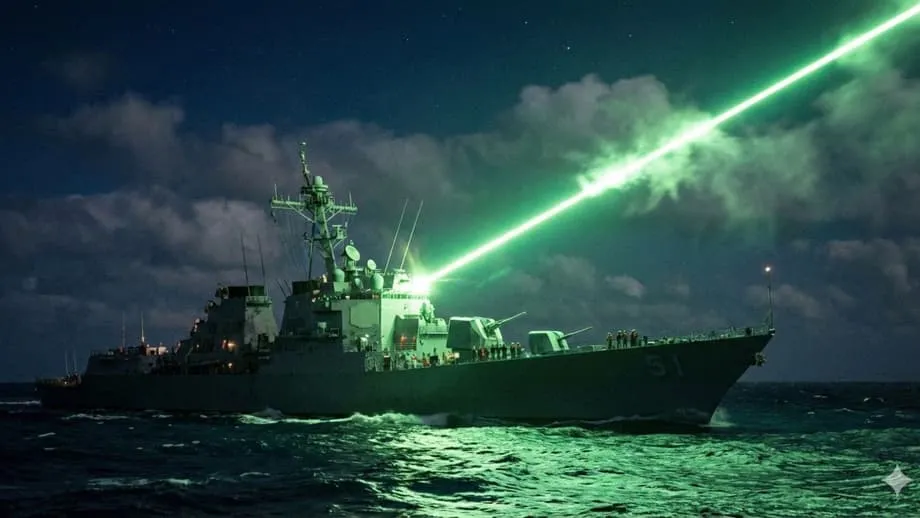
Japan has installed a laser weapon in the 100-kilowatt class aboard JS Asuka, a 6,200-ton test ship operated by the Japan Maritime Self-Defense Force, as it prepares for sea trials scheduled to begin after February 27, 2026. The system combines ten fiber lasers, each rated at 10 kilowatts, into a single beam designed to destroy drones and other lightweight airborne threats.
Contents
- A powerful beam faces its next test at sea
- Why drones are changing naval defense
- How ten lasers become one weapon
- Electricity replaces a magazine of projectiles
- What JS Asuka carries
- Sea trials will test tracking and weather resistance
- Power and cooling set practical limits
- Japan joins a wider push for laser weapons
- From the prototype to planned fleet deployment
- The Bottom Line
As of January 21, 2026, the next step is to test how the weapon performs above the water. Japan's Acquisition, Technology, and Logistics Agency (ATLA) has confirmed that the system destroyed unmanned aerial vehicles and mortar rounds during ground tests earlier this year. Testing also demonstrated its ability to cut through metal surfaces without physical contact.
The weapon delivers energy through a concentrated beam of light rather than a shell or missile. Its strike is silent and almost invisible. From a distance, an engagement may appear uneventful until the target fails, a sharp contrast with the noise and visible force associated with conventional weapons.
Japan's program addresses a growing naval problem: small, inexpensive drones can threaten ships whose missiles cost far more than the aircraft they intercept. A laser promises a cheaper defensive option, with repeated engagements possible while sufficient electricity and cooling remain available.
Moving from a ground test to a moving ship is a demanding step. JS Asuka will provide a platform for testing whether the system can detect aerial targets, track them over water and keep its beam focused despite the ship's motion and the effects of the maritime atmosphere. Those results will help determine how the technology develops toward planned deployment on vessels equipped with the Aegis combat system after 2032.
Why drones are changing naval defense
Small drones and fast moving airborne threats have become increasingly common, creating demands that helped drive the development of Japan's laser system. The weapon is intended to address threats that were not part of the same defensive problem a decade ago.
Swarm attacks make that problem harder. Dozens or hundreds of drones can coordinate their approach to overwhelm a target. A ship may need to respond to many aircraft in quick succession, placing pressure on its tracking systems, weapons and ammunition stocks.
Missiles can destroy these threats, but they are expensive to manufacture and deploy. Using an interceptor costing millions of dollars against a cheap drone creates an unfavorable financial exchange. Repeating that exchange through a prolonged attack can consume both money and a ship's limited supply of missiles.
Naval guns provide another defensive option, but they require physical ammunition and time to reload. Missile magazines also have limits, and replenishment requires a return to port. The Japan Maritime Self-Defense Force is therefore seeking a layer of defense that can sustain repeated engagements without the same dependence on stored projectiles.
A laser sends its energy toward a target at the speed of light. Damage still requires the beam to remain focused long enough to heat and weaken the target. Speed and precision are central to the concept, especially at sea, where crews may have little time to respond to an approaching threat.
How ten lasers become one weapon
The Japanese system uses beam combining, a process that brings the output of ten individual fiber lasers together into one beam. Each laser contributes 10 kilowatts, producing a combined output in the 100-kilowatt class. Concentrating that energy on a small area allows the weapon to burn through metal and disable an aircraft within seconds.
A fiber laser generates its beam within a solid optical fiber containing rare earth elements. Light is amplified as it travels through the fiber and is then directed toward the target. The system uses that concentrated light to heat a surface rapidly, rather than striking it with an explosive projectile.
Rapid heating can cause a target's structure to fail. It can also trigger the detonation of an explosive payload carried by a drone or mortar round. The weapon's effect therefore depends on both the energy delivered and the part of the target held under the beam.
Japan began researching laser weapons with chemical lasers more than a decade ago. Those earlier technologies required hazardous fuels and were less efficient. The move to fiber lasers was intended to overcome those limits and produce a system better suited to military use.
Fiber lasers are generally more compact and easier to cool than their chemical predecessors. Their scalability, safety and operating efficiency make them attractive for installation aboard naval vessels, where equipment must fit within restricted space and work alongside other demanding systems.
ATLA has pursued the technology over several years, moving from prototypes with lower power to the present configuration. Kawasaki Heavy Industries, the manufacturer, delivered a prototype to the agency in early 2023. Engineers have since refined the system for the demands of maritime operations.
Electricity replaces a magazine of projectiles
ATLA has highlighted the weapon's potential economic advantage in a public technical briefing. With sufficient power, the agency said, the system can continue engaging targets without exhausting ammunition. It described the cost of an engagement as substantially lower than that of conventional air defense, likening it to the expense of the electricity consumed.
The term unlimited magazine depth describes this ability to keep firing without using up a fixed number of shells or missiles. For the Japanese laser, continued operation depends on the ship supplying enough electricity and removing the heat produced during firing.
Traditional naval guns need large magazines containing heavy shells. Missile systems require vertical launch cells that occupy valuable deck space. The laser instead needs electricity and cooling water, reducing the burden of storing and replenishing ammunition.
Against hundreds of inexpensive drones, that difference could help a ship preserve its costly interceptor missiles. The laser is intended to work as an additional defensive layer, leaving guns and missiles available alongside it.
Sustained operation is central to the attraction. A ship facing several waves of attacks could continue using the laser while its power and cooling systems support the weapon, without needing to reload physical projectiles between engagements.
What JS Asuka carries
JS Asuka is a dedicated test platform, making it the vessel chosen to evaluate the laser before wider fleet integration. The ship arrived at a Japan Marine United shipyard for the installation process.
The weapon occupies two modules, each the size of a container measuring 40 feet in length. Together, they house the fiber laser array, optics that control the beam, power systems and cooling infrastructure. The installation brings together the equipment needed to generate energy, direct it accurately and manage the resulting heat.
A distinctive unit resembling a dome is visible on Asuka's rear deck. This is the beam director, containing the optics that aim the laser toward its target. It is connected to thermal imaging cameras, precision tracking sensors and mirrors that change direction rapidly.
Those components must work together to keep the beam on a specific point of a moving target. At sea, the system must also compensate for the ship pitching and rolling, including in rough conditions. A beam powerful enough to damage a drone is useful only if the optics can hold it where the energy is needed.
The installation's modular design allows easier maintenance and creates the possibility of fitting the system to other vessels if the trials succeed. The immediate task aboard Asuka is to assess performance in the environment where a naval weapon must operate.
Sea trials will test tracking and weather resistance
The current phase involves preparing the installation for live sea trials after February 27, 2026. The initial tests will focus on detecting aerial targets, tracking them above the water and maintaining a lock. No more precise starting date has been given.
Moisture in the air, rain, fog and dust can scatter a laser beam, reducing the energy that reaches the target and affecting accuracy. Humidity and sea spray also create challenges for both the beam and the sensors used to follow a threat.
Engineers have developed algorithms intended to correct distortion. Reference lasers examine the air between the weapon and its target, providing information that allows the system to adjust its beam. The sea trials will assess how well those corrections work in maritime conditions.
Ship movement adds another problem. The weapon may be tracking an aircraft that is changing position while its own mounting platform rises, falls and tilts with the sea. The beam director must account for both movements at the same time.
Fast moving drones and mortar rounds require particularly precise tracking. The system must anticipate the target's movement and adjust its mirrors immediately to keep the focal point on a vulnerable area. Holding that point long enough to cause damage is one of the central engineering tasks.
ATLA's successful ground tests against mortar rounds and unmanned aerial vehicles gave engineers the confidence to move toward maritime testing. The next phase brings those targeting tasks together with weather, saltwater exposure and the motion of the ship.
Power and cooling set practical limits
A laser's stated output describes the power in its beam, rather than all the electricity needed to operate the weapon. A laser producing 100 kilowatts of light might require as much as 300 kilowatts of electrical power. Energy that does not become useful laser output produces heat that the system must remove.
Fiber lasers are efficient compared with earlier technologies, but they still create a substantial thermal load. Cooling is therefore essential to sustained firing. Without enough heat removal, the equipment cannot maintain the intended operating performance.
Asuka's installation includes substantial cooling infrastructure to prevent overheating during repeated engagements. The power and cooling equipment contained within its modules is part of the weapon's working machinery, alongside the lasers and aiming optics.
The potential logistical gain is straightforward: the ship replaces the repeated expenditure of ammunition with demand for electrical energy and cooling. That makes the capacity of those supporting systems central to how long the laser can keep engaging targets.
Maritime testing will examine a complete installation, rather than the beam alone. Tracking accuracy, atmospheric correction, power management and temperature control all need to function together for the weapon to provide dependable defense at sea.
Japan joins a wider push for laser weapons
The United States, France, Germany and the United Kingdom are confirmed to be developing similar directed energy systems. Japan's decision to test a laser in the 100-kilowatt class aboard a ship places it among the leading countries pursuing this technology.
China is also suspected of advancing its laser capabilities. In 2024, equipment resembling a laser weapon appeared aboard a Chinese amphibious transport dock. The Japanese program is developing amid this broader international effort to move directed energy weapons from experimental prototypes toward operational use.
Israel has taken a prominent role in that transition. The Israeli Defense Force announced that Iron Beam became the first tactical laser weapon using high energy to be fully integrated and cleared for operations within a national defense array.
Iron Beam operates at around the 100-kilowatt level and is designed to intercept threats at short range, including rockets, mortars and drones. Its target set overlaps with the immediate goals of Japan's system.
The United Kingdom has also tested DragonFire, successfully shooting down several drones during trials off the coast of Scotland. These programs reflect growing military interest in weapons that use concentrated energy alongside conventional ammunition.
For Japan, developing such a system is also a demonstration of technological capability and industrial strength. Within the defensive posture shaped by its constitution, the laser is intended as a protective weapon against approaching threats, consistent with restrictions on offensive strike capabilities.
From the prototype to planned fleet deployment
ATLA's immediate focus is on drones, mortar rounds and other lightweight airborne targets. The agency has also acknowledged that future versions could address more demanding threats. Lasers with higher power could potentially intercept missiles, although that remains a goal for the longer term.
Data from the Asuka sea trials will help determine whether such an increase in capability is feasible. Engineers first need to establish how the current system performs when exposed to the conditions of naval operations.
The Japanese Ministry of Defense has scheduled deployment of a laser system at sea on vessels equipped with the Aegis combat system. Those ships are expected to enter service with the capability after 2032, allowing a further period of testing and refinement before the technology becomes a standard fleet feature.
The program's principal dates show the progression from delivered equipment to proposed operational use:
- Early 2023: Kawasaki Heavy Industries delivered a prototype to ATLA.
- Earlier in 2026: ATLA confirmed successful ground tests against unmanned aerial vehicles and mortar rounds.
- January 21, 2026: The system is installed aboard JS Asuka as preparations for maritime trials continue.
- After February 27, 2026: Sea trials are scheduled to begin, initially focusing on detection, tracking and maintaining a target lock.
- After 2032: Vessels equipped with Aegis are expected to enter service with the planned laser capability.
Successful integration could give ships a durable and economical defensive layer during prolonged operations. Lasers would work alongside guns and missiles, reducing pressure on ammunition stocks while adding another means of dealing with aerial threats. The Asuka trials are the next step toward that planned role.
The Bottom Line
- Japan has installed a laser weapon in the 100-kilowatt class aboard the 6,200-ton JS Asuka test ship.
- Ten fiber lasers rated at 10 kilowatts each combine into a single beam capable of cutting metal and disabling airborne targets.
- ATLA confirmed successful ground tests against drones and mortar rounds earlier in 2026.
- Sea trials are scheduled after February 27, 2026, with initial attention on detection, tracking and maintaining a lock over water.
- The system uses electricity and cooling water instead of physical ammunition, allowing repeated engagements while those resources remain sufficient.
- Weather, ship movement, electrical demand and heat removal are central challenges for sustained operation.
- Japan's program joins laser weapon development in the United States, France, Germany, the United Kingdom and Israel, with China also suspected of pursuing the technology.
- Deployment on vessels equipped with Aegis is expected after 2032; intercepting missiles with more powerful lasers remains a longer term goal.