A Saturday Afternoon Under the Moon's Shadow
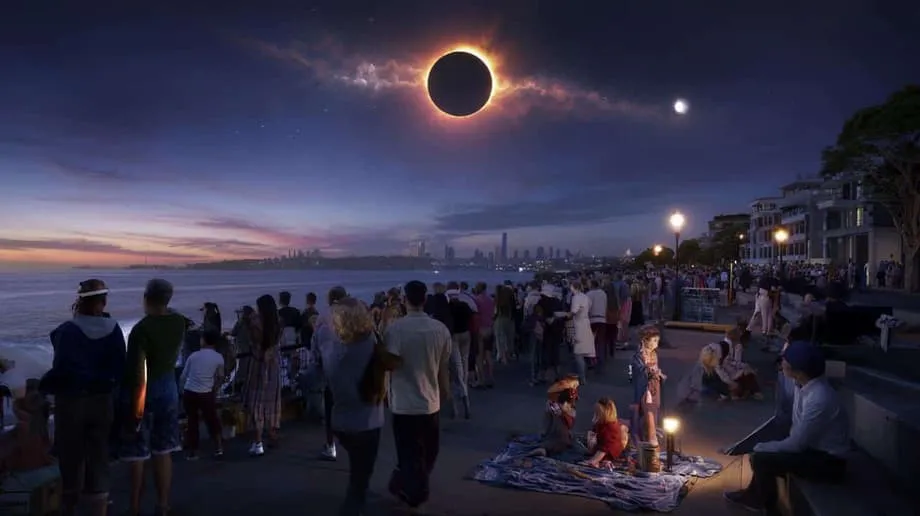
On Saturday, 22 July 2028, a total solar eclipse will sweep across Australia, the Pacific and New Zealand, bringing several minutes of darkness to places ranging from the Kimberley wilderness to central Sydney. The event is billed as the longest total solar eclipse of the century, with a stated maximum of 6 minutes and 23 seconds near the central Pacific around 02:09 UTC. Sydney is expected to experience approximately 3 minutes and 44 seconds of totality, beginning at 1:59 PM local time.
Contents
- A Saturday Afternoon Under the Moon's Shadow
- How the Sun Disappears
- A Cycle That Repeats Across Generations
- From Indian Ocean Islands to Sydney
- Sydney's First Total Eclipse Since 1857
- New Zealand's Winter Viewing Window
- Three Years of Major Eclipses
- Where Future Shadows Will Meet
- Clouds Will Shape the Travel Plans
- Tourism Preparations Beyond the Big Cities
- A Brief Laboratory for Solar Science
- Protecting Eyes Before and After Totality
- The Experience Beyond the Photographs
- The Essentials
The duration figures attached to the event include about 5 minutes and 10 seconds near the Drysdale River in Western Australia, described as its longest period of totality on the Australian route. The total eclipse on 2 August 2027 is also described as holding the century's duration record, at 6 minutes and 22 seconds. Both events are part of an unusually rich period for eclipse watching, although the competing record descriptions leave the headline ranking unresolved.
Astronomers have confirmed the date and refined the timing, route and visibility zones of an event predicted years in advance. A narrow corridor will experience the sun completely covered by the moon. A much larger area of the Southern Hemisphere will see a partial eclipse, with the sun appearing to have a bite taken from it.
The moon's shadow will move at more than 2,000 kilometres per hour. Along its route, daylight will fade, temperatures may fall and streetlights may switch on. Birds may interrupt their songs and dogs may become quiet as beaches, farms, roads and rooftops briefly take on the appearance of deep twilight.
How the Sun Disappears
A total solar eclipse happens when the moon passes directly between Earth and the sun and appears large enough to cover the sun's bright disk. The moon casts a dark central shadow, called the umbra, onto Earth. Only people inside that moving shadow see totality, the period when the solar disk is completely hidden.
Earth's curved surface and the alignment of the three bodies produce a relatively slim viewing corridor. People outside it see a partial eclipse instead. The 2028 path is approximately 230 kilometres wide, or 143 miles, giving observers some room to choose a location without needing to stand precisely on its centreline.
The explanation for the event's duration combines apparent size and alignment. The moon is described as appearing slightly larger during the alignment, while its approach to apogee, its farthest point from Earth, on 23 July would make it appear slightly smaller. The eclipse is nevertheless expected to be total, with the geometry producing a prolonged passage of the shadow.
Astronomers have refined the path to within a few hundred metres using updated measurements of the moon's surface from recent missions. Mountains and valleys along the lunar edge affect exactly when sunlight disappears or returns. Those details matter especially near the boundary between a total and a partial eclipse.
A Cycle That Repeats Across Generations
The July 2028 eclipse belongs to Saros 146, a family of eclipses separated by approximately 18 years, 11 days and eight hours. A Saros cycle is a repeating pattern in the movements of Earth and the moon that produces similar eclipse alignments.
Successive eclipses in a family follow related tracks, with their locations gradually shifting northward or southward. Saros 146 has been producing total solar eclipses since 1938 and will continue doing so until 2154.
The pattern explains why astronomers can calculate an eclipse long before anyone begins arranging a viewing trip. Predicting the shadow's arrival is a matter of orbital geometry. Predicting whether clouds will hide it on a particular afternoon is a different task.
From Indian Ocean Islands to Sydney
The shadow will begin over the Indian Ocean before reaching the Australian territories of Christmas Island and the Cocos (Keeling) Islands. Christmas Island is expected to receive 4 minutes and 5 seconds of darkness, while the Cocos Islands are expected to experience 3 minutes and 26 seconds.
Western Australia's Kimberley region will be the first part of the Australian mainland on the route. Near the Drysdale River, the expected duration is approximately 5 minutes and 10 seconds. Rugged landscapes and ancient rock formations will form the setting for one of the longest viewing opportunities described along the mainland path.
The eclipse will then travel southeast across Australia, passing through the Northern Territory, briefly grazing South Australia, crossing southwest Queensland and continuing through New South Wales. Towns near or on the route include Wyndham, Kununurra, Tennant Creek, Birdsville, Bourke and Dubbo.
Sydney will sit directly in the path before the shadow leaves the Australian coast and crosses the Tasman Sea. Nearby cities outside the corridor will still experience a deep partial eclipse, but their local start times and degree of coverage will vary.
Sydney's First Total Eclipse Since 1857
Sydney, Australia's largest city, is expected to enter totality at about 1:59 PM local time for approximately 3 minutes and 44 seconds. Its last total solar eclipse was on 26 March 1857. The next opportunity given for the city is 3 June 2858, making the 2028 event a rare prospect for its approximately 5 million residents.
The Opera House, Harbour Bridge, Anzac Bridge, Darling Harbour and the Bondi to Coogee coastline are among the landmarks expected to fall under the shadow. Photographers are already planning images that place the eclipsed sun above the city's familiar skyline.
Authorities are discussing crowd management around places such as the Harbour Bridge and Opera House. Moving large numbers of people to waterfronts and other viewing areas will require planning, while local conditions will determine how much of the spectacle each location can see.
Sydney offers an accessible urban setting for totality, but its coastal weather creates uncertainty. A central location and a famous foreground will mean little to a photographer if a cloud covers the sun during those few minutes.
New Zealand's Winter Viewing Window
New Zealand's South Island will receive the shadow after it crosses the Tasman Sea. The path will pass across the Southern Alps and reach areas including Queenstown and Dunedin, connecting major tourism destinations with a rare astronomical event.
New Zealand last experienced a total solar eclipse in 1965, when totality was visible only in a small part of Northland. The 2028 event will bring totality back to the South Island, although winter weather and a sun low in the sky will shape the viewing experience.
Dr. Ian Griffin, an astronomer and director of the Otago Museum, bought a house in Dunedin specifically to be on the eclipse's centreline. He sees the event as a major tourism draw and a possible photographic opportunity, describing the prospect as a "money shot" if the weather cooperates.
Griffin described the places expected to see totality and compared the experience with an eclipse witnessed in America:
Anyone who is on a line basically going through Queenstown and Alexandra - all those places in Central from Milford to Dunedin will be able to see what those folks in America saw today," Griffin explained. "Of course it's the middle of winter and the sun will be low in the sky but that makes for some amazing pictures if we do get clear skies.
The low winter sun offers striking photographic possibilities. It also makes the choice of an unobstructed viewing position particularly relevant for visitors hoping to combine the eclipse with mountain or coastal scenery.
Three Years of Major Eclipses
The period from 2026 to 2028 is described as a golden age of eclipses, with three total solar eclipses and three annular eclipses. An annular eclipse produces the familiar ring of fire appearance rather than complete coverage of the sun. The clustering is attributed to repeating eclipse cycles.
The main total eclipses in that sequence will occur on the following dates:
- August 2026: A total eclipse will be visible from Greenland, Iceland and Spain.
- 2 August 2027: An eclipse described as the Eclipse of the Century will cross Egypt and the Middle East, with maximum totality of 6 minutes and 22 seconds.
- 22 July 2028: The sequence will shift to Australia, the Pacific and New Zealand, with a stated maximum of 6 minutes and 23 seconds.
The July 2028 event combines a long duration with accessible cities and varied landscapes. It will also be the second of five total solar eclipses visible from Australia between 2023 and 2038, a sequence often called the Eclipse Quintet. Its duration and accessible route have earned it the description of the series' "king".
Where Future Shadows Will Meet
The 2028 route will intersect the November 2030 eclipse path at a point between Thargomindah and Bourke in eastern Australia. It will also intersect the July 2037 route near Bedourie in southwest Queensland and the December 2038 route at a point in the Tasman Sea.
A particular place on Earth experiences a total solar eclipse only about once every 375 years on average. That makes the prospect of totality in parts of New South Wales in 2028 and another opportunity in 2030 an unusual concentration of events.
The intersections give some locations a place in more than one eclipse story. The broad 2028 corridor, approximately 230 kilometres across, also provides flexibility for observers choosing between accessible towns, remote landscapes and alternative positions if weather forecasts favour a move.
Clouds Will Shape the Travel Plans
Western Australia and the Northern Territory offer the most favourable historical weather figures described for the eclipse. Around Kununurra and the Bungle Bungles, late July cloud cover probability is approximately 10 to 11%. Karlu Karlu, also known as Devils Marbles, in the Northern Territory has a figure of about 20%.
Sydney's historical late July cloud cover probability is approximately 47%. Parts of New Zealand's South Island may exceed 70%, reflecting the challenges of winter weather there. Christmas Island has a stated cloud cover probability of 65%, while the Cocos Islands have a figure of 57%.
July is winter in the Southern Hemisphere, and Australia's interior generally offers clearer conditions than coastal locations. The historical figures help travellers compare destinations; the weather on 22 July 2028 will determine the actual view.
Eclipse chasers are already planning years ahead. Some will choose Sydney's transport connections and landmarks. Others will accept a more demanding journey into the outback in exchange for better historical chances of a clear sky and a quieter setting.
Tourism Preparations Beyond the Big Cities
Small coastal towns along the route are discussing crowd control, temporary campsites and gatherings on school sports fields. An unnamed tourism official in Western Australia predicts the event could bring the region its "busiest week of the decade" as visitors begin booking well in advance.
The 2017 eclipse in the United States offers a practical comparison: small towns received caravans, telescopes and last minute campers, including people using supermarket parking areas. The 2028 event is presented as longer and rarer, with a route through regions that do not usually attract worldwide attention for astronomy.
Specialist trips are already being organised. One New Scientist tour will start at Uluru, travel through the Red Centre and use a private eclipse viewing site near Alice Springs. Another will explore New Zealand's South Island, including Queenstown, Christchurch and the Aoraki Mount Cook region, before reaching a selected viewing location.
Visitors choosing remote destinations will need to think about accommodation, transport and a backup viewing position as well as the eclipse itself. An early arrival, tested equipment, warm blankets, a thermos and snacks can reduce the need to leave a chosen site at the critical moment.
A Brief Laboratory for Solar Science
Astronomers use totality to study the corona, the sun's outer atmosphere. The bright visible surface of the sun, called the photosphere, usually overwhelms this faint surrounding light. When the moon covers that surface, the corona becomes visible.
Several minutes of totality, including more than five minutes in some locations, provide time to measure the corona's temperature and density and examine the behaviour of the solar wind. The solar wind carries material outward from the sun, and studying it helps researchers understand space weather that can affect satellites, electricity grids and communications.
Some research teams will use spectrometers to analyse the corona's composition. Others will deploy balloons at high altitude to photograph the eclipse from above much of Earth's atmosphere. The longer viewing window gives researchers more time to collect measurements than a shorter eclipse would allow.
Climate researchers can also observe a temporary reduction in incoming solar energy across a large area. Measurements of temperature, wind and different atmospheric layers can help improve climate models and understanding of Earth's energy balance.
Amateur astronomers can contribute observations through citizen science projects. Measurements from thousands of locations can help map the corona's structure and record the contact points, the moments when the moon begins or finishes covering particular parts of the sun.
Protecting Eyes Before and After Totality
Looking directly at the sun can permanently damage eyesight, even when much of its disk is covered. Eclipse glasses meeting the ISO 12312-2 standard are required for direct viewing during the partial phases. Ordinary sunglasses provide insufficient protection.
Cardboard viewers from reputable suppliers can be suitable. Telescopes and cameras need proper solar filters. Taping eclipse glasses to a phone camera is among the improvised approaches to avoid, and nobody should try to watch the sun while driving through a darkening landscape.
Only during totality, when the sun is completely covered, can observers briefly remove their eclipse glasses to look directly at the corona. The glasses must go back on the instant a sliver of sunlight returns. Observers outside the totality corridor need protection throughout direct viewing.
Children will copy adults, making consistent habits especially useful. Groups can agree on simple rules before the event and write down the exact local beginning and ending times of totality. Those moments vary by location and should be part of the preparation.
Observers can alternate safe checks of the sun with breaks to notice the changing surroundings. While looking away from the sun, they can watch the ground, the shadows and the shifting colour of daylight without spending the entire event behind a camera.
The Experience Beyond the Photographs
People who have witnessed totality describe an emotional response that sometimes surprises them. An unnamed eclipse chaser explained how the scientific attraction gave way to a more immediate awareness of the sun's place in everyday life:
You think you're going for the science," one eclipse chaser said, "and then the sky goes dark and your brain suddenly remembers that this is the star that keeps you alive... and it's gone. Everyone around you makes the same tiny sound.
Veteran observers often plan for comfort as carefully as they plan their optics. A place to sit or lie down can prevent a strained neck. A conversation with children or friends beforehand can make the sudden drop in light less alarming.
Some groups agree to spend 60 seconds without talking during totality. Others plan a single photograph, then put their phones away. Constant changes to camera settings or livestreaming can consume the brief interval people travelled so far to experience.
The shadow will connect very different scenes: surfers on a darkened beach, farmers watching their fields fade, office workers gathering on balconies and pilots passing through daytime twilight. People may notice sharper or changing shadows, a fall in temperature and altered animal behaviour.
The eclipse's schedule will remain fixed regardless of daily commitments or the news of the moment. The sun will disappear behind the moon and return within minutes, leaving a shared memory for partners, colleagues and strangers who happen to stand together along the route.
The Essentials
- The total solar eclipse is scheduled for Saturday, 22 July 2028, crossing Australia, the Pacific and New Zealand.
- The stated maximum is 6 minutes and 23 seconds near the central Pacific around 02:09 UTC; competing century record descriptions also accompany the 2027 eclipse.
- Near the Drysdale River in Western Australia, totality is expected to last approximately 5 minutes and 10 seconds.
- Sydney expects approximately 3 minutes and 44 seconds of totality from 1:59 PM local time, its first total solar eclipse since 26 March 1857.
- The path is approximately 230 kilometres wide and will reach parts of New Zealand's South Island, including Queenstown and Dunedin.
- Historical cloud figures favour Western Australia and the Northern Territory over Sydney and much of New Zealand's South Island.
- Direct viewing requires ISO 12312-2 eclipse glasses except during complete totality; cameras and telescopes require appropriate solar filters.
- The event is the second of five total solar eclipses visible from Australia between 2023 and 2038.