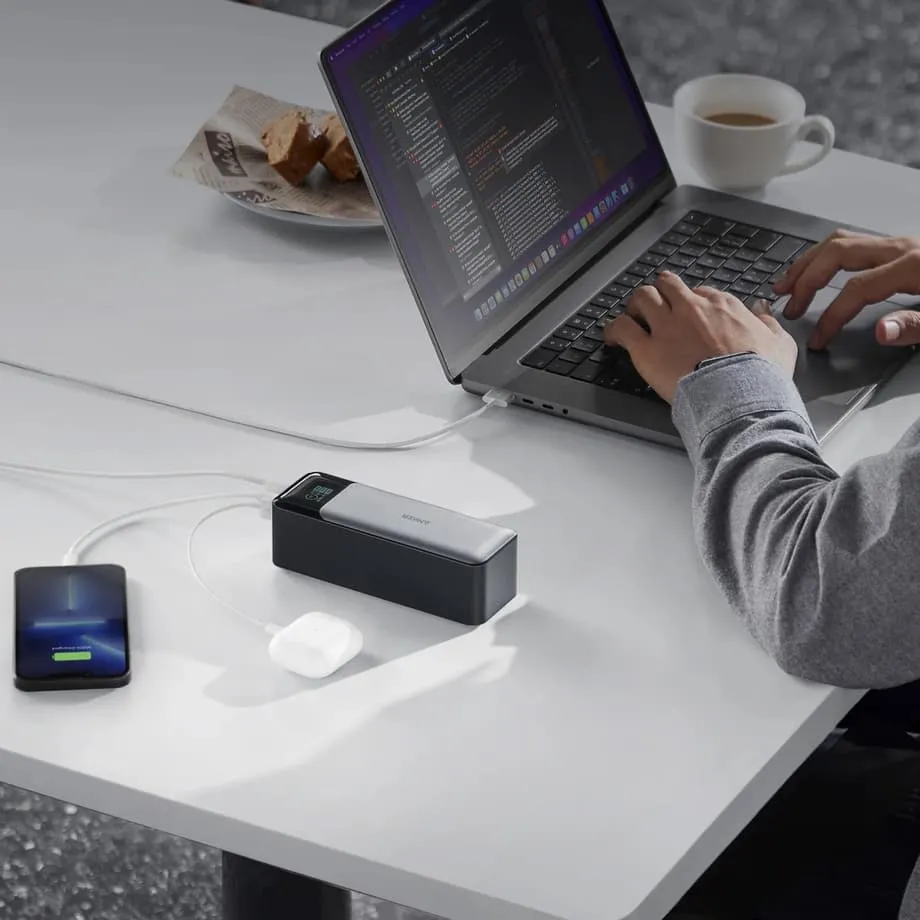
A new safety standard would change how power banks are made
China is preparing a dedicated power bank safety standard that would require newly manufactured portable chargers to have either an LCD screen or a companion app showing their status in real time. The Ministry of Industry and Information Technology (MIIT) plans public consultation in December 2025, publication in February 2026 and full enforcement in June 2026.
Contents
- A new safety standard would change how power banks are made
- What users would see on a screen or app
- Labels would identify the maker and the battery's expected life
- How the proposed rollout would work
- Why damaged lithium batteries can become dangerous
- Hotter tests and stronger overcharge protection
- What China's current flight rules require
- How to calculate a power bank's capacity
- Small manufacturers face rising costs
- Airlines elsewhere are tightening their rules too
- What buyers and travelers can do now
- Key Points
The proposed changes reach well beyond a battery percentage display. They cover cells, circuits, firmware, product design, labels and information for users. Among the planned tests are exposure to 135 degrees Celsius for 60 minutes, replacing 130 degrees Celsius for 30 minutes, and tolerance of an overcharge voltage reaching 1.4 times the standard level.
China's push follows a rise in incidents involving lithium batteries at airports and aboard aircraft, including smoke and fire in overhead bins. An Air China flight diverted on October 18 after smoke was detected in an overhead bin. The following day, a passenger's power bank ignited while an IndiGo aircraft was taxiing.
China already tightened aviation rules in 2025. On domestic flights in mainland China, power banks must carry a valid China Compulsory Certification mark, commonly called CCC or 3C. Airport security teams check markings and capacity, and units that fail those requirements can be seized at checkpoints.
MIIT's proposed specification would govern what manufacturers can produce and sell nationwide. China is the largest producer of portable chargers, so the changes would also affect supply chains serving export markets. Large brands already offer screens showing charge and power delivery, but the proposal calls for more detailed information and tougher protection against battery failures.
What users would see on a screen or app
Every newly manufactured power bank covered by the proposal would need an LCD screen or a connection to an app providing the same information. Users would be able to see the remaining charge and output power, along with health information such as cycle count and an indicator of battery condition.
A simple display with four LED lights gives only a rough indication of how much charge remains. The proposed approach would provide a more detailed picture of the battery's condition and use. Several of these features already appear in premium products, but they would become requirements across the Chinese market.
Real time readings and alerts could help users identify problems before continuing to charge a device. Information about rising internal temperature, battery aging or a swelling warning could prompt someone to stop using a pack. The aim is also to discourage risky use, such as operating a damaged battery or leaving it inside a hot car.
Clear information could help airlines and airport security staff identify capacity, usage and brand details more quickly. A screen or app would serve a different purpose from the protection circuitry inside the charger: it would tell the user what is happening, while the circuitry would control charging and respond when limits are crossed.
Labels would identify the maker and the battery's expected life
Manufacturers would have to print more information on the power bank's casing. The proposed labels would include the full name of the manufacturer or original equipment manufacturer, known as an OEM, the battery type, production date and recommended safe service life.
A recommended service life would give buyers a stated period for safe use. The production date would help them understand how old a product is, while the manufacturer's full name would make responsibility for the device easier to identify.
Component and batch traceability would also become part of the requirements. Manufacturers would need records connecting finished products with their parts and production batches, helping inspectors check compliance and helping companies identify affected products during recalls.
How the proposed rollout would work
MIIT intends to replace the current CCC program for power banks with a dedicated safety specification. As of December 8, 2025, the consultation, publication and enforcement dates remain planned milestones. The exact way airport checks would move from the existing certification rule to the new specification has not been set out.
The timetable links the aviation restrictions already introduced in 2025 with the planned changes to manufacturing and sales:
- During 2025: China tightened domestic flight rules, requiring power banks to carry a valid 3C mark.
- October 18, 2025: An Air China flight diverted after smoke was detected in an overhead bin.
- October 19, 2025: A passenger's power bank ignited while an IndiGo aircraft was taxiing.
- December 2025: Public consultation on the new power bank specification is planned.
- February 2026: Official publication is expected.
- June 2026: Full enforcement is targeted.
The proposal would phase out the current 3C program for power bank manufacturing. Aviation rules could then refer to the new standard when airports inspect products. Until that transition, travelers on domestic flights in mainland China must meet the current certification requirement.
Why damaged lithium batteries can become dangerous
Lithium ion cells can enter a condition called thermal runaway when they overheat or suffer a short circuit. Heat builds rapidly inside the cell, hot gases escape, and the battery can ignite nearby material. The proposed engineering and testing requirements aim to make that chain of events less likely and limit its effects if it begins.
Penetration tests use a nail or spike to simulate a sharp object piercing a cell. Damage inside a battery can create an internal short circuit, leading to rapid heating and the release of gas. Under the proposed procedure, units would have to withstand a compromised cell without catching fire, cracking open or leaking.
The test also checks the design of separators, current interrupters and the chassis containing the cells. Separators keep the cell's internal electrical parts apart, while current interrupters stop the flow of electricity under dangerous conditions. The enclosure has a role in containing and protecting the battery assembly.
The wider test program would cover cells and complete battery packs, including penetration, heat, overcharge and short circuit scenarios. Manufacturers would also need stronger protection circuitry and firmware, the software built into the device that manages its operation.
Hotter tests and stronger overcharge protection
The proposed heat resistance test would raise the temperature from 130 degrees Celsius to 135 degrees Celsius and extend exposure from 30 minutes to 60 minutes. That means a temperature increase of 5 degrees and twice as much time under heat stress.
Heat speeds up chemical reactions inside a lithium cell. A longer and hotter test places greater demands on the battery's ability to resist smoking or ignition. The safety concern includes exposure to heat in ordinary use, such as a power bank left inside a parked vehicle in the sun.
The overcharge requirement would also become tougher. Packs would need to tolerate a voltage surge up to 1.4 times the standard level without catastrophic failure. Overcharging can push lithium cells into dangerous conditions, so manufacturers would need electronics capable of detecting and interrupting excessive charging.
Battery management systems would have to monitor individual cells, balance their charges and cut off power quickly when limits are exceeded. The changes would also place greater demands on the selection of charger chips and MOSFETs, electronic components used to control the flow of power.
These tests would work alongside improvements to enclosures, separators and cell quality. The proposed approach combines resistance to physical and electrical stress with controls intended to stop a battery reaching dangerous conditions during use.
What China's current flight rules require
Travelers face two sets of requirements: aviation rules decide what can go aboard an aircraft, while the planned MIIT specification would decide what can be manufactured and sold. For domestic flights in mainland China, the current rule requires a power bank with a valid, clearly visible 3C mark.
Security agents can inspect the certification mark and capacity rating. A missing or faded mark may prevent the device from passing the checkpoint, and a power bank that does not meet the requirements can be confiscated. Travelers should keep it in cabin baggage and be ready to remove it for inspection.
Capacity limits follow the widely used thresholds of 100 watt hours and 160 watt hours. A power bank of up to 100 Wh is allowed without special permission. A pack above 100 Wh and up to 160 Wh needs airline approval, while anything above 160 Wh is not allowed on passenger flights.
Power banks belong in the cabin, never in checked luggage. Airports discourage placing them in overhead bins because smoke or overheating can take longer to detect there. Greater attention to battery fires also means travelers should expect tighter inspections in the near term.
How to calculate a power bank's capacity
A power bank's capacity may be printed in milliamp hours, or mAh, while airline limits use watt hours, or Wh. To convert, multiply the stated milliamp hours by the battery's nominal voltage, then divide by 1,000. The voltage is needed because milliamp hours alone do not give the energy figure used for flight limits.
For a pack using cells with a nominal voltage of 3.7 volts, a 10,000 mAh rating works out to about 37 Wh: 10,000 multiplied by 3.7, divided by 1,000. A 20,000 mAh model at the same voltage works out to about 74 Wh.
Most models of those capacities are therefore below 100 Wh when they use cells rated at 3.7 volts. Checking the actual label remains useful, especially when preparing for airport inspection. Staying below 100 Wh avoids the need for special capacity approval; travelers carrying a pack between 100 and 160 Wh should contact their airline before departure.
Small manufacturers face rising costs
China has hundreds of small power bank assemblers that depend on commodity cells and simple control boards. The proposed requirements would demand investment in design, firmware, testing and production records. Industry estimates suggest that as many as 70 percent of smaller producers may leave the market because they cannot fund the upgrades or meet the documentation requirements for certification.
Screens, health sensors and more capable battery management systems would increase the cost of components. Stronger enclosures, better separators and higher grade cells would add further expense. Manufacturers would also need equipment such as chambers for heat testing and rigs for penetration tests.
Factories would have to track production batches and retain test results for inspectors. For businesses accustomed to assembling inexpensive cells and basic boards, meeting the new specification would involve changes to quality management as well as to the product itself.
Large brands are better placed to make those investments. Many already sell power banks with status displays and robust protection circuits, have relationships with leading cell suppliers and can develop companion apps. The proposed rules could speed a shift toward products that report cycle counts, battery health and firmware versions, much as laptop batteries do.
More detailed records of battery condition could support longer warranties and more responsible disposal when a pack reaches the end of its rated service life. Because China supplies export markets as well as its own consumers, changes at its factories could reach buyers elsewhere.
Airlines elsewhere are tightening their rules too
The International Air Transport Association (IATA), the global airline trade group, says incidents involving lithium batteries occur about once every ten days worldwide. Concern about those events has led some airlines to impose restrictions beyond the basic limits on battery capacity and baggage placement.
Most countries follow the 100 Wh and 160 Wh thresholds promoted by IATA and adopted by regulators in places including the European Union, the United Kingdom and the United States. Spare lithium batteries and power banks must travel in the cabin rather than checked baggage. Many airlines also limit the number of units and require protection of terminals against short circuits.
Some carriers in Australia, Singapore and parts of the Middle East now prohibit passengers from using power banks to charge devices during flights. Several require power banks to remain within reach rather than in overhead bins. Keeping them accessible makes it easier to notice smoke and allows cabin crews to respond quickly with fire containment equipment.
China's proposed screen or app requirement stands apart because it concerns manufacturing rather than permission to carry or use a battery on an aircraft. Other countries could adopt similar requirements. Even without that step, exporters seeking access to the Chinese market may build products to its standard, bringing more detailed battery information and stronger safety requirements to customers elsewhere.
What buyers and travelers can do now
Anyone preparing for a domestic flight in mainland China should check the power bank's 3C mark, capacity and physical condition before packing. Keep the device in cabin baggage, accessible for inspection and within reach during travel. Airline restrictions on using or storing it may apply alongside the airport's entry checks.
Buyers choosing a power bank in 2026 or later should look for models that display health and cycle count or connect to a trusted app. The casing should identify the full manufacturer name and battery type and provide a recommended service life. Reputable brands and sellers offer a clearer route to checking those details than unbranded products or units with unclear labels.
A display gives users information, while better cells, protection electronics and tougher tests address the conditions that cause failures. A rising temperature reading, swelling warning or high cycle count can alert a user to stop. Circuitry designed to prevent overcharging and short circuits works inside the pack to control electrical risks.
Power banks should be kept away from hot cars and should not be covered with clothing while charging. Stop using a unit that feels hot, smells of chemicals or shows swelling. A pack that has been stored in a hot car or has become swollen should be recycled. If a device smokes or sparks aboard an aircraft, tell the crew immediately and follow their instructions.
Key Points
- As of December 8, 2025, China plans consultation in December, publication in February 2026 and full enforcement in June 2026.
- The proposed specification would replace the current CCC program for power bank manufacturing.
- Newly manufactured power banks would need an LCD screen or companion app showing status and battery health information.
- Labels would identify the manufacturer, battery type, production date and recommended safe service life.
- Proposed tests include stricter penetration checks, 135 degrees Celsius for 60 minutes and overcharge voltage of up to 1.4 times the standard level.
- Industry estimates suggest as many as 70 percent of smaller producers may leave the market.
- Domestic flights in mainland China currently require a valid 3C mark. Packs above 100 Wh and up to 160 Wh need airline approval; those above 160 Wh are prohibited.
- Power banks must travel in the cabin. Several airlines also restrict their use and require them to remain within reach.
- Clearer battery information would accompany tougher engineering requirements, while safe storage and prompt action on damage would remain essential.