Europe puts security at the centre of infrastructure contracts
Sweden plans to give local and regional authorities new powers from 2027 to exclude suppliers linked to hostile states from sensitive infrastructure contracts. Officials identify China as a prime concern. The proposal is part of a broader European shift toward tighter checks on who can build, own and operate ports, railways and other essential networks.
Contents
- Europe puts security at the centre of infrastructure contracts
- Why control of a terminal or railway matters
- Sweden prepares exclusion powers for 2027
- Poland weighs stronger control over its ports
- Austria's trains bring digital access into the debate
- The EU tools behind tighter procurement checks
- Military transport and ports face closer oversight
- Chinese infrastructure links shape Europe's choices
- Alternative corridors gain attention and investment
- Stronger checks bring costs and new demands
- Key Points
As of December 3, 2025, Poland is debating legislation to strengthen control over port facilities, while Chinese built passenger trains entering service in Austria have prompted calls for stronger procurement and digital security rules. At the European Union level, existing trade and investment tools are being joined by measures focused on infrastructure needed for defence and crisis response.
A recent EU court ruling has reinforced the legal basis for greater scrutiny. It clarified that suppliers from countries without a free trade agreement with the EU do not enjoy the same access rights in public tenders as European suppliers or bidders from countries covered by agreements. A public tender is the process through which an authority invites companies to compete for a contract.
European governments increasingly treat power grids, telecommunications networks, data centres and the software that runs infrastructure as strategic assets alongside ports and railways. The question is no longer simply which bidder can deliver the lowest price or finish fastest. Authorities also want to know who controls a supplier, what information it can access and whether essential services could become dependent on it.
Russia's war in Ukraine has helped drive this turn toward economic security by showing how supply chains and infrastructure can become instruments of pressure. Europe is seeking more selective market access, stronger national security checks and reciprocal opportunities for European companies abroad, while keeping trade with China open.
Why control of a terminal or railway matters
Ports and railways move information as well as passengers and cargo. Their systems can reveal trade flows, the organisation of supply chains and movements connected to military or emergency services. A company that owns, operates or maintains part of a network may gain visibility into activity that governments want to protect.
Modern ports use automated cranes, scheduling platforms, sensors and interconnected operational technology. Operational technology means the equipment and software that control physical tasks, such as moving containers. Digital twins, computer models of real facilities and their operations, are also becoming common. Together, these systems help terminals coordinate increasingly complex movements.
Remote maintenance and software updates are routine parts of running this equipment. Access to those systems may allow a supplier to learn who ships what and when, understand contingency plans or interfere with operations. Railway concerns extend across trains, signalling, ticketing and maintenance platforms, where the company servicing the system often retains important access.
European officials see greater risks when suppliers are owned by a foreign state or must follow their home government's strategic directions. Their concerns include espionage, access to data that could support targeted economic pressure, and bottlenecks that could be used during a crisis. Infrastructure contracts combined with financing can also create dependencies lasting many years, narrowing a government's choices when relations deteriorate.
Sweden prepares exclusion powers for 2027
Sweden's proposal would give local and regional authorities an explicit basis to examine bidders' nationality and ownership when awarding contracts for critical projects. A supplier linked to a hostile state could be excluded where reasonable security concerns exist.
The government presents the measure as a practical way to protect ports, railways, information technology systems, energy networks and other essential services while maintaining access for friendly partners. The planned rules would make security considerations a clearer part of procurement decisions affecting national resilience, meaning the ability to keep essential services working through a crisis.
The legislative push accelerated after the EU court decision clarified the rights of suppliers from outside the bloc. Swedish prosecutors and investigators have also called for stronger tools to keep suppliers considered a high security risk out of sensitive contracts.
The proposed start in 2027 would give public agencies time to revise procurement procedures, develop security assessments and improve checks on vendors. Companies would still be able to challenge exclusion decisions. The intended change is that authorities would have a clearer legal basis for treating security criteria as decisive when essential infrastructure is involved.
Poland weighs stronger control over its ports
Poland's draft legislation focuses on who can own and operate facilities in ports that support grain exports, energy imports and defence logistics. It seeks tighter oversight of ownership and operational concessions in strategic terminals. A concession gives an operator permission to run a facility under agreed conditions.
Poland currently relies on state owned port authorities that lease land to private terminal operators. Policymakers argue that this arrangement may need revision so the state retains sufficient influence over assets essential to the economy and national security.
The bill's passage is uncertain because coalition politics and concerns about foreign investment could slow it. The debate extends beyond any individual bidder: lawmakers are considering how to preserve control as ports develop and attract commercial interest.
Poland also occupies an important position in China Europe rail transport, including at the border crossing of Malaszewicze. Chinese investment in Polish transport nevertheless remains modest. Warsaw has balanced interest in commercial opportunities with caution, shaped by close ties to the United States and concern that some infrastructure projects mainly extend routes for Chinese exports.
Gdansk's growth into a major gateway for trade between Asia and Europe gives that debate added weight. Lawmakers want the benefits of greater trade without allowing expansion to weaken control over critical facilities.
Austria's trains bring digital access into the debate
Chinese built passenger trains entering service in Austria have brought together questions about price, innovation, security and fair competition. Lawmakers and regulators have called for stronger procurement safeguards, while policymakers and industry groups are pressing for clearer vendor transparency and tighter digital security.
Source code, remote diagnostics and access to operational data are central concerns. Source code contains the instructions behind software, while remote diagnostics allow a supplier to inspect equipment from another location. Both can help keep trains running, but they also make the supplier's access and responsibilities important parts of a security assessment.
European companies raise a second issue: whether foreign state support gives competing suppliers an advantage that distorts tender results. They also argue that European bidders face barriers in China while Chinese companies can compete for European contracts. This is the reciprocity question, whether each side offers comparable opportunities to the other's businesses.
The Austrian debate therefore connects two pressures that are spreading across Europe. Authorities want transport systems with dependable support and protected data, while industry wants competition on terms it considers fair. Calls for a clearer basis to exclude suppliers on national security grounds sit alongside those demands.
The EU tools behind tighter procurement checks
The recent EU court ruling clarified that companies from countries without a free trade agreement with the bloc cannot claim the same treatment as EU bidders or companies from countries covered by agreements. Contracting authorities retain wide discretion to exclude those suppliers where justified, particularly in sensitive sectors. The ruling has encouraged governments to bring national security assessments more directly into tender design and supplier selection.
The International Procurement Instrument addresses access to public contracts. It allows the European Commission to restrict participation in EU tenders by companies from countries that keep their own procurement markets closed to European bidders. Its focus is reciprocal access rather than the ownership of an individual port or railway.
The Foreign Subsidies Regulation addresses another problem: financial support from governments outside the EU that may distort competition. It allows the Commission to investigate such support in public tenders and impose remedies where needed. This puts the financing behind a bid under scrutiny alongside its price and technical merits.
The EU investment screening framework coordinates national reviews of foreign direct investment in critical assets. These reviews concern investment and control, while procurement rules concern the award of contracts. Many member states have strengthened their own screening rules and widened the range of sectors they cover.
Together, these instruments allow governments and the Commission to examine different parts of an infrastructure arrangement: who wins the contract, how the bid is supported and who ultimately controls the asset. Their growing use reflects the increasing weight attached to economic security in decisions once driven more heavily by commercial considerations.
Military transport and ports face closer oversight
The EU's military mobility package calls for stricter checks on the ownership and control of roads, railways, bridges, tunnels, ports and airports needed to move troops and equipment. These routes matter during defence operations and other crises, making reliable access a security priority.
An upcoming EU ports strategy is expected to address ownership, remote access to operational systems and minimum security standards across terminals. These measures fit within Europe's economic security strategy, which seeks to target a narrow set of critical risks while preserving open trade.
European Commission President Ursula von der Leyen set out the intended balance between openness and caution in a speech in 2023:
We need to de risk, not decouple.
Her message describes an approach based on reducing dangerous dependencies while continuing trade with China and welcoming investment in many areas. Critical infrastructure, sensitive technology and strategic supply chains would receive closer security scrutiny and tighter participation controls.
The developments span several stages:
- 2013: China's Belt and Road Initiative began reshaping infrastructure investment across Eurasia.
- 2023: Ursula von der Leyen described the EU approach as reducing risk while maintaining economic connections.
- December 3, 2025: Sweden's proposed exclusion powers, Poland's port legislation and the forthcoming EU ports strategy form part of an expanding security agenda.
- 2027: Sweden plans to bring its new exclusion rules into force.
Chinese infrastructure links shape Europe's choices
China's Belt and Road Initiative seeks to connect factories, ports and markets through railways, highways, pipelines and shipping routes. Since 2013, it has reshaped investment across Eurasia and placed transport links at the centre of debates about commercial reach and political influence.
Two European projects stand out in those discussions. China Ocean Shipping Company's majority stake in Greece's port of Piraeus helped turn it into one of the Mediterranean's busiest terminals. The Budapest to Belgrade railway, supported by Chinese financing, is intended to provide a faster route between Central Europe and Piraeus.
European policymakers often cite those projects as examples of how infrastructure can expand trade and create political influence at the same time. The concern is rooted in the combination of ownership, financing and the importance of the routes themselves.
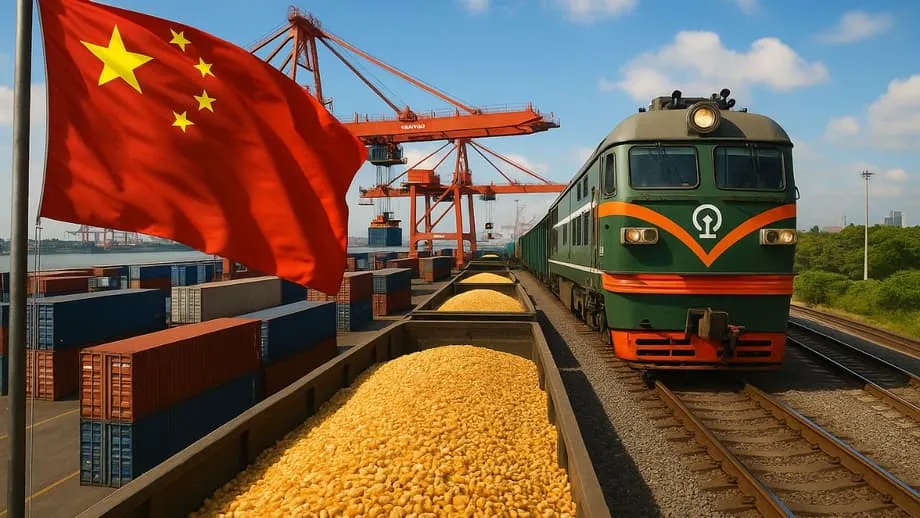
Rail has become the fastest growing middle option between sea and air for China Europe trade, although it still carries a small share of total trade by volume. Sea transport remains dominant for goods of low value shipped in bulk, while air serves cargo with the highest value. Rail occupies an important but limited place between them.
Studies point to heavy Chinese subsidies supporting the expansion of rail routes, persistent trade imbalances and bottlenecks at European border crossings within older transport networks. These factors help explain why growing rail services remain a niche part of the larger trading relationship.
Alternative corridors gain attention and investment
The middle corridor through Kazakhstan, across the Caspian Sea, through the Caucasus and into the EU via Türkiye has gained prominence as shippers seek alternatives to routes dependent on Russia. Governments are supporting diversification, and the route is receiving new investment and attention.
Kazakhstan's role as a transit hub has expanded. Plans include additional border crossings, more railway capacity and a container hub at Aktau to ease cargo movements. These projects address the practical need for greater capacity along an alternative route.
The EU's Global Gateway infrastructure plan is intended to provide credible alternatives by combining public funding and private capital for trusted projects with environmental and social safeguards. Its approach puts quality, transparency and benefits lasting many years alongside the construction of new connections.
The Lobito Corridor, linking Angola, the Democratic Republic of Congo and Zambia to the Atlantic, illustrates that effort. The EU and its partners aim to support rail and port investment that develops local value chains, so more economic activity takes place in the countries along the route rather than focusing solely on extracting raw materials.
These projects also reflect a desire to avoid unsustainable debt and dependence on a single vendor. Sea routes will remain the foundation of trade, while rail and road connections that bypass individual choke points are expected to continue receiving policy support.
Stronger checks bring costs and new demands
European authorities face tradeoffs as they tighten access to critical projects. Excluding some suppliers can raise costs in the near term or reduce the number of available bids. Replacing existing vendors also takes time and money when spare parts, software support and staff training depend on contracts already in place.
Policymakers argue that disruption or loss of control could carry greater costs. Their case for a measured shift toward trusted suppliers rests on making essential networks more resilient and helping them recover faster during a crisis.
Procurement officers and investors should expect more national security clauses in tenders involving ports, railways, telecommunications and energy. Data access, remote maintenance and supply chain transparency will face closer scrutiny. Reviews are likely to examine beneficial ownership, meaning the people or organisations that ultimately own or control a business, as well as board control and connections to foreign state programmes.
Authorities are also expected to make greater use of exclusion grounds tied to economic security and seek contracts that keep core systems under EU jurisdiction and governance. Companies can prepare by tracking ownership and exposure to subsidies throughout their supply chains, separating sensitive data, and maintaining access controls that do not depend on foreign support.
Bidders will need alternatives if a supplier becomes restricted and should be ready to show whether European firms can win comparable contracts in their home market. Preparing that reciprocity case can help reviews proceed more quickly and reduce uncertainty.
Sweden's rules still need to be finalised for the planned 2027 implementation. Poland's bill will test how far a member state moves to secure strategic assets while remaining open to investment, and the Commission's ports strategy is expected to establish a baseline for ownership oversight, data protection and remote access. Greater use of the International Procurement Instrument and Foreign Subsidies Regulation is anticipated in rail, ports and energy tenders as Europe continues trading with China under tighter infrastructure safeguards.
Key Points
- Sweden plans powers from 2027 to exclude suppliers linked to hostile states from sensitive infrastructure contracts.
- A recent EU court ruling reinforced unequal procurement access rights for suppliers from countries without an EU free trade agreement.
- Poland is debating stronger control over port ownership and operations, with passage uncertain.
- Chinese built trains in Austria have prompted demands for stronger procurement, digital security and vendor transparency rules.
- EU instruments address reciprocal tender access, foreign subsidies and investment in critical assets.
- The military mobility package and forthcoming ports strategy focus on infrastructure ownership, control and operational access.
- Piraeus and the Budapest to Belgrade railway remain prominent examples in debates over Chinese infrastructure involvement.
- China Europe rail is growing but carries a small share of trade by volume, with subsidies, trade imbalances and bottlenecks shaping its development.
- The middle corridor and Global Gateway projects support alternative routes and investment choices.
- Europe aims to reduce strategic dependencies while keeping trade with China open.