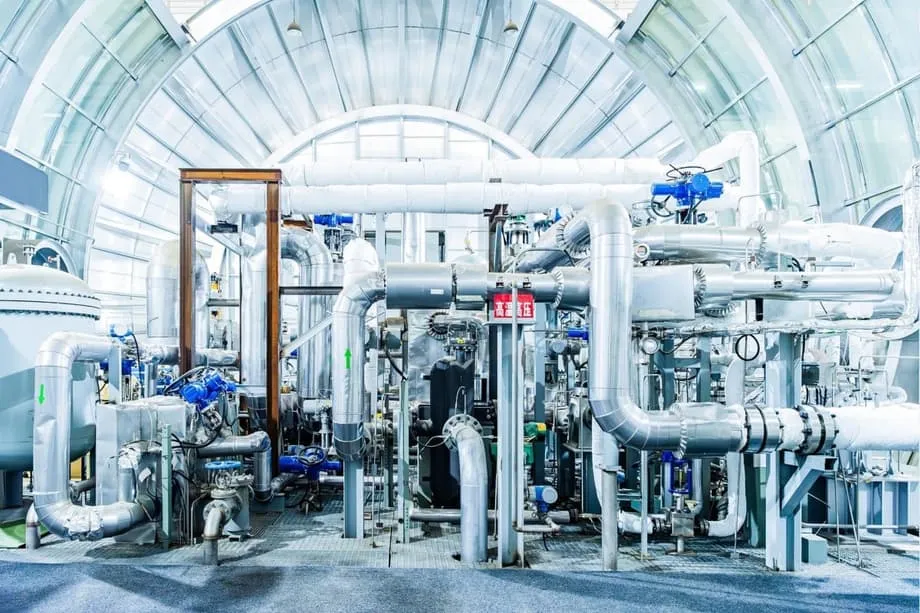
Two 15 megawatt units turn steelmaking heat into electricity
China has connected what is described as the world's first commercial power generator using supercritical carbon dioxide to the electricity grid at Shougang Shuicheng Steel in Liupanshui, Guizhou. The project comprises two units rated at 15 megawatts each, a combined rated capacity of 30 megawatts, and captures heat from steel production to generate electricity.
Contents
- Two 15 megawatt units turn steelmaking heat into electricity
- What makes carbon dioxide supercritical?
- How the efficiency claims compare with steam
- Why steelmaking offers a useful heat source
- A development program built around industrial operation
- What the Texas pilot and named researchers say
- Where nuclear and solar power could use the technology
- Turbines, seals and bearings face demanding conditions
- Controls and heat exchangers determine usable output
- Water, emissions and the role of captured CO2
- Commercial expansion depends on reliability and suppliers
- The Bottom Line
The Nuclear Power Institute of China, part of China National Nuclear Corporation (CNNC), built the installation with engineering support from Jigang International Engineering and Technology. Instead of using steam to drive its turbines, the system circulates carbon dioxide in a special physical state known as supercritical CO2, often shortened to sCO2.
The manufacturer says the units can capture and use waste heat at least 50 percent better than conventional systems using steam in steel mills. For the host plant, the immediate attraction is practical: heat that would otherwise escape through exhaust channels and cooling systems becomes a source of electricity, reducing the amount of power the plant needs from the local grid.
The connection moves the technology into commercial industrial service, where equipment must work alongside a steel plant's changing production conditions. Smaller turbines, faster startup and higher thermal efficiency at high temperatures have made sCO2 attractive to developers of waste heat systems, advanced nuclear reactors and concentrated solar power plants.
As of November 28, 2025, the Guizhou project represents a milestone in that effort. Its longer term performance, maintenance needs and economics will depend on operation over months and years. The same installation that generates electricity will also provide experience of running the technology outside a laboratory.
What makes carbon dioxide supercritical?
Carbon dioxide reaches its critical point at roughly 31 degrees Celsius and 74 bar of pressure. Above both thresholds, it becomes a dense fluid with properties associated with a gas and a liquid. Engineers can use that density to build smaller turbines and heat exchangers than would be needed for steam at a comparable power level.
The carbon dioxide travels around a closed loop. It absorbs heat, expands through a turbine that turns a generator, releases some remaining heat, and is compressed before returning to collect more energy. The gas carries heat through the equipment; it is not the fuel supplying the heat.
Engineers call this arrangement a Brayton cycle. It is related to the cycles used in gas turbines and jet engines, but this system uses CO2 as its working fluid and includes recuperators. A recuperator is a heat exchanger that recycles heat inside the loop, transferring energy from the hot outgoing fluid to the cooler returning fluid.
At the steel plant, hot gases from sintering and related processes pass through a heat exchanger. Their energy heats the CO2 without mixing the industrial exhaust with the fluid inside the power system. The heated CO2 then expands through the turbine and produces mechanical motion that the generator turns into electricity.
After leaving the turbine, the CO2 still contains useful heat. The recuperator uses some of it to warm the incoming stream. A cooler removes the remaining unwanted heat, and a compressor sends the fluid back toward the main heat exchanger. CO2 near its critical point requires less compression energy than a normal gas, helping increase the electricity left after the plant powers its own equipment.
How the efficiency claims compare with steam
Conventional steam systems use a Rankine cycle, a mature and reliable method of turning heat into electricity. Their equipment is relatively large, and further efficiency gains become difficult without very high temperatures and pressures. Supercritical CO2 offers a different route, combining a dense working fluid with internal heat recovery.
Reports from the Chinese project and international pilots indicate that sCO2 cycles operating at high temperatures can exceed 50 percent thermal efficiency, while modern steam cycles are nearer 40 percent in similar operating conditions. Thermal efficiency describes the share of heat entering a cycle that becomes useful power. At those illustrative levels, more than half of the incoming heat becomes power in the sCO2 cycle, compared with about two fifths in the steam cycle.
The manufacturer's claim of at least 50 percent better waste heat capture and use concerns the comparison with conventional steel mill systems. The actual efficiency of a waste heat installation depends on the temperature of the available heat and the design of its equipment. The Guizhou system's performance therefore rests on how well its power block matches the plant's heat streams.
Dense CO2 also allows smaller turbines and piping for a given power output. Compact equipment can reduce the space needed for a power block and its supporting machinery. Faster startup and shutdown can make the system more flexible when the temperature of an industrial process changes during the day.
Why steelmaking offers a useful heat source
Steel plants consume large amounts of energy in sintering, coking and hot rolling. Sintering joins fine ore particles into larger material suitable for further processing. Sintering lines and furnaces release substantial flows of heat at temperatures well above 700 degrees Celsius, or 1,292 degrees Fahrenheit.
Furnaces and channels carrying exhaust gases move that heat away from production. A heat exchanger can intercept the flow and transfer part of its energy to the clean CO2 loop. Recovering that energy improves the plant's energy balance and provides a potentially stable source of electricity from an activity already taking place.
Shougang Shuicheng Steel supplied the site and access to these streams of high temperature waste heat. An industrial setting also offers a demanding test of flexibility: the power system must respond as production conditions change, while remaining reliable enough to support regular operation.
The closed loop requires little water compared with conventional steam systems because it avoids large volumes of boiler feedwater and can reduce dependence on wet cooling towers. Lower water demand is valuable where supplies are limited. CO2 is also relatively inert and less corrosive to many alloys than steam at high temperatures, which can ease some materials challenges.
During normal operation, the circulating CO2 stays inside the system. Small losses from its inventory can occur and require management, but the cycle does not depend on a continuous supply of fresh CO2. For the plant operator, the combination of compact machinery, fewer auxiliary systems and flexible operation may make waste heat recovery easier to fit into an existing industrial site.
A development program built around industrial operation
The Nuclear Power Institute of China has worked on sCO2 technology for more than a decade. Its program has included loops, turbines, bearings, seals and control systems, along with published component tests and pilot rigs. The Guizhou installation brings those separate engineering tasks together in a commercial power project.
Jigang International Engineering and Technology supported integration with heavy industry, while Shougang Shuicheng Steel provided the operating environment. The two units, each rated at 15 megawatts, give the project redundancy and allow operators to test control strategies under real production conditions.
CNNC describes the installation as a foundation for future units in heavy industry and power generation. The aim is to develop standard modules that can be repeated across sites. Producing equipment at scale and installing it with less customization can strengthen the economic case for recovering industrial heat.
The development milestones span several periods:
- For more than a decade, the Nuclear Power Institute of China has developed and tested sCO2 components, controls and pilot systems.
- In 2024, the Supercritical Transformational Electric Power pilot in Texas completed its first phase and demonstrated operation at full speed with integrated machinery and controls.
- By November 28, 2025, China's commercial installation at Shougang Shuicheng Steel had been connected to the grid.
- China's stated climate targets are to peak carbon emissions before 2030 and reach carbon neutrality before 2060.
What the Texas pilot and named researchers say
The United States is also developing sCO2 power equipment. In Texas, the Supercritical Transformational Electric Power project, known as STEP, is a pilot facility rated at 10 megawatts of electrical output. Backed by the U.S. Department of Energy and led by a consortium, it completed its first phase in 2024, produced power and demonstrated operation at full speed with integrated turbomachinery and controls.
Researchers at the Southwest Research Institute, which supports STEP, stress testing the compressor, turbine, heaters, coolers and software together as one plant. Tim Allison, director of the institute's Department of Machinery and a participant in the Texas project, described the achievement of operating the integrated system.
Operating the integrated system is a noteworthy accomplishment. It follows the team's successful component based commissioning activities and demonstrates combined operation of all equipment, including plant controls, compressor, heat exchangers, heater, turbine and CO2 inventory in addition to the facility's electrical and gas supply and cooling water systems.
Mark Hibbs, a senior fellow at the Carnegie Endowment for International Peace who studies China's nuclear sector, described the pace of China's effort to demonstrate technical leadership.
The Chinese are moving very, very fast. They are very keen to show the world that their program is unstoppable.
The Texas pilot and the Guizhou installation mark different stages of development. STEP has demonstrated integrated operation at a pilot facility, while China's project places the technology in commercial service using an industrial process as its heat source. Teams in the United States, Europe and Asia are continuing work on component reliability and plant integration.
Where nuclear and solar power could use the technology
Advanced nuclear reactors can produce temperatures suited to sCO2 power conversion. High temperature gas reactors, molten salt reactors and sodium fast reactors target hotter outlet temperatures than pressurized water reactors. A compact turbine can also suit small modular reactors, where space and simplicity are priorities.
Advanced reactor designers are planning sCO2 as a default power conversion system in some designs, replacing the bulk of steam equipment with smaller turbines and recuperators. Mobile nuclear sources intended for remote sites could benefit from the same compact machinery. Higher cycle efficiency can allow a smaller reactor core to supply a given electricity output.
Concentrated solar power offers another application. These plants collect solar energy as heat, store it in molten salts and send it through a power block to generate electricity. A demonstration plan in China aims to replace the steam power block at a demonstration solar tower plant in Dunhuang with an sCO2 system to assess supplier readiness and operating behavior.
The Dunhuang effort depends on two demanding components: a reliable heat exchanger transferring energy from molten salt to CO2, and compressors that can control CO2 near its critical point. Progress in materials, seals and control systems is bringing those tasks within reach.
For solar thermal projects, better efficiency can mean a smaller field of solar collectors for the same grid output, as well as a smaller turbine hall. Reduced water use can ease restrictions on where solar and nuclear projects are built. Scaling to larger power blocks will depend on whether heat exchangers and rotating machinery remain durable in operating plants.
Turbines, seals and bearings face demanding conditions
Compact turbines must withstand high temperatures and fast rotation. Academic and industrial studies describe rotors turning at about 30,000 to 40,000 revolutions per minute, with blades and casings exposed to temperatures above 600 degrees Celsius. Those conditions require careful choices of materials and mechanical design.
Nickel based alloys and advanced steels are commonly used for inner cylinders and rotors, while outer casings use ferritic steels to balance stress and cost. Engineers must account for strength, corrosion resistance and thermal expansion. Parts expand as they heat up, and the gaps between rotating and stationary components must remain small enough for efficiency without allowing them to rub together.
Dry gas seals limit CO2 leakage around the shaft. Bearings support the rotating machinery, and some designs explore gas bearings instead of oil bearings to simplify lubrication and avoid thermal problems.
Research on a turbine in the 25 megawatt class found that placing a balance piston inside the cooling gas section shortened the rotor, reduced leakage paths and lowered mechanical losses. A shorter rotor can improve stability and simplify its housing. Another arrangement replaced oil bearings with gas bearings, shortening the shaft further and removing the need for a separate cooling and lubrication system.
These refinements address both efficiency and reliability. A turbine that performs well for a short test must also tolerate repeated changes in temperature, pressure and output if it is to become routine industrial equipment.
Controls and heat exchangers determine usable output
Small demonstrations have shown that changes in pump speed, heat input and electrical load can cause pressure and flow to overshoot before settling. Engineers study combinations of mass flow, pressure ratio and rotational speed to identify stable operating areas that deliver the best power and efficiency.
A small sCO2 turbine generator test produced electricity in the tens of kilowatts and recorded total efficiency near 59 percent under optimal conditions. The result illustrates the promise of the technology and the precision needed to operate it effectively.
Compressors face a particular challenge near CO2's critical point. Small temperature changes can cause large changes in density, affecting compressor performance. Control systems must respond quickly enough to keep the cycle operating smoothly.
Heat exchangers at an industrial site face a different set of stresses. Equipment transferring energy from dirty exhaust gases to the clean CO2 loop must resist fouling, the buildup of deposits on heat transfer surfaces, and stresses caused by changing temperatures. Inside the loop, recuperators need a large heat transfer surface in a compact space while avoiding excessive pressure losses.
Reliable operation depends on all these parts working together. Better turbines cannot deliver their full benefit if heat exchangers restrict flow, compressors operate poorly or seals lose too much fluid.
Water, emissions and the role of captured CO2
China's commitments to peak carbon emissions before 2030 and reach carbon neutrality before 2060 put pressure on energy intensive industries to use energy more efficiently. Recovering heat from steelmaking can lower a plant's demand for electricity from grids supplied by fossil fuels. Reduced water use provides a second resource benefit, especially in arid areas where conventional cooling requires scarce water.
For nuclear and solar thermal projects, higher efficiency can directly lower the cost of clean electricity. Compact power equipment could also fit on ships or at remote industrial sites, turning heat available at the location into electricity used there and supporting energy security.
Some analysts point to possible connections with carbon capture. Captured CO2 could, in principle, supply the fluid used in the closed loop. The power equipment requires clean, dry CO2 to protect rotating machinery and reduce corrosion.
A closed power cycle keeps reusing its CO2, so it needs only a limited inventory rather than a continuing flow of captured gas. Cooperation with carbon capture would center on shared handling, storage and purification equipment. The CO2 carries energy through the system instead of being burned or converted into another product.
Commercial expansion depends on reliability and suppliers
The Guizhou project will provide information about continuous operation, maintenance cycles and the economics of turning steelmaking heat into power. Further units in steel and cement plants are likely if the performance claims hold up during monthly and yearly operation.
Manufacturers will need dependable supplies of heat exchangers, dry gas seals and generators designed for fast rotation. Having multiple vendors matters for wider deployment. Codes and standards covering pressure vessels, piping and seals in CO2 service will also need to mature.
Plant operators will need training to run the cycle safely and diagnose problems. Demonstrations followed by repeated installations can help reduce costs and give owners confidence that the systems will perform under ordinary industrial conditions.
China's grid connection supplies a commercial test of that proposition. The immediate achievement is generating electricity from heat already present in steel production. Wider adoption in heavy industry, solar thermal plants and advanced nuclear systems depends on turning promising efficiency and compactness into reliable, repeatable equipment.
The Bottom Line
- China connected a commercial sCO2 power project at Shougang Shuicheng Steel in Liupanshui, Guizhou, comprising two units rated at 15 megawatts each.
- The manufacturer says waste heat capture and use are at least 50 percent better than conventional steel mill systems using steam.
- CO2 circulates in a closed loop above roughly 31 degrees Celsius and 74 bar, transferring heat through compact power equipment.
- The Nuclear Power Institute of China developed the project with engineering support from Jigang International Engineering and Technology.
- The Texas STEP pilot, rated at 10 megawatts of electrical output, completed its first phase in 2024 and demonstrated integrated operation.
- Advanced nuclear reactors and concentrated solar power plants are potential applications, including a planned conversion at Dunhuang.
- Durable turbines, seals, bearings, heat exchangers and responsive controls remain central engineering tasks.
- Lower electricity demand and water use can support industrial efficiency, while wider deployment depends on operating results, suppliers, standards and costs.