Three children, one back seat and a coming deadline
Nhat Tung, a father of three in Ho Chi Minh City, faces a practical problem ahead of January 1, 2026. His family sedan has room for him and his wife in front and their three children, ages three to nine, in the back. Finding space for three suitable child restraints is another matter.
Contents
- Three children, one back seat and a coming deadline
- What changes on January 1, 2026?
- Why a short, slow trip still carries risk
- Can three restraints fit across a sedan?
- Choosing a device for the child's size
- Installation, anchor points and airbags
- Prices, labels and the risks of buying used
- Why taxis need a different practical solution
- Education must reach parents and grandparents
- Building safer habits before the deadline
- Key Points
Vietnam's Law on Road Traffic Order and Safety will require children who are both under 10 years old and shorter than 1.35 meters to sit away from the driver's row and use an appropriate child safety device. Three certified restraints do not always fit across the rear bench of a typical car with five seats. For Tung, a vehicle that remains safer than a motorbike can no longer carry the family in the way it previously did while meeting the new requirements.
Families across Vietnam are reviewing their vehicles, shopping for seats and working out how to manage everyday journeys. The difficulties are especially sharp for households with several young children, small cars and frequent short trips through slow urban traffic. Many parents support protecting children but need workable ways to meet the rule.
The World Health Organization says child restraints can reduce the risk of death for infants by up to 71 percent, and children are safer in the rear than in the front. Vietnam's growing use of cars, alongside a continuing shift from motorbikes to private vehicles, gives lawmakers a chance to establish safer habits.
As of November 27, 2025, families have a short period to learn which devices qualify, how to install them and whether they fit. Retailers are expanding their ranges and advertising promotions, while consumers report uncertainty about labels, safety standards and installation. Practical guidance will be central to turning the law into protection on the road.
What changes on January 1, 2026?
The Law on Road Traffic Order and Safety sets two linked thresholds: a child must be under 10 years old and under 1.35 meters tall for the requirement to apply. Such children cannot sit in the same row as the driver and must use a suitable restraint when travelling in a passenger car.
The requirement applies to most passenger vehicles, with an exception for vehicles that have only one row of seats. Drivers are responsible for installing the devices and instructing passengers in their use. A draft decree envisages fines of 800,000 to 1,000,000 VND for violations, with possible deductions from driving licence points.
Vietnam's technical regulation allows several kinds of equipment, including infant carriers, seats for younger children, booster seats and booster cushions for older children. Families therefore need to choose a device that matches the child's size and can be secured in their vehicle, rather than assume every child needs the same product.
Officials and safety advocates expect enforcement to develop in phases, with private cars a likely starting point because they regularly carry children at different speeds. Taxis and ride hailing fleets could follow as supply, education and checks improve. The proposed fines and suggested enforcement phases remain proposals or expectations at this stage.
The schedule and proposed preparation period are:
- November 27, 2025: Families are preparing for the requirement, while retailers expand their selection and promotions.
- January 1, 2026: The child seating and restraint requirement takes effect.
- During a suggested buffer of three to five years: Experts in Vietnam recommend education and free installation centres in major cities to help families adapt.
Why a short, slow trip still carries risk
Traffic in Vietnamese cities often moves at only 20 to 30 kilometres per hour. Some parents consequently regard a dedicated child seat as excessive for a short journey. The danger, however, comes from how abruptly a child's body slows during braking or a collision, as well as the vehicle's speed.
A child continues moving forward when the car suddenly stops. The restraint must manage that movement and the resulting forces. A child weighing 10 kilograms can place a load equivalent to hundreds of kilograms on whatever tries to stop them, far beyond what an adult can hold with their arms.
Dr. Do Van Dung, former vice chairman of the Ho Chi Minh City Automobile and Power Association, hears parents argue that a tight hug is enough on a short trip. He describes the forces involved at a higher speed:
In a sudden stop or a collision at around 50 kilometers per hour, a 10 kilogram child can exert an impact force in the range of 700 to 1,000 kilograms. No parent's arms can hold that. The child will be thrown forward and could strike the dashboard or windshield.
Adult seat belts present a different problem. They are made for larger bodies and can cross a small child's neck or abdomen, exposing those areas to serious injury. A suitable child seat or booster changes the belt's position so the load falls across stronger parts of the skeleton. The United States National Highway Traffic Safety Administration reports large reductions in infant deaths and substantial reductions for young children when restraints are used correctly.
Bui Tan Viet, a father aged 35 in Ho Chi Minh City, decided to buy a seat for his son after sudden braking during family journeys. He described both the incident and his son's adjustment:
A few times when I braked suddenly, my son hit his head on the front seat even though I was holding him. After that I decided to buy a child seat. At first he resisted, but now he climbs in on his own.
Heavy vehicles and sudden lane changes remain hazards in slow traffic. Families also travel on highways and longer arterial roads. A restraint provides protection when an ordinary journey ends in an unexpected stop or crash.
Can three restraints fit across a sedan?
A rear bench intended for three passengers does not necessarily have enough usable width for three child restraints. The answer depends on the vehicle, the devices and each child's size. Some families can solve the problem with a mix of seats and compact boosters, particularly when two children are already eligible for boosters.
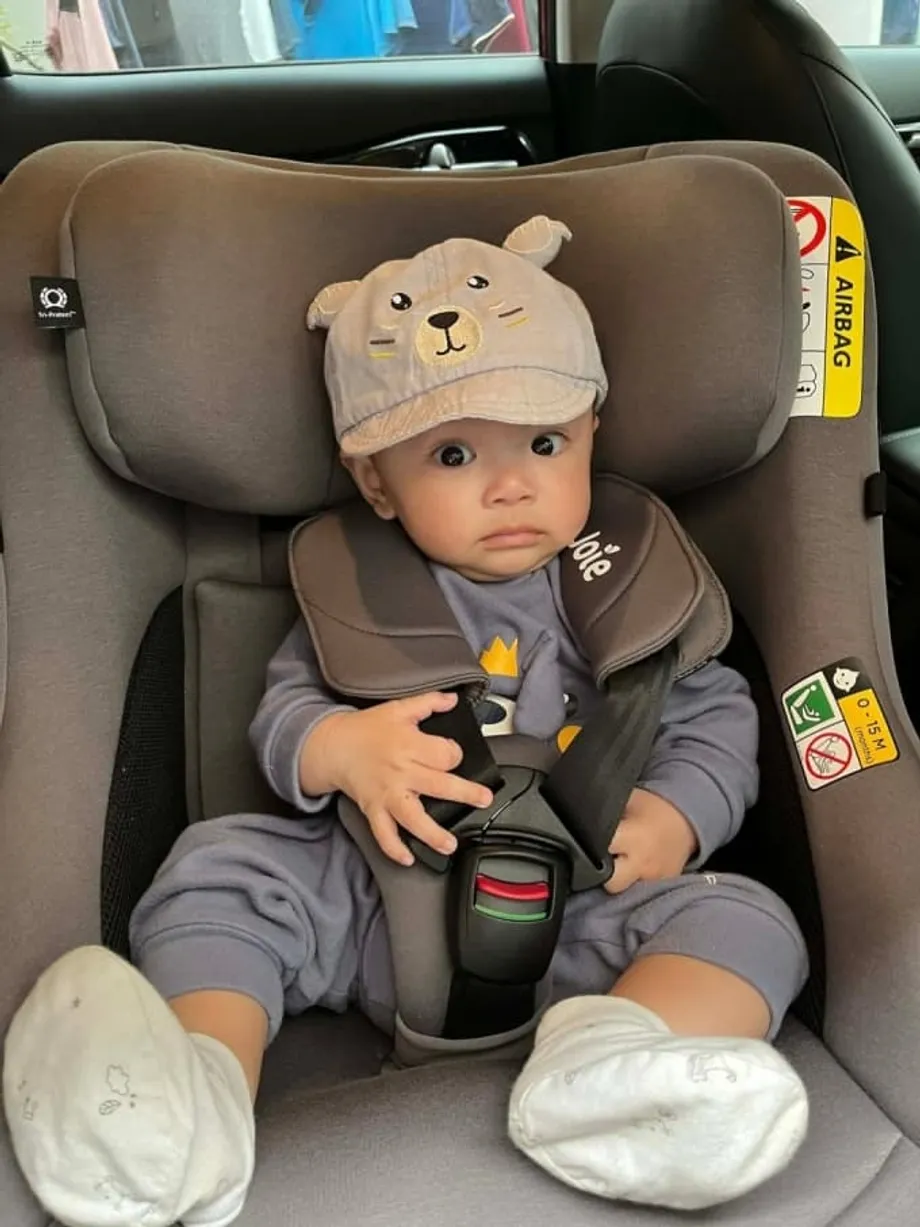
Booster seats raise children who have outgrown a harnessed seat but are still too small for an adult belt to fit correctly. Many boosters are about 10 centimetres thick and relatively narrow. Three can fit across the back of a typical sedan with five seats if each child meets the devices' weight and height requirements. Entry level boosters in Vietnam often cost around 800,000 VND.
Families with three children under four may have greater difficulty fitting three full size seats with harnesses. Once the oldest child can use a booster secured with the car's belt, the arrangement may become easier. For children older than about four who meet booster requirements, trying narrow models in the actual vehicle is a useful preparation step.
Convertible or multifunction seats offer another option. Some begin facing the rear for infants, later face forward with a harness, and eventually work with the vehicle's belt. Depending on the model, multiple headrest positions and shoulder height settings can allow use from infancy to roughly age 10 to 12.
Such seats can save later purchases, but they tend to be wider than simple boosters. Families seeking space for three children may combine one narrow convertible seat with two boosters or look for brands with slim designs. A shop that permits a test fitting, or a return policy allowing a trial installation, can help parents avoid buying equipment that cannot work together in their car.
Choosing a device for the child's size
Vietnam's National Technical Regulation for child safety devices in cars defines a device as equipment that secures a child sitting or lying in a vehicle and is designed to reduce injury during a crash or sudden deceleration. It covers the seat shell or cushion, harnesses, buckles, locking and adjusting parts, and the anchorage system that attaches it to the vehicle.
The equipment must be firmly installable using either the car's seat belt or dedicated anchor points. Devices are grouped by weight rather than age because children grow at different rates. The common groups are:
- Group 0: Infants weighing up to roughly 10 kilograms, often using a carrycot that allows them to lie flat and is positioned facing the rear.
- Group 0+: Infants weighing up to around 13 kilograms, using an infant carrier facing the rear.
- Group I: Children weighing about 9 to 18 kilograms, typically using a seat facing forward with a harness secured at five points.
- Group II: Children weighing about 15 to 25 kilograms, often using a booster with a high back and the vehicle's belt secured at three points.
- Group III: Children weighing roughly 22 to 36 kilograms who remain shorter than 1.35 meters, using a booster cushion without a back.
Parents should measure both height and weight and select a device whose stated limits cover their child. Age gives only a rough guide. Infants and young toddlers should face the rear to reduce stress on the neck and spine, with a move to facing forward only when the child reaches the maximum limits for travel facing the rear in that seat's instructions.
Permanent labels must show weight and height limits, installation direction and safety warnings. The regulation also calls for designs without sharp edges or parts that could wear the harness. A device without proper labels or instructions may fail to meet national standards and leaves parents without essential fitting information.
Installation, anchor points and airbags
ISOFIX and the vehicle's seat belt are the two main ways to install a child restraint. ISOFIX connects the device to metal anchor bars built into the car's rear seats and can reduce installation mistakes. A seat secured with the car's belt is also acceptable when fitted correctly.
Most mass market cars sold in Vietnam over the past few years include ISOFIX points in the rear. Buyers of newer vehicles from popular brands typically find them in models produced from about 2018 onward. Luxury brands often provide additional features, and some include an integrated booster cushion.
Owners may never have noticed the anchors because they sit between the seat base and backrest, sometimes identified by small tags. Checking that area is a useful first step. A vehicle without ISOFIX can still accommodate a suitable restraint installed with its seat belt.
Parents should check for interference from headrests and seat belt buckles during a trial installation. Recessed buckles in some cars make belt routing difficult with certain boosters. Adjustable head support and protection against impacts from the side can improve comfort and safety on longer journeys. A comfortable fit also makes children more willing to use the device consistently.
A seat installed with a belt should be tight and move no more than a couple of centimetres at the belt path when correctly fitted. A device that rocks or slides beyond a small amount needs further adjustment, assistance or replacement with a model that suits the vehicle.
A child seat facing the rear must never be placed in front of an active passenger airbag, because deployment can kill a child. In the rare circumstances where front placement is necessary, the airbag must be deactivated and the vehicle manufacturer's instructions followed exactly. The new rule restricts front placement for children within its age and height thresholds, while the rear remains the safest and simplest position.
Prices, labels and the risks of buying used
Seats with harnesses in the middle of the market often cost 2 million to 3 million VND. Premium imported products can exceed 10 million VND, while boosters and cushions without backs generally cost less. Retailers report sharp increases in searches and orders as the deadline approaches, alongside steep promotional discounts.
The growing selection brings uneven quality and confusing claims. Some products list European standards such as ECE R44/04 or UN R129. Others describe themselves simply as a child safety seat without technical details. Clear certification, instructions and labels stating weight and height limits give parents information they need to assess suitability.
Families making occasional journeys can consider rentals, available in some cities at daily rates. Buying used may also reduce costs, but parents need to check the manufacturing date, history, condition and completeness of the device. A seat that cannot be securely installed in their particular car is not a useful saving.
Used seats are common in social media groups. Plastics deteriorate with age, and many manufacturers specify a service life of around six to eight years. A device that has been in a crash, has cracks or has a frayed harness should not be used. Missing parts, absent labels and unavailable instructions are further reasons for caution.
Parents considering a used seat should confirm that the model's manual is available and ask about its history. Missing labels remove the information needed to check whether the device suits the child and how it should be installed.
Installation clinics and free fitting days, where offered by authorities or retailers, can help families choose and secure equipment. Community groups may also know of demonstration sessions. A lesson lasting about 10 minutes can resolve most installation mistakes and give caregivers confidence before their next trip.
Why taxis need a different practical solution
Taxi and ride hailing drivers face a supply problem that owners of private family cars can plan around more easily. A driver cannot carry a complete range of restraints for every possible child's height and weight. Equipment also needs to fit the particular vehicle and be installed correctly for the journey.
Policymakers suggest starting enforcement with private cars while developing arrangements for commercial vehicles. Possible approaches include ride options that accept seats supplied by parents and training drivers in correct installation. Wider application could follow improvements in equipment supply, education and verification.
Private car owners usually know which children they carry and can choose devices for them. Commercial fleets serve changing passengers, making the choice and installation of suitable equipment a recurring task. A phased approach aims to raise compliance without placing unworkable demands on families or drivers.
Education must reach parents and grandparents
Vietnam's experience with motorcycle helmets shows that behaviour can change quickly when rules, education and social expectations work together. Rear seat belt use and child restraint use remain low in many places, reflecting habits formed when car journeys were less common.
Parents and grandparents may trust their arms to protect a child, while some drivers regard slow city traffic as safe enough without a restraint. Demonstrations of the forces created by sudden braking can help explain the danger. Families also need practical support on choosing a device, fitting it in a small car and using it on every journey.
The World Health Organization has supported the policy change with evidence and guidance, working with ministries and the National Assembly on best practice. Dr. Angela Pratt, WHO's representative in Vietnam, welcomed the law as part of a wider commitment to safer roads:
These law changes are a vote for children's safety and will help realize the promise of safe mobility, especially for young people, in Vietnam.
Civil society road safety programmes have worked on parent behaviour for years. Workshops and school activities teach seat selection and installation. Social media campaigns reach large audiences and challenge beliefs such as the assumption that an adult belt alone is suitable for a small child in the rear.
Authorities can support those efforts through consistent enforcement and visible checkpoints, starting with warnings and minor penalties before expanding their approach. Experts in Vietnam suggest a buffer of three to five years, accompanied by public education and free installation centres in major cities. Beginning with private vehicles and developing standards for commercial fleets later could reduce disruption.
Vietnam's framework brings it into line with almost 100 countries that already require child restraints in private vehicles. Europe, North America and parts of Asia use rules tied to height and weight, backed by penalties. Decades of international experience show that mandates, education and enforcement can increase use, with practical support helping families turn requirements into routine behaviour.
Building safer habits before the deadline
Families can begin using suitable restraints before January 2026. Measuring children, checking anchor points and testing devices together in the back seat can reveal problems while there is still time to choose another model or arrangement.
Caregivers should make fastening the restraint part of every trip. Viet's experience shows how a child who initially resisted can become comfortable enough to climb into the seat independently. Consistent expectations help children adjust, while a suitable fit reduces discomfort and complaints.
For families such as Tung's, the biggest challenge is combining the right equipment with the space they already have. Compact boosters may help when children meet their requirements; younger children still need devices matched to their size. Trial installations and practical advice can prevent costly purchases that leave the family's transport problem unresolved.
Vietnam's safety goal rests on a simple mechanism: a correctly fitted device holds the child securely and manages the forces of a sudden stop better than an adult's arms or an adult belt alone. Clear information, affordable choices and help with installation will determine how readily families can make that protection part of everyday travel.
Key Points
- From January 1, 2026, children both under 10 and shorter than 1.35 meters must sit away from the driver's row and use a suitable restraint in most passenger cars.
- Vehicles with only one row of seats are excepted. Drivers are responsible for installation and instructions.
- A draft decree proposes fines of 800,000 to 1,000,000 VND and possible driving licence point deductions.
- WHO says child restraints can reduce infant fatality risk by up to 71 percent. Slow traffic still carries danger during sudden stops.
- Infant carriers, harnessed seats and boosters must match the child's size and fit securely in the vehicle.
- Three restraints may not fit across a sedan's rear bench. Suitable narrow boosters can help some families.
- Entry level boosters often cost around 800,000 VND; seats with harnesses in the middle of the market commonly cost 2 million to 3 million VND.
- ISOFIX is common in newer cars. Correct installation with the vehicle's seat belt is also acceptable.
- Labels, instructions, condition and crash history matter when choosing equipment, especially used seats.
- Education, fitting assistance and a suggested phased enforcement approach aim to help families and commercial fleets adapt.