A factory base Beijing wants to protect
China is preparing to protect the place of manufacturing in its economy as it shapes its development plan for 2026 to 2030. The country has been the world's largest manufacturer for 15 consecutive years, and manufacturing generated about 33.55 trillion yuan in 2024, equivalent to 24.86 percent of gross domestic product.
Contents
- A factory base Beijing wants to protect
- What the next plan prioritizes
- Preserving manufacturing is an existing commitment
- The numbers behind China's industrial strength
- Industrial clusters keep suppliers close
- How AI will enter the factory floor
- Fiscal support and a unified national market
- More capacity can squeeze profits
- Supply chain security meets foreign resistance
- Productivity, cleaner production and household incomes
- The decisions still to come
- The Bottom Line
Beijing wants to preserve that industrial strength while making factories more advanced and reducing dependence on foreign technology. The Communist Party's Central Committee has outlined a modern industrial system centered on advanced manufacturing, stronger supply chains and breakthroughs in core technologies. It calls for manufacturing to retain a reasonable share of the economy, without setting a numerical target.
The choice reaches beyond factory output. Manufacturing supports jobs, innovation, exports and tax revenue. For a country with a large population that is still developing, China's leaders see a broad factory network, from heavy equipment to precision components, as a foundation for economic resilience and national strength.
As economies become richer, manufacturing usually rises to a peak as a share of output and then declines. Beijing wants to manage that change while moving companies toward more complex and valuable products. Its concern is industrial hollowing out, when a country loses production capacity, suppliers and the skills needed to make goods.
An official guide interpreting priorities for the next plan, published in a book released by the Communist Party leadership, warns that rebuilding such capacity can be difficult. The authors explain why they want China to avoid losing it in the first place:
"In recent years, some advanced economies have attempted to revive their manufacturing sectors after deindustrialisation, but it has proven to be extremely difficult," the authors wrote.
As of November 8, 2025, the policy direction was clearer than the detailed targets. The next task was to turn the broad commitment into decisions about investment, technology, demand and which industries should expand.
What the next plan prioritizes
The 2026 to 2030 framework puts production quality, secure supplies of essential inputs and greater technological self reliance at the center of industrial policy. Self reliance means building more of the knowledge, equipment and components China needs within its own economy, especially where foreign suppliers control critical technologies.
Trade tensions with major partners, tighter restrictions on advanced technologies and national security concerns have strengthened Beijing's argument for keeping a large, capable factory base. A disruption to a small but essential component can affect an entire production chain, making access to key inputs a practical concern for manufacturers.
China intends to strengthen its competitive positions in clean energy, electric vehicles, batteries and industrial machinery. Traditional industries, including steel, chemicals and textiles, are also part of the strategy. Automation and digital tools are expected to help those sectors improve quality and productivity.
The leadership also calls for stronger domestic demand and higher living standards. Production and investment nevertheless remain the main engine of the framework. The challenge is to make factories more innovative and better able to withstand disruptions while ensuring that households have the income and confidence to buy more of what those factories produce.
Preserving manufacturing is an existing commitment
China's effort to maintain manufacturing's economic share continues an established policy rather than starting a new one. Recent campaigns have sought to produce core inputs domestically, expand advanced equipment manufacturing and reduce reliance on foreign suppliers for critical parts.
Dong Yu, executive vice president of the China Institute for Development Planning at Tsinghua University, said the requirement to preserve manufacturing's share was already part of the current planning framework:
"The 14th five year plan already has such a requirement," Dong said.
The next plan connects that longstanding commitment more closely with national security and prosperity over the longer term. Keeping industrial capacity does not mean keeping production unchanged. Beijing wants factories to make more complex goods, improve quality control and establish important technologies at home.
Advanced economies trying to rebuild manufacturing have faced high costs, shortages of skilled workers and supply chains that have become fragmented. China seeks to avoid those difficulties by retaining its industrial scale while investing more heavily in innovation.
Economists inside and outside China have also urged a stronger shift toward household consumption to address imbalances in the economy. Leaders acknowledge that need, but their framework continues to put manufacturing at the center while developing domestic demand over time. Balancing those priorities will be a major test during the next planning period.
The numbers behind China's industrial strength
Manufacturing represented roughly a quarter of China's economy in 2024, about 24.9 percent when rounded. China accounted for about 30 percent of manufacturing value added worldwide and was the only economy covering every industrial category in the United Nations classification system.
Value added measures the value created during production, rather than counting the full selling price of a product at every stage. It helps show how much manufacturing contributes to the economy without repeatedly counting the same materials as they pass between suppliers and factories.
China's factory sector is also deeply connected to overseas markets. Manufactured goods represented more than 90 percent of total exports in 2024. Manufacturing received more than a quarter of total foreign direct investment that year, reflecting continuing interest in Chinese supply chains, skilled workers and infrastructure.
Production growth remained solid through 2024 and into 2025, although momentum varied between industries. Monthly growth in manufacturing value added during 2025 ranged roughly from 5.7 percent to 7.9 percent. Surveys of purchasing managers hovered around the 50 percent line that separates expansion from contraction.
Purchasing manager surveys track conditions reported by businesses, such as orders and production. Their uneven readings show why a large sector can keep growing while individual industries or companies experience weaker demand.
Fixed asset investment in manufacturing, spending on assets such as factories and equipment, continued to rise. Growth rates during 2024 and 2025 were typically in the middle single digits to the lower double digits, pointing to continued investment in capacity and production upgrades.
Industrial clusters keep suppliers close
More than 2,000 industrial clusters underpin China's manufacturing network. They are spread across eastern and central provinces, with new clusters emerging in western and northern regions. These concentrations bring factories, suppliers and related services close together.
Labor and land costs have risen in many cities. Companies nevertheless continue to invest because proximity to suppliers, ports and large domestic markets can make production and delivery easier. Tax preferences and support for research and development also influence those decisions.
China's industrial breadth extends across machinery, electronics and materials. Jin Zhuanglong, a prominent Chinese engineer, described the scale of production in public remarks:
"Among 500 major industrial products, China ranks first globally in the production of more than 220," Jin said.
The next plan seeks to preserve this extensive network while improving what it produces. Scale gives manufacturers access to a broad supplier base; better technology and quality control can help them make goods that command more value and are harder to replace.
How AI will enter the factory floor
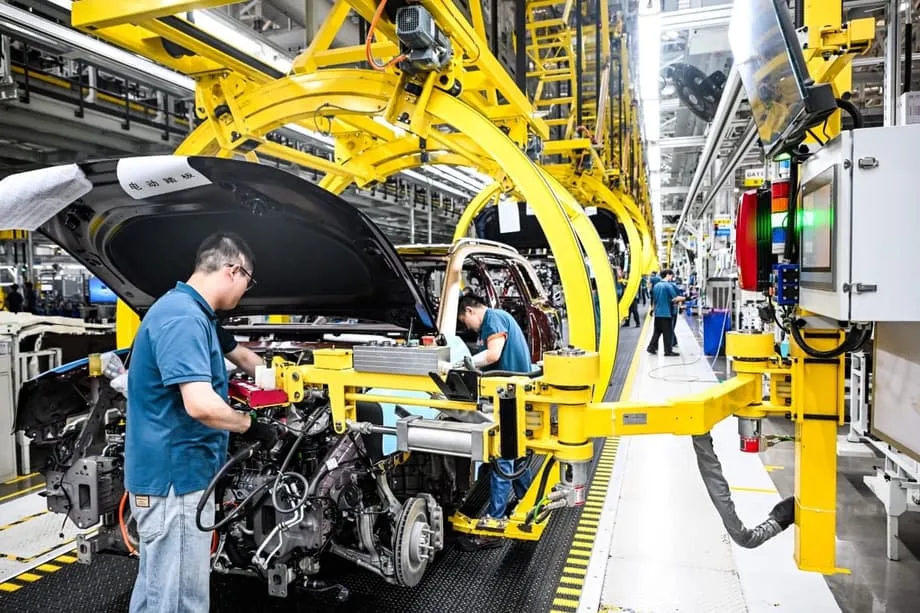
The Ministry of Industry and Information Technology is preparing a comprehensive AI plus manufacturing program to bring artificial intelligence into key production processes. The goals are higher quality, lower costs and better energy efficiency.
Factories can use machine vision to inspect products, predictive analytics to anticipate maintenance needs and industrial software to organize production. These tools use data to help equipment and workers make decisions about workflows, repairs and quality checks.
China's authorities point to an AI ecosystem containing thousands of firms and a growing group of specialized small and medium enterprises using these technologies. The broader strategy also calls for more research funding, closer connections between universities and industry, and faster deployment of digital tools across factories.
Li Lecheng, minister of industry and information technology, described how the government intends to guide companies adopting AI:
We will establish a comprehensive policy framework to support the application of AI, including implementation guidelines for the AI plus Manufacturing plan," Li said. "These policies will address intelligent transformation in key industries and critical processes, supported by an AI application guide for manufacturing enterprises.
The policy combines two goals: developing domestic capabilities in strategic technologies and increasing productivity throughout the factory base. Productivity means producing more, or producing better goods, with the resources available. Smaller manufacturers are part of that effort alongside companies developing advanced equipment.
Fiscal support and a unified national market
The Ministry of Finance has pledged to direct more resources toward breakthroughs in core technologies, upgrades to traditional industries and digital improvements at smaller companies. The aim is to reward innovation and reduce bureaucratic obstacles.
In a report on fiscal policy execution, the ministry set out its commitment to industrial innovation, more efficient use of science and technology funds, and equal treatment for businesses:
China will direct more fiscal resources towards industrial innovation, pursue breakthroughs in core technologies, and promote the transformation and upgrading of the manufacturing sector," the ministry said. "Support for the digital transformation of small and medium sized enterprises will be increased, and a unified national market will be advanced to ensure equal treatment in fiscal subsidies and government procurement.
A unified national market is intended to reduce fragmentation so that efficient firms can grow across regional boundaries. Equal treatment in subsidies and government purchasing is part of that effort. Public spending can then support industrial development without giving different businesses uneven access to opportunities.
The new framework also carries forward ambitions from Made in China 2025, launched a decade earlier. That strategy targeted stronger domestic suppliers in information technology, robotics, aerospace, rail equipment, medical devices and vehicles designed to save energy.
Officials increasingly describe the updated approach as new quality productive forces. The phrase refers to combining fundamental scientific progress with practical industrial applications and advanced manufacturing. The next plan inherits the earlier industrial ambition while updating the policy tools used to pursue it.
More capacity can squeeze profits
Autos, solar products, batteries and some metals have shown the pressures that arise when many companies expand in the same promising industries. When production capacity grows quickly, competition can push prices down faster than costs fall.
Price wars reduce profit margins, including those of market leaders. Thin profits can discourage private investment and put pressure on corporate finances. Low prices also spread through international markets, increasing friction with trading partners that regard Chinese goods as underpriced.
Overcapacity means factories can produce more than buyers are willing or able to purchase at sustainable prices. Building additional capacity can therefore support output while making it harder for businesses to earn enough to repay debt and fund their next investment.
China's prolonged property downturn has weakened domestic demand and local government finances. Economists have warned that debt levels, roughly three times the size of the economy by some estimates, combined with low inflation can make reducing debt more difficult. When prices and revenues grow slowly, borrowers have less room to manage what they owe.
Banks could come under pressure if weak profits leave large numbers of manufacturers struggling to repay loans. Policymakers have tried to prevent abrupt layoffs and factory closures because those would damage incomes and social stability. Continued support for unproductive companies, however, can slow the movement of capital toward more dynamic businesses.
The government must balance employment and industrial scale against the need for companies to restructure, merge or close when their business models fail. Too much subsidized capacity adds price pressure; too little investment risks China falling behind in technology.
Supply chain security meets foreign resistance
China has built strong positions in rare earths, components used in pharmaceuticals and parts of the clean energy supply chain. Control over essential inputs gives Beijing bargaining power in disputes, while prompting closer foreign scrutiny and efforts to find alternative suppliers.
The United States and Europe have launched efforts to rebuild industrial production, offered subsidies for domestic manufacturing and tightened screening of sensitive technologies. China faces this changing external environment while seeking to make its own production network more secure.
Chinese officials describe a comprehensive industrial system as protection against outside pressure. They point to progress in equipment manufacturing and chips of intermediate sophistication, while acknowledging dependence on the most advanced semiconductors.
The next plan's focus on bottleneck technologies addresses those remaining gaps. A bottleneck is a part of the production process where limited access to technology or supplies can hold up everything else. Beijing wants domestic suppliers to provide more core components and improve quality across complex systems, including aerospace, autos and power equipment.
External analysts have noted reduced Chinese reliance on imports in many supply chains, changing the balance of bargaining power in trade disputes. Foreign technology still dominates some areas. Export growth can help offset weak domestic demand, but higher tariffs and tighter trade rules can restrict that outlet when partners see Chinese capacity as a threat to their industries.
Productivity, cleaner production and household incomes
Beijing's measure of success extends beyond producing larger quantities of goods. Upgraded factories are intended to deliver higher productivity, more secure supply chains and better paid jobs. Vocational education, stronger links between research laboratories and production lines, and digital management in smaller firms are part of that effort.
Steel, cement and chemicals also face pressure to improve environmental performance. Cleaner production and lower energy intensity, meaning less energy used for a given amount of output, are important parts of industrial upgrading.
Higher productivity can allow wages to rise without weakening competitiveness. Authorities have discussed stronger social insurance, making benefits easier for migrant workers to carry between jobs and places, and policies that reduce the need for households to save against future uncertainty.
Stronger household consumption would help absorb more valuable domestic production and reduce reliance on unpredictable overseas demand. Private companies also need confidence that they can earn reasonable profits, because their investment drives innovation and employment in many industrial clusters.
Fiscal and regulatory decisions will shape how resources move between businesses. A unified market and equal access to procurement can help efficient firms expand, while market signals need to guide exits where production is no longer viable. Protecting manufacturing's economic share alone offers no guarantee of faster growth; productivity and stronger incomes remain central goals.
The decisions still to come
The next plan was expected to gain more detailed targets and policies in the months after November 8, 2025. A catalog of social and economic goals was expected in the spring, although no exact release date was given.
The policy sequence provides a short timeline of how the strategy has developed:
- A decade before 2025: Made in China 2025 launched with priorities including robotics, aerospace, information technology and stronger domestic suppliers.
- The 14th five year plan: Preserving manufacturing's share of the economy was already a stated requirement.
- 2024: Manufacturing generated roughly 33.55 trillion yuan, accounting for 24.86 percent of GDP.
- November 8, 2025: The direction for the next plan centered on advanced manufacturing, technological self reliance and supply chain security.
- The coming spring: A catalog of social and economic goals was expected.
- 2026 to 2030: The next planning period would put the updated industrial strategy into practice.
Decisions to watch include funding and rules for public research, procurement preferences for advanced domestic equipment, and incentives for digital upgrades across supply chains. They will show how Beijing balances technology investment with measures to increase household demand.
Industries requiring large amounts of capital present another choice: consolidation and market exits to address excess capacity, or continued support to preserve employment and scale. Trade diplomacy will run alongside those domestic decisions, influencing how easily new production can reach overseas buyers and how many barriers Chinese firms face.
The central task for the next five years is to turn a large industrial base into a more productive one while strengthening incomes and limiting renewed financial stress. That requires coordination between industrial targets, market demand, fiscal support and the willingness to let uncompetitive firms change course.
The Bottom Line
- China wants to preserve a reasonable manufacturing share of GDP in its 2026 to 2030 plan, without a stated numerical target.
- Manufacturing contributed 33.55 trillion yuan in 2024, or 24.86 percent of GDP, and China accounted for about 30 percent of global manufacturing value added.
- Advanced manufacturing, domestic technology capabilities and secure supply chains are central priorities.
- The industry ministry is preparing AI plus manufacturing guidelines, while the finance ministry promises support for innovation and digital upgrades at smaller firms.
- Overcapacity, price wars, weak demand, debt and foreign trade barriers threaten factory profitability.
- Higher productivity, cleaner production, better wages and stronger household consumption are intended outcomes.
- Further targets and policies were expected in the months ahead, with a catalog of social and economic goals anticipated in the spring.