Two seats, two tons and a new market above the streets
A passenger aircraft with two seats and a range of about 30 kilometers, a cargo drone capable of carrying nearly two tons, and a flight across the sea covering 52 kilometers in about 20 minutes show how China is putting its low altitude economy into practice. As of October 29, 2025, delivery services, sightseeing flights and aircraft tests are advancing alongside a race to build the rules and infrastructure they need.
Contents
- Two seats, two tons and a new market above the streets
- What belongs in the low altitude economy?
- How large could the market become?
- Who decides where aircraft can fly?
- Guangdong puts routes and landing sites to work
- Cargo offers the clearest early business
- Safety depends on aircraft and operating limits
- China's strengths and its technology constraints
- A crowded sky needs shared digital rules
- Other markets and Southeast Asian partnerships
- What will make the services affordable?
- What to Know
China is treating commercial activity in airspace below roughly 1,000 meters as a new engine for growth. National planners see opportunities ranging from medicine and parcel deliveries to tourist flights above riverfronts. The ambition reaches beyond individual aircraft: it requires landing sites, reliable communications, traffic management and a system for deciding who can fly where.
Guangdong province, particularly Shenzhen, Guangzhou and Zhuhai, is leading much of the early work. Local governments are mapping routes, building small landing sites and inviting companies to test services. EHang and its partners have received key approvals for limited commercial passenger routes focused on sightseeing, while cargo operators are expanding trials in logistics, agriculture and emergency response.
Progress varies by region and aircraft type. A delivery drone operating along a selected corridor faces different practical demands from an aircraft carrying passengers across a city. Cargo and tourism are therefore setting the pace while larger ambitions for routine urban air taxis depend on further testing, certification and public confidence.
China also sees a chance to strengthen its position in batteries, sensors and avionics, the electronic systems used in aircraft. Successful services could ease pressure on crowded roads, reduce the cost of reaching remote communities and help shape global standards for managing thousands of small aircraft above cities.
What belongs in the low altitude economy?
The low altitude economy covers much more than flying taxis. It includes drones delivering goods bought online, spraying crops, inspecting power lines, making maps, patrolling coastlines and pipelines, and transporting medical supplies. Sightseeing and short passenger journeys in small electric aircraft are further parts of the same market.
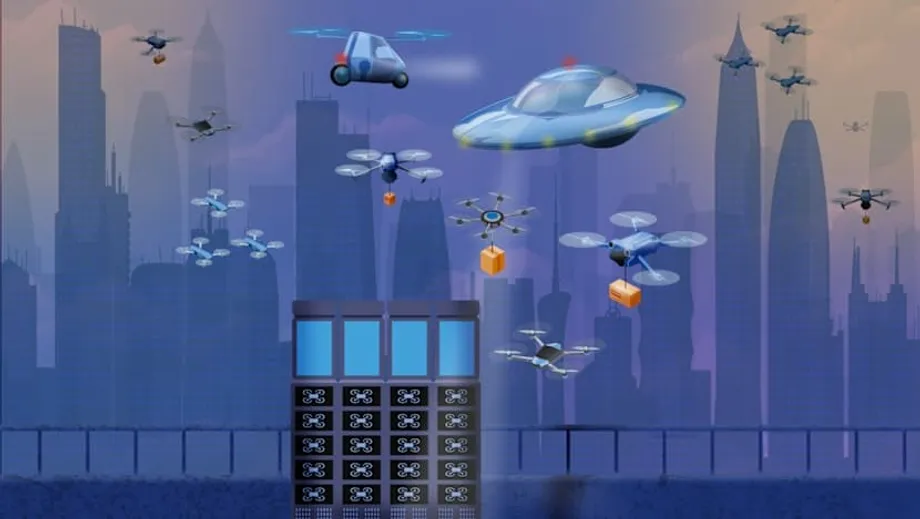
Airspace close to the ground becomes commercially useful only when aircraft can share it safely. Location services, secure data links and traffic management software are therefore as much a part of the sector as motors and batteries. They help operators know where aircraft are, communicate with them and coordinate their movements.
Drones are usually small aircraft without people on board, carrying cameras or light cargo. Electric vertical takeoff and landing aircraft, commonly called eVTOL, are larger. They use multiple electric motors and propellers to rise vertically like a helicopter, with designs that then use wings during forward flight to save energy.
Most early eVTOL models are intended for one or two passengers on journeys of 10 to 30 kilometers. Their appeal is a direct trip across a congested city, with lower noise than helicopters and no tailpipe emissions. Short routes remain the immediate focus because aircraft range, landing locations and operating procedures must work together.
EHang's EH216 S illustrates that approach. The fully electric aircraft has two seats, a top speed near 130 kilometers per hour and a range of around 30 kilometers. Those specifications suit rides lasting a few minutes along designated paths rather than long journeys.
How large could the market become?
Beijing has made the low altitude economy a national priority. The Civil Aviation Administration of China (CAAC) and economic planners project industry value of about 1.5 trillion yuan in the near term, rising toward roughly 3.5 trillion yuan by 2035. Other estimates put the sector near 2 trillion yuan by 2030.
An industry report estimated the market at around 506 billion yuan in 2023, with annual growth in double digits. The projections describe different future periods, while the 2023 figure provides a measure of the market before the expansion now being pursued.
The figures and publication date give readers a useful timeline:
- 2023: An industry report put market value near 506 billion yuan, with annual growth in double digits.
- October 29, 2025: Cargo services, passenger sightseeing approvals and local infrastructure programs form the current stage of development.
- 2030: Some estimates place the sector near 2 trillion yuan.
- 2035: CAAC and economic planners see industry value reaching roughly 3.5 trillion yuan.
Moving from 506 billion yuan to 1.5 trillion yuan would mean a market almost three times as large. The business opportunity depends on aircraft becoming useful in regular operations, with enough demand and dependable services to support continued investment.
Who decides where aircraft can fly?
A dedicated government unit has been created to coordinate policy across agencies and with the military, which controls much of China's airspace. Its goals include unifying supervision, simplifying approvals and building shared systems for traffic management and safety oversight.
China's airspace involves military, civil aviation and local authorities. That division creates complicated approval paths and differences in enforcement. A unified framework is being developed to move from individual permits toward standard procedures for approving routes, operating aircraft without pilots on board and maintaining those aircraft.
Provinces are building networks of landing pads and service points. Hunan has verified dozens of fixed routes for local low altitude flights. Pilot cities including Shenzhen, Hefei, Suzhou, Hangzhou, Chengdu and Chongqing are opening portions of airspace below 600 meters to controlled civilian use.
Aircraft approval is another part of the work. Hou Xiaoyu, deputy director of the system certification department at the CAAC Airworthiness Certification Center, said the approval process is being updated to address new technologies and safety challenges. Certification is the process through which aviation authorities assess whether an aircraft or operation meets the requirements for its intended use.
Local access to airspace, aircraft certification and operating permissions all have to align. A company needs an approved aircraft, a suitable route and procedures that allow it to run that service reliably. The creation of shared rules is intended to make those steps more predictable as activity grows.
Guangdong puts routes and landing sites to work
Shenzhen has opened large areas of low altitude airspace, created test corridors and offered incentives for certified passenger eVTOL operations. Guangzhou and Zhuhai are developing tourism services and short transfers using both piloted helicopters and autonomous aircraft.
AutoFlight completed a flight of 52 kilometers across the sea between Shenzhen and Zhuhai in about 20 minutes, a fraction of the time required by road. EHang is conducting trial sightseeing rides in Guangzhou and Hefei. These activities show how short routes and specific destinations are shaping early passenger applications.
A helicopter service linking Kunshan and Shanghai's Pudong Airport covers 100 kilometers in about 20 minutes, reducing a journey that can take several hours. Its prices are aimed at business travelers. Alongside electric aircraft trials, such services show the commercial appeal of avoiding a lengthy road trip.
Local governments elsewhere are putting simple landing pads near parks, stadiums and transit hubs to establish an initial network. The choice of location matters: a short flight becomes more convenient when passengers can reach the departure point easily and continue their journey after landing.
Yue Tingting, vice president at electric air taxi developer Vertaxi, said the opportunity is large, while routine public services depend on mature airspace management, infrastructure, laws and scheduling systems. She described China's market potential:
We believe China has the potential to become one of the largest and most dynamic markets in this sector globally.
Cargo offers the clearest early business
Meituan says its drones have opened dozens of delivery routes in major cities and handled hundreds of thousands of orders. Logistics companies are also operating regular deliveries on selected routes, including shipments of fresh produce from Hainan to Guangdong.
Larger cargo aircraft are advancing through tests. Engineers recently flew a drone with two engines and a payload near two tons for about 20 minutes in Sichuan. The leading state aerospace group has flown a model capable of carrying 700 kilograms over a range exceeding 500 kilometers and is planning a larger platform carrying two tons.
Cargo operations offer a different risk profile from passenger flights. Aircraft can follow fixed corridors over water or industrial zones, and deliveries have readily identifiable uses: urgent supplies, remote communities and emergency response. Operators can develop procedures and collect performance data through those services.
Several companies have shifted resources from early visions of urban air taxis toward revenue from delivery, industrial inspection and low altitude tourism. Certification for heavier passenger models continues while these applications offer opportunities to earn money sooner.
China's cargo activity ranges from light parcels in cities to much heavier loads over longer distances. Each requires aircraft and operating arrangements suited to the job. The common commercial aim is to move something valuable more quickly or reach a place that is difficult to serve by road.
Safety depends on aircraft and operating limits
Passenger aircraft designs use multiple layers of protection. Redundant batteries and flight control systems provide backups, while multiple motors are intended to allow the aircraft to tolerate a failure. Parachutes or autorotation options are included where applicable. Autorotation allows a suitable rotor system to turn in the airflow during descent.
Operators are also planning controlled routes, strict weather limits and supervised takeoffs and landings. These operating restrictions matter alongside the aircraft's engineering because reliable service depends on managing the conditions in which it flies.
Early services prioritize fixed routes, robust software and failsafe behavior, meaning planned responses when something goes wrong. Cargo and sightseeing flights provide operating data that companies can use to refine procedures before attempting a larger network. Recent incidents involving drone operations have reinforced the need for caution and clear rules for avoiding other aircraft and obstacles.
Wang Huailin, an engineer at Aerofugia, said consumer access would develop in stages as aircraft, vertiports and traffic systems come together. Vertiports are sites where aircraft that take off vertically can land, depart and receive services. Wang gave this estimate:
Flying taxis could be widely available to the public within five years.
Wang's estimate accompanies a gradual rollout. No firm date for nationwide passenger availability was given. Aircraft approvals, landing infrastructure and traffic coordination remain central to making routine services possible.
China's strengths and its technology constraints
China has strengths in batteries, electric motors and manufacturing at scale. It has also developed its own satellite navigation system, Beidou. Policymakers point to the domestically developed C919 jetliner as evidence that complex aviation programs can mature within the country.
The most advanced passenger aircraft still depend on some imported chips, sensors and flight processors. Those dependencies can raise costs and slow certification. Flight processors handle information used to control an aircraft, while sensors provide measurements needed to understand its position and surroundings.
Automated urban flights require these components to work together dependably. Batteries and motors provide power and movement; navigation, sensors, software and communications help the aircraft follow its route. Developing that complete system takes time and operating data.
DJI dominates the consumer drone market, while EHang, AutoFlight, Aerofugia, Vertaxi and Xpeng's aviation unit are developing passenger models. Industry groups say Chinese entities hold a large share of global patents related to drones. Domestic demand, subsidies and public sector applications help finance early fleets.
Those advantages support expansion across several types of aircraft. Companies are also seeking growth and certification experience outside China, adding overseas operating knowledge to the lessons collected through domestic services.
A crowded sky needs shared digital rules
Provinces are establishing control centers to monitor flights and share data. National systems for aircraft registration and remote identification are also taking shape. Remote identification allows an aircraft to communicate identifying information so that its activity can be monitored.
Traffic management for small aircraft will rely on digital systems. Each aircraft will broadcast its identity and position. Geofencing, a virtual boundary built into software, will help keep drones outside sensitive areas. Software will assign altitude layers or time slots along busy routes so that aircraft movements can be coordinated.
The approach resembles Europe's U space concept for managing drone activity. China will need common interfaces so aircraft from different manufacturers can connect to the same network and operate under the supervision of certified operators.
Ground crews, maintenance providers and emergency responders will also need training and licensing. A growing network requires people who can prepare aircraft, keep them serviceable and respond when a flight encounters trouble. Digital coordination and qualified staff are complementary parts of that system.
Other markets and Southeast Asian partnerships
The United States is progressing through staged certification for eVTOL manufacturers and trials of drone deliveries beyond the operator's visual line of sight. Europe is developing U space corridors and common safety cases, the evidence and reasoning used to show that an operation can be conducted safely.
Dubai is showcasing aerial mobility through public demonstrations and plans for early airport transfers. Japan has focused on industrial drone use and is preparing passenger trials around major events. Across these markets, the shared goal is to expand activity safely within airspace used by others.
Chinese manufacturers and service operators are courting Southeast Asia as a testing ground. Its thousands of islands, long coastlines and congested cities create potential uses for medical deliveries, coastal monitoring and precision agriculture, where drones help target work to particular parts of a field.
Governments in the region are experimenting with regulatory sandboxes, controlled arrangements for testing services under defined rules. Local startups are partnering with Chinese suppliers for aircraft, batteries and software. Flight data and training gained abroad can help companies refine their products at home.
ASEAN partnerships also involve traffic management, licensing and data security. Shared projects can help systems work together from an early stage. Regional adoption then supports demand for motors, avionics and composite structures, reinforcing the supply chain behind the aircraft.
For investors and city planners, activity across borders provides further evidence of commercial potential beyond demonstrations. Policymakers also face privacy concerns and changes to jobs as adoption spreads. Public engagement and programs to help workers gain new skills will matter alongside technical development.
What will make the services affordable?
Tourism routes are expected to come first, followed by airport shuttles and short urban connections. The economics depend on how frequently an aircraft flies, the cost of energy and the maintenance time required between missions. An aircraft that spends too much time waiting or being serviced has fewer opportunities to earn revenue.
Industry engineers expect fares in the near term to exceed premium ride hailing prices. Their longer term targets approach the cost of car journeys as fleets grow and operations become routine. Better batteries are expected to increase range, although short routes that have been mapped carefully will dominate the early years.
Cities are planning small landing pads on rooftops or near transit lines, supported by charging equipment or battery swapping. Scheduling systems will need to coordinate hundreds of short flights. Security and noise rules must also protect neighborhoods around operating sites.
Local governments often support operators through subsidies or guaranteed demand for public safety missions and medical logistics. That support helps companies work toward covering their costs. Analysts caution that excessive competition or too much infrastructure could damage the sector, making careful pacing and clear rules essential.
China's immediate opportunity lies in matching particular aircraft to useful routes, whether carrying a parcel, medical supplies or sightseeing passengers. Wider access to air taxis depends on the same foundations already being tested: dependable aircraft, convenient landing sites, coordinated airspace and services that people trust and can afford.
What to Know
- China is prioritizing commercial activity below roughly 1,000 meters, including deliveries, inspections, tourism and short passenger flights.
- A 2023 industry estimate put market value near 506 billion yuan; projections reach about 1.5 trillion yuan in the near term and 3.5 trillion yuan by 2035.
- Guangdong leads early development, with Shenzhen, Guangzhou and Zhuhai opening routes and building infrastructure.
- EHang and its partners have key approvals for limited autonomous passenger operations focused on sightseeing.
- Cargo services are expanding alongside tests of drones able to carry nearly two tons.
- Regulators are working to coordinate military, civil aviation and local oversight and build shared digital traffic systems.
- Early operations use fixed routes, strict weather limits and supervised takeoffs and landings.
- Southeast Asian partnerships offer operating experience and opportunities to develop compatible standards.
- Costs, imported components, infrastructure, privacy, workforce changes and public trust remain practical challenges.