A working GPU and a 5% throughput claim
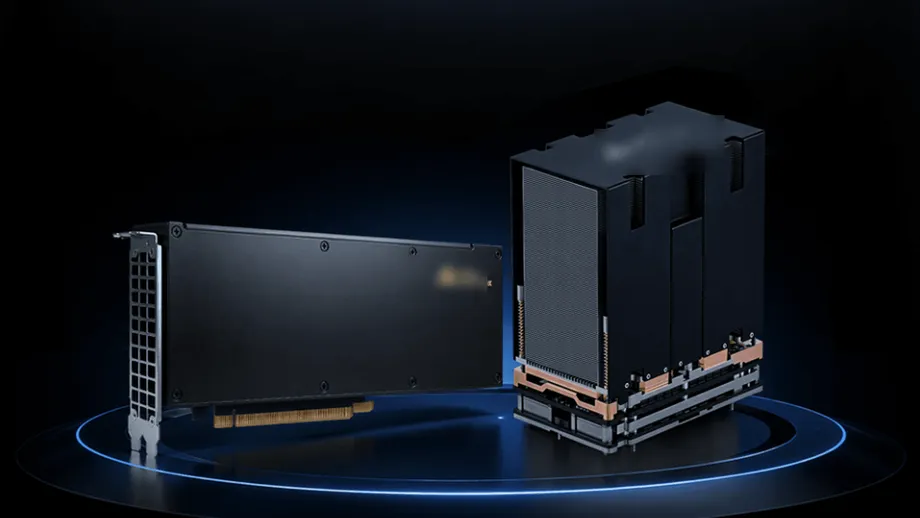
Iluvatar CoreX has publicly demonstrated its Tiangai 300 graphics processor in Shanghai, presenting a Chinese alternative to Nvidia's H200 with a claimed 5% advantage in a third party inference test. At its October 28, 2026, media open day, the company also showed an eight GPU training system and described a rack containing 144 GPUs and 18 CPUs.
Contents
- A working GPU and a 5% throughput claim
- What the H200 comparison measures
- Long documents and faster first responses
- Training results use a different Nvidia reference
- From July launch to October demonstration
- A rack built around 144 GPUs
- Sharing AI work across different chips
- Software claims target deployment time
- TY1200 extends the pitch to robots
- Key Points
The headline comparison comes from testing that Shanghai Electric Group completed in July, according to Iluvatar CoreX. In a deployment that separated two stages of large language model processing, the Tiangai 300 achieved end to end throughput equivalent to 1.05 times that of an H200 after the results were converted to a figure per card.
Throughput means how much useful work a system completes in a given time. For a chatbot, that can mean how many pieces of text it generates each second. A result of 1.05 times the reference performance means 5% more output under the conditions of that test.
The company described Tiangai 300 as the first Chinese general purpose GPU to reach H200 performance in measured testing. Its October demonstration extended the comparison to language models, image generation and video generation, while a separate training demonstration used Nvidia's H100 as the reference.
The event brought together more than a chip specification. Iluvatar CoreX presented cards, servers, a dense rack design, software tools and a method of sharing AI work between different processor types. Its commercial pitch is that these pieces can produce useful AI output more cheaply and with less waiting.
What the H200 comparison measures
Shanghai Electric Group's July test used prefill and decode separation, often shortened to PD separation. Prefill is the stage when a language model reads a user's request and its supporting material. Decode is the stage when it generates an answer, one token at a time. Tokens are the small pieces into which AI systems divide text.
Separating those stages lets a system assign resources differently to reading and writing. The Tiangai 300 result therefore concerns a particular deployment arrangement, with total performance expressed as an equivalent figure for one card.
Iluvatar CoreX had not published the detailed test method, model list or workload conditions behind the headline third party result. Those details, together with the conversion calculation and software settings, are needed for independent reproduction. The cost comparison also lacks a published breakdown, while the memory figures for individual cards and the complete rack need clarification.
The performance laboratory's named demonstrations provide a more detailed picture of the company's claims. They describe different improvements for different tasks, from a small gain in multimedia generation to a larger increase in recommendation throughput. For a buyer, the relevant comparison is the task their own service actually runs.
Long documents and faster first responses
Tiangai 300's attention performance reached 1.05 times H200 performance at a context length of 64K, according to the company's laboratory. Attention is the process that helps a model work out which parts of its input matter to one another. A context length of 64K means the model is handling roughly 64,000 tokens.
On GLM-5.3 at the same context scale, Iluvatar CoreX claimed throughput of 1.15 times H200 performance while maintaining an equivalent user experience. That is a 15% increase for the mixture of experts workload tested. A mixture of experts model directs work to selected specialist networks rather than using every network for every token.
For AI agent workloads with contexts ranging from 8K to 128K, the company reported a reduction of about 10% to 30% in the wait for the first output token. That measure matters to someone waiting for an assistant to begin answering after it has read a long document or processed a complicated request.
Image and video generation formed another part of the demonstration. The company reported an increase of about 2% to 5% in multimodal generation throughput compared with H200. In online search, advertising and recommendation workloads, it claimed 21% higher recommendation inference throughput and 26% lower latency for lightweight computation.
Training results use a different Nvidia reference
The training demonstration used Qwen3-32B, a model with approximately 32 billion parameters, on an eight GPU server. Parameters are the numerical values a model adjusts during training to learn patterns. Iluvatar CoreX said effective throughput per card reached 1.33 times that of Nvidia's H100.
The reported advantage was therefore 33% for that training demonstration, with H100 as the comparison chip. The inference results elsewhere at the event used H200. Keeping those reference products separate is essential to understanding the numbers.
The training system operated at FP8 precision. FP8 stores numbers using eight bits, reducing the amount of data that must be moved and processed compared with formats that use more bits. AI training software must manage that lower precision carefully to preserve the quality of learning.
Iluvatar CoreX also reported step time variation of 0.43% during prolonged operation at full load, compared with 0.76% for a Hopper based reference system. Step time is the time needed to complete a repeated unit of work. More consistent timing can help operators plan how much work a busy system will finish.
From July launch to October demonstration
Tiangai 300 was formally introduced at the World Artificial Intelligence Conference in July 2026. It uses the company's Tianshu architecture, incorporates a new generation of Tensor Cores and is specified with 144GB of graphics memory.
The processor supports scalar, vector and tensor operations. In simple terms, those handle individual numbers, groups of numbers and larger mathematical arrays. The supported numerical formats include FP4, FP8, FP16 and BF16, giving software developers different choices for speed, memory use and numerical precision.
The public milestones described by the company span several months:
- July 2026: Tiangai 300 was launched at the World Artificial Intelligence Conference.
- July 2026: Shanghai Electric Group completed the third party test cited for the H200 throughput comparison.
- Before the October media event: the IXL144 rack design was shown at the China International Industry Fair.
- October 28, 2026: Iluvatar CoreX opened live Tiangai 300 hardware demonstrations to the media in Shanghai.
The October event moved the product story from architecture presentations to systems running named workloads. The deployment range described by the company now extends from individual accelerator cards to servers with eight cards and the larger IXL144 system.
A rack built around 144 GPUs
The IXL144 combines 144 GPUs and 18 CPUs in one standard rack, with approximately 10.1TB of aggregate GPU memory, according to Iluvatar CoreX. The company described it as the industry's densest GPU supernode housed in a single rack. A supernode connects many processors closely so they can cooperate on large jobs.
The stated 144GB specification per Tiangai 300 and the rack's stated 10.1TB total require a clearer configuration breakdown. Multiplying 144 cards by 144GB gives 20,736GB, before differences in how capacity is counted. The rack description needs to specify the card configuration and the memory capacity available to workloads.
Iluvatar CoreX estimates that the system can reduce the cost per million effective tokens by about 40% compared with mainstream international systems. Effective tokens refer to output counted as useful work. For operators selling AI services, this measure connects hardware spending to the amount of usable output produced.
A 40% reduction would mean a cost of 60 units for work that costs 100 units on the reference system. The practical saving will depend on the equipment price, power use, software, workload and how consistently the GPUs stay busy.
The company also described a target for its next generation peer to peer interconnect engine: reducing a single transfer within the connected domain from 3 to 5 microseconds to 1 microsecond. Faster communication helps when different GPUs hold different parts of a model and must exchange data repeatedly.
Sharing AI work across different chips
Iluvatar CoreX's heterogeneous deployment approach assigns different parts of inference to different processor types. Under its AFD separation scheme, Tiangai 300 handles the entire prefill stage and the attention calculations during decoding. A partner's XPU handles the feed forward expert networks.
XPU is a broad label for another type of computing accelerator. The underlying idea is to give each processor the work it handles best, while a common scheduler coordinates the whole job. Feed forward networks perform another major part of the mathematical processing inside a language model.
The company reported a 60% reduction in decoding inference latency under unified scheduling. This is a separate system configuration from the headline 5% throughput advantage over H200, with a different performance measure.
Shan Tianyi, the company's head of AI and accelerated computing, said future AI computing systems would depend on organising different chips efficiently rather than relying on one type of processor for every task. The AFD demonstration puts that strategy into a concrete arrangement of GPUs and partner accelerators.
Software claims target deployment time
Iluvatar CoreX also presented an AI for AI software stack intended to automate parts of deployment and optimisation. The company said an environment setup task fell from one hour to 10 minutes, while the number of manual operations dropped from dozens to one.
For one large model optimisation task, the company reported cutting the work cycle from seven days to less than two hours, with performance approaching twice the previous level. These examples concern the engineering work needed to get models running efficiently on the hardware.
The company also claimed deep integration with FlyDSL, a language used to develop GPU computation routines. It said compilation speed improved by more than 90% and described a workflow previously requiring 10 people working for a day being completed by one person within hours.
Software support matters because a processor needs more than capable arithmetic hardware. Models, mathematical libraries and deployment tools must work together. The software demonstrations address how much engineering effort customers may need before they can turn a new GPU into a working service.
TY1200 extends the pitch to robots
The Shanghai event also featured Tongyang TY1200, a separate processor aimed at AI PCs and embodied intelligence, including robots that sense and act in the physical world. Its stated dense compute capability is 300 TOPS, or 300 trillion operations per second. Dense compute counts work without relying on skipped calculations involving zero values.
Iluvatar CoreX claimed TY1200 reached 1.2 times Nvidia Thor T5000 performance in tests involving Qwen3.8-27B and Qwen3.6-35B-A3B. For the Cosmos-R2-2B and Cosmos-R2-8B models in physical AI scenarios, it reported performance equal to 158% and 180% of the Thor T5000 reference, respectively.
The company also said TY1200 could run GPU accelerated physics simulation using MuJoCo-Warp. That allows a robot development system to simulate movements, train a control policy and check actions locally. A control policy is the set of learned instructions a robot uses to decide how to move.
Reported applications include robots assisting people during medical visits, industrial vision and visitor guidance. A planned successor, TY2000, carries a stated compute target of 600T. Together, these products extend the company's strategy from large AI servers to equipment operating near users and machines.
Key Points
- Iluvatar CoreX demonstrated Tiangai 300 hardware in Shanghai on October 28, 2026.
- The company cited Shanghai Electric Group testing for throughput equivalent to 1.05 times Nvidia H200 performance per card.
- An eight GPU Qwen3-32B training demonstration reportedly delivered 1.33 times H100 throughput per card at FP8 precision.
- The detailed method behind the headline third party benchmark has not been published.
- The IXL144 rack contains 144 GPUs and 18 CPUs, with a claimed 40% reduction in cost per million effective tokens.
- A separate deployment sharing work between GPUs and XPUs reportedly reduced decoding latency by 60%.
- The event also covered software automation and TY1200 applications in local AI and robotics simulation.