Nearly 850,000 workers face a difficult choice
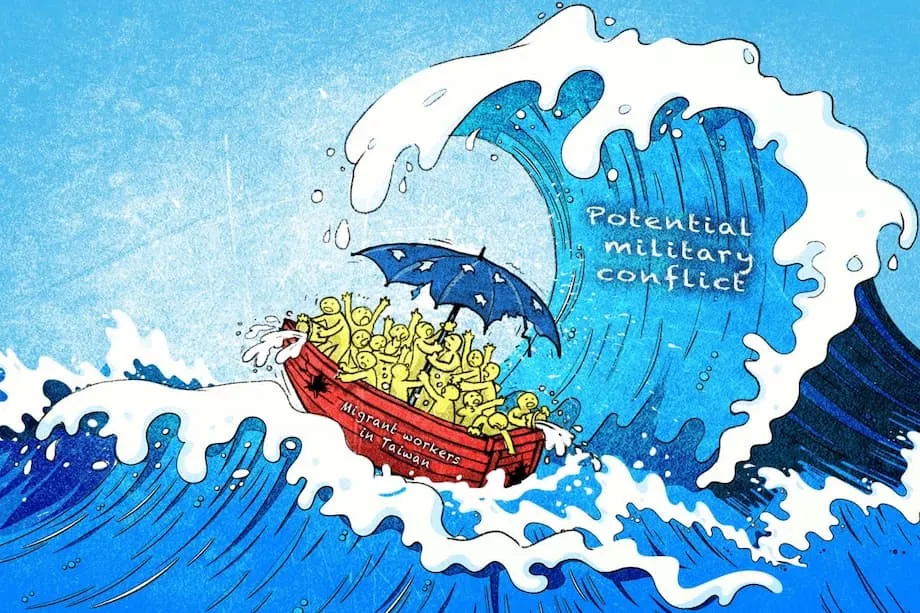
Taiwan had 849,777 foreign workers at the end of July, according to the Ministry of Labor's Workforce Development Agency. Including spouses, children and other dependents, its foreign resident population exceeded 950,000, roughly 4 percent of the island's population. As of October 3, 2025, rising tensions across the Taiwan Strait left this community facing a difficult question: whether leaving in a crisis would protect their families or deprive them of the income those families need.
Contents
- Nearly 850,000 workers face a difficult choice
- How a crisis begins would shape the escape routes
- Rescue preparations face a task of enormous scale
- Indonesia, Vietnam and Thailand have citizens at stake
- Jobs determine where workers could become stranded
- Civil defense needs to reach foreign residents
- Lost wages would travel far beyond Taiwan
- Why some workers would choose to stay
- Representative offices would carry the diplomatic burden
- What to Know
Most workers come from Indonesia, the Philippines, Thailand and Vietnam. They assemble electronics, pour concrete, crew fishing boats, care for older adults and work in hospitals. Many expect to stay for several years, sending money home regularly while filling shortages in Taiwan's manufacturing, construction, fishing and care services.
Gilda Banugan, a housekeeper from Davao City in the Philippines, has spent more than a decade in Taiwan so her children can finish school. She has learned the language, earned the trust of a local family and saved money she could not earn at home. Military drills nevertheless remind her that a crisis could arrive with little warning.
Banugan described why many Filipino migrant workers would choose to remain even if danger increased:
If you ask many Filipino migrant workers, in case something happened are they going back to the Philippines or not, most likely the answer is no, they want to stay put in Taiwan. Because, how can we survive even if they tried to rescue us?
A conflict could close ports and airports, stretch emergency services and leave residents without Taiwanese citizenship struggling to obtain help. For workers supporting relatives abroad, however, evacuation would also mean leaving a paycheck behind. Their decisions involve both immediate safety and the longer financial survival of their households.
Many already describe treatment as second class residents, crowded dormitories, heavy debts to recruiters and unpaid overtime. Fishers and caregivers living with employers can find the boundary between work and rest especially difficult to maintain. Scarce official assistance and language barriers could deepen those problems during an emergency.
How a crisis begins would shape the escape routes
A blockade, missile strikes and military pressure that stops short of war would create different conditions for evacuation. The practical questions would be whether transport can operate, how much time remains and whether governments in Taipei, Beijing and Southeast Asia can coordinate civilian departures.
A blockade would be the most difficult scenario for foreign residents. Commercial flights would be grounded, while container ships and ferries would stop. Taiwan has limited ports capable of handling large ships and a small number of international airports, leaving few places from which large groups could depart.
China's People's Liberation Army could surround the island with ships and aircraft without immediately opening fire. That space between a military threat and open combat would leave foreign governments with few legal tools to force an evacuation corridor, a route agreed for civilians to leave safely. Departures by sea would be risky, slow and dependent on an agreement with Beijing.
Moving people away from major ports and airports could reduce crowding within Taiwan. It would still leave them on the island, waiting for a route abroad.
Missile strikes or cyber attacks affecting runways, radar and electricity would create another set of problems. Civilian movement could become chaotic, while Taiwan's emergency services would prioritize citizens and critical infrastructure. Charter flights or military aircraft might carry small groups out if runways remained usable and a temporary pause in fighting could be negotiated. Without such a pause, evacuation by air on a large scale would be unlikely.
China has also spent years applying daily pressure through aircraft and ships near Taiwan without going to war. A sharper version of that pressure could include tighter maritime checks, warnings about airspace and cyber pressure on communications and banking.
Commercial flights and ferries might continue under those conditions if operators accepted the risks. People leaving early would have the best chance of securing a departure. Workers who waited could become stranded if the situation escalated. Across all three scenarios, transport and diplomatic agreements would determine how much of an evacuation plan could actually be carried out.
Rescue preparations face a task of enormous scale
The Philippines, Indonesia, Vietnam and Thailand have discussed evacuation contingencies in recent years. Preparations range from contact lists and safe houses to drills and arrangements for possible charter transport. None can guarantee movement without secure routes.
The Philippines alone counts close to 200,000 citizens in Taiwan. Indonesia has hundreds of thousands, many working in domestic service and fishing. Moving even a fraction of these communities would require cooperation involving Taiwan, China, the United States, Japan and other countries, alongside favorable weather and a clear opportunity to depart.
Philippine leaders have begun speaking more openly about that challenge. Foreign Affairs Secretary Theresa Lazaro has indicated that direct discussions with Beijing about the safety and evacuation of Filipinos in Taiwan are on the table. Addressing the prospect of such talks, she said:
Such discussions were timely.
President Ferdinand Marcos Jr. has cited geography and the need to protect Filipinos in Taiwan as reasons the Philippines could not stand apart if fighting began. He has said Manila is not seeking war, while strengthening defense partnerships and preparing for humanitarian operations in the country's north.
Marcos has also stated his position on national defense and territorial integrity:
The Philippines will not cede any territory.
China could seek to keep Southeast Asian countries neutral during a Taiwan crisis by offering humanitarian corridors or assistance evacuating their citizens. Accepting help from Chinese forces would be politically sensitive for some governments. The urgency of protecting people could nevertheless outweigh their hesitation.
A tight blockade or damaged runways would leave governments little time to translate preparations into actual departures. The existence of contact lists, shelters or charter arrangements would still leave the central operational question unresolved: whether aircraft and ships could reach Taiwan and leave safely.
Indonesia, Vietnam and Thailand have citizens at stake
Indonesia's trade with China far exceeds its trade with Taiwan, and Chinese companies finance prominent projects across the Indonesian archipelago. Jakarta generally stresses neutrality and dialogue, reflecting the weight of its economic relationship with Beijing.
Hundreds of thousands of Indonesian citizens in Taiwan make their safety a pressing concern alongside those economic interests. They include caregivers, factory workers and fishers. Indonesia has outlined contingency measures in the past, but distance and transport arrangements would still make evacuation a dangerous operation.
Vietnam and Thailand also have sizable worker communities in Taiwan, including people employed in factories, construction and home care. Their governments would likely seek humanitarian corridors and use available channels to advise citizens.
All three countries face the same practical constraint as the Philippines. A carefully prepared plan needs a secure route to become a rescue operation. Diplomatic efforts would have to address access to Taiwan as well as the safety of people waiting to leave.
Jobs determine where workers could become stranded
Fishers aboard vessels linked to Taiwan can spend months away from home. Some travel through contested waters where no country has clear authority. Reports of unpaid wages, debt bondage and violent treatment in parts of the fleet operating far from Taiwan have drawn outside scrutiny in recent years.
Debt bondage describes a situation in which debt binds a person to work and limits their ability to leave. For workers already struggling with wages or treatment, an emergency at sea could add another layer of dependence on shipowners.
Fishers can be difficult to reach even in peaceful conditions. During a crisis, crews could face conflicting pressures from owners' orders, the danger of interception and a shortage of safe harbors. A worker far from Taiwan when tensions escalated would face different choices from someone waiting near an airport.
Caregivers and factory workers have vulnerabilities on land. Many workers live in accommodation supplied by employers and depend on labor brokers to handle paperwork and resolve problems. A power failure or transport shutdown could make it hard to reach a designated meeting point.
Caregivers may also feel obliged to remain with patients in private homes or hospitals. Factory workers in crowded dormitories could struggle to move quickly when transport stops. Recruiter debt may push people in either setting to remain in their jobs despite growing concern for their safety.
- Fishers could be far from Taiwan, with limited access to a safe place to dock.
- Caregivers could face responsibilities to patients when deciding whether to leave.
- Factory workers could depend on transport from large employer dormitories.
- Workers owing recruiters money could find it financially difficult to abandon employment.
Language barriers would complicate each situation. Some local governments provide multilingual notices for typhoons and other disasters, but conflict would bring additional problems involving shelter space and food supplies. Workers without clear instructions from employers could be left to make urgent decisions alone.
Civil defense needs to reach foreign residents
Taiwan has expanded military readiness in recent years through longer conscription and greater attention to civil defense. Civil defense covers preparations to protect civilians during an emergency. City governments promote basic readiness through drills and public guidance.
Much of that communication is designed around citizens. Migrant workers often receive information late or miss it entirely, and many cannot read Chinese. An instruction that arrives too late, or in a language someone cannot understand, gives them less time to act.
The Ministry of Labor's 1955 hotline provides multilingual support for foreign workers. Local authorities and community groups have also published guidance in several Southeast Asian languages for earthquakes and typhoons. These existing channels provide ways to reach people who might otherwise miss official messages.
Employers are urged to maintain current contact lists, share evacuation routes and ensure foreign staff know where to gather during an emergency. Workers also need clear information specific to a conflict: where shelters are located, what to pack and whether transport will be provided.
Instructions in the languages workers speak would help reduce panic and rumors. They would also make it easier for people living in private homes, dormitories and other workplaces to understand the same plan.
Public attitudes create another challenge. Surveys in recent years suggest that parts of Taiwan's society feel less urgency about war than the headlines might imply. Repeated Chinese military activity without bloodshed can make the danger feel distant.
That reduced sense of urgency can make it harder to sustain spending, training and planning for civil defense. An inclusive emergency system would need to reach everyone living on the island, including people without Taiwanese passports.
Lost wages would travel far beyond Taiwan
Taiwan's migrant workforce supports both industry and everyday care. Foreign caregivers and hospital aides help an aging society and allow more Taiwanese residents to take paid work. Migrants in factories and construction fill shortages in a tight labor market.
Taiwan is also a center of advanced manufacturing, led by semiconductor companies. Semiconductors are the chips used in phones, cars and industrial machines. A disruption to their supply would reach countries well beyond the Taiwan Strait.
Factories in Southeast Asia that assemble phones and appliances could slow or stop production if components failed to arrive. Countries relying on Taiwanese chips could face shortages, while consumers far beyond Asia could encounter higher prices.
Families in Indonesia, the Philippines, Thailand and Vietnam would face a more immediate loss through interrupted remittances, the money workers send home. Those payments help cover school fees, housing and daily expenses.
Workers leaving early or losing employment would have less income to send. Their governments would have to weigh the cost and danger of evacuation against the need to support people after they returned. A prolonged crisis would place growing pressure on public budgets and social safety nets.
Why some workers would choose to stay
Many workers say they would remain in Taiwan if a crisis began. Leaving before transport closed could reduce the danger of becoming stranded, but it would also mean giving up work and wages. Staying would preserve the chance to support relatives for as long as employers and transport continued operating.
Banugan's concern captures that financial calculation. A rescue could bring a worker home while leaving the household without the income that paid for children's education and other necessities. The fear of being trapped in Taiwan sits alongside the fear of being unable to provide after returning.
Workers who expect to stay describe practical preparations that give them some control. They keep passports accessible, prepare a small bag of essential items, save emergency contacts and agree on meeting points with friends.
They also ask supervisors about company plans and discuss with brokers what to do if phone calls and messages stop working. Such steps can reduce confusion, especially for people who depend on employers or brokers for routine assistance.
The largest uncertainty remains whether there would be a guaranteed route off the island during a crisis. Workers' preparations would help them respond locally, while departure would still depend on operating transport and agreements among governments.
Representative offices would carry the diplomatic burden
Most countries follow a one China policy and do not maintain embassies in Taipei. They instead operate representative offices that handle matters such as visas and trade. During an emergency, these offices and informal diplomatic channels would have to coordinate much of the response for foreign residents.
Representative offices can work with Taiwan's authorities and employers, but they lack the tools embassies bring to a war zone. If an evacuation crossed waters patrolled by Chinese forces, governments would need quiet discussions about access and safety. Those discussions would be harder to arrange after fighting began.
Consular assistance already depends on cooperation among representative offices, Taiwan's ministries, labor brokers and employers. A conflict would require those networks to reach people across several languages while managing the safety of their own staff.
Offices could need to issue alerts, move personnel to safe locations and manage crowds at collection points. The task would combine diplomacy with the practical demands of telling people where to go and arranging transport when services were under strain.
The Philippines and Japan, both close to Taiwan, could serve as staging areas for evacuees if corridors opened. Using those routes would require quick decisions in Manila, Tokyo and Taipei, together with assurances from Beijing that civilians would not be targeted.
For migrant workers, the central issue is concrete: whether they can receive understandable instructions, reach a safe location and retain a way to support their families. Governments' rescue preparations would have to account for people who want to leave as well as those who believe they cannot afford to do so.
What to Know
- Taiwan had 849,777 foreign workers at the end of July; foreign residents including dependents exceeded 950,000, roughly 4 percent of the population.
- Most workers come from Indonesia, the Philippines, Thailand and Vietnam and support manufacturing, construction, fishing and care services.
- Many workers say they would stay during a crisis because losing wages would threaten their families' finances.
- A blockade would stop commercial departures; missile damage could sharply limit evacuation by air.
- Sending countries have discussed contingency plans, but secure routes and cooperation among governments would determine whether departures were possible.
- Fishers, caregivers and workers in large dormitories face different obstacles involving location, responsibilities, debt and transport.
- Taiwan's multilingual 1955 hotline and disaster guidance provide support, while workers still need clear instructions for a conflict.
- A disruption would affect remittances, Taiwan's workforce and international supplies of chips and manufactured goods.
- Representative offices would coordinate assistance, with the Philippines and Japan possible staging areas if safe corridors opened.