A tasting journey through rice fields and coastal scenery
More than 100 varieties of sake at a railway station, three sightseeing routes and a train with its own tasting space make Japan's Niigata Prefecture a place where the journey can be as much about the drink as the destination. At Echigo Yuzawa Station, visitors can compare small pours from a wall of dispensers before heading into a landscape of rice fields, mountain valleys and cliffs above the Sea of Japan.
Contents
- A tasting journey through rice fields and coastal scenery
- How snow, water and rice shape the flavor
- What happens between the rice field and the glass
- Inside the three carriages of the Shu*Kura
- Three routes through Niigata's changing landscapes
- Reservations, passes and dining choices
- Ponshukan turns the station into a tasting stop
- Older breweries and new uses for rice
- A new generation follows the snowmelt
- Extend the journey to Niigata City and Sado Island
- Choose the season and keep a comfortable pace
- What to Know
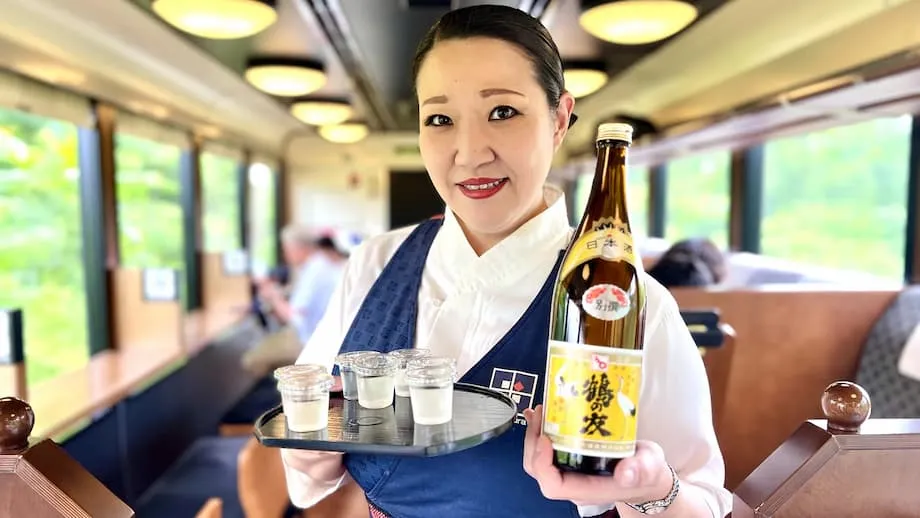
JR East's Shu*Kura sightseeing services carry that experience onto the railway. Staff pour regional sake, musicians play live sets and broad windows frame the countryside that supplies the drink's ingredients. Food served along the way connects the glass to the surrounding farms, rivers and coast.
Niigata is a coastal prefecture known for deep winter snow and extensive rice cultivation. Its sake identity rests on those two features: water supplied by melting snow and rice grown for brewing. Together with generations of brewing knowledge, they help produce the light, dry style closely associated with the region.
The train's name joins shu, a word for sake, with kura, meaning brewery. Its asterisk refers to Niigata's mountains, snow, rivers and coast. Those elements become part of the view as passengers travel through the prefecture, making the service both a moving tasting room and a way to understand the places behind the bottles.
The experience can begin or end at a station tasting counter, continue with a brewery visit and extend to markets or an island trip. Each stop offers a different connection between Niigata's food, landscape and brewing traditions.
How snow, water and rice shape the flavor
Heavy snow arriving from the Sea of Japan accumulates through winter before melting and feeding water supplies in spring. Niigata's meltwater is soft, meaning it contains relatively few minerals. Brewers say that softness helps yeast work at an even pace, contributing to clean aromas and a light, dry finish.
Tanrei karakuchi is the local phrase used to describe that familiar profile. It gives visitors a useful starting point when choosing a bottle: a restrained, crisp style rather than a drink defined by heavy flavors. Purity and balance sit at the center of this regional identity.
Rice provides the other foundation. Niigata is one of Japan's largest rice producers and grows varieties intended specifically for sake, including Gohyakumangoku. These grains polish well and can produce the sharp, restrained flavors associated with local brewing.
The prefecture has more than 80 breweries, with some estimates putting the number near 90. Families have brewed here for centuries. Yoshinagawa, founded in 1548, is among Japan's oldest active breweries, linking today's tasting counters and sightseeing trains to a much longer history.
Local drinkers also help sustain the industry. Sake consumption per person is among the highest in Japan, keeping smaller producers closely connected to regional preferences even as their bottles compete in national and international markets.
What happens between the rice field and the glass
Sake is brewed, not distilled. Production begins by milling rice to remove its outer layers, then washing and steaming the grains. How much rice is polished away is one of the choices that helps determine the finished drink.
Brewers treat part of the steamed rice with koji, a mold that converts starch into sugar. A yeast starter called shubo gets fermentation under way. The main mash, known as moromi, combines steamed rice, koji rice, water and yeast in stages over several days.
Fermentation can continue for weeks, with temperatures carefully controlled. The mash is then pressed to separate the clear sake from the remaining rice solids. Water, yeast, polishing and fermentation time all influence the result, so bottles made within the same prefecture can still offer different experiences.
Niigata's combination often produces restrained aromas and a crisp finish that works well with seafood. Comparing glasses makes those differences easier to follow than reading labels alone: a dry junmai, a fragrant ginjo or a seasonal sparkling sake can each show another side of the region.
Inside the three carriages of the Shu*Kura
JR East's Koshino Shu*Kura belongs to the sightseeing services often called joyful trains, where enjoying the ride is part of the purpose. Its retrofitted carriages date to the 1970s, while the interiors have a warm, modern feel.
Car 1 has spacious seating and large picture windows. Car 2 serves as the event space, with a bar and a standing area for tastings. Car 3 combines reclining seats with a lounge area where passengers can socialize. The arrangement encourages riders to move around, watch the scenery and learn about what they are drinking.
Staff introduce different breweries during the journey and explain flavors in accessible terms. The sake selection changes with the date and route. One departure might feature a crisp daiginjo alongside a seasonal sparkling sake; another could pair a smooth junmai with a limited bottling from a mountain town.
Snacks and bento meals draw on Niigata rice, river fish, mountain vegetables and coastal specialties. Live performances range from jazz to folk music. As the train slows through a scenic stretch, tasting, conversation and photography become parts of the same journey.
The setting brings several regional experiences together without requiring passengers to travel between individual breweries. A glass introduces a maker, the food offers local ingredients and the windows show the terrain where rice grows and water gathers.
Three routes through Niigata's changing landscapes
The Shu*Kura name covers three routes that rotate through the year. All connect Joetsu Myoko with a different destination, giving travelers a choice between inland towns, the mountain gateway at Echigo Yuzawa and the prefecture's coastal capital.
- Koshino Shu*Kura runs between Joetsu Myoko and Tokamachi.
- Yuzawa Shu*Kura connects Joetsu Myoko and Echigo Yuzawa.
- Ryuto Shu*Kura links Joetsu Myoko and Niigata City.
The journeys cross plains lined with rice paddies, mountain valleys where snow can linger late into spring and stretches of the Sea of Japan coast exposed to strong winds. The views connect the sake served inside with the natural conditions outside.
Some runs pause at stations with broad views. Omigawa Station, just steps from the surf, is a favorite place for photographs. On afternoon departures, staff often time service so passengers can enjoy a pour as the sun drops behind the water.
Most departures operate on weekends and holidays from spring to late autumn. Winter service is limited, partly because the train is designed around seasonal scenery and local events. Choosing a travel date therefore means checking both the route and the operating calendar.
Reservations, passes and dining choices
Reservations are required, with limited capacity and tastings arranged for each departure. Seats can sell out weeks ahead during holidays and the peak autumn foliage period, making advance booking particularly useful for travelers with fixed dates.
Holders of the JR Pass or JR East regional passes can reserve standard seats without an extra fare, then pay separately for drinks and food on board. Car 1 dining packages are available on selected departures, with set menus and exclusive pours.
Travelers who prefer not to drink can choose a nonalcohol plan featuring local soft drinks and sweets. This gives companions with different preferences a way to share the scenery and regional food without everyone taking part in the sake tasting.
Schedules and booking options are listed on the JR East Joyful Trains page. Seat reservations can be finalized at JR ticket counters or through JR East's online tools where available. The route, standard seat reservation and any dining package are details to check when arranging the trip.
Allowing time at the departure station also makes the journey less hurried. Travelers starting at Echigo Yuzawa can explore Ponshukan before boarding, rather than trying to fit a tasting and station shopping into the last few minutes.
Ponshukan turns the station into a tasting stop
Ponshukan has tasting corners inside Echigo Yuzawa, Niigata and Nagaoka stations. Visitors buy tokens, collect a small ceramic cup and choose pours from dispensing machines. At Echigo Yuzawa, the wall holds more than 100 varieties from across the prefecture.
Each dispenser identifies the brewery and style and provides a short tasting note. The format lets visitors compare a crisp Kubota with a fruity Kikusui, try dry junmai and fragrant ginjo styles, or begin learning how a daiginjo differs from a junmai.
The small servings make comparison central to the visit. A traveler can move between bottles from different parts of Niigata, notice a preference and then look for that label in the adjoining shop. The station becomes a destination even for someone who does not board the sake train.
Nearby shelves carry rice snacks, foods to accompany sake, regional crafts and other artisan goods. Onigiri offer a quick meal, including large rice balls made with local Koshihikari rice and seasonal fillings. These food counters connect the tasting experience to the prefecture's rice growing tradition.
The Echigo Yuzawa branch also has a sake themed bath, bringing the drink into the area's hot spring culture. Between the tasting machines, food shops and bath, a station stop can become a substantial part of the itinerary.
Older breweries and new uses for rice
Niigata's brewing industry combines established methods with experimentation. Local officials have designated parts of the prefecture as zones for agricultural innovation, while startups are exploring ways to connect consumers with bottles and find uses for brewing byproducts.
Some businesses use data tools to match drinkers with sake, an approach sometimes called sake AI. Others are working with nutrient rich lees, the material left after brewing, as feed for aquaculture, or turning rice waste into biodegradable goods.
These projects aim to reduce waste, support farmers and create additional businesses that can help stabilize rural incomes. They connect sake production to activities beyond selling the finished drink, from raising aquatic animals to developing materials.
Universities and technical schools contribute to that work. Professors advise small firms and help turn research into commercial practice, keeping experienced producers involved while giving new ideas room to develop.
The changes also appear in the glass and on the shelf. A traditional junmai can sit beside a limited sparkling expression, while packaging and sustainability practices receive attention alongside flavor. Niigata's long brewing history leaves room for both familiar styles and experiments.
A new generation follows the snowmelt
In the mountain city of Tokamachi, brewer Tomomi Duquette has drawn attention as a founder representing a new generation of makers. Her project, Snow Satoyama Sake, focuses on the qualities that Niigata water brings to fermentation.
Snowmelt filters through granite and sand before reaching springs with very low mineral content. That soft water gives yeast a calm environment in which to work and contributes to the sense of clarity in the finished sake.
Visitors traveling in winter or early spring can sometimes observe parts of brewing. Rice is washed, soaked and steamed. Koji rice is prepared in a warm room, then combined with water and yeast in measured stages. Workers stir the mash, check its temperature and taste it daily during fermentation.
Some brewers demonstrate heirloom techniques; others experiment with bubbles or styles containing less alcohol for casual sipping. Meeting a producer and tasting the result connects the work in the brewery with the rice fields, water and landscape seen along the railway.
Winter therefore offers a different kind of sake trip from the main sightseeing train season. Railway departures become less frequent, while breweries are busy and snow transforms the towns and surrounding countryside.
Extend the journey to Niigata City and Sado Island
Niigata City offers brewery visits that add history and production knowledge to the railway experience. Imayo Tsukasa, founded in the 1700s, runs short guided tours that finish with a tasting flight.
At the brewery, modern quality control sits alongside cedar casks and timber beams. The visit connects techniques explained during a tasting with the building, equipment and working environment where sake is made.
Nearby markets such as Pier Bandai sell fresh seafood and local produce that can accompany a favorite bottle. Short walks link tasting rooms, izakaya serving regional labels and shops selling pottery and cups designed for sake.
Travelers with more time can take a ferry from the mainland to Sado Island. Its gold mining history, wooded slopes and rugged coast offer a different setting after the rice fields and station tastings of the mainland.
The island also hosts summer festival performances by the renowned taiko group Kodo. Trails, beaches and cultural sites can be combined with meals of island seafood and Niigata rice, making Sado a relaxed extension to a visit centered on sake.
Choose the season and keep a comfortable pace
Spring brings cherry blossoms around the paddies, summer turns the countryside green, and autumn combines the rice harvest with colorful hillsides. Winter covers the landscape in snow. Each season changes the scenery, although fewer sake train departures operate during winter.
Holiday periods and autumn foliage weekends call for early seat reservations. Arriving with time to explore the station makes it easier to enjoy Ponshukan, pick up food or browse local goods before boarding.
On the train, water and snacks help passengers pace their tastings. Staff can recommend nonalcohol options, and travelers should stay mindful of their own limits. The experience leaves room to enjoy music, food and scenery as well as the drinks.
A photograph of a bottle's label can help when looking for it later. Rather than trying more than is comfortable during the journey, visitors can ask about buying a small bottle to take back to their hotel. Many shops can arrange shipping within Japan for those who prefer not to carry glass.
The most rewarding itinerary connects the different parts of Niigata at an unhurried pace: a station tasting, a railway journey, a brewery visit or a meal featuring local rice and seafood. Together, they show how snow, farming and generations of craft shape what reaches the cup.
What to Know
- JR East's Shu*Kura services combine Niigata sake, regional food, live music and views from three distinct carriages.
- The three routes connect Joetsu Myoko with Tokamachi, Echigo Yuzawa or Niigata City.
- Most departures run on weekends and holidays from spring to late autumn, with limited winter service.
- Reservations are required. Standard seat reservations are available to JR Pass and JR East regional pass holders without an extra fare, while food and drinks cost separately.
- Selected Car 1 departures offer dining packages, and a nonalcohol plan includes local soft drinks and sweets.
- Niigata has more than 80 breweries, with some estimates near 90. Soft snowmelt water and brewing rice help shape its light, dry sake style.
- Ponshukan operates tasting corners at Echigo Yuzawa, Niigata and Nagaoka stations, with more than 100 varieties at Echigo Yuzawa.
- Brewery tours in Niigata City and a ferry trip to Sado Island can extend the journey.
- Book early for busy dates, pace tastings with food and water, and check operating schedules before traveling.