China Cuts Reshape Japan's International Flight Network
Japan's approved international passenger flight schedule will shrink by 3% at the start of winter 2026, with services to China falling 49% even as airlines add flights to South Korea, Taiwan and several other markets. Kansai and Chubu airports face the sharpest declines among the country's five main international gateways.
Contents
- China Cuts Reshape Japan's International Flight Network
- What the National Figures Measure
- Kansai and Chubu Lose Flights While Tokyo Grows
- Kansai Adds Routes Beyond China
- Regional Airports Grow Despite an 86% China Cut
- Kobe Plans More Korea and Taiwan Services
- Kobe's Expansion Puts Terminal Capacity in Focus
- New Services Arrive Throughout the Winter
- Key Points
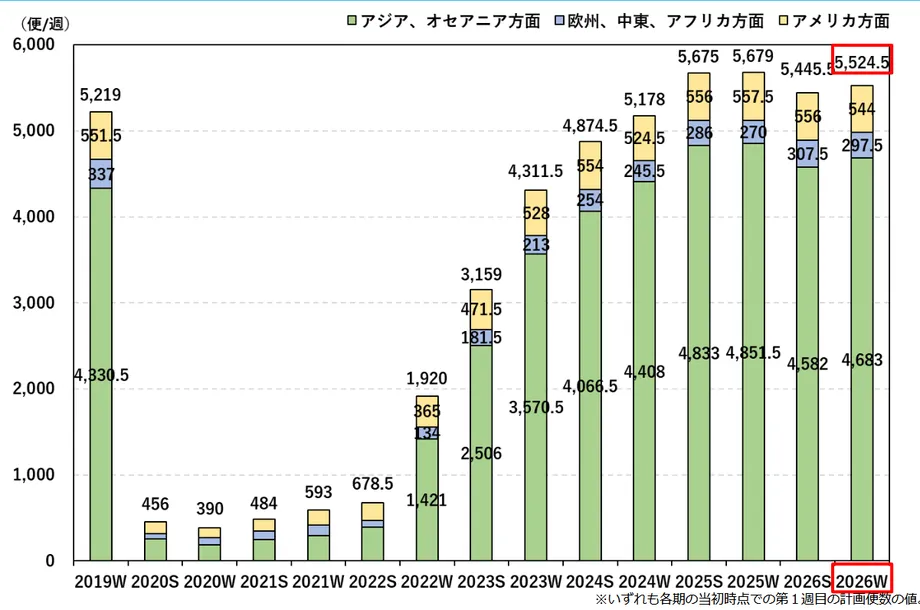
The Ministry of Land, Infrastructure, Transport and Tourism announced approval of applications from 130 airlines on October 26 for the winter season running from October 25, 2026, to March 27, 2027. Its figures, based on plans as of October 23, put passenger services in the opening week at 5,524.5 flights, compared with 5,219 at the start of winter 2019.
That leaves the opening schedule about 5.9% above its 2019 level despite the decline from winter 2025. Japan has more international passenger flights than at that earlier benchmark, but the destinations served and the airports handling them are changing.
South Korea services are set to increase by 18%, Taiwan by 11% and Hong Kong by 10%. Outside those markets, India will grow by 52%, Malaysia by 25%, Finland by 36% and the United Kingdom by 13%.
For travelers, the practical result depends on the route. More flights can mean a wider choice of departure times and connections. The sharp reduction in China services means fewer scheduled options on that part of the network, while other destinations gain capacity.
What the National Figures Measure
The ministry's opening snapshot covers October 25 to 31. Passenger and cargo services together total 6,094.5 flights per week, down 2% from the opening of the previous winter schedule. Cargo flights rise 2% to 570 per week, cushioning the decline in passenger services.
Nine Japanese airlines and 121 foreign airlines submitted plans. Japanese carriers will add 67.5 passenger flights per week, an increase of 6%. Foreign carriers will cut 222 flights per week, a decline of 5%. Together, those changes produce a net reduction of 154.5 weekly passenger flights.
Asia and Oceania account for 4,683 passenger flights per week, about 84.8% of the national total. Services to the Americas total 544, while Europe, the Middle East and Africa together account for 297.5.
That concentration helps explain why changes within Asia have such a strong effect on the national result. Growth in several markets is substantial, but it still leaves Japan's opening passenger schedule smaller than a year earlier after the China cuts.
The ministry's opening week count and airport operators' averages across the winter season cover different periods. Services beginning in November, December or February can increase a seasonal average without appearing in the October opening snapshot. The figures measure flight frequency; passenger numbers and the number of seats available also depend on aircraft size and how full each service is.
Kansai and Chubu Lose Flights While Tokyo Grows
Kansai International Airport's opening passenger schedule falls 17% to 1,201.5 flights per week. Chubu Centrair International Airport, serving the Nagoya region, records a 16% decline to 260. Both airports face reductions much larger than the national decrease of 3%.
The two main Tokyo gateways move in the opposite direction. Narita rises 4% to 1,663.5 weekly passenger flights, and Haneda grows 2% to 1,128.5. Together, they account for 2,792 flights, about 50.5% of Japan's opening international passenger schedule.
Fukuoka also expands, increasing 5% to 479 flights per week. The split across the five airports shows why the national decline gives only part of the picture: airlines are adding services at three major gateways while cutting them at two others.
Travelers in western and central Japan will therefore see a different pattern from those using Tokyo or Fukuoka. The changing schedules affect which international journeys can begin at a nearby airport and which may require a connection or travel to another gateway.
Kansai Adds Routes Beyond China
Kansai Airports, the operator of Kansai International, Osaka Itami and Kobe airports, projects an average of 1,426.1 international scheduled flights per week at Kansai International across the winter season. Its winter schedule announcement divides that total into 1,226.8 passenger flights and 199.3 cargo flights.
The ministry's opening passenger figure is 1,201.5 per week, while the operator's seasonal passenger average is 1,226.8. Kansai Airports describes its seasonal passenger total as slightly below winter 2025, alongside uncertainty over the recovery of China routes.
Kansai Airports says passenger services excluding China are projected to grow by 7% from the previous winter. In its statement, the airport operator explains the markets supporting that increase:
Passenger flights excluding China, however, are projected to increase by 7% year on year, driven by growth on Korea and Southeast Asia routes.
Korea services are expected to rise 10%, supported by demand for travel both into and out of Japan. Southeast Asia services are projected to increase 13%, with additional flights to destinations including Da Nang, Manila, Hanoi and Bangkok.
Air India also plans to launch direct Kansai–Delhi flights in February 2027. The airline previously served Kansai via Hong Kong until 2019. A direct service would let passengers travel between Kansai and Delhi without that intermediate stop. The announcement gives the launch month but no exact starting date or weekly frequency.
Regional Airports Grow Despite an 86% China Cut
Airports outside the five main gateways will collectively handle 792 international passenger flights per week at the start of winter, up 4%. Their China services fall 86%, a much steeper reduction than the national decline of 49%.
Growth elsewhere offsets that loss. South Korea flights at these airports increase 21%, Taiwan services rise 19% and Hong Kong services grow 15%. Each of those increases is faster than the corresponding national rate.
Singapore services at regional airports rise 125%, while Vietnam services increase 133%. In simple terms, those routes will have more than twice as many flights as in the previous winter opening schedule. The published figures give percentage increases without the underlying weekly totals for those two markets.
The regional result shows that a large fall in one market can coexist with a growing airport network when other routes expand sufficiently. For communities outside Japan's largest gateways, additional international services can provide more opportunities to start a journey locally and bring overseas visitors directly into the region.
Kobe Plans More Korea and Taiwan Services
Kobe Airport is preparing for further international expansion through charter services. Kansai Airports expects these flights to average 71 per week over the winter. A more detailed operating plan starts at 61 round trips per week and reaches a maximum of 77 during the season.
The opening network comprises 35 weekly services to Seoul Incheon, 19 to Taipei Taoyuan and seven to Taichung. Korean Air, Asiana Airlines, Jin Air and Jeju Air operate the Incheon route. EVA Air and Starlux Airlines serve Taipei, while Starlux also serves Taichung.
Trinity Airlines is scheduled to join the Incheon route on December 18, raising its frequency from five to six round trips per day. Cheongju services are planned to begin on December 24 with four round trips per week, followed by a daily Kaohsiung service from January 1, 2027.
From January, the plan lists 42 weekly services to Incheon, 17 to Taipei, seven to Taichung, four to Cheongju and seven to Kaohsiung. Those add up to 77, about 26% above the opening winter schedule of 61 round trips.
Kobe began international operations in April 2025 with about 40 weekly services. The planned winter peak would bring the airport close to twice that initial scale, giving the Kansai region more international choices alongside the scheduled network at Kansai International.
Kobe's Expansion Puts Terminal Capacity in Focus
Kobe is designing facility expansion ahead of the planned introduction of international scheduled services in 2030. Its growing charter network already brings attention to the capacity of check in counters, security screening, immigration areas, baggage collection and boarding facilities.
Several flights arriving or departing close together can put pressure on these facilities even when the daily total looks manageable. More routes mean more passengers moving through the same terminal spaces, making the timing of flights and the capacity of individual processing areas important to the travel experience.
Kobe's international expansion has also been accompanied by complaints about limited restaurants and shops in Terminal 2 and the connection between the airport station and the terminal. A proposed connecting deck would improve access from the Port Liner station, including in wet weather.
About 20 airlines had their service proposals turned down around the airport's initial international opening, and airlines continue to seek opportunities to operate there. Terminal space and passenger handling capacity therefore matter both for existing travelers and for the airport's ability to accept more services.
The wider Kansai airport network is also changing domestically. Kansai Airports expects passenger flights across its three airports to average 275.8 per day, broadly matching the previous winter. Osaka Itami plans new scheduled services to Obihiro, Asahikawa and Memanbetsu, with direct flights between the Kansai region and Obihiro returning after 17 years.
New Services Arrive Throughout the Winter
Several international routes are scheduled to begin after the ministry's October snapshot. Sapporo New Chitose gains two links to North America, Hiroshima gains an Incheon service, and Narita gains a Christchurch route. Together with the changes at Kobe and Kansai, they make the winter schedule a sequence of additions rather than a single change on opening day.
- October 25, 2026: The winter schedule begins, with the ministry's opening snapshot covering October 25 to 31.
- November 27: Air New Zealand plans to begin Christchurch–Narita flights four times per week.
- December 11: United Airlines plans to begin San Francisco–Sapporo New Chitose flights three times per week.
- December 18: Air Canada plans to begin Vancouver–Sapporo flights three times per week, while Trinity Airlines joins Kobe's Incheon route.
- December 23: Korean Air plans to begin Incheon–Hiroshima services seven times per week.
- December 24: Kobe's Cheongju route is scheduled to begin with four round trips per week.
- January 1, 2027: Kobe's Kaohsiung route is scheduled to begin with one round trip per day.
- February 2027: Air India plans to launch direct Kansai–Delhi services.
- March 27, 2027: The winter schedule ends.
Sapporo's two planned North America routes would provide six weekly services combined once both are operating. Hiroshima's new daily link would add another international option outside the five largest gateways, while the Christchurch service expands Narita's connection with New Zealand.
Key Points
- Japan's opening winter 2026 passenger schedule totals 5,524.5 flights per week, down 3% from winter 2025 but about 5.9% above winter 2019.
- China services fall 49%, while South Korea rises 18%, Taiwan 11% and Hong Kong 10%.
- Kansai and Chubu record passenger flight declines of 17% and 16%. Narita, Haneda and Fukuoka grow.
- Regional airports collectively expand 4% despite an 86% reduction in China services.
- Kansai expects passenger flights excluding China to increase 7% across the season, with direct Delhi services planned for February.
- Kobe plans to grow from 61 international round trips per week at the winter opening to a maximum of 77.
- New routes to Sapporo, Hiroshima and Narita begin later in the season, which ends on March 27, 2027.