Kuala Lumpur closes the gap on Singapore
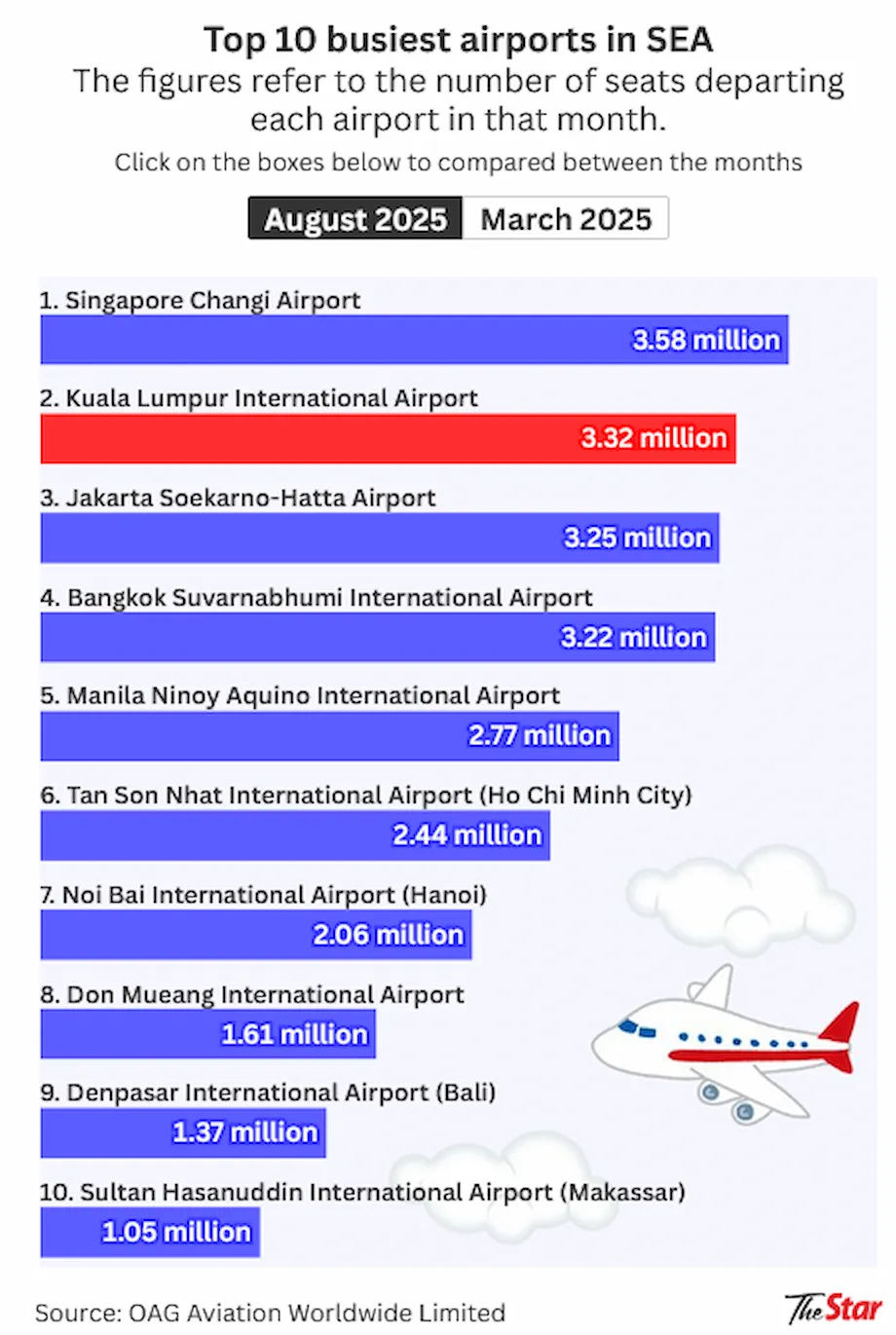
Kuala Lumpur International Airport has climbed to second place among Southeast Asia's busiest airports by scheduled departing seats, after capacity increased from 3.02 million in March to 3.32 million in August 2025. The rise of about 10 percent has brought Malaysia's main airport closer to Singapore Changi, which remained first with 3.58 million departing seats.
Contents
- Kuala Lumpur closes the gap on Singapore
- More airlines connect more cities
- July traffic shows the growing demand
- Visa exemptions support China and India routes
- Malaysia's recovery extends beyond KLIA
- Regional airports are expanding together
- How Kuala Lumpur works as a transfer hub
- Terminal changes target everyday travel
- Expansion plans face strong competition
- Queues, staffing and cargo shape the next stage
- What changes for passengers and airlines
- Key Points
KLIA's expansion has come with a wider network: 117 international destinations, compared with 105 a year earlier, and 66 airlines, up from 59. New services, returning carriers and Malaysia's temporary visa exemptions for visitors from China and India have helped drive the growth.
The August figures put KLIA about 260,000 departing seats behind Changi. Its rise marks the first time it has moved ahead of other regional rivals in this way since travel returned at scale after the pandemic. Malaysia Airlines, AirAsia and Batik Air Malaysia have expanded their networks, while foreign airlines have added services through the northern summer.
Departing seats measure how much space airlines schedule on flights leaving an airport. Passenger counts measure people who actually travel. The ranking therefore describes the supply of flights and seats, while passenger figures show how much traffic airports handle. Read together, the two measures help explain where airlines expect demand and how travel is recovering.
KLIA also ranked fourth for annual capacity growth among the region's leading airports in August, with departing seats up 7.5 percent from a year earlier. That is a different comparison from the roughly 10 percent increase between March and August: one tracks growth over a year, while the other follows the airport's expansion across five months.
More airlines connect more cities
KLIA's network has gained 12 international destinations and seven airlines over the past year. Terminal 1 now serves 52 airlines, while Terminal 2, used by many carriers offering lower fares, serves 14. Together, the terminals support both journeys beginning or ending in Malaysia and trips that connect through Kuala Lumpur.
British Airways resumed flights in April, restoring its London connection. Chinese airlines have expanded services to major cities and added links to smaller markets. Local airlines have increased frequencies and adjusted schedules to make connections more reliable, giving passengers more choices and supplying connecting travelers for longer flights.
The new and returning services include:
- British Airways, which resumed London flights to Kuala Lumpur.
- Juneyao Air, which added capacity from China.
- Jiangxi Airlines, which launched Nanchang to Kuala Lumpur as its first Southeast Asian route.
- Lucky Air, which increased its presence between China and Malaysia.
- FitsAir, which expanded links with Colombo.
- Hainan Airlines, which strengthened connections with China.
- Loong Air, which opened a route between Xi'an and Kuala Lumpur.
Malaysia Airports Holdings has been working to attract carriers, secure more frequent flights and encourage airlines to use larger aircraft where demand supports them. A larger aircraft adds seats without requiring another departure, while extra frequencies give passengers more departure times.
The strategy serves two groups: people traveling directly to or from Malaysia, and passengers changing planes at KLIA. More flights from smaller cities can bring additional travelers into the airport's longer routes, helping support services that rely on passengers arriving from several different places.
July traffic shows the growing demand
KLIA handled 3.9 million international passengers in July, up from 3.6 million in June. Malaysia Airports reported a monthly increase of 10.3 percent. The published passenger totals are rounded, while the percentage gives the operator's stated rate of growth.
Loong Air's service from Xi'an, operating three times a week, was one contributor to the expansion. The route adds another Chinese city to a network that already includes Guangzhou, Shanghai, Xiamen and Beijing, spreading connections beyond the largest established markets.
Malaysia Airports' July traffic statement connects the increase in travel with route development. Direct links to emerging Chinese markets are intended to bring visitors to Malaysia while supporting business relationships that benefit from easier travel.
Dato' Mohd Izani Ghani, managing director of Malaysia Airports, described the commercial purpose of expanding the China network:
Strategic growth in Chinese connectivity is a key driver of Malaysia's broader economic expansion and reinforces KLIA's position as Southeast Asia's preferred aviation hub. Direct air links with emerging cities like Xi'an not only increase passenger traffic but also facilitate greater trade and investment opportunities.
The Xi'an connection illustrates how the airport is building its network: adding direct access to another city, then linking those arriving passengers with flights elsewhere in Malaysia and beyond.
Visa exemptions support China and India routes
Malaysia's exemption from visa requirements for tourists from China and India allows visits lasting 30 days. As of September 9, 2025, the temporary policy has been extended through the end of the following year, supporting demand from two major travel markets.
Removing the need to obtain a visa makes a holiday easier to arrange. At KLIA, the policy has supported the return of international travel alongside the increase in airline seats. Demand from China and India also feeds connections to Australia, the Middle East and Europe.
Additional Chinese routes and steady Indian demand help Kuala Lumpur serve as a transfer point for passengers traveling across ASEAN and onward to the Pacific and Europe. For airlines, passengers arriving from several markets can help fill a departing flight that would otherwise depend more heavily on local demand.
KLIA has also benefited as airlines use Kuala Lumpur to supplement services through rival hubs facing capacity constraints or higher costs. Its combination of more available flights and a broader range of destinations gives carriers another way to move passengers across the region.
Malaysia's recovery extends beyond KLIA
Malaysia handled 61.2 million passengers from January through July 2025, according to the Civil Aviation Authority of Malaysia, or CAAM. July alone accounted for 9.3 million passengers, an increase of 3.9 percent from June and 5.3 percent from July 2024.
International traffic reached 98.7 percent of its July 2019 level, bringing that part of the market close to its position before the pandemic. International travel grew faster than domestic travel as airlines restored services into Malaysia and onward to other countries.
New routes have supported airports beyond KLIA, including Subang and Kota Kinabalu. Added seats, the visa exemptions and a wider choice of destinations have all contributed to the national recovery.
The main developments across 2025 follow a clear sequence:
- March: KLIA scheduled 3.02 million departing seats.
- April: British Airways resumed its Kuala Lumpur service.
- May: Regional traffic figures placed Changi first with 3.59 million passengers and Kuala Lumpur next with roughly 3.23 million.
- July: Malaysia handled 9.3 million passengers, including 3.9 million international passengers at KLIA.
- August: KLIA's scheduled departing seats reached 3.32 million, putting it second behind Changi's 3.58 million.
The May passenger figures and August seat figures describe different parts of the recovery. Both show Kuala Lumpur near the top of the regional market, while the August capacity ranking captures the latest expansion in airline schedules.
Regional airports are expanding together
Singapore, Malaysia, Indonesia and Thailand are all benefiting from recovering tourism and regional business travel. In the May passenger comparison, Jakarta Soekarno Hatta and Bangkok Suvarnabhumi each handled more than 3 million passengers, alongside Changi's 3.59 million and Kuala Lumpur's roughly 3.23 million.
The August airport capacity ranking places KLIA's rise within that competitive regional recovery. National airlines and carriers offering lower fares are both restoring connections and adding room for passengers.
Most international seats departing Southeast Asian airports serve destinations within Asia Pacific, including Northeast Asia, South Asia and Australia. Africa is the fastest growing regional flow, although it starts from a small base. A high growth rate from a small starting point can still represent fewer additional seats than slower growth on a much larger network.
The next stage of expansion depends partly on aircraft deliveries, staffing and the pace at which airlines restore services using larger aircraft on longer routes. Airports need airline capacity as well as terminal space: a new destination requires aircraft and crews to operate it.
How Kuala Lumpur works as a transfer hub
Malaysia Airlines connects KLIA with Australia, South Asia and selected European destinations. AirAsia and Batik Air Malaysia bring regional traffic from across ASEAN and beyond, including substantial flows from Indonesia, Thailand, Vietnam and the Philippines.
The combination gives Kuala Lumpur both premium and budget travel options. Each additional destination becomes another spoke in the network, supplying passengers who can connect through the hub to somewhere else.
Terminal 1 handles most airlines providing a full range of services, their alliance partners and longer flights. Terminal 2 mainly serves airlines focused on lower fares, with operations designed to turn aircraft around quickly and keep them flying for more of the day.
Passengers choosing Kuala Lumpur often cite value for money, expanding schedules and straightforward connections. More frequent services can make it easier to find an itinerary with a shorter wait, while a broader network can reduce the need to route a journey through another airport.
Airline partnerships also matter. Interline arrangements let carriers combine parts of a journey, while codeshares allow an airline to sell certain flights operated by a partner under its own flight code. Those arrangements can extend an airline's reach without requiring it to operate every route itself.
Terminal changes target everyday travel
KLIA's improvements in 2025 include additional seating, new baggage trolleys, more parking bays for families and better signs. Cultural displays in public areas and a new playground are also intended to make time in the terminals more comfortable, especially for families and people visiting for the first time.
An Open Belt bag drop system is being tested to give passengers more flexibility when checking luggage. The system allows airlines to share bag drop points, helping spread demand when several flights leave within a short period.
Shared facilities can make better use of the available space. Instead of queues building at one airline's assigned drop point while another is quieter, the trial is designed to let passengers use a more flexible arrangement.
Malaysia Airports is also planning a transfer system between Terminal 1 and Terminal 2 within the area beyond normal public access. The aim is to move passengers and baggage more smoothly between the terminals, reduce the minimum time needed for connections and make combined journeys involving airlines in both terminals easier to sell.
The Open Belt system remains a trial, and the terminal transfer solution is planned; no introduction date was given for the transfer service. For passengers, the intended benefit is a simpler connection between the airport's two different airline networks.
Expansion plans face strong competition
Malaysia Airports is reviewing whether KLIA needs a third terminal while continuing to improve its existing terminals. Its approach is to match capacity growth with passenger comfort and dependable operations.
Other major Asian hubs are investing in larger facilities. Singapore Changi is advancing Terminal 5. Bangkok is planning a larger terminal complex and more runway capacity. Hong Kong is expanding terminal facilities around its third runway and remains an important airport for travel involving China and global finance.
Those projects seek a share of connecting journeys linking Asia with Europe, North America and the Middle East. KLIA is competing through its strong network of airlines offering lower fares, the recovery of its national carrier and deeper connections with China, India and Australia.
Lower operating costs for some airlines and more available takeoff and landing slots than at congested rivals can help Kuala Lumpur attract services. A slot is an allocated opportunity to arrive or depart, so its availability affects whether an airline can introduce a flight at a useful time.
KLIA's growth also depends on the practical details of each journey: punctual departures, efficient security checks and baggage arriving quickly enough for passengers to make their next flight. More seats create opportunities, while reliable operations help airlines and travelers use them.
Queues, staffing and cargo shape the next stage
Faster check in and security clearance during busy periods remain priorities. Better queue management, more services passengers can complete themselves, biometric identity checks and clearer directions can each reduce the time spent moving through an airport.
Rail and highway access also matter during peak travel seasons. Within KLIA, enough gates and dependable staffing are needed to keep schedules running as more airlines add flights. Weather and constraints on regional air traffic can disrupt operations, making spare time in schedules and contingency plans part of managing growth.
Cargo provides another reason for airlines to expand. KLIA has several large cargo handlers and five major cargo terminal operators. When passenger airlines add flights, they also add space for freight in the aircraft holds beneath the passenger cabin.
That space carries small parcels, perishable goods, electronics and components. Freight revenue can help support a route's finances and strengthen the case for additional flights, particularly those using larger aircraft on longer journeys.
More frequent connections can therefore serve both travelers and businesses. A new passenger route may also give producers and traders another way to move goods, linking airport growth with the commercial opportunities described by Malaysia Airports.
What changes for passengers and airlines
Travelers have more direct flights and journeys with one connection through Kuala Lumpur, particularly across China, India, ASEAN and Australia. Additional seats can encourage more competitive fares, while several departures a day give passengers more flexibility over arrival and departure times.
Clearer signs, family facilities and more comfortable waiting areas should make longer connections less tiring. The planned transfer arrangements between terminals would address a different part of the journey: moving people and their luggage between airlines using separate terminal buildings.
Airlines gain access to a hub with room to absorb additional capacity without the same pressure for gates or slots found at more congested airports. The combination of Malaysia Airlines and a large budget airline network also supports partnerships that bring passengers from smaller cities onto major routes.
As those connections deepen, airlines have a stronger base from which to consider further services over longer distances. KLIA's immediate achievement is measurable: 300,000 more scheduled departing seats in August than in March, a broader international network and second place in the regional capacity ranking.
Key Points
- KLIA ranked second in Southeast Asia by scheduled departing seats in August 2025, with 3.32 million, behind Changi's 3.58 million.
- Capacity increased about 10 percent from March's 3.02 million seats and 7.5 percent from August 2024.
- The airport served 117 international destinations and 66 airlines, compared with 105 destinations and 59 airlines a year earlier.
- KLIA handled 3.9 million international passengers in July, a monthly increase of 10.3 percent reported by Malaysia Airports.
- Malaysia recorded 61.2 million passengers from January through July; July international traffic reached 98.7 percent of its July 2019 level.
- Visa exemptions allowing tourists from China and India to stay for 30 days were extended through the end of 2026.
- British Airways returned in April, while Chinese carriers and FitsAir added or expanded connections.
- Terminal improvements include seating, trolleys, family facilities, signs and an Open Belt bag drop trial.
- Malaysia Airports plans better transfers between the two terminals and is reviewing the need for a third terminal.
- Further growth depends on aircraft, staffing, reliable operations and competition from expanding regional hubs.